Every logical fallacy we have covered on the show, explained in plain English. Search for one, jump to a letter, or hit the dice for a random fallacy. Each one links to the episode, with the clips where we caught it in the wild.
The Fallacy Dictionary
Fallacy A–Z
No fallacies match that search. Try a shorter word, or search all episodes.
-

Accelerating Truth FT#56
The Accelerating Truth Fallacy is committed when someone uses their own previous assertions as evidence or proof that those assertions are true.
-

Accent Fallacy FT#74
The Accent Fallacy is committed when the meaning of a sentence or phrase is changed by placing the emphasis on a different part, or leaving emphasis ambiguous in writing.
-

Accident Fallacy FT#126
The Accident Fallacy is committed when someone applies a general rule to a specific situation which is actually an exception to the rule.
-

Ad Fidentia FT#204
The Ad Fidentia fallacy occurs when someone attacks their opponent’s self-confidence instead of their argument, and take any doubt expressed as evidence in their favor.
-

Ad Hoc Fallacy FT#63
The Ad Hoc Fallacy is committed when someone makes stuff up in order to avoid accepting evidence against their belief.
-

Ad Hominem FT#21
Ad Hominem is Latin for ‘to the man’ and describes an argument where the focus of the attack is not on the views a person holds but on the person themselves. It is an attempt to distract from the matter at hand by introducing irrelevant…
-

Ad Hominem Circumstantial FT#42
The Ad Hominem Circumstantial Fallacy is committed when, instead of addressing someone’s argument, you question the reason that they are making the argument, often suggesting that their circumstances mean that they benefit in some way from such an argument.
-

Affirming the Consequent FT#145
Affirming the Consequent is a formal logical fallacy taking the form:
-

Alleged Certainty FT#50
The Alleged Certainty Fallacy is committed when someone makes a claim and then alleges that everyone knows it’s true, thereby avoiding the need to offer any evidence.
-

Amazing Familiarity FT#91
The Amazing Familiarity Fallacy is committed when someone makes an argument based on information they couldn’t possibly have, such as what someone else is thinking.
-

Ambiguity Fallacy FT#62
The Ambiguity Fallacy is committed when someone is deliberately vague or ambiguous to make their point or avoid answering a question.
-

Anecdotal Fallacy FT#71
The Anecdotal Fallacy is committed when someone allows an anecdote to lend far more weight to an argument than it warrants.
-

Apophasis FT#148
Apophasis occurs when someone raises a subject by claiming they are not going to mention it.
-

Appeal to Accomplishment FT#79
The Appeal to Accomplishment Fallacy is committed when someone refers to their abilities or achievements as a reason to believe them rather than using arguments.
-

Appeal to Anonymous Authority FT#70
The Appeal to Anonymous Authority is committed when someone cites an authority to back up a claim, but the authority is unnamed, vague or similarly uncheckable.
-

Appeal to Coincidence FT#151
The Appeal to Coincidence occur when someone claims luck or coincidence is the reason something happened despite evidence of a more likely cause.
-

Appeal to Common Folk FT#81
The Appeal to Common Folk is committed when someone tries to get the listeners to believe him by showing them what a regular guy he is.
-

Appeal to Common Sense FT#170
The Appeal to Common Sense fallacy occurs when someone invokes “common sense” as a reason to believe something instead of providing evidence.
-

Appeal to Definition FT#194
The Appeal to Definition Fallacy occurs when someone relies on a specific definition, from a dictionary or other authority, which supports their argument, and ignores the possibility that other definitions are also reasonable.
-

Appeal to Fame FT#184
The Appeal to Fame Fallacy occurs when someone equates fame with being trustworthy
-

Appeal to Fear FT#34
People often make decisions based on emotion rather than logic, so appealing to that emotion can be a very useful technique when you’re trying to persuade someone. However, to be part of an effective logical argument emotion has to be used to back up the…
-

Appeal to Fiction FT#86
The Appeal to Fiction Fallacy is committed when someone tries to use something that happened in a work of fiction to back up their claim about the real world.
-

Appeal to Flattery FT#45
The Appeal to Flattery Fallacy is committed when someone uses flattery in the place of an argument when convincing someone to accept their point of view.
-

Appeal to Force FT#32
Appeal to Force, or Argumentum Ad Baculum, is a fallacy where someone tries to use pressure or threat to get their opponent to accept their position instead of using logical arguments and persuasion.
-

Appeal to Freedom FT#110
The Appeal to Freedom Fallacy is committed when someone claims that they should be entitled to something because any restraint of personal freedom for any reason is unacceptable.
-

Appeal to Loyalty FT#95
The Appeal to Loyalty Fallacy is committed when someone suggests you should believe a truth claim due to the loyalty you feel to the person making the claim, or suggests that if you don’t believe something you are being disloyal.
-

Appeal to Nature FT#82
The Appeal to Nature is committed when someone assumes that something that is natural is therefore good, or something that is unnatural or artificial is therefore bad.
-

Appeal to Outdated Data FT#176
The Appeal to Outdated Data fallacy occurs when someone uses evidence to support their claim, but the evidence has already been debunked or superseded by contradictory data.
-

Appeal to Pity FT#199
The Appeal to Pity Fallacy occurs when someone tries to convince others by making them feel sympathetic instead of using evidence.
-

Appeal to Probability FT#163
The Appeal to Probability Fallacy occurs when someone assumes that because something is possible or probable then it will definitely happen.
-

Appeal to Ridicule FT#54
The Appeal to Ridicule occurs when someone mocks their opponents argument instead of making a counter argument, often by taking the argument to an illogical but ridiculous conclusion.
-

Appeal to Self-Evident Truth FT#104
The Appeal to Self-Evident Truth is committed when someone claims something is self-evidently true, thereby avoiding the need to provide any evidence.
-

Appeal to Sincerity FT#72
The Appeal to Sincerity fallacy is committed when someone tries to convince you of just how sincerely they believe in their claims, rather than offering evidence to back them up.
-

Appeal to Stupidity FT#106
The Appeal to Stupidity is committed when someone dismisses or devalues education, intellect or reason in order to make their uneducated, idiotic, unreasonable claim sound more plausible.
-

Appeal to the Law FT#53
The Appeal to the Law is committed when someone equates the legality of an act with its morality, i.e. saying whatever they did was fine, because there’s no law against it.
-

Argument by Gibberish FT#58
The Argument by Gibberish Fallacy is committed when someone uses jargon or nonsense in place of an argument or an answer because they are unable to provide a coherent, useful or logical response.
-

Argument by Rhyme FT#51
The Argument by Rhyme Fallacy is committed when someone uses a rhyming slogan in place of an argument in an attempt to sway opinion or simplify a complex issue.
-

Argument by Slogan FT#59
The Argument by Slogan Fallacy is committed when someone uses a short snappy phrase to avoid making an argument that actually requires some nuance, explanation or evidence.
-

Argument by Vehemence FT#97
The Argument by Vehemence is committed when someone gets loud, angry or indignant in place of making an actual argument.
-

Argument from Antiquity FT#30
The Argument from Antiquity is a fallacy where the arguer claims that something is right or good because it’s traditional. If a person claims that we should do something a certain way because “that’s the way it’s always been done” or that a particular herb…
-

Argument from Authority FT#16
This is more accurately called the Argument from Improper or False Authority. After all, it’s entirely valid to support your argument by invoking a relevant authority like, say, climate scientists’ opinions on climate change.
-

Argument from Consequences FT#65
The Argument from Consequences occurs when someone makes a truth claim based on how good (or bad) things would be if the claim was in fact true.
-

Argument from Ignorance FT#18
The Argument from Ignorance fallacy describes a situation where someone claims a proposition to be true simply because it has not yet been proven to be false. Obviously if an outlandish claim is made and it cannot immediately be proven to be false that does…
-

Argument from Personal Incredulity FT#29
The Argument from Personal Incredulity describes a situation where someone dismisses a claim for no other reason than they find it difficult to believe. In fact, the person may be having trouble believing something simply because it doesn’t conform to how they currently think, or…
-

Argument from Popularity FT#7
Trump likes to talk about ‘many people’ doing, thinking or saying something, to give the impression that whatever they are doing, thinking or saying is correct. In doing so, he is arguing from the popularity of an idea, rather than using evidence to show the…
-
Argument from Popularity (Redux) FT#175
The Argument from Popularity Fallacy occurs when someone makes a claim based on how many people believe an idea or use a product rather than providing evidence the idea is true or the product is good.
-

Argument from Silence FT#90
The Argument from Silence Fallacy is committed when someone assumes that no response from their opponent is proof that they are right.
-

Argument from Too Much Evidence FT#132
The Argument from Too Much Evidence occurs when someone suggests an imbalance of evidence in one direction is somehow suspicious and therefore proof of the opposite being true.
-

Argument to Moderation FT#114
The Argument to Moderation Fallacy is committed when someone assumes that true or most reasonable answer is a compromise between two given answers (when in fact one of the given answers may be right)
-

Argument to the Purse FT#115
The Argument to the Purse occurs when someone suggests rich people are smarter, better or more likely to be correct based on their wealth.
-

Argumentum ad Fastidium FT#123
The Argumentum ad Fastidium, or Argument from Disgust, occurs when someone claims that because they find something unpleasant that means it is morally or factually wrong.
-

Argumentum Ad Feminam FT#188
The Ad Feminam Fallacy occurs when someone attacks their opponent using misogynistic or dismissive rhetoric because they’re a woman, rather than engaging with their argument.
-

Argumentum ad Lunam FT#67
The Argumentum ad Lunam Fallacy is committed when someone compares putting a man on the moon (or another very hard thing that has been achieved) to a hard thing that has yet to be achieved.
-

Argumentum Ad Nauseam FT#15
The Ad Nauseam logical fallacy refers to a situation where someone asserts a claim repeatedly, often even after the claim has been debunked, in the hope that people will start to believe it through sheer repetition and that people will get sick of trying to…
-

Assuming a Tell FT#121
The Fallacy of Assuming a Tell is committed when someone convinces themselves that they’ve identified a way of spotting secret information and then uses that as evidence in their reasoning.
-

Automation Fallacy FT#140
The Automation Fallacy occurs when people are over reliant on technology for decision making.
-

Base Rate Fallacy FT#55
The Base Rate Fallacy is committed when someone offers a statistic as evidence without considering (or including) the prior probability of one or more of the factors involved.
-

Begging the Question FT#35
Begging the Question is one of those phrases that has come to mean something different over time. Colloquially, it is used to mean ‘raising the question’, but the original meaning is the one invoked by this fallacy, and it’s fun to point out that people…
-
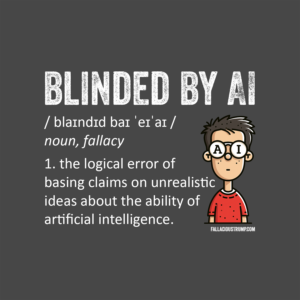
Blinded by AI FT#198
The Blinded by AI Fallacy occurs when someone bases their claim on an unrealistic view of what artificial intelligence is currently capable of reliably achieving.
-

Broken Clock Fallacy FT#116
The Broken Clock Fallacy occurs when someone suggests that because they were right once (even if it was for the wrong reason) they should be trusted generally.
-

Broken Window Fallacy FT#85
The Broken Window Fallacy is committed when someone tries to claim when a bad thing happens, that good things will result from it, which makes it OK.
-

Bulverism FT#138
Bulverism occurs when someone explains why another is wrong without first establishing that they are wrong.
-

Calling Cards FT#158
The Calling Cards Fallacy occurs when someone dismisses a valid point by accusing their opponent of playing a rhetorical card.
-

Cherry Picking FT#22
Cherry Picking is a logical fallacy in which the arguer ignores a large amount of evidence which casts doubt on their claim, carefully selecting only the parts which make their claim sound plausible. Where there is controversy on an issue, data to support both sides,…
-

Chronocentrism FT#185
Chronocentrism occurs when someone assumes a specific time period is inherently better or more important than all others.
-

Circular Reasoning FT#73
The Circular Reasoning fallacy is committed when someone makes at least two claims, each of which is offered as evidence for the other.
-

Complex Question Fallacy FT#108
The Complex Question Fallacy is committed when someone asks a question which includes the answer they are expecting or only allows people to answer in one way.
-

Conflating Views FT#88
The Conflating Views Fallacy is committed when someone conflates the opinions or actions of multiple people within a group and suggests if those views conflict that the group is hypocritical.
-

Conspiracy Theory FT#11
Conspiracy theorists often create unfalsifiable arguments, using a combination of goalpost moving, arguments from ignorance and circular logic.
-
Conspiracy Theory Thinking (Redux) FT#196
Conspiracy theorists often create unfalsifiable arguments, using a combination of goalpost moving, arguments from ignorance and circular logic.
-

Contextomy FT#60
The Contextomy Fallacy is committed when someone uses another person’s quote out of context to change the intended meaning and support their own argument.
-

Contrarian Fallacy FT#150
The Contrarian Fallacy occurs when someone reflexively opposes something without any attempt to offer evidence or counter arguments.
-

Counterfactual Fallacy FT#37
The Counterfactual fallacy is often committed when someone speculates on the specifics of how things would be different in different circumstances, or in the future if a particular thing happens. Where the arguer purports to have more certainty of the hypothetical situation, or their speculation…
-

Countless Counterfeit FT#131
The Countless Counterfeit fallacy is committed when someone suggests a large amount of unreliable evidence, when combined together, can be considered reliable.
-

Cum Hoc Ergo Propter Hoc FT#159
Cum Hoc Ergo Propter Hoc occurs when someone assumes or implies a causal relationship because two things happen at the same time.
-
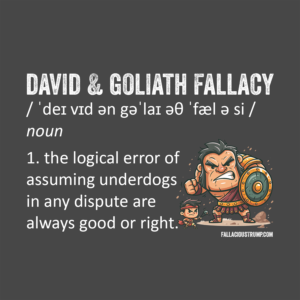
David and Goliath Fallacy FT#203
The David and Goliath Fallacy occurs when someone suggests that the underdog in any dispute is good or right merely because they are the underdog, and their bigger, better funded, or more powerful opponent is therefore wrong, bad, or corrupt.
-

Definist Fallacy FT#193
The Definist Fallacy occurs when someone deliberately redefines a term in a way that’s favorable to their own argument (and is probably a stretch of the real definition)
-

Denying the Antecedent FT#144
Denying the Antecedent is a formal logical fallacy taking the form:
-
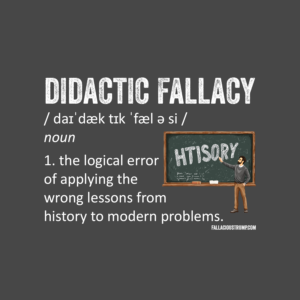
Didactic Fallacy FT#192
The Didactic Fallacy occurs when someone attempts to apply a historical analogy to a current situation but takes the wrong lesson from history or applies it to an inappropriate modern problem.
-

Double Standard Fallacy FT#83
The Double Standard Fallacy is committed when someone treats two very similar situations differently (usually to their advantage) with no explanation why.
-

Dysphemism FT#164
The Dysphemism fallacy occurs when someone replaces a neutral term with an unnecessarily negative one to support their position.
-

Equivocation FT#36
The Equivocation fallacy relies on using a word with more than one meaning to set up a misleading argument. Often the word will be used in one sense in the premise, and in the other sense in the conclusion, implying that because the word is…
-

Ethnocentric Fallacy FT#179
The Ethnocentric Fallacy occurs when someone starts from an assumption that their own culture is superior to others or was more instrumental in history than it really was.
-

Euphemism FT#168
The Euphemism Fallacy occurs when someone uses a misleadingly positive word or phrase in order to avoid a negative reality.
-
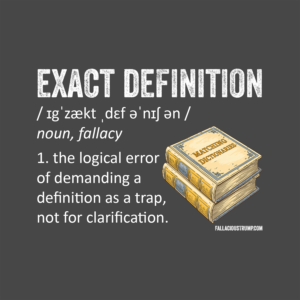
Exact Definition Fallacy FT#195
The Exact Definition Fallacy occurs when someone disingenuously demands their opponent provide a definition solely to score debate points when they can’t provide one that meets an arbitrary standard
-

Factoid Propagation FT#122
The fallacy of Factoid Propagation is committed when someone uses a ‘fact’ they heard to support their position, without knowing (or caring) if the fact is true or not.
-

Failing Occam’s Razor FT#68
The Failing Occam’s Razor Fallacy is committed when someone ignores an obvious or simple explanation for something and chooses a far-fetched hypothesis instead.
-

Fallacy Fallacy FT#182
The Fallacy Fallacy occurs when you assume a claim is false because a logical fallacy was used during arguments supporting the claim.
-

Fallacy of Worse Evil FT#76
The Fallacy of Worse Evil is committed when someone acts like something is not a problem because worse problems exist or can be imagined.
-

False Balance Fallacy FT#118
The False Balance Fallacy is committed when someone suggests that both sides of an issue are equally worthy of debate or consideration, even when most or all the evidence favors one side.
-

False Consensus FT#100
The False Consensus fallacy occurs when someone makes an argument based on their assumption that most other peoples behaviour, beliefs, thoughts and motivations are the same as their own.
-

False Dilemma FT#4
The False Dilemma fallacy is depressingly common, and quite easy to spot. It occurs when someone suggests or implies there are only two possible choices or outcomes, and if you don’t choose one then the other is inevitable.
-
False Dilemma (Redux) FT#155
The False Dilemma Fallacy occurs when someone suggests or implies there are only two possible choices or outcomes, and if you don’t choose one then the other is inevitable
-

False Uniqueness FT#200
False Uniqueness occurs when someone overestimates how rare their positive traits, abilities, or experience are.
-

Fault as Virtue FT#166
The Fault as Virtue Fallacy occurs when someone disingenuously reframes a flaw in themselves or a situation as a good thing to support their argument.
-

Faulty Analogy FT#41
The fallacy of the Faulty Analogy is committed when you assume that because two things are alike in one way, then they are alike in all ways.
-

Fractal Wrongness FT#92
The Fractal Wrongness Fallacy is committed when someone’s argument is based on logic or premises so wrong that they are wrong at every level from detail to worldview.
-

Furtive Fallacy FT#174
The Furtive Fallacy occurs when someone assumes that significant events are due to hidden actions by nefarious powerful people.
-

Galileo Fallacy FT#9
When someone claims that the fact that everyone called them crazy means they must be right, because ‘they called Galileo crazy’ (or some other person who was historically dismissed then turned out to be right), they are committing a fallacy. They are forgetting that the…
-
Galileo Fallacy (Redux) FT#191
When someone claims that the fact that everyone called them crazy means they must be right, because ‘they called Galileo crazy’ (or some other person who was historically dismissed then turned out to be right), they are committing a fallacy. They are forgetting that the…
-

Gambler’s Fallacy FT#111
The Gambler’s Fallacy is committed when someone confuses dependent and independent events or claims that a particular outcome is ‘due’ because it hasn’t happened for some time.
-

Genetic Fallacy FT#1
The Genetic Fallacy doesn’t have anything to do with genes. Rather, it relates to the ‘genesis’, or origin, of an argument. When someone commits the Genetic Fallacy they are basing their decision about whether a claim is true or false on who is making the…
-
Genetic Fallacy (Redux) FT#130
The Genetic Fallacy is committed when someone believes or dismisses a claim based on its origins rather than on evidence.
-

Gish Gallop FT#28
The Gish Gallop is a method of debating that focuses on quantity of arguments over quality, overwhelming your opponent with multiple arguments, each of which is often poorly argued or evidentially lacking. The sheer number of arguments makes a detailed, effective refutation impossible due to…
-

Glittering Generalities FT#160
The Glittering Generalities Fallacy occurs when someone uses vague, emotionally appealing phrases in place of reason.
-

Golden Hammer Fallacy FT#171
The Golden Hammer Fallacy occurs when someone assumes it is sensible to rely on a single tool or method to solve every problem.
-

Gotcha Argument FT#87
The Gotcha Argument is used by people who are backing into a corner and unable to answer a tough question. So they accuse their opponent of asking a ‘gotcha’ question.
-

Greater Good FT#101
The Greater Good Fallacy is committed when someone claims you should accept their argument or make some sacrifice because it’s for the greater good of everyone. It is a specific form of Thought Terminating Cliché
-

Guilt By Association FT#17
The Association Fallacy occurs when a person or information source is dismissed because of their connection to, or their similarity to another person or source which is already viewed negatively for some established reason.
-

Halo Effect FT#177
The Halo Effect is a cognitive bias that leads people to base their whole opinion of someone on a single positive or negative trait.
-

Hasty Generalization FT#14
The fallacy of Hasty Generalization is committed when an assumption is made based on too little information. It may, for example, be that a small sample of a large group has been observed, and the properties of this sample are assumed to be present in…
-

Hedging FT#46
The Hedging Fallacy is committed when someone changes their story or point of view and then acts like nothing has changed and they always thought like that.
-

Historical Fallacy FT#49
The Historical Fallacy is committed when someone assumes the current situation was always inevitable and ignores or denies the context of what led up to it.
-

Holmesian Fallacy FT#153
The Holmesian Fallacy occurs when someone assumes they have eliminated all incorrect answers and arrive at their conclusion because it is the only remaining answer they can think of.
-

Honor by Association FT#181
The Honor by Association Fallacy occurs when someone tries to make themselves look better because of a connection to a positive person or concept.
-

Hot Hand Fallacy FT#112
The Hot Hand Fallacy is committed when someone confuses dependent and independent events and claims that because particular outcome has been happening recently, it will continue to happen.
-

Hyperbolic Fallacy FT#20
When someone supports their argument by making a statement that is significantly more emphatic than can possibly be supported by evidence, they may be committing the Hyperbolic Fallacy.
-

Hypophora FT#173
Hypophora occurs when someone answers their own question without giving anyone else a chance to answer. It can be fallacious if the answer given serves them better than other plausible answers.
-

I’m Entitled to my Opinion FT#136
The I’m Entitled to my Opinion Fallacy occurs when someone invokes this supposed right in the face of opposing evidence which they can’t argue against.
-

If By Whiskey FT#117
The If By Whiskey Fallacy is committed when someone either takes such a non-committal stance on an issue that they could be supporting either side, or redefines the terms of the question to answer in the way they want to answer.
-

Ignoratio Elenchi FT#24
This fallacy, sometimes called ‘Missing the Point’, is committed when someone provides evidence refuting or proving a point which is irrelevant to the issue at hand. This can often be a quite effective distraction, but as it does not address the real question, it remains…
-

Ignoring Linear Time FT#77
The fallacy of Ignoring Linear Time is committed when someone acts like because something hasn’t happened yet then it can’t or won’t happen.
-

Imposter Fallacy FT#69
The Imposter Fallacy is committed when someone claims without sufficient evidence that a member of their group who is making them look bad is actually an infiltrator from another group.
-

Incomplete Comparison FT#93
The Incomplete Comparison fallacy is committed when someone suggests a thing is better or worse, without specifying what it is better or worse than.
-

Inconsistent Comparison FT#6
When supporting your claims by comparing two things, it’s important to be consistent in terms of what you’re actually comparing. By doing so you can ensure it is a fair comparison and your point can be supported. If you are not fair when setting up…
-
Inconsistent Comparison (Redux) FT#169
The Inconsistent Comparison Fallacy occurs when someone backs up their argument by comparing things which actually differ in important and relevant ways.
-

Insignificant Cause FT#167
The Insignificant Cause Fallacy occurs when someone claims an outcome is due to something which may be a minor factor, but is certainly not the main cause.
-

Invincible Ignorance FT#39
Invincible Ignorance describes a situation where, no matter how much evidence is presented or how clearly they are wrong, a fallacious arguer simply refuses to waver from their original position.
-

Iron Man Fallacy FT#120
The Iron Man fallacy is committed when someone misrepresents their own position (or one they agree with) to suggest it is in fact a much stronger position that nobody could argue with.
-

Jingoism Fallacy FT#172
The Jingoism Fallacy occurs when someone attempts to appeal to patriotic emotions rather than reason to persuade others.
-

Just Because FT#124
The Just Because Fallacy occurs when someone refuses to give a reason or evidence for their assertion, instead expecting others to trust their authority just because.
-

Just World Fallacy FT#80
The Just World Fallacy is committed when someone assumes that if something bad happens to you, it’s probably because you’re a bad person.
-

Kettle Logic FT#26
Kettle Logic is when multiple arguments are presented at once, often overlapping or contradicting each other, without acknowledging the contradictions.
-

Labelling FT#178
The Labelling Fallacy occurs when someone assigns a (usually negative) label to a person or idea as a shortcut to avoid providing evidence of how the person or idea is wrong.
-

Lying with Statistics FT#19
Lying with Statistics can involve using highly specific numbers to make it seem like you know what you’re talking about, using a true statistic out of context to bolster a particular point of view, or simply using made up statistics and hoping your opponent doesn’t…
-

Magic Words Fallacy FT#154
The Magic Words Fallacy occurs when someone uses specific phrasing to avoid consequences for what they say.
-

Magical Thinking Fallacy FT#105
The Magical Thinking Fallacy is committed when someone claims that a real world outcome is the result of a magical cause or process, such as a wish, jinx or curse.
-

McNamara Fallacy FT#78
The McNamara Fallacy is committed when someone treats something as important because it is easy to measure, or dismisses something as unimportant because it is hard to measure.
-

Moral Equivalence (Redux) FT#147
The fallacy of Moral Equivalence is committed when someone argues that because the actions of two people or groups are morally equivalent (whether they are or not), those people or groups are just as bad as each other.
-
Moral Equivalence Fallacy FT#3
The fallacy of Moral Equivalence is committed when someone argues that because the actions of two people or groups are morally equivalent (whether they are or not), those people or groups are just as bad as each other.
-

Morton’s Fork FT#119
The Morton’s Fork Fallacy is committed when someone suggests two seemingly different choices actually lead to the same negative result.
-

Moving the Goalposts FT#8
Moving the Goalposts is such a common tactic that I’m sure everyone has come across it at some point.
-
Moving the Goalposts (Redux) FT#186
Moving the Goalposts occurs when someone changes the rules after their initial criteria have been met.
-

Need for First Hand Accounts FT#99
The Need for First Hand Accounts Fallacy is committed when someone refuses to accept an argument based on any evidence except personal experience.
-

Nirvana Fallacy FT#43
The Nirvana Fallacy is committed when someone dismisses an argument or an option because it is flawed in some way, even though it may be the best of all available arguments or options.
-

No True Scotsman FT#48
The No True Scotsman Fallacy is committed when your existing definition of a particular group is challenged by a member who doesn’t fit the criteria. Rather than adjust the definition, the offending group member is redefined as a non-member of the group.
-

Non Sequitur FT#5
Non Sequitur is Latin for ‘does not follow’. Colloquially, non-sequitur tends to be used to mean a sentence which has no relation to the previous one, but in logical fallacy terms, that would more likely be a Red Herring fallacy.
-
Non Sequitur (Redux) FT#162
The Non Sequitur Fallacy occurs when someone makes a conclusion that does not follow from the premises.
-

Notable Effort FT#152
The Notable Effort Fallacy occurs when someone relies on effort rather than evidence in evaluating a claim.
-

Nutpicking FT#129
Nutpicking is the practise of choosing an extreme view or fringe member of a group and representing it as typical of that group to support an argument or point of view.
-

Obfuscation FT#146
Obfuscation occurs when someone provides deliberately vague or confusing information in an attempt to make a claim or present a point of view.
-
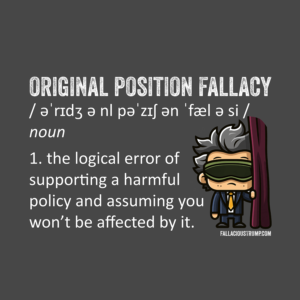
Original Position Fallacy FT#202
The Original Position Fallacy occurs when someone supports a potentially harmful policy because they assume they won’t be among the people harmed by it.
-

Overextended Outrage Fallacy FT#52
The Overextended Outrage Fallacy is committed when an isolated or infrequent incident is used to demonize a whole group of people.
-

Parade of Horribles FT#161
The Fallacy occurs when someone lists lots of unpleasant but theoretical (or made-up) outcomes that they insist would follow from an action.
-

Passing the Buck FT#157
The Passing the Buck Fallacy occurs when someone attempts to avoid responsibility by claiming someone else is to blame for their actions.
-

Planning Fallacy FT#113
The Planning Fallacy describes the tendency for people to underestimate the time a task will take to complete.
-

Playing Politics FT#143
The Playing Politics fallacy occurs when someone avoids engaging with an argument by claiming their opponent is merely ‘playing politics’ when in fact they are trying to effect change.
-

Playing the Victim FT#133
The Playing the Victim fallacy occurs when someone tries to deflect criticism by arguing the target of criticism is just being persecuted, without addressing the content of the accusation.
-

Poisoning the Well FT#23
Poisoning the Well is a kind of Ad Hominem fallacy where the attack on the person making a claim happens in advance.
-

Politician’s Fallacy FT#57
The Politician’s Fallacy is committed when someone recognises that ‘something’ must be done about a problem and assumes that any ‘something’ will do.
-

Pooh Pooh Fallacy FT#102
The Pooh Pooh Fallacy is committed when someone dismisses a claim, argument or question as not being worthy of discussion, especially as a technique to avoid having a difficult conversation.
-

Post Hoc Ergo Propter Hoc FT#13
Latin for ‘after this, therefore because of this’, this fallacy is committed when people confuse correlation for causation and assume that because one event followed another, the former was caused by the latter. Of course, while this may be the case, it is by no…
-

Pragmatic Fallacy FT#149
The Pragmatic Fallacy occurs when someone argues a course of action should be undertaken because it ‘works’, even though it may only work in certain circumstances or only if you define ‘works’ unconventionally.
-

Promised Proof FT#66
The Promised Proof Fallacy is committed when someone can’t back up their claims with anything other than some currently non-existent proof that they claim will appear later.
-

Prosecutor’s Fallacy FT#61
The Prosecutor’s Fallacy is committed when someone mixes up the conditionals when stating a probability or doesn’t factor the conditionals in at all.
-

Red Baiting FT#107
The Red Baiting Fallacy is committed when someone calls their opponent a communist or a socialist based on little or no evidence and in order to avoid engaging with their actual arguments.
-

Red Herring FT#33
A Red Herring is a distraction, anything that sends a conversation off on a tangent and away from the original point. When someone completely avoids a question by bringing up another issue entirely, they are committing a Red Herring fallacy.
-

Reductio ad Hitlerum FT#109
Reductio ad Hitlerum is committed when someone compares their opponent to Hitler without due cause, usually in a Herculean avoidance of nuance.
-

Reification FT#94
The Reification Fallacy is committed when someone suggests an abstract concept is real and has intent or agency.
-

Rhetorical Question Fallacy FT#47
The Rhetorical Question Fallacy is a way of accusing people of something while appearing to be ‘just asking questions’. Often the questions being asked have already been debunked or already have a satisfactory answer.
-

Sanctimony Fallacy FT#189
The Sanctimony Fallacy occurs when someone claims to be morally superior to their opponent, either without evidence or in the face of contradictory evidence.
-

Scapegoating FT#141
The Scapegoating fallacy occurs when someone unfairly blames a problem on an already unpopular person or group.
-

Schrödinger’s Idiot FT#142
The Schrödinger’s Idiot fallacy occurs when someone says something ignorant, bigoted or just wrong, and later claims it was a joke when they are criticized for it.
-

Shifting the Burden of Proof FT#38
Typically, the burden of proof lies with the person making the claim. The more outrageous the claim, the more the claimant should be expected to provide evidence before anyone is likely to believe him.
-

Silent Majority Fallacy FT#98
The Silent Majority Fallacy is committed when someone assumes all or most of the people who aren’t vocally disagreeing with them, in fact agree with them.
-

Single Cause Fallacy FT#27
The Single Cause Fallacy is committed when the speaker assumes a complex outcome to have one cause, thereby making it easier to blame on somebody or propose a solution. The reality is that many real-world issues are caused by a combination of factors, some of…
-

Slippery Slope FT#10
The Slippery Slope fallacy is committed when a person assumes if one bad thing happens, then more, and often worse, bad things will inevitably follow. It is often applied to changes in the law that some groups are campaigning for, and others find distasteful.
-
Slippery Slope (Redux) FT#180
The Slippery Slope fallacy is committed when a person assumes if one bad thing happens, then more, and often worse, bad things will inevitably follow. It is often applied to changes in the law that some groups are campaigning for, and others find distasteful.
-

Sour Grapes FT#134
The Sour Grapes Fallacy occurs when someone rationalizes their failure after the fact by claiming the thing they were trying to attain wasn’t actually any good.
-

Special Pleading FT#25
Special Pleading describes a situation where you have a rule that you apply to everyone else, but make up an excuse to explain why the rule doesn’t apply to you. When you are inconsistent in applying the rules in this way without a valid logical…
-

Spin Doctoring FT#190
Spin Doctoring occurs when people manipulate or frame information to control public perception.
-

Square One Fallacy FT#187
The Square One Fallacy occurs when someone dismisses all the work and research that has been done and pretends we need to start from the beginning to solve or understand a problem.
-

Straw Man (Redux) FT#139
A Straw Man Fallacy occurs when someone distorts or misrepresents their opponents argument to make it easier to defeat.
-
Straw Man Fallacy FT#2
When someone makes a strong argument that’s hard to refute, don’t despair. Simply pretend they made a different argument, that’s easier to knock down – you could massively oversimplify what they said, misrepresent the point of their argument, or just put words in their mouth.…
-

Subverted Support FT#103
The Subverted Support Fallacy is committed when someone tries to describe or explain a phenomenon without first providing any evidence that the phenomenon exists at all. It is a form of Begging the Question in that the existence of the phenomenon is assumed.
-

Sunk Cost Fallacy FT#84
The Sunk Cost Fallacy is committed when someone justifies maintaining or extending a course of action based on the cost already incurred (whether in terms of money, time, effort or intellectual capital).
-

Survivorship Bias FT#89
The Survivorship Bias Fallacy is committed when someone makes an argument based on a biased sample that only includes items that have survived some kind of selection pressure.
-

Tautological Templar FT#125
The Tautological Templar Fallacy involves a person claiming their actions are good or right because they are a good person who only does good things.
-

Texas Sharpshooter FT#40
The Texas Sharpshooter Fallacy describes a situation where someone collects or examines a large amount of data without deciding in advance exactly what they’re testing, then chooses a sample which provides evidence for their existing opinion. It’s based on a story where an inexperienced gunman…
-

The Courtier’s Reply FT#197
The Courtier’s Reply occurs when someone dismisses their opponent’s opinion by claiming they lack sufficient expertise on the subject to be allowed to opine.
-

Think of the Children Fallacy FT#183
The Think of the Children Fallacy occurs when someone invokes an appeal to emotion involving theoretical harm to children to avoid addressing an actual argument.
-

Thought-Terminating Cliché FT#64
The Thought-Terminating Cliché occurs when someone uses a well known or common phrase as a way of ending the debate and accepting no further thoughts on the matter.
-

Tokenism Fallacy FT#75
The Tokenism Fallacy is committed when someone makes a minimal gesture and claims it is far more significant than it really is.
-

Toupée Fallacy FT#96
The Toupée Fallacy is a type of Argument from Ignorance where someone doesn’t notice evidence that would prove that they don’t notice confounding evidence, such as when someone claims that all toupées are bad because they’ve never seen a convincing one (possibly because if it…
-

Traitorous Critic Fallacy FT#31
The Traitorous Critic Fallacy, or Ergo Decedo, is a fallacy where someone dismisses a person with genuine complaints by telling them if they don’t like it, they can leave. It’s a way of avoiding dealing with the complaint itself and branding the complainer as unworthy…
-

Truth Rejection FT#165
Truth Rejection occurs when someone addresses a question by specifically mentioning a particular response they won’t accept – which happens to be the truth.
-

Tu Quoque FT#12
Tu Quoque is another Latin one – it literally means “You too.” It’s a particular type of Red Herring fallacy where the speaker avoids responding to a criticism by distracting the listener with claims that other people (ideally the one doing the criticizing) have also…
-
Tu Quoque (Redux) FT#201
Tu Quoque literally means “You too.” It’s a particular type of Red Herring fallacy where the speaker avoids responding to a criticism by distracting the listener with claims that other people (ideally the one doing the criticizing) have also done similar bad things.
-

Two Wrongs Make a Right Fallacy FT#156
The Two Wrongs Make a Right Fallacy occurs when someone tries to justify an action by pointing out that someone else did it too, or would if they had the chance.
-

What’s the Harm FT#137
The What’s the Harm Fallacy occurs when someone suggests trying something be rhetorically asking what’s the harm, thereby implying that there is none.
-

Whataboutism FT#127
Whataboutism occurs when someone who is accused of something tries to distract and derail the conversation by talking about something somebody else did, which is implied to be equivalent.
-

Worst Case Scenario FT#135
The Worst Case Scenario Fallacy occurs when someone argues as if the worst case scenario is the probable outcome rather than an unlikely situation.
-

Wrong Tool Fallacy FT#44
The Wrong Tool Fallacy is committed when someone tries to present evidence for their argument, but the method or tool they are using isn’t designed to show what they claim it shows.
-

Zero Sum Fallacy FT#128
The Zero Sum fallacy occurs when someone assumes gains and losses in a specific situation are directly balanced when in fact they are not.