Show Notes
When supporting your claims by comparing two things, it’s important to be consistent in terms of what you’re actually comparing. By doing so you can ensure it is a fair comparison and your point can be supported. If you are not fair when setting up the parameters, and you end up comparing the two in different ways, you are engaging in the fallacy of Inconsistent Comparison.
Trump
We started out with Trump talking about regulations:
Mark’s British Politics Corner
Mark talked about Boris Johnson’s £350 million a week promise:
Fallacy in the Wild (Sting: the Muppet Show)
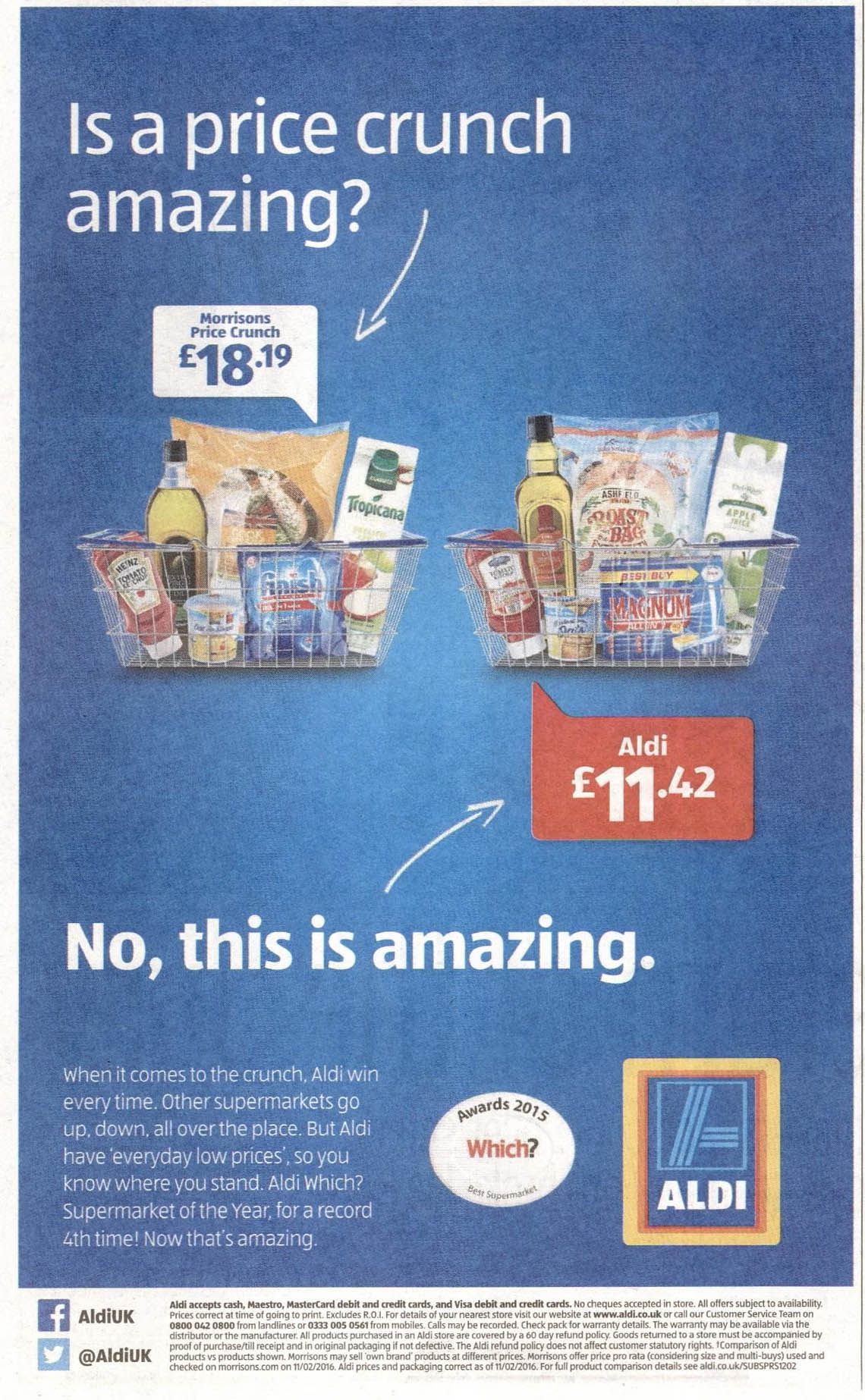
In the Fallacy in the Wild we looked at this print ad from Aldi, which was banned for comparing Aldi own brand products to premium brands at other supermarkets:
Fake News
Here are the statements from this week’s Fake News game:
- I’m very pro-Israel. When I decided to recognise Jerusalem as the capital of Israel, it was time. It should have been done years ago. The State of Israel has had Jerusalem as their capital for over 100 years.
- For the past 17 years, Obamacare has wreaked havoc on the lives of innocent, hardworking Americans.
- We met with the Queen, who is absolutely a terrific person, where she reviewed her Honour Guard for the first time in 70 years, they tell me.
Click below for the answer
Spoiler
Statement 1 is Fake News. Mark chose number 2Mark got it wrong yet again this week, and is STILL on 0%
Collusion is not a logical fallacy
We talked about Rudy Giuliani’s claim that collusion isn’t even a crime
The stories we really didn’t have time to talk about:
- Trump threatened to shut down the government if Democrats refused to fund his wall, forgetting three important things. The Republicans have control of the House, the midterms are in three months and people don’t like it when the government shuts down.
- Trump tweeted last week “I am looking into 3-D Plastic Guns being sold to the public. Already spoke to NRA, doesn’t seem to make much sense!” Which is odd, since it was his administration that allowed the instructions for untraceable homemade 3d printed guns to be published online.
- Trump said at a speech in Kansas City: “The party told you to reject the evidence of your eyes and ears. It was their final, most essential command”. Oh no, wait, that was from 1984. What Trump actually said was “Just remember, what you’re seeing and what you’re reading is not what’s happening”. So, basically the same.
- Just when you thought 2018 couldn’t get any weirder, it turns out the Republican candidate in Virginia’s 5th Congressional District, who is brilliantly named ‘Denver Riggleman’, is a self published author. Of Bigfoot Erotica. He claims his interest in Bigfoot is entirely non-sexual. The title of his next book, ‘The Mating Habits of Bigfoot and Why Women Want Him’, says otherwise.
- Trump announced a 12 billion dollar bailout for the farmers he screwed with his trade war. He really loves fixing problems he created and acting like a hero. He’s like Muttley from Wacky Races, begging for a medal.
- The guy who took a pickaxe to Trump’s star on the Hollywood Walk of Fame has been bailed out…. by the guy who destroyed it in 2016. Is it just me, or could this be the beginning of a chain. Pay it forward!
- Someone set Betsy DeVos’s $40 million yacht adrift, doing $10,000 worth of damage. In other news, a bird crapped on my car, which, proportionally, is just as bad.
- The Trump administration still doesn’t have anyone in charge of preventing foreign election interference, and the Republicans just blocked an effort to allocate $250 million to increase election security measures ahead of the midterms. I guess when your strategy is so obvious, why waste the money?
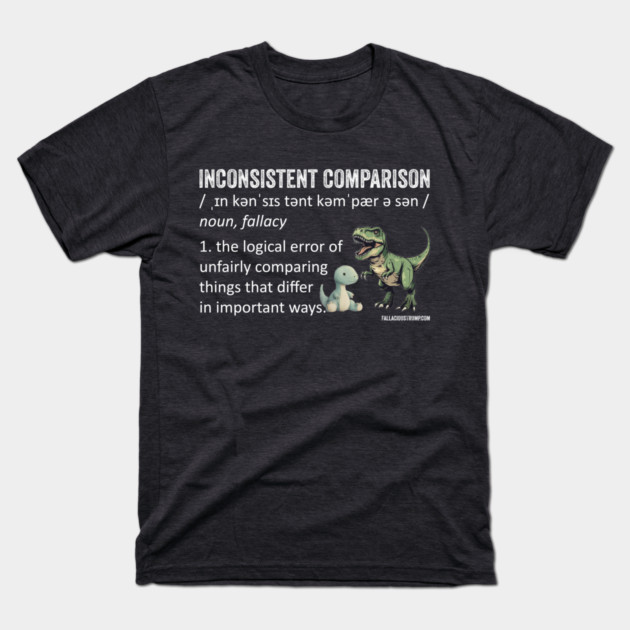
If you wanted to buy a T-shirt featuring this fallacy, you could click here. No pressure
And if you have some money left over after that, Jim’s book, 2000 Mules and One Big Lie: A Stubborn Conspiracy Theory is available now.
That’s almost all for this week, but here’s our AI-aided transcript, which is quite accurate, but not totally:
Inconsistent Comparison – FT#6 Transcript
Read the full transcript
00:51 Clip
— You really do have to ask yourself, where does it stop?
00:54 Jim: Hello and welcome to Fallacious Trump, the podcast where we use the insane ramblings of America's racist grandpa to explain logical fallacies. I'm your host, Jim.
01:02 Mark: And I'm your other host, Mark. A logical fallacy is an error in reasoning that results in bad or invalid arguments, and the logical fallacy we're looking at this week is inconsistent comparison, also known as faulty or unfair comparison.
01:16 Jim: Yeah so this fallacy is based on when you compare two things just being fair about it really. The unfair comparison is probably quite a good term for it, and the way way that you can make sure you're fair is by being consistent about what you're comparing. Because if you're looking at two different things and trying to draw an analogy between them, or trying to trying to make a point about the two things and the connection between them, if you're looking at different aspects of them and comparing that, then it you're not making the point. You're not actually doing it, making a good argument.
01:47 Mark: So would it be fair to call it apples and oranges?
01:50 Jim: Actually, apples and oranges is sometimes used as an alternative title for this fallacy. So yeah, that's perfect. And so an example from Trump is at the World Economic Forum in Davos, where he said this.
02:06 Clip: Trump talking about regulations
— I pledged to eliminate two unnecessary regulations for every one new regulation. We have succeeded beyond our highest expectations. Instead of two for one, We have cut 22 burdensome regulations for every one new rule.
02:30 Jim: That was a kind of campaign. Pledge of Trump's was to get rid of regulations, to remove two old regulations every time they made a new rule. And he's claiming there that every time they've made a new rule, they've got rid of 22, which is quite a significant difference. And this claim is based on a press release from the White House from December. Which says that since Trump issued the executive order 13771, the two for one rule that federal agencies have issued 67 deregulatory actions and imposed only three new regulatory ones. So they've only made three new rules and they've got rid of 67 rules. So that seems to back up what he says.
03:12 [Unclear]: But the thing is,
03:14 Jim: they're not actually classing the regulatory actions and the deregulatory actions the same. They're. They are using different rules to say what is a new rule and what is a rule we got rid of. So there's a memorandum from the office of management and budget which defines regulatory actions and deregulatory actions to help agencies comply with the two -for -one rule. So it says that a regulatory action – a new rule, basically says a significant regulatory action – is defined in section 3f of executive order 12866, while deregulatory actions are not limited to those defined as significant under executive order 12866. So it specifically says in this memorandum we are not treating these the same. We're not saying that the rules that you come up with are not the same as the rules that we get rid of.
04:07 Mark: So you can have, you can just get rid of any old thing. It doesn't have to have the same significance as the one that you're introducing.
04:13 Jim: Yeah, basically it means that when you're counting up regulations that you've got rid of, yeah, you count everything, yeah, so even there's rules about, um, the changing the timetables for drawbridge opening, um, if you, if you get rid of that rule, that counts right, um,
04:30 Mark: and suddenly you've got this image of, suddenly you've got this image of how many castles are there in America that have got drawbridge?
04:38 Jim: I think we think, yeah, you would think, yes, you're British, yeah, drawbridge castle, but no, this would be for, uh, bridges which boats go through.
04:47 Mark: Oh okay, yeah, yeah, yeah.
04:49 Jim: So they lift up the bridges. So you know, you have to have a timetable, yeah, for that. Oh yeah, for when the boats can go through and when cars can go over the bridge. So, um, if you make a rule about what you can do with the timetable, how you have to publish the timetable, things like that, right, if, If you take away that rule, that counts. However, when you're counting new rules, you only count really significant ones: ones, according to this executive order, that have a greater than $100 million annual impact on the economy, ones that interfere with multiple government agencies or ones that raise new legal issues. So that's quite a significantly different criteria.
05:31 Mark: So, yeah, you couldn't. You couldn't introduce the drawbridge rule. That would impact the economy to 100 million dollars, could you probably not? No, no, the thing is,
05:41 Jim: if you actually look at the rules the same, if you, if you treat them the same, the change isn't so significant between how many they get rid of and how many new rules they make. Politifact looked at it and found that actually only five deregulatory actions were significant under the same rules. So only five of the rules – rules they got rid of – had that that much impact on the economy or interfered with multiple government agencies, compared to the three new ones that they imposed. So actually they didn't meet their criteria of two for one. Essentially, yeah, because they created three new rules and got rid of five. Politifact can be, it's quite, I think it's quite – neutral, but it's probably leaned slightly to the left. If you look at a right -leaning advocacy group, the American action Forum, they looked at only regulations with any Economic impact, so they ignored the other elements and they found that um, and this was this was not the hundred million dollar impact, this was any Economic impact at all. And they found – they found that they were based on that. There were five new rules, because obviously it's a slightly – uh, wider criteria, but there were only nine rules got rid of, so that still doesn't actually fit. The one to two not quite all right. So when you don't compare things fairly, when you don't use the same criteria for both things that you're comparing, you're not offering good evidence, you're not making a good argument to support your claim, you're. What you're doing is using a logical fallacy, and in this case it's the fallacy of inconsistent comparison.
07:12 Mark: Yeah, so you've done it, and it requires a certain amount of fact -checking to dig that stuff out, and you kind of rely on the people that are telling you these things to be telling you the truth, of just suddenly realising the daftness of that statement, because you know. Look at who they are.
07:35 Jim: Yeah, but it's only because of the world that we live in now where fact-checking is such an important part of the political discourse. Yeah in the old days, um, okay, yeah, sometimes you know, yes, politicians lie and you couldn't necessarily guarantee it but you wouldn't necessarily have gone. Oh, we should check that. Yeah, we should see what basis they're making that statement on. These days you've got political facts, you've got the washington post fact checking, you've got all kinds of organizations that look into that kind of thing and it and, frankly, it makes it harder for them to get away with it in the sense that no one will notice, but they still get away with it in the sense that their base doesn't care. So they still get to say this stuff.
08:20 Mark: I was going to be a bit more charitable and say, in the heat of the moment – and I was also thinking we should caveat somewhat this notion – that in the old days people would tell the truth because in the old days Soviet Russia existed, when they would publish the five -year plan and say: we are beating our planned roster for wheat supplies or whatever,
08:47 Jim: yeah, it's probably fair to say that there wasn't this uh culture, yeah, of scrutinizing their words much more carefully and you have the ability to go in and check this stuff.
08:58 Mark: Yeah, I think in the past, the, the west – well, in my experience of the trouble is my experience of politics in the past was when I I was a lot younger and so it just felt like that actually they used the excuse of the, the enemies. The other side of the iron curtain was saying: well, we don't lie, like they are obviously lying. You know we can, you can take it from us that we, you know, we are at the, as Harold Wilson said said, you know, the White heat of technology is helping us all out. And Harold McMillan said, you've never had it so good. Well, you're really dating yourself. But I'm just thinking that actually they were lies just as much as this stuff. And even who was the guy that said, I have here in my hand a piece of paper? Neville Chamberlain. Yeah, that promises peace in our time. You know, none of it was all. None of it was true.
10:01 Jim: If you're kind of making that argument that, uh, actually the lies have always been around, it's just that we're better at spotting them now, that, I think, is true. But there's a danger that that abdicates responsibility for checking Trump or suggests that Trump is normal in some way. Yeah, yeah, yeah, um, yeah, and it was just just announced, actually today, I think – that um in his first year. According to the washington post fact checkers, they said in his first year he made over 2 000 false or misleading statements. Um, he's actually almost doubled that now in the the next six months he's done another 2 000. Wow, in just six months he's kind of ramping up his bullshit at a quite alarming rate. Yeah, again, to be fair to him, um, most politicians didn't say as much publicly uh, in days gone by. Yeah, he can make uh statements on the internet. He can tweet, obviously, all the time that that you know he's done something. I think last weekend he sent about 40 tweets. So that gives plenty of opportunity. Yeah to to talk nonsense. Yeah, but yeah, he's, he's saying a lot more, I think, than certainly if you go back 20 years, as politicians used to, so there's more opportunity for him to lie, but I I do think that the proportion of stuff he says that isn't true is unusually high.
11:26 [Unclear]: Yeah, so much for draining the swamp.
11:28 Jim: Yeah, hard to drain the swamp when you are the swamp. Now
11:40 [Sting: Mark's British Politics Corner] And now is the time, I think, for Mark's British Politics Corner.
11:43 Mark: Yeah, well, I'm glad you brought Boris back in, because we miss him so anyway. Um, so this, this This week's example is: early on in the campaign for leave before the Brexit referendum, Boris Johnson jumped on the bandwagon and became the spokesperson for the leave campaign. And there was a double -decker bus that had a big slogan on the side which said: we send 350 million pounds per week to the EU. Why don't we spend it on the nhs instead? And this clip is from the launch of the battle bus,
12:23 Clip: Vote Leave's £350 million claim
— and if we vote leave on june the 23rd, we can take back control of 350 million pounds a week and spend on our priorities here in this country, including on the national health service.
12:35 Mark: So there's all sorts of fallacies going on in there. Um so the inconsistent comparison is the 350 million pounds a week. Um so the fact checking site over here, which is, I guess, the equivalent of the washington post, one of them is run by the bbc and it talks about exactly that and it says the Uk doesn't send 300 million pounds a week to brussels because there's a rebate because of the, the size of the country that we are and the contributions that we make to the European Union in ways other than just pure cash, which was renegotiated by Margaret Thatcher in the 80s, which is where the continuing euro scepticism within her party was somewhat assuaged at the time. So we have a there's a rebate which is sent back to the UK. So, in fact, it's deducted before we send the money. That deduction would take that weekly contribution down to £276 million. But that figure includes £88 million that we spend on stuff in the UK itself like support for farmers, regional aid. There's another £27 million a week that goes to support things like research projects in UK universities and UK companies. Is so that leaves us with 161 million, but even that includes the international development funding, because our government has a pledge to spend at least 0, .7 percent of its gross national product on international development, so that comes out of that contribution as well. So the next inconsistent comparison is okay. Well, how do we divert that 161 billion to the nhs? Well, we'd have to see what deal we ended up with after we left the european union. Can we have a relationship with the european union? Um, like Norway or switzerland? So they aren't necessarily ruled by all of the regulations in place from the Eu, but they still pay into the Eu And the contribution for the Norway model. The BBC site comes up and says: OK, well, in 2011, where the figures are available, the Norway's contribution to the EU was £106 per head, compared with our contribution of £128 per head. So even if we were out of the EU and in a different relationship like Norway, we would only save, what's that, £22 a head. So the total of that is about £1.2
15:32 [Unclear]: billion a year,
15:35 Mark: which isn't £350 million a week.
15:39 Jim: So yeah, yeah, I mean, Boris is comparing the money that we, that he's claiming we give to the Eu, obviously ignoring lots of other things. Yeah, but even if he was right about that, even if he was right that the 350 million goes directly from us to the Eu and we don't get anything back, um, by suggesting we could just use that for the nhs, we could spend that however we want, he's he's comparing money that goes out in one budget, in one for one purpose, with money that is used for another thing. That's not how budgets work. No, that's not how government works. No, you can't just um take money and go: oh, we're not using that anymore, let's put it into this budget. Yeah, it's, it's a lot more complicated than that. And and suggesting that that we can just make that decision, we can just spend on the nhs.
16:28 Mark: Yeah, but we're particularly, we know. We know that some some of that money that goes to the EU is being spent in the UK on farmers.
16:38 Jim: Yeah, so it would be taking away. Even if they did that, they're taking away money from one budget that we're currently using it for, like you say, for development or for farmers. So, yeah, it's suggesting that that money just immediately comes back to us and we get to use it for whatever we want.
16:56 Mark: Yeah, and in fact the chairman of the UK Statistical Authority, Andrew Dilnot, wrote a letter to the government saying: I conclude that there is a lack of clarity in the way the official statistics have been drawn on in the statements I've considered. In particular, I note the use of the 350 million pound figure, which appears to be a gross figure which doesn't take into account the rebate or other flows from the EU to the UK public sector. That, alongside the suggestion that this could be spent elsewhere without further explanation, I I consider these statements to be potentially misleading. Given the high level of public interest in this debate, it is important that official statistics are used accurately, with important limitations or caveats clearly explained. So that's the… That's quite a British complaint. Yes, there's the guy who's in charge of statistics as government body set up to look after statistics on the behalf of the government who then points out to the government. You've been using these statistics quite in a cavalier fashion and I recall at the time that he was hauled over the coals for it. He was, you know, literally almost became an enemy of the people for pointing out the truth of the matter.
18:18 Jim: You know, I like that the guy in charge of statistics for the Uk is is particularly particularly keen that official statistics used accurately because of the high level of public interest, like if, if people didn't really care, just do what you want. Because since people are concerned about this, yeah, we should be careful. We should be careful what we say.
18:40 Mark: Yeah, exactly, just in case you know. And we should explain the caveats that we're using. But you know he hasn't really kind of grasped the notion of what a soundbite is. You know it's just got to sound good, it's got to be, you know Boris saying, yeah, let's take back control, and all that kind of stuff. So but what is interesting is that, despite the fact that there was almost universal condemnation, despite all that, in on the 17th of june this year, um, theresa may revived the self -same fallacy, like some kind of populist zombies shuffling through the public gaze to divert attention from close run votes over brexit negotiations in parliament. And she said: at the moment, as a member of the european union, every year we spend significant amounts of money on our subscription, if you like, to the Eu. She's talking to andrew maher again, who we met last week, and she said: when we leave, we won't be doing that. It's right that we use the money to spend on our priorities, and the nhs is our number one priority. It's one of those. I'm very disappointed you didn't do her her voice. Yeah, I can't do the quavering thing. We can auto -tune it. That'd be fun. So that, yeah, it's, that's what. Why did she do that? Well, we know why she did it: because it's a populist thing. And people go: yeah, we've forgotten about that. Yeah, bring back the bus. We believe you thing is.
20:05 Jim: Immediately they won the brexit vote, didn't people say: um, so are you going to give the 350 million into the nhs now? And they basically went: oh, yeah, we didn't say we were going to do that, we just said we could.
20:17 Mark: Yeah, yeah, well for nigel Farage, who, uh, was then the leader of the Uk independence party, um, and self -styled prince of brexit, um, was interviewed. He said so, about this 350 million. He said, no, we can't do that and I'm sorry, and I'm sorry that we promised that basically,
20:37 Jim: Basically immediately after that. It was like they didn't have to think about it. They just went, oh, yeah, that's just something we said.
20:45 Mark: So actually the basis upon which the Leave campaign was conducted was on this big fat lie.
20:57 Jim: Well, they never expected to win. That's the thing. They didn't think it was going to be called on it.
21:03 Mark: Which is almost the same premise as Trump's presidency. Isn't it? You know, if you think he was never supposed to win, it all makes perfect sense.
21:12 [Sting: Fallacy in the Wild (The Muppet Show)]
21:23 Jim: Well, that was fucking weird.
21:34 Mark: It's animal, it's animal out of the Muppets.
21:36 Jim: I recognise, I recognise the character. I just don't know what he's doing in the sting.
21:44 Mark: He's a wild kind of guy. He knows all about fallacies in the wild, right then.
21:51 Jim: Well, Well, in the Fallacy in the Wild, we talk about the fallacy of the week from a non -political point of view. And this week we have actually an advert from a UK budget supermarket. I think actually they have them in the US as well. It's Aldi. And I'm going to play the end of the TV ad. It's not very descriptive, but I'll explain what's going on. And the beginning of the ad is a dad kind of helping his little daughter to learn to ride her bike and she goes off and then does various bike tricks which are pretty amazing, right. So the it ends like this: that was amazing.
22:32 Clip: Aldi ad
— I know we saved 35 shopping at Aldi this week. Now that is amazing. Be a sport, take the challenge, see how much you could save.
22:40 Jim: So when the mum uh mentions how much they've saved shopping at Aldi, there's a kind of a four Second flash up on the screen showing a kind of shopping basket of goods that have been bought in Aldi and it says Aldi, 33 pounds and 4p. And on the other side of the screen is a comparable shopping basket, a the same goods basically, and it says big four supermarkets: 53 pounds 35. So that's that's quite significant saving. That's 20 quid difference. Yeah, the thing that you don't necessarily spot in the four seconds that that's up on screen is that the Aldi stuff is all own brand right, and the stuff from the big four supermarkets is all kind of premium brands right, like kellogg's, heinz, pg tips, finished dishwasher tablets instead of just Aldi dishwasher tablets. So what Aldi are doing here is not comparing own brand, uh, their own brand with the other supermarkets, own brands, the tesco's own brand and so on, but with the, the most expensive things you can buy, yeah, yeah, yeah. So you're not saving by going to Aldi, you're saving by not buying the premium brands.
23:58 Mark: Yeah, but even the – I think even the – even the comparison with other supermarkets own brands, is probably probably an inconsistent comparison because they're not the same brands, you know they're.
24:13 Jim: Even then, I think it would be fair. I think it would be fair if you were saying: uh, like, for example, there was an, there was a print ad as well, which specifically called out morrison's, which is one of the big four supermarkets in the Uk. Um, and they had a basket of of products that it said said Aldi 11 pounds, 42, morrison's 18 pounds, 19, and again, it's compared. It's not comparing morrison's. Okay if it's, if it had morrison's own brand goods, yeah, and they were like 13 pounds or something, yeah, and then Aldi is 11, 42, it's not as impressive. Yeah, yeah, it's a fair comparison. You're saying that if you buy, you can buy the same stuff. It's our, it's our version of it. You know, everyone knows the own brand stuff probably isn't as high quality as the premium brand stuff, but really, for the most part, the own brand stuff of each of the individual supermarkets is probably quite similar and if the price is significantly lower in Aldi, fair enough. Yeah, but they're not saying that. They're implying it. In this instance, they aren't comparing fairly, they aren't doing the same, the same thing. And actually morrison's complained about this. Yeah, um, and it was upheld by the uh, the advertising standards authority, yeah, as um, as unfair, essentially because they said that there was a morrison's, uh or other competitor supermarket own brand product for each branded product shown and as such, um, each own brand product was qualitatively equivalent to the branded product. Um, in in Aldi, yeah, the Aldi branded product, yeah, whereas the the kind premium brand wasn't the same and was the uh,
25:51 Mark: yeah, because morrison's morrison's is fairly well before Aldi, I think morrison's was probably the cheapest own brand supermarket on the high street. That's a. It was a northern,
26:03 Jim: that's from northern, I mean morrison's uh for, for American listeners, uh, morrison's owns in the Uk and safeways, um, safeways used to be a supermarket in the Uk. Uh, I know you've got safeways in the us and morrison's was actually a reasonably small northern um supermarket chain and they bought all of the Uk safeways and and turned them into morrison's a few years ago. So, um, basically, we've got tesco, sainsbury's, asda and morrison's. Those are the main ones and and they're fairly comparable. But, yeah, I would say that morrison's is one of the certainly on the cheaper end of those four. Yeah, but the budget ones, the real budget ones, Aldi and little now, but they've kind of come up and and tried to take away some of that market and they've been quite successful. But using these tactics is, yeah, it's not fair. Yeah, they've been told not to do it and they've said they won't do it.
26:56 Mark: Good, the power of logical fallacy, thinking the advertising standards authority wins out again, championing the consumers rights.
27:13 [Sting: Fake News] So we're gonna, we're gonna – play fake news. Folks. I love the game. It's a great game. I understand to end the game as well as anybody. As well as anybody.
27:21 Jim: Yes, it's time for fake news. The game where I read out three Trump quotes, two of which are real and one I made up, and Mark has to figure out which one is fake news. Now, uh, Mark isn't doing particularly well at this game so far, so I'm lulling you into a false sense of security.
27:37 [Unclear]: You see, yeah,
27:38 Jim: I've got this, is it? I've got a feeling, I've got a good feeling about this week. This is your week,
27:41 Mark: this is my paul newman hustler thing. You see, I'll get you in and then, then I'll get you to eat 100 boiled eggs. Oh, no, that's the different. You're confusing your paul newman,
27:53 [Unclear]: yeah, so uh, but my, let you get away with that.
27:58 Mark: No, my tactic last week, uh, which I kind of hit upon, was to deliberately try and choose the wrong one in the hope that this week, doing that, it might succeed and I might actually pick the wrong one. I mean, pick the one that,
28:11 [Unclear]: yes, that you made up.
28:12 Jim: I think it's worth a go. Yeah, it's certainly. Certainly anything is worth a go, because what you've been doing so far isn't working.
28:17 Mark: It's not working at all. But you know, it's interesting and what, what happens? I see what I'm doing is providing I am the fall guy. So other people, when they're listening to this, they will feel that much more uh, smug and self -satisfied that they can.
28:32 Jim: They can get it. Then they will feel better about themselves, knowing that they've beaten you. So that's very you know,
28:38 Mark: knowing how much we've, you know, spent hours and hours studying all this stuff and they could just get it straight away. It's a bit like watching um jeopardy on the Tv, where you just shout at the at the Tv.
28:50 Jim: What people don't realize is how much pressure you're under. They just think it's, it's easy, yeah, sitting at home listening, yeah, guessing the right answer, but they don't realize you're under studio lights,
29:03 Mark: under the hot lamp, and then you know I've got a floor manager pointing at me and pointing at a watch and, you know, doing all those kind of signals to kind of wrap it up, and it's very stressful. We've got fact checkers listening to our every word, lawyers tapping us on the shoulder, one tapping me on the shoulder right now because I shouldn't have mentioned the lawyers. So, yeah, it's, it's immense pressure,
29:25 Jim: so I think people should go easier on. Yeah, so there's a theme this week. Okay, I've noticed that Trump um doesn't seem to know when things happened – happened in history, much right – or how long ago things happened, so. So the theme this week is: is things that Trump got wrong in terms of how long ago they happened, which is okay. This should be a snappier. I need a snappier title. Yeah, yeah, I don't have one. So we have three Trump quotes. You're looking for the one that I made up? Okay, uh, is it number one. I'm very pro Israel when I I decided to recognise Jerusalem as the capital of Israel. It was time. It should have been done years ago. The state of Israel has had Jerusalem as their capital for over 100 years. Is it number two? For the past 17 years, Obamacare has wreaked havoc on the lives of innocent, hardworking Americans.
30:19 Mark: Number three.
30:21 Jim: We met with the Queen, who is absolutely a terrific person, where she reviewed her honour guard for the first time in 70 years, they tell me.
30:29 Mark: He doesn't get out much, does he? That's the thing. Well, yeah, do you see it now? Number three I know is real because at the time that he met with the queen I was deliberately looking out for what he would say to make something up about. So I think that one's real. I'm very proud of Israel. When I decided to recognise Jerusalem as the capital of Israel, it just has to take all the credit, doesn't it? It should have been 10 years ago. State of Israel have had Jerusalem as their capital for 100 years. No, they haven't. For the past 17 years, Obamacare has wreaked havoc on the… That's good. Oh, God. God, I think that's because it made me laugh. I think number two, you wrote. So I think the pro-Israel 100-year capital thing is real. I think, the 17 years one. He's not even going to kind of lump Medicare in with Obamacare and get that wrong. I think you made that one up. Okay, I hope you did, because it's very funny.
31:55 Jim: You're most confident about number three, so let's go in reverse order. Okay, he met with the queen. He did do that. That's true. Yay, yay, right, and yeah, number three is real.
32:09 Clip: Trump, played during Fake News
— We met with the queen, who is absolutely a terrific person,
32:14 Mark: where she reviewed her honor honor guard for the first time in 70 years, they tell me. So she does it every day, doesn't she, the queen?
32:22 [Unclear]: The queen has only
32:23 Jim: been queen for 66 years. And and she reviews, she inspects the guard of honor on a fairly regular basis. Yeah, certainly, um, it's a very common thing that she does with visiting dignitaries. Yeah, um, she did it with Obama in 2011.
32:45 [Unclear]: Does it on her birthday? It's that kind of stuff. Yeah, it's, it is.
32:49 Jim: Yeah, I don't know where on earth he got that idea. In fact, there's a had been. I think the last time she did it was four years before she was queen.
32:58 Mark: Yeah, which maybe she went as a child with her dad. You know the king, um, but yeah, because I think there There is a when she's expecting the guard. There's a Photoshop or an early not Photoshop. It would have been a cut and paste job of the Queen sitting on a horse in all the regalia and somebody's put Mickey Mouse's head on her. That, yeah, Google it, people. It does exist. And that was from the 60s, so, yeah, during the, it was all that Mickey Mouse, Richard Nixon type thing. Yeah, so I know she's done it once at least. Dressed as Mickey Mouse. She's done it many times.
33:43 Jim: It's a common thing for us to accept. So you think number one is also real?
33:48 [Unclear]: I think it's real.
33:50 Mark: I think it's real.
33:52 Jim: And number one is fake news.
33:57 Mark: Oh, man, that's very good indeed. What I should do is count the number of sentences is because that's very good.
34:08 Jim: He did not claim that, uh, the state of Israel has had Jerusalem as their capital for 100 years. Of course, the state of Israel has only existed since 1948. Yeah, so so that would? Oh, no, so it doesn't preclude him saying things:
34:22 Mark: no, no, that's true. So what that is?
34:24 Jim: Because what that does mean is that number two is real.
34:33 Mark: So what? For the past 17 years,
34:36 Clip: Trump, played during Fake News
— Obamacare has wreaked havoc on the lives of innocent, hardworking Americans.
34:43 Mark: It's not like you haven't been immediately in office straight after Obama, who introduced Obamacare for maybe a year before you got into office. And what the hell? And when you campaigned on stamping it out because it was a communist conspiracy in 2016?
35:03 [Unclear]: Yeah, it's really not clear what he was talking about. No, it's obviously not 17 years so,
35:09 Mark: and so that's the horrifying thing about the fact that one is fake is that two is true because Because for the past 17 years, since 2001, before Obama was even a senator, Obamacare has been running. And it's wreaked havoc on the…
35:29 [Unclear]: What the hell?
35:33 Mark: Who did you elect, you stupid people? I don't mind losing for that one. Don't mind losing.
35:44 [Unclear]: because that is just…
35:46 Jim: Well, that's good because you have lost which means I win again and that means that I'm undefeated still at fake news. 6-0.
35:56 [Unclear]: Half a dozen.
35:58 Jim: So, podcast listeners, I need your help because this is getting ridiculous, and if you think you can make up a convincing fake Trump quote, then share this episode on Twitter. Include your quote in the hashtag FallaciousTrump and I'll pick the best one and you'll be podcast famous. So it's time for the part of the Show that, this week at least, is called collusion is not a logical fallacy. This is the part of the Show where we want to talk about all the crazy stuff that's going on in the White House and in the Trump administration. But we can't talk about all of it because there's just so much crazy stuff. So we have to pick one story, and the story that we have picked this week to talk about is Rudy Giuliani going on TV again and just changing the story. Change he's. It's amazing what he does for the president. He, he, he causes, I think, as many problems as he, in inverted commas, solves. Yeah, I don't. It doesn't seem like there's any kind of real plan.
37:05 Mark: No, I like to think of him as the deck chair attendant on the titanic. He's kind of he goes around, he moves them around.
37:14 Jim: It's like that kind of the three card monte. It's like it's just kind of keep, keep, keep everything moving and no one will be able to pick.
37:21 Mark: Yep, nobody knows where it lands. Yeah, which ones? Yeah, pick the lady, find the lady, yeah, yeah, yeah, find the collusion, yes, yeah, so with collusion,
37:31 Jim: he has has been saying for a while now, as has Trump that there was no collusion. Uh, every opportunity they get, they mention there's no collusion. Trump has tweeted that there's no collusion at least 90 times since last march, and this week giuliani continued with that. He didn't deviate, but he did mention that, just in case there was collusion, right, uh, collusion isn't a crime, anyway, we. So, it's fine, um, right, but it did, there wasn't any.
38:00 Clip: Rudy Giuliani on collusion
— But if there was, yeah, it wasn't a crime. It's not a crime,
38:03 Mark: collusion in it in itself. Just colluding isn't isn't a crime. Okay, that's true, but there wasn't any,
38:11 Jim: is true collusion, the word collusion, yeah, uh, isn't, isn't a crime, right, so, and that's the that's the brilliant thing about this – is that by saying collusion so much by by every time it's come up saying there was no collusion, and I, this may be a good strategy. I don't know if this has been intentional. It's possible they have turned the narrative into: was their collusion or not? Because they've, because that's the thing they've been denying, so that kind of makes people think: well, that's what miller's trying to prove, is collusion, that's not. It's not what he's trying to prove. But if it was, they've, they've done a good job of saying again and again that there was no collusion. Yeah, yeah, and they're right that collusion there isn't in the federal code. Right, there isn't a a law against collusion. It mentions collusion a couple of times in in kind of the antitrust statutes, which are about price fixing and things like that. Yeah, yeah, but in terms of political collusion there, there isn't anything in there. If the special counsel's job was to look for collusion, yeah, that would be a really good argument, right, yeah? Yeah, it's not. Rosenstein's letter authorizing the special counsel says that he is supposed to look for any links on, and or coordination between, the russian government and individuals associated with the campaign of president Donald Trump, any matters that arise directly from the investigation and any other matters within the scope of the? U .s code. So the? And? If the special counsel believes it's necessary and appropriate, he's authorized to prosecute federal crimes arising from the investigations of these matters. Right, so no collusion. He's not looking for collusion, he's looking for crimes in general. Yeah, and there are loads of crimes there. There's laws against election fraud, computer hacking, wire fraud, falsifying records, obstruction of justice, all kinds of things. The fact that there isn't a law against collusion specifically, specifically, is irrelevant to whether anyone has done anything wrong or anyone is going to end up in prison.
40:15 Mark: So actually what he's doing is constructing a straw man, isn't he? In a way, yes. Because he's kind of saying: all of this stuff that's going on is all concentrating on collusion and well, A – there is no collusion and B – it isn't illegal. Colluding is not a crime. So it's going to be like another, the Trump. When he mentioned a report and he said you'll find in the report that it upholds the fact that there was no collusion, is it whether the report wasn't about that at all,
40:48 Jim: so it wouldn't include that in there? Yeah, you're talking about the inspector general's report into hillary's email scam? Yeah, if it.
40:54 Mark: If it was a magazine that was about how to to grow zucchini, then sure that doesn't have any paragraph in there about collusion. They could find no collusion at all in that magazine about growing zucchini. So you know he's completely exonerated when it comes to colluding with zucchinis and he just throws it into the conversation.
41:18 Jim: Yeah, he said that. He said that he's been saying it since the beginning, which I don't think is It's entirely true. He says it's a very, very familiar lawyer's argument. My client didn't do it, and even if he did it, it's not a crime.
41:31 Jim: Which, I mean, it is just contradicting yourself within the same sentence, isn't it, basically? It's saying, no, no, he definitely didn't do it. But if he did do it,
41:43 [Unclear]: it's just not a crime.
41:44 Mark: Then what he did do isn't a crime anyway.
41:47 Jim: What? And Trump totally backed him up on Twitter. With this. Well, yeah, um, collusion isn't a crime, but it doesn't matter because I didn't include, basically. So I don't know what the actual tweet was. It was very similar to that, but he's been pushing collusion, uh, onto the Democrats. He's been saying there was no collusion and then, quite like probably about 30 at the time, he says there's no collusion. He puts in brackets after, except with hillary,
42:14 [Unclear]: hillary and the russian right,
42:16 Jim: um, and so he's been pushing collusion onto them. And now Now he's saying collusion isn't a crime. Ah.
42:24 [Unclear]: Okay, that's fine.
42:25 Mark: They could just turn around and go, well, that's fine. Yeah, we did all of it, but, you know, you can't get us for any of it. Well, it is interesting because I read an article in Computer Weekly which states that there was a British hacker that set up a kind of smokescreen to try and divert the fact that the manipulation of the election was done by the russians. So he made it look like it wasn't done by the russians and it was done by some American hacktivists. And there's no breadcrumb trail yet back to the White House from that story. But it seems clear that there was something going on sufficient that they needed to set something up to make it look like it wasn't the russians.
43:15 [Unclear]: Yeah, the thing is there was no one asking,
43:19 Jim: asking who it was for him to stand up and say: I'm spartacus to he the. The people who were looking weren't looking at his direction, they were looking at the russians. Yeah, because it was the russians. Yeah, yes, that's why they've indicted several russians. Yeah, yeah, yeah, they're so bad at crime, aren't they? They're so bad at, yeah, covering up stuff and making it look innocent or anything, anything like that. Yeah, they're really bad at it. Yeah, if they were better, they would have found a patsy by now to to claim that it was them. Surely I mean yeah, yeah, how hard can that be? Well, I think, yeah, yeah to, to set someone up for it and say, no, look, it was this 400.
43:58 Mark: Yeah, you kind of think it happens all the time, isn't it? That's the, that's the staple of of many uh film with political yeah, yeah, with harrison ford in.
44:09 Jim: No, I can't even do that properly.
44:11 Mark: Surprise, surprise, they're going, going to find some collusion at some point and then they will go: do you know what?
44:18 Jim: That's why they've changed their story. Yeah, because they've. They've been very consistent about there being no collusion. The only reason to suddenly start saying, even if there was collusion, it's not against the law. Yeah, it's because you know the evidence of collusion is coming out pretty soon. Yeah, probably from cohen, to be honest, because he is, yeah, it seems, singing like a canary, exactly. Yeah, and. And now Giuliani's changed his tune on Cohen as well because, um, a month ago, two months ago, he was saying what an honorable, uh, honest lawyer Cohen was right, uh, and and how he, you know, absolutely trusted him and he hopes he does talk to the FBI because he will tell them that nothing was going on. Yeah, and now he's saying, oh, Cohen's a liar, he's always been a liar, he's a pathological liar. I knew this was going to happen, because he just lies all the time. He's been lying for years.
45:08 [Unclear]: Yeah, yeah, it's just yeah,
45:11 Jim: whatever is useful at the moment, yeah, that particular time, yeah, yeah, ignore everything else. Well, that's um, and I think that's. That's what it is – is that is that Trump lives in just a very short parcel of time. Yeah, he doesn't think about the past or the future, he just thinks what, what is important right now? Yeah, and also say right now, to get out.
45:33 Mark: Yes, exactly yes, what can I get away with right now? You know, he's standing there with with a hammer in his hand, by the broken window and you know, like Bart Simpson, and he just says, no, it wasn't me.
45:45 Jim: It wasn't me. You can't prove it was me.
45:47 Mark: No, no, you can't prove it. And even if you could, it's not a crime. So yeah, but whilst he's surreptitiously dropping the hammer and backing away – which is why he has no idea of how long things have been going on, like Obamacare has been going on since the turn of the century. 17 years. And the past is coming up to get me. What is the past? It's nothing to do with me. Dim guy. Wasn't me.
46:13 [Unclear]: Just like Shaggy. Just like Shaggy.
46:21 Mark: And finally, some things we really don't have time to talk about.
46:25 Jim: Trump threatened to shut down the government if Democrats refused to fund his wall, forgetting three important things. The Republicans have control of the House, the midterms are in three months and people don’t like it when the government shuts down.
46:36 Mark: And Trump tweeted last week “I am looking into 3-D Plastic Guns being sold to the public. Already spoke to NRA, doesn’t seem to make much sense!” Which is odd, since it was his administration that allowed the instructions for untraceable homemade 3d printed guns to be published online.
46:56 Jim: Trump said at a speech in Kansas City: “The party told you to reject the evidence of your eyes and ears. It was their final, most essential command”. Oh no, wait, that was from 1984. What Trump actually said was “Just remember, what you’re seeing and what you’re reading is not what’s happening”. So, basically the same.
47:14 Mark: Just when you thought 2018 couldn’t get any weirder, it turns out the Republican candidate in Virginia’s 5th Congressional District, who is brilliantly named ‘Denver Riggleman’, is a self published author. Of Bigfoot Erotica. He claims his interest in Bigfoot is entirely non-sexual. The title of his next book, ‘The Mating Habits of Bigfoot and Why Women Want Him’, says otherwise. The inference there is: he's already written several other books.
47:45 Jim: He's written – he's written – a book about bigfoot hunters like a non -fiction thing, and that's where he claims his interest lies. Right is in how crazy these people are that they think bigfoot's real. Yeah, um, and, and. And his instagram has a number of drawings of bigfoot with enormous penises.
48:05 [Unclear]: Uh yeah, bigfoot by name – yeah,
48:08 Jim: well, you know what they say about big feet, expensive shoes. Trump announced a 12 billion dollar bailout for the farmers he screwed with his trade war. He really loves fixing problems he created and acting like a hero. He’s like Muttley from Wacky Races, begging for a medal. Medal, medal, medal, medal.
48:24 Mark: Give me, give me, give me, give me, give me. The guy who took a pickaxe to Trump’s star on the Hollywood Walk of Fame has been bailed out…. by the guy who destroyed it in 2016. Is it just me, or could this be the beginning of a chain. Pay it forward!
48:37 Jim: Someone set Betsy DeVos’s $40 million yacht adrift, doing $10,000 worth of damage. In other news, a bird crapped on my car, which, proportionally, is just as bad.
48:49 Mark: The Trump administration still doesn’t have anyone in charge of preventing foreign election interference, and the Republicans just blocked an effort to allocate $250 million to increase election security measures ahead of the midterms. I guess when your strategy is so obvious, why waste the money?
49:09 Jim: So that's all the bad arguments and faulty reasoning we have time for this episode. If you hear Trump say something stupid and wonder if it's a fallacy, email us on Fallacioustrump at gmail .com or find us on Twitter at FallaciousTrump.
49:20 Mark: And if you think we've used a fallacy ourselves, let us know. And if you had a good time, please give us a review on iTunes, Stitcher or wherever you get your podcasts. Also, you can now buy Jim's book, Upon Which This Show Is Based, Fallacious Trump, available online on Jeff Bezos' little mail-order start-up. It's well-researched, brilliantly written and perfectly encapsulates the absurdity of Trump and the wryly observant humour of Jim.
49:46 Jim: Thanks very much. You're welcome. You can support the Show on our Patreon page at Patreon .com – slash ftrump, where you can get early access to extended episodes, exclusive bonus content and other cool stuff.
49:57 Mark: All music is by The Outburst and was used with permission. So until next time on Fallacious Trump, we'll leave the last word to the Donald.
50:05 [Outro] That's right, go home to mommy. Bye. Bye!