Show Notes
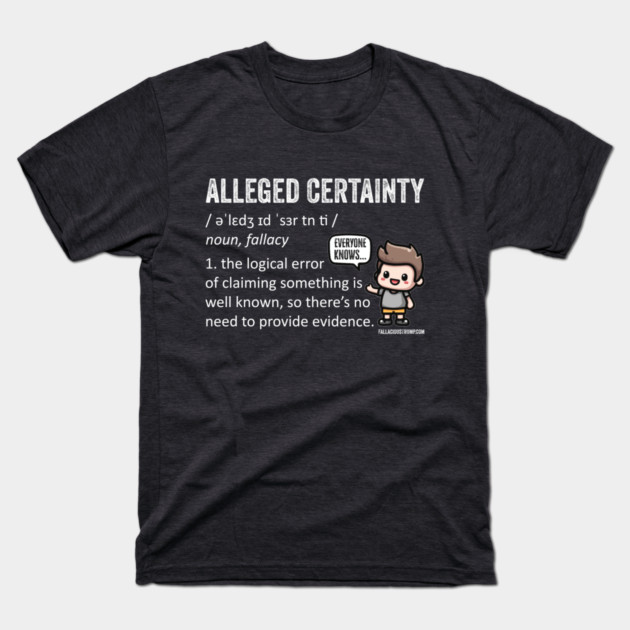
The Alleged Certainty Fallacy is committed when someone makes a claim and then alleges that everyone knows it’s true, thereby avoiding the need to offer any evidence.
Trump
We started out with Trump being unable to name a crime that Obama committed, so claiming that it’s obvious to everyone:
And then, in honour of our 50th episode, we provided 50 more examples of things Trump says everyone knows:
Mark’s British Politics Corner
Mark talked about the government’s inability to explain the new rules around the UK’s lockdown. If you really want to see Boris fumble around, you can watch it below, but comedian Matt Lucas summarised it brilliantly in this clip:
— realmattlucas (@RealMattLucas) May 10, 2020
Fallacy in the Wild (Sting: Everybody Knows – Leonard Cohen)
We looked at this clip from Bee Movie:
And we followed that up with this one from Singing in the Rain:
And finally, a clip from Muppets Most Wanted:
Fake News
Here are the statements from this week’s Fake News game:
- Many of these people aren’t very sick but they still go down as a case so actually the number of cases… and we’re also a much bigger country than most. So when we have a lot of cases I don’t look at that as a bad thing, I look at that as — in a certain respect as being a good thing because it means our testing is much better. So if we were testing a million people instead of 14 million people we would have far few cases, right? So I view it as a badge of honor. Really it’s a badge of honor.
- When you think about it it makes sense that we have the most cases. We’re a big country, really a big — one of the biggest in terms of people, and size. Some other countries — you know South Korea is a lot smaller than us, but they’re still — Seoul is huge. 38 million people in Seoul. I didn’t know that. Did you know that? When you have that many people all in one… you can get to them very easily to test. We have some very large areas of country which makes it a lot harder and still we’ve done a phenomenal job.
- I’m probably going to show you charts of some of the countries that are really having trouble and one in particular is having a massive problem where they said “let’s go, we’re just going to keep going” well they’re — the lines that we’re famous for now some are flat and some are up — this is like a rocket ship. This country is — and they didn’t, they decided “let’s go and let’s wing it” that’s, you know, they thought it was okay but it’s… It’s a problem. It’s a big problem and there’s another couple — there’s one in particular that everybody thinks did it, but the people are staying in.
Click below for the answer
Spoiler
Statement 2 is Fake News. Mark chose number 2.Mark got it right AGAIN this week, so now he’s on 23/50, or 46%.
Sponsor!
This week’s sponsor was The Super Politics Show, a progressive politics podcast that we think you’ll enjoy! Search for them on your podcast app or go you their website.

Logically Fallacious is not a logical fallacy

Jim’s guest this week was Dr Bo Bennett, creator of the fantastic website Logically Fallacious, and author of the new book The Rules of Reason: Making and Evaluating Claims, which will make you better at critical thinking even if you think you’re already amazing at it. You can find out more about Bo and his many books at his website and you can pick up a copy of the new book here.

The stories we really didn’t have time to talk about
- Trump has touted the huge numbers of people tested in the US so much that the more cynical among you could be forgiven for wondering whether he even knows what per capita means. Well, wonder no more: “When you say per capita, there’s many per capitas. It’s like per capita relative to what? But you can look at just about any category and we’re really at the top – meaning positive, on a per capita basis.” This is so fundamental right now that my first reaction was “No. That’s not how this works. That’s not how any of this works”. But then I actually started to doubt myself. Are there multiple types of per capita? Like with different types of average? Am I the one being stupid? But no, I checked. And you’ll be relieved to know that the leader of the free world, 5 months into a global pandemic, doesn’t have the slightest idea, or interest, what per capita means. Holy fuck. And by the way, 20th in the world is not ‘at the top’, just in case that wasn’t clear either.
- Not happy with just talking up chloroquine Doogie Trump M.D. now claims to be taking the stuff, as a preventative against catching Covid-19, which does seem a bit like taking arsenic to prevent sleep problems. Apparently he says “he’s okay so far” which we all know has never been true. Trump says he asked the White House physician about it and he said “well if you’d like it”, that’s like calling Keith Richard’s dealer the band’s physician. Said White House physician Sean P. Conley wrote in a subsequent statement, “we concluded the potential benefit from treatment outweighed the relative risks” which you’ll note did not explicitly confirm that Trump is taking the drug. Where’s the evidence for those benefits? ever the home shopping channel presenter “Are you ready? Here’s my evidence—I get a lot of positive calls about it,” No you don’t, well, if any, then maybe from malaria sufferers and, oh, the manufacturer. Trump does have investments in a mutual that has holdings in pharma company Sanofi who make Plaquenil aka chloroquine, but I think he just fancied endorsing something, Shame it’s not that bleach he’s injecting hey – Clorox shareholders must be pissed! And as a bonus it’s obviously working cos apparently he was tested again on the morning of May 21st “And I tested very positively in another sense. So this morning. I tested positively toward negative, right? So no, I tested perfectly this morning. Meaning I tested negative. But that’s a way of saying it. Positively toward the negative.” – So not clear what test he’s talking about then – IQ?
- Republican Senator Richard Burr stepped down as chairman of the Senate Intelligence Committee following news that he is under investigation by the FBI for insider trading after he dumped a million dollars worth of stocks following a coronavirus briefing and while the government was telling everyone there was nothing to worry about. Good news, you might think – and evidence that the DOJ isn’t in Trump’s pocket if they’re willing to go after high-ranking Republicans. Well…while Burr is almost certainly a piece of shit, profiteering while Americans die, he’s not the only one, and yet there’s no news yet of an FBI investigation of Senator Kelly Loeffler who, as you’ll remember from episode 47, dumped more than $18 million of stocks under similar circumstances. Why the difference? Surely it can’t have anything to do with the fact that Burr was in the final stages of putting together a report on Russian interference in the 2016 election, or that Burr subpoenaed Don Jr to testify to his committee, or that he agreed that Russia was trying to help Trump when they interfered. Nah. It’s more likely because Senator Loeffler’s husband donated a million dollars to the leading pro-Trump SuperPAC a few weeks ago. That’s alright, then.
- Our favourite bat-shit fun-factory – QAnon – and the theories it espouses have been declared a domestic terrorist threat no less by the FBI, and yet it is a go to place for ‘the information’ for insurance agent Jo Rae Perkins who beat 3 others to become the Republican nominee to represent Oregon in November’s election. She had tweeted “I stand with President Trump. I stand with Q and the team. Thank you Anons, and thank you patriots. And together, we can save our republic,” in a video posted on Tuesday, while holding up a sign with a popular QAnon slogan on it. Oddly, given who’s the current troller-in-chief, Republicans seem to be a little bit troubled over having a candidate who openly embraces baseless conspiracy theories. When asked why the Republican Party had nominated such a dodgy nut job – *cough not for the first time in their history cough* – The Oregon state Republican Party issued a lukewarm and seemingly reluctant statement saying, “By virtue of being the GOP nominee, this is what we do – support them in winning the general election.” Which is also a bit of allsorts-of-circular-fallacies-going-on-in-there too. Thankfully Jeff Merkley, the incumbent, is considered a strong favorite in the Senate race. The state has gone blue for every presidential election since 1984 and hasn’t elected a Republican governor since the 1980s. Which of course is part of the whole conspiracy goddammit you fools can’t you see?
- As everyone knows, the less you test, the less cases of coronavirus you have. But that’s not the only way to minimise coronavirus within your state. While justifying their aggressive re-opening measures, Georgia Governor Brian Kemp released a chart showing how the state had effectively beaten the virus, and if you look at the chart, it’s true. For example, Fulton County alone saw a dramatic and progressive decrease in new cases over four consecutive days. Unfortunately, those consecutive days were May 7th, April 26th, May 3rd and May 8th. It turns out that if you don’t restrict yourself to the mainstream understanding of time, you can show a decreasing curve on any graph. In the competition for stupidest/most evil Republican Governor, Kemp’s perpetual rival is Florida’s Ron De Santis. Less than a month after trying to get Florda’s medical examiners to stop publicly releasing data on coronavirus deaths, De Santis’s administration fired the Florida Department of Health’s data manager after she refused to manually change data to drum up support for the plan to reopen. Dr Rebekah Jones, who previously managed the online dashboard that gave Florida’s residents detailed data on testing, cases and deaths in all of Florida’s counties, emailed her subscribers to say “As a word of caution, I would not expect the new team to continue the same level of accessibility and transparency that I made central to the process during the first two months. After all, my commitment to both is largely (arguably entirely) the reason I am no longer managing it,”
- According to a study by Columbia University 54,000 fewer people would have died by the beginning of May if lockdown had been imposed on March 1st, and 34,000 fewer if it had been imposed just a week later. And that’s the same number as ALL of the deaths, so far, in the UK – which has the worst Covid-19 death rate in Europe – the whole of Europe. We are sickened enough that the lackadaisical, ah whatever, we’re better nay pluckier than the rest of the governments in Europe attitude of OUR leader could have meant more deaths than necessary, but Trump’s “I don’t give a shit about anyone but me baby” attitude needlessly cost the same number of lives as ALL of ours lost. And actually 54,000 is nearly the same as the 58,300 names of members of the U.S. armed forces who were killed or went missing in action in the Vietnam war! That’s why your tie is so red and long Donald you need a lot of red cloth to wipe those bloodied hands clean without us seeing!
- There’s an old myth that once a shark or a lion or something gets a taste for human flesh then it becomes an unstoppable maneater, because we’re just so delicious or something. Well, it seems it’s the same with Trump and Inspectors General. Way back on April 3rd, which seems like about 12 years ago, Trump fired Michael Atkinson, the IG who had the temerity to let the House Intelligence Committee know about the whistleblower. Since then, he just can’t stop himself! Next was Glenn Fine, who job used to include monitoring how the government spent the $2 trillion coronavirus relief bill. Then it was Christi Grimm, who was fired after she reported on the shortages of medical supplies and coronavirus tests. Last week, Trump fired State Department IG Steve Linick, on the advice of Mike Pompeo, and it wasn’t long before we found out that Linick was investigating Pompeo for sidestepping Congress to arrange an arms deal with Saudi Arabia. Finally, for now at least, Trump fired Department of Transportation IG Mitch Behm, who was investigating Transport Secretary Elaine Chao, who just happens to be married to Mitch McConnell. That’s five in less than two months. Asked about it recently, Trump said “I think every president has gotten rid of probably more than I have.” So, lets see, the number of Inspectors General fired between 2000 and 2020 was… one.
- Britpol news – In Wednesday’s Prime Minister’s Questions, whilst still coming from the empty haunted castle of the House of Commons had got a few noisy screamers in to lend noise if not weight to Boris’ answers, Keir Starmer pointed out that Boris’ government had a policy to charge immigrants extra for using the NHS, which is paid for through a compulsory National Insurance payment deducted from their wages along with income tax anyway. This of course includes the very foreign-born NHS staff that saved Boris’ pox-ridden, lily-livered, oxygen-starved, flabby and sorry hide only last month. BoJo told the House of Commons that imposing the immigration health surcharge on foreign-born NHS workers was “the right way forward”, but apparently only right for one more day cos 24 hours later he scrapped it as ‘the right thing to do.’ You see that’s the advantage of having no moral compass other than ‘be popular” you just go where the wind blows to stay in power. Fortunately the opposition has a leader who knows how to trim the right sails to make sure Boris capsizes!
If you wanted to buy a T-shirt featuring this fallacy, you could click here. No pressure
And if you have some money left over after that, Jim’s book, 2000 Mules and One Big Lie: A Stubborn Conspiracy Theory is available now.
That’s almost all for this week, but here’s our AI-aided transcript, which is quite accurate, but not totally:
Alleged Certainty – FT#50 Transcript
Read the full transcript
00:24 Jim: Hello and welcome to episode number 50 of Fallacious Trump, the podcast, where we use the insane ramblings of the fool on the hill to explain logical fallacies. I'm your host, Jim.
00:33 Mark: And I'm your other host, Mark. A logical fallacy is an error in reasoning that results in bad or invalid arguments, and the logical fallacy we're looking at this 100th week is the alleged certainty.
00:46 Jim: So alleged certainty is basically when you don't back up a claim because you don't need to, because it's so obviously right and and instead you just say, well, everyone knows that that's true. So, yeah, oh, okay,
01:01 Mark: right, so it's not. It's not an alleged certainty, it's not, or allegedly you're certain. No, it's, it's no.
01:07 Jim: You allege that it is so certain you don't even need to provide evidence for it.
01:11 Mark: Yeah, yeah, right, it's kind of self -evidently true or no, not even that. It's everybody. Everybody knows this already. I haven't got to provide any proof.
01:22 Jim: What you're claiming is that this is a universally accepted truth. Basically right, it's not. It's not something that anyone questions, so it's Fine. And and it's it's often used, certainly by Trump, in the face of people questioning it, right? So our first example from Trump is when a reporter asked him: when he says obamagate, what crime is he actually alleging?
01:44 Clip: Trump unable to name a crime Obama committed
— What crime exactly are you accusing president obama of committing, and do you believe the justice department should prosecute him?
— The President, I know it's been going on for a long time. It's been going on from before I even got elected. And it's a disgrace that it happened.
02:00 Clip: Trump unable to name a crime Obama committed
— And if you look at what's gone on and if you look at now, all of this information that's being released, and from what I understand, that's only the beginning. Some terrible things happened, and it should never be allowed to happen in our country again. And you'll be seeing what's going on over the next, over the coming weeks. But I and I wish you'd write honestly about it, but unfortunately you choose not to do so.
02:20 Clip: Trump unable to name a crime Obama committed
— So, yeah, John, please.
— What is the crime exactly that you're accusing him of?
— You know what the crime is. The crime is very obvious to everybody. Okay.
02:28 Jim: Yeah, so the crime is ramble, ramble, ramble for 20 seconds or so, and then when you're asked again, okay, so what is it again? Well, everybody knows what it is. It's obvious. Everybody knows what it is.
02:42 Mark: You know what it is, but you won't report it, partly because we don't know what it is. I don't need to actually
02:49 Jim: say a thing because, yeah, it's.
02:52 [Unclear]: You know, I just need to,
02:53 Jim: wasting everyone's time if I did that,
02:55 Mark: yeah, and because, frankly, you're not going to report that anyway, so why do I even bother saying it? Well, you need to bother to say it so that we can report it, because you know that's what we do. We report the things you say and the explanations that you give, the positions that you hold vis -a -vis obamagate, which was happening before he was even elected. What during obama's – yeah, presidency, obamagate was happening?
03:24 Jim: Yeah, I mean the, the allegations that have been coming out, which are obviously, you know, it's all linked to the doj's decision to to drop the charges against Michael Flynn after he pled guilty twice in federal court, and people are kind of going:
03:43 Mark: wait a minute, he's pled guilty twice and yet you're dropping the charges and he's going: oh, yeah, obama, what? Yeah, that's kind of here's this thing that is very dodgy. Oh, yeah, look, I'm just going to distract you by holding up this thing over here. Okay, look, obamagate, yeah,
04:02 Jim: so the claim there's – There's lots of claims around unmasking at the moment and saying that that proves the Obama administration were targeting Mike Flynn in an attempt to make him lie to the FBI somehow. Somehow, and um, right, and, and the thing about unmasking – and this is why I have had a lot of difficulty figuring out what on earth they're talking about here – is that unmasking is what happens when an agency like the Nsa listens in on a conversation between someone they are authorized to listen to – in this case, the Russian ambassador – and an unknown American, or at least an American that in the report is not named. Yeah, um, yeah, and and so they aren't spying on the American, they're spying on the Russian. And it happens that the American talked to the Russian, but in their report they say: this was the Russian and the and he spoke to an American. The people with security clearance then get to say: if they think it's warranted, who was that? American? Right, and that is how someone gets unmasked. By definition. You can't be targeting a person by asking to have their name unmasked because, no, you don't know who.
05:19 Mark: They are unmasked, so you can't be targeting them, because being targeting somebody is the is kind of uh, you, You have to be taking precise aim at the thing that you know you're firing at.
05:36 Jim: And in this case it's weird because Richard Grenell, the director of National intelligence, released this document of like 20 or so unmaskings. That happened around the time of this alleged phone call, or recorded phone call.
05:54 Jim: It's not alleged at all. Which is weird. Which is weird, because none of them were the phone call. And the reason we know none of them are phone call is that the NSA didn't listen in on that one. That was the FBI, because they were the ones surveilling Kislyak, the Russian ambassador. And in their report, because they're not the NSA, Flynn's name wasn't masked anyway. It was just Michael Flynn spoke to Sergei Kislyak. And we know that because we were listening on Kislyak's calls. So there was no unmasking to be done.
06:24 Mark: And they went, hey, Michael, how are you in an Irish accent? What? I suddenly, yeah, my Russian left me there.
06:33 Jim: And the transcripts of those calls are how we know that Flynn was talking to the Russians about trying to soften them up and ask them not to respond to the sanctions that Obama put in place, which isn't allowed. Out. You can't do that, because what they were doing was essentially tipping the hat and saying: if you help us to get Trump elected, then we will not. We will stop those sanctions, we'll take them away. Yeah, and that's. And even if that wasn't what he meant, the implication of that is why you're not allowed to do that kind of negotiation. And because the russians were listening in on those calls as well. They know that when Flynn told the Fbi and pence and Trump that he hadn't discussed sanctions with the russians, they knew that he'd lied and therefore the russians had some leverage over mike Flynn. So that's not a good thing and that's why he needed to be fired and prosecuted. And here we are now. So here we are,
07:38 Mark: and the whole unmasking thing makes me think of the, the end of Scooby -Doo, where they pull the rubber gould mask off. The guy who said: if it wasn't for those meddling kids, I would have got away with it.
07:52 Jim: Yeah, and I don't ever remember anyone accusing the Scooby gang of targeting the old man who ran the water slide.
08:00 Mark: No, absolutely, because they didn't know it was him. They always went, oh, it's the old man who ran the water slide. We had no idea. They were very clear on that until that moment. Even Scooby went. Oh, like that, you know, with surprise. He didn't just go, yeah, he didn't just, he didn't just go. Oh, yeah, and it was him all along. In fact, we, you know, we've kind of been stalking him in in a knowing way, not why, you know.
08:29 Jim: You notice that fred always kind of explained how he'd figure it out after they'd unmasked the guy, as if he knew before. But, yeah, yeah, I was always always suspicious of fred.
08:39 Mark: Well, exactly, and kind of film, film, were always kind of looked over our glasses and go, oh yeah, you say that now. Yeah, yeah, dope, they only hung around with him because he had the van – yeah, that's, you know, sweet band and uh,
08:52 Clip: 50 things Trump says everyone knows
— it was so, yeah, yeah.
08:54 Jim: Since this is the 50th episode – oh, yeah, he's Trump – and we felt the need to do some celebrating. This is a particular prevalent fallacy that Trump does, and so I'm surprised we did it.
09:06 Mark: We took us this long to get there. It was yeah.
09:08 Jim: Well, in in honor of that and the 50th episode, I have created a compilation of, yeah, 50 things that, oh, everybody knows according to Trump.
09:19 Clip: 50 things Trump says everyone knows
— Everybody knows they are manipulating their currencies. Everybody knows what a mess our country is in. You're paying too Too much tax, folks. Everybody knows it. We didn't have one illegal immigrant on the job. Everybody knows it. Everybody knows she's guilty. I never went bankrupt, by the way. You know, everybody knows.
09:37 Clip: 50 things Trump says everyone knows
— We have illegal immigrants that in many cases are treated better than our great veterans. And you know that and everybody knows that. Everybody knows it's a horrible deal.
— Everyone knows all I talk about is cars. Our country has gone so far behind. Everybody knows it.
— 15,000 people showed up to hear me speak, bigger than anybody, and everybody knows it. Everybody knows that on Super Tuesday, Trump was the winner.
10:00 Clip: 50 things Trump says everyone knows
— Some of the voting is rigged. Okay, everybody knows. We have a real unemployment rate of 15 or 16 percent. You know that, I know that, everybody knows that. I'll be the greatest jobs president that God ever created. I will. But everybody knows that, especially God. Obamacare is dead. I've been saying it for a long time. Everybody knows it. Hillary Clinton lacks the judgment, temperament, and moral character to lead this country. She does. You know it. Everybody knows it. Everybody knows that walls work. They make a left where you don't have the wall. It's so simple. Everybody knows it.
— People were there protesting the taking down of the monument of Robert E.
10:48 Clip: 50 things Trump says everyone knows
— Lee. Everybody knows that.
— Everybody knows that China's been ripping off the United States. When I took over as president, I will tell you it looked like it was going to be war with North Korea. it. You know that. Everybody knows that.
— Nancy Pelosi has been hijacked by the radical left and everybody knows it. Lion Ted Cruz. Everyone knows he's a liar.
— Chuck Schumer. Everyone in New York knows he's a total phony.
11:10 Clip: 50 things Trump says everyone knows
— Gerald Nadler. I've known him a long time. He's a sleazebag. Everybody knows that. The FBI has been in turmoil. You know that. I know that. Everybody knows that. As everyone knows, we just won seven and a half billion dollars. As everyone knows, I have done a lot for Israel. I won't use a certain word because it's not politically, but everybody knows the word I'd love to use.
11:33 Clip: 50 things Trump says everyone knows
— Ninth Circuit, everybody knows it. It's totally out of control. I have nothing to do with Russia. Everybody knows it. Everyone knows we did nothing wrong. There was no obstruction. Everybody knows it. Everybody knows there was no collusion. Everybody knows the Russian witch hunt was a faux, phony fraud. The dossier now, everybody knows it was fake. All they do is the impeachment nonsense,
11:56 Clip: 50 things Trump says everyone knows
— and everyone knows it's nonsense. We had a perfect phone call with the president of Ukraine. Everybody knows it. Everybody knows who the whistleblower is. Everybody knows that Schiff, we call him Shifty Schiff, he made up the story. As everybody knows, we've been treated very unfairly, very different from anybody else. Everybody knows that Joe Biden does not have what it takes. I am totally opposed to domestic violence of any kind. Everyone knows that. I was spying on my campaign, and it went right up to the top, and everybody knows it. We've done more than any other president in the first three years. You know that. Everybody knows that. If Sleepy Joe was president, he wouldn't even know what's going on. You know that. I mean, everybody knows that. Everyone knows he came out of China.
— I do have an absolute right to pardon myself,
12:41 Clip: 50 things Trump says everyone knows
— but I'll never have to do it because I didn't do anything wrong and everybody knows it.
— So there we go.
12:48 Mark: It is. Everybody knows everything. All of those things. All of his pet hates, he knows that everybody knows. So he hasn't got to provide any proof at all. It's a bit like the latest thing in Michigan with the mail-in votes. Yeah, the voter fraud.
13:07 Jim: Everybody knows that voter fraud is a fraud.
13:08 Mark: Everybody knows the voter fraud. Everybody knows because even though everybody also knows, weirdly, that the FBI investigated that and there was no voter fraud, all that stuff, everybody knows. Comes back to infallible ignorance. It's not Trump saying: I am believing this in the face of all the evidence that you can present to me. But it's not me, it's everybody. Everybody knows this is true and will maintain the fact that Obama is from Kenya, even after it's been proved that he isn't. He will just go. Well, it isn't me, it's not me. You need to convince. It's everybody, everybody, Everybody else. Everybody knows this.
13:51 Jim: Yeah, it is a way of saying if you disagree, you're in the minority. And not only that, basically, you know, everyone disagrees with you. You're just being stupid if you don't go along.
14:01 Jim: It's a kind of argument from numbers and proof by assertion. And yeah, it's a number of fallacies all rolled into one.
14:09 Mark: All rolled into one. 50 of them. That's all rolled into one.
14:14 [Sting: Mark's British Politics Corner] And now is the time, I think, for Mark's British Politics Corner.
14:19 Mark: Okay, so this is a bit of an involved one, and we've only got one example, but there's lots of clips to listen to. There's been a recent change in the status of the sloganeering around COVID -19 in the UK and my thesis is that Boris isn't able to explain what the new sloganeering actually means and yet he maintains it's the right thing to do and that everybody knows that that. So therefore he doesn't have to explain it, and I think it's because he can't. He doesn't get it. You know, he, he more than at any time it's become very clear that he's the puppet of his comms team who just say: who are just going: okay, you just need to spin it slightly differently now, um, and he. They just wheel him out and get you. Just say this: people like you – you were on the, the telly once – they think you're funny. You've got odd hair and a weird way of clenching your fists when you're pointing. He's the only man I know who points with a clenched fist, with the knuckles of his first. You know, we thought it was odd that Trump points with tiny hands, but Boris clenches his fist and then points with the with the pointy bit of your fist. There are no pointy bits on your fs. Who are you pointing at, Trump? Trump doesn't.
15:39 Jim: Trump doesn't point so much as play the invisible accordion all the time when he's talking.
15:42 Clip: The UK government explaining the new lockdown rules
— Yeah, that's true.
15:43 Mark: Yeah, so anyway, two weeks ago everything was clear, even all the way up to Saturday, May the 9th. The welcome fall we've seen deaths is not only achievement of the doctors and nurses and care workers,
15:54 Clip: The UK government explaining the new lockdown rules
— but everyone in the country for following the stay at home guidance. To reiterate, nothing I'm saying today changes these basic rules.
16:03 Mark: So So that's Grant Shapps there on May the 9th. And the three basic rules are stay at home, protect the NHS, National Health Service, save lives. Fairly clear. On Sunday, in a 15-minute address to the nation, Boris changed it to stay alert, control the virus, save lives. And you can watch the whole thing. We've put the link in the show notes. But here's Matt Lucas, the TV comedian and actor, summing up basically what Boris said.
16:33 Clip: The UK government explaining the new lockdown rules
— So we are saying don't go to work, go to work, don't take public transport, go to work, don't go to work, stay indoors. If you can work from home, go to work, don't go to work, go outside, don't go outside. And then we will or won't do something or other.
16:52 Mark: Which is a pretty accurate summary of what went on. So on May 11th, following day at the press briefing, he was asked, well, what does this mean?
17:04 Clip: Boris Johnson asked about his speech
— A lot of people felt your speech last night raised as many questions as it gave answers. There are, Prime Minister, different instructions for people in different parts of the UK. You can see your colleagues if you go to work, but grandparents can't look after their children. Many employers say they're just not ready to have people back to work yet. So what do you say to millions of people watching right now who May well be a bit perplexed by what you're actually trying to say and what they are meant to do?
— The answer is that, and I totally get where you're coming from. Yes, of course, the message that we were giving out initially was incredibly clear and incredibly stark. And the UK population actually obeyed it more thoroughly, perhaps, than many other populations around the world. We really did stay at home. And for those who you know who think that, Laura, that the stay alert is not the right message, I think it is absolutely the right message for our country now. Now, I'm interested that just today in in France, they've they've gone for a slogan. Sauver des vies, rester prudent, which is, as I'm sure everybody knows, is roughly the same, the same sort of thing as our message. I think it's the right way to go.
18:32 Mark: There we are. Clearly clarifying succinctly and lucidly exactly what the message is. He kind of, apart from fumbling around for any kind of an idea at all, he doesn't actually answer her question. What is it that it means? What have people got to do? He says, we obeyed the last thing because it was very stark and very clear what the message was last time. So by inference, this is neither stark nor clear. And then, instead of saying what it means, he says: I think it's important that we use it now, so much so that he then says it in french: yeah, which, as not quite everybody knows either, not quite – he doesn't actually translate the french,
19:21 Jim: and there's no need to translate french, because everyone's, because everybody knows everyone,
19:25 Mark: and not only does everybody know what it is, but they know that this is the right time to use that slogan. Yeah, it's, it's just nuts, but what he doesn't do? So he's simply Making the assertion that everybody knows this, so he doesn't have to explain it. I think it's because he has no idea how to make the link between the last set of behaviors: stay at home, save lives, protect the lhs and stay alert. I mean there's just staying alert
19:59 Jim: won't help you. That's the problem.
20:02 Mark: You've got to say: stay alert to what exactly? Stay alert about what you know. It's not.
20:08 Jim: You know it's not because someone's coming to get you with a knife. It's like you know. Be ready like clouseau. Yeah, it's, yeah.
20:16 Mark: Yeah, you're walking through the apartment waiting for kato to leap out the fridge. Coronavirus leaps at you from the fridge where it's been sat all day, tries to chop you in half and smashes you through most of the furniture? Yeah, but you're alert for that, you're ready. Ready for that. You'd be constantly gritting your teeth, you'd have jaw ache from that alertness, and you're out with tape, holding your eyes open, alert for an what? For an invisible thing. That's, my minuscule, can't see it anyway. You can't tell whether anyone's got it, because you could have it with having no symptoms. Yeah, so what is it you're supposed to be alert to and then and then rule to control the virus?
21:07 Jim: As for controlling the virus, yeah, so make a vaccine,
21:11 Mark: uh, yeah, I don't know. Make a tiny little series of channels so that it all. It just goes down there like guttering. So you're just controlling the flow of the virus away from you. It's bizarre.
21:27 Jim: It's rebranding for the sake of it, isn't it? It's like when a big company just thinks: you know, we've had this, this slogan and this brand for a long time. Yes, we're really well recognized and everyone knows it and we already make billions of dollars a year. But let's just mix it up a bit, just change it.
21:44 Mark: We know that it's because he's getting there's pressure from within in the Tory party to get people back to work, because otherwise we're just socialists. We're paying everybody's wages and if you listen to the don't, don't do it for God's sake, for your sanity. Well, the thing is,
22:00 Jim: if you know what the rules were before – and you do listen to it, because the rules changed very, very dramatically – from work at home if you can, if you can't, you're allowed to go to work. That was the rule beforehand, beforehand, and Boris changed that to: if you can't work from home, you can go to work. But if you can stay at home, then stay at home, yeah.
22:27 [Unclear]: So go to work,
22:29 Mark: don't go to work. What which? Go outside, don't go outside.
22:32 Jim: All that changed at like eight o 'clock on a Sunday night was saying: yeah, we're expecting some workplaces to open up in the morning, so yeah, but don't go to work if you can, but not all. All workplaces, yeah.
22:46 Mark: It was a positioning of the problem to the other end of their arm. So it was moving them arm's length so that they're not responsible for dealing with the problem. That's what it was. It was a kind of a shifting of the notion that we will look after you. We're going to make this at home. Home. We're going to fund the Nhs so that they're not underfunded. We're going to pay you so you can stay at home, all that kind of stuff. We are basically going to be a big government and look after stuff and they're moving away from that because it's getting expensive.
23:25 Jim: But at the same time, this was like the day after they announced that they were extending the furlough scheme for four more months. Yeah, yeah, so yeah, while also telling people to stay at home: stay at home, but stay alert, and if you have to leave home, then stay alert.
23:43 Mark: Nonsense. And the irony is that the the question. That question was asked by laura kunzberg at the bbc. She also asked whether the scientists had any um input into this change of message. And – And Chris Whitty, who? You look at them these days, they look even more unhappy. And they're beginning to realize that they're swimming with sharks. They're kind of going along with these people. And any minute now, they're going to get scapegoated and eaten. If that's if sharks eat goats, they kind of they're just going to get thrown under the bus. They're going to go, well, we followed the science. But to use the oft-repeated phrase when people say, yeah, Dominic Cummings, he's actually running the country, isn't he? Your advisor, he's running the country. You do what he tells you to do. And he says, ah, no, advisors advise, politicians decide. So I think the scientists should say, scientists advise, politicians decide. Hide so that the scientists don't get, you know, get the rap for this, because they don't. And in fact, the irony is, patrick valence, the chief scientific scientific advisor, explained perfectly the link between stay alert and and the previous stuff. And it is obviously true that we must all be alert during this in terms of hand washing,
25:18 Clip: The UK government explaining the new lockdown rules
— in terms of social distancing, in terms of understanding what role we play, because if we allow this to get out of control, if we allow the transmission
25:27 Mark: to increase between households, then we go back to where we were: perfect, that's it. That's all he needed to have said when somebody said: what was what's? What does this mean? So well, you need to stay alert in terms of – and he – and there's patrick – even saying: everybody knows, it's perfectly obvious, which is a kind of like a nice little dig at Boris, you idiot, you can't even see the the obvious thing that's put in front of you, that we've got to stay alert in terms of all of the behaviors that we put in place when we had the old rules. So it's just God damn. And actually chris witty says we, although we were the scientists, we're not the comms experts. So he was washing his hands of this change of messaging. But, ironically, the best bit of comms came from the scientists, who were utterly clear, and they're just like the grown -ups in the room. They just go with this. There's this umming and ahhing fool who doesn't know what to say, what it means, why he's saying it, what, what the implications are or any of that, or how to sell it to enter the listening public. You're all going, okay, we're, we're waiting for you. Here you are doing a broadcast. You've told us nothing other than,
26:43 Jim: yeah, just just imagine Americans, how we feel to have a total bumbling idiot in charge, and then scientists coming along with weird and explaining everything.
26:53 Mark: Yeah, can you imagine how that must be?
26:56 Jim: You don't want to be us,
26:58 Mark: so no, and so, also in the spirit of our 50th show, I wanted to count how many times Boris under nerd in total in providing a response – I hesitate to use the word answer to that question. And yes, here they are. There are indeed 32, so, and here they all are.
27:18 [Unclear]: Um,
27:36 Mark: I don't know which is worse: either having Boris not knowing what to say or have Trump fill up the air with saying things that mean no more than uh, uh, that's. You know. If Trump did that, that would be a blessed relief,
27:53 Jim: wouldn't, yeah, yeah, it would – leonard
27:56 [Sting: Fallacy in the Wild (Everybody Knows – Leonard Cohen)]
28:44 Mark: cohen there with everybody knows which, which was covered for the the marvel film justice league by sigrid I, I I learned today.
28:55 Mark: Yeah, there you go.
28:56 Jim: I tried to. I don't know if I've tried to blank out Justice League or it's just it was so forgettable that I can't remember any of it. It's hard to tell.
29:04 Mark: Well, I had to watch the official video to go, oh, well, I'm intrigued by that. And then you're going, oh, well, that's, what's his name being, who's it? And the other bloke.
29:16 Jim: So in the Fallacy in the Wild, we like to talk about the fallacy of the week from a non-political perspective. And this week our first example is from the jerry seinfeld film B movie in which, uh, he plays a B and this is right at the very, very beginning of the film. Two bees driving along in a car as they do. Hey, did you hear about frankie?
29:36 Clip: Bee Movie
— Yeah, you're going to his funeral.
— No, I'm not going to his funeral. Everybody knows you stink someone, you die. You don't waste it on a squirrel. He's such a hot
— everybody knows. So,
29:51 Mark: yeah, I've actually seen the B movie.
29:52 [Unclear]: That's yeah, it's got moment.
29:55 Jim: It's weird, it's super fucking weird.
29:57 Mark: Actually, did you see the sausage party? That is completely bloody bonkers as well.
30:01 Jim: The thing is, B movie is for children. Sausage party is very much a grown -ups film, but B movie is yeah, yeah, and and it revolves in a way around a human woman having a relationship with a B, which is okay, pretty fucking weird.
30:16 [Unclear]: Yeah, well, there's a.
30:18 Mark: There's a song in, uh, an early monty python record called eric the half a bee. Yeah, somebody had a relationship with him and he loved him carnally, to rhyme with eric the half a bee.
30:29 Jim: So, yeah, everyone knows that when bees sting you, they die. That's just a given. So that bee who stung a squirrel deserved to die.
30:39 [Unclear]: But that isn't necessarily true,
30:41 Jim: because, first of all, only honeybees die when they sting you. Other other types of bee, like bumblebees and things like that are all the other species of bee – are able to sting you and and then remove the sting, get away with it. Yeah, absolutely, um, and in fact, because basically the the stinger is designed to to attack other animals and other insects, and it's only mammals that have skin that is kind of fibrous enough to grab onto the barbs on the stinger and essentially rip the abdomen apart when the bee pulls out. Also, and more importantly for this, because these are honeybees, so that would be fair. But male bees can't sting you. Male bees don't have stingers, and this they are talking specifically about a male bee here, um, because, because the stinger is is actually an adapted ovipositor. So only female bees can sting. There you go. So everybody knows that, but it's not everyone knows that. So our next example is from Singing in the Rain, the 1952 Stanley Donen film. In case you haven't seen Singing in the Rain, first of all, fucking sort yourself out. What are you doing?
31:53 [Unclear]: What have you been doing all your life?
31:56 Jim: But it's the story of Hollywood in the 20s and when talkies were coming in and there's two kind of studio stars in the film, Lena and Don, and they are romantic leads in many films and they are kind of set up by the studio as a couple. And this happened in real hollywood. Uh, all the time. But don is not in love with lena. He falls for a new character, kathy, who is is much nicer than we like.
32:25 Clip: Singin' in the Rain
— Are you kissing him?
— I was kissing her. I happen to be in love with her.
— That's ridiculous. Everybody knows.
32:35 Jim: Yeah, again, as lena says, everybody knows that don is in love with her and that is technically what everybody knows, because that's what the studio tells people. But it isn't yeah, yeah, and that reminded me of.
32:47 Mark: So my other uh candidate for the the sting this week was: everybody knows I love you by the divine comedy and that. And then was it? Everybody knows I love you except you. Yeah, that's the. Yeah, that's the payoff, but that's yeah, but we covered it in Singing in the Rain so I didn't need to, so it's Fine, yeah,
33:05 Jim: so, yeah, lena can't just assert that. Everyone knows that he loves her. So that must, must be true. The? It's not true.
33:11 Mark: Yes, it's, especially in the face of the evidence to the contrary from the man himself.
33:16 Jim: Yeah, yeah, classic, classic film, brilliant. A much more recent musical is uh, muppets most wanted, which begins with a song that includes these lyrics:
33:29 Bo: that's what we do in hollywood and everybody knows that the sequel's never quite as good.
33:36 Mark: Then they just exit out of shot. They realize what they've said.
33:44 [Unclear]: So my immediate thought was,
33:47 Mark: yeah, godfather 2, yeah, I mean, it's kind of mostly true,
33:50 Jim: but it's not always true. But, um, but it is, I mean it's usually true. I mean I've seen ride along too and oh, wow, that's a piece of shit.
33:59 Mark: So, yeah, Jesus christ,
34:01 Jim: I mean the first one wasn't great,
34:03 Mark: but oh no, that's what I meant. You actually went to see it again. I'm thinking of toxic avengers six, you know that kind of stuff,
34:12 Jim: yeah, but you know, it's not, it's not universal truth. There's. There's some films, arguably, where the sequels are better. Struggling to bring any to mind.
34:22 Mark: Godfather part two, but, but only on the virtue of the fact that that won an oscar for best picture and godfather rather didn't.
34:30 [Sting: Fake News] So we're gonna, we're gonna play fake news. Folks, I love the game. It's a great game. I understand the game as well as anybody, as well as anybody.
34:38 Jim: Yes, it's time for fake news. The game where I read out three Trump quotes, two of which are real and one I made up, and Mark has to figure out which one is fake news.
34:45 Mark: The score is what we can't, it's.
34:47 Jim: We're at 21 out of 49 at the moment, so you have the the possibility of getting up to 44 percent with this.
34:53 [Unclear]: Yeah, with the question.
34:54 Mark: Well, because, see, everybody knows the question has been weighed in your favor throughout this entire entire series and no one's looking into that. Why, why is no one investigating that? How dumb, how dumb luck could be, how dumb is actually dumb luck?
35:07 Jim: Yeah, let's, let's see how dumb luck is. Uh, with this one. So, um, so, these, these are, I mean, it's, it's coronavirus themed. Basically, yeah, unsurprising, really. Statement number one: many of these people aren't very sick, but they still go down as a case. So, actually, the number of cases – and we're also a much bigger country than most. So when we have a lot of cases, I don't look at that as a bad thing. I look at that as, in a certain respect, as being a good thing, because it means our testing is much better. So if we were testing a million people instead of 14 million people, we would have far few cases, right, so I view it as a badge of honor. Really, it's a badge of honor.
35:45 Mark: Uh, okay, yeah, that's not an unreasonable thing to say really, because, Because it's that kind of. Well, no, the badge of honor, yeah, obviously. But the thing about our testing, because we've got a lot of cases, because our testing is better. Actually, if our testing was worse, we wouldn't know how many we've got. Yeah, that's the thing.
36:10 Jim: It's not that they would have fewer cases. They just wouldn't know about all the cases they had.
36:16 Mark: And the reason they've got as many cases that they've got is because they did fuck all about it. Yeah, months and months, and months, so, yeah, so, so that's the equivalent of Boris saying: we've been quite successful. People, many people, instead of,
36:32 Jim: instead of stay alert, if they just said, uh, you know, bury your head in the sand, then it'd probably go away. Yeah, yeah, bury your dead.
36:39 Mark: Yeah, bring out your dead. Yeah, yeah, really, it's a badge of honor.
36:43 [Unclear]: What the fuck? All right, okay. Statement number two: right,
36:47 Jim: when you think about it, it makes sense that we have the most cases. We're a big country, really a big one, of the biggest in terms of people and size. Some other countries, you know, south Korea is a lot smaller than us, but they're still. Seoul is huge: 38 million people in seoul. I didn't know that. Did you know that when you have that many people all in one, you can get to them very easily to test? We have some very large areas of country, which makes it a lot harder, and still we've done a phenomenal job.
37:11 Mark: Okay, that, yeah, yeah, okay, my, my suspicions about that, but okay.
37:19 Jim: State number three: I'm probably going to show you charts of some of the countries.
37:24 Mark: That's fake for a minute. You're not going to show anybody any charts. He won't know what they are. Let's, he sharpied them himself, right, okay, sorry, some
37:34 Jim: of the countries that are really having trouble – and one in particular is having a massive problem, where they said: let's go, we're just going to keep going. Well, they're the lines that we're famous for now. Now some are flat and some are up. This is like a rocket ship. This country is, and they didn't. They decided, let's go and let's wing it. That's, you know, they thought it was okay, but it's a problem. It's a big problem. And there's another couple. There's one in particular that everybody thinks did it, but the people are staying in.
38:00 Mark: Everybody knows.
38:02 [Unclear]: What the hell is that? Okay.
38:09 Mark: What? It's a rocket ship. Now as I'm going up. Okay, yeah, right, so the other one, South Korea. See, I think I probably know what he's talking about in the third one, oh, yeah, well, that's Sweden, so he's. The thing about Trump is he relies on the fact that you know what he's talking about exactly. Yeah, they go into the hospital, they have the problems. You know what I'm doing, you know the problem. Yeah, exactly, everybody knows that. Yeah, so, okay, many people are sick. Because I think that I don't want any of them to be real, because it's just appalling, God damn. Uh, okay, I'm having trouble, massive problem. Okay, so I'm convinced. My number Number three, because there's my cognitive bias at work that costs that Sweden. That's saying Sweden to me. So I'm convinced by that one. Oh, God. Okay, on that basis then, I think number two, everybody knows number two is the one you made up.
39:34 Jim: Okay, so of the other two, you're more sure about number three, I think, are you? Is that right? Okay, so number three is real.
39:44 [Unclear]: I'm probably going to show you charts of some of the countries that are really having trouble, and one in particular is having a massive problem where they said: let's go, we're just going to keep going. Well, the lines that we're famous for now, some are flat and some are up. This is like a rocket ship. This country is uh, and they didn't. They decided: let's go and let's wing it. It's uh. You know, they thought it was okay, but it's uh, it's, it's a problem. It's a big problem. And there's another couple. There's one in particular that everybody thinks did it, but the people are staying in.
40:23 Jim: I have no idea what that means. Do you know what that means? No, everybody thinks did it. Like, does everybody think that the government told them to stay in, but people are staying in just because?
40:33 [Unclear]: Because I don't know
40:35 Mark: what does that mean? Or they just said, stay out. Go outside, but they didn't, and the people are staying in. Is that a problem? It's a big problem. There's another couple, one in particular, that everybody thinks did it, but the people are staying in.
40:53 [Unclear]: No idea. Who did it?
40:57 Jim: That's the beauty of not saying who the country is that you're talking about. Out.
41:01 Mark: Yeah, everybody has to do the work for you. Yeah, really, what does it? Does he mean that one or does he mean that one? And then they come back and go. Oh, that's a very wise, insightful thing you've just said.
41:11 Jim: I also like the lines, the lines that where some are flat and some are up. Those are the two kinds of lines that you can have on charts,
41:18 Mark: yeah, and then one like a rocket ship. I love that. Who says rocket ship? Nobody has said rocket ship since about 1953.
41:25 Jim: Someone who would would say something like super duper missile.
41:28 Mark: Yes, yeah, exactly, somebody has brought up on on buck rogers and that, or duck or duck dodgers and more like duck dodgers.
41:40 [Unclear]: Yeah, yeah, in
41:41 Jim: the 25th and a half century,
41:43 Mark: yeah, and the martian here, oh dear, who is kind of basically trooper, troopy the dog, the, the, what's his name? Kevin or something, marvin the martian, marvin, marvin the martian, who has, Who has no face. It's just he's got a black ball inside a Roman helmet. Why does he wear a Roman helmet? Why is that?
42:06 Jim: I don't know. There's probably a good reason.
42:09 Mark: But that's Trump. Trump's grasp of space technology comes from then.
42:16 Jim: So you also think that number one is real?
42:19 Mark: I think it really ought not to be.
42:23 [Unclear]: A number one. But I think, yeah, it's real. Many of these people aren't very sick, but they still go down as a case. So actually, the number of cases and we're also a much bigger country than most. So when we have a lot of cases, I don't look at that as a bad thing. I look at that as in a certain respect as being a good thing, because it means our testing is much better. So if we were testing a million people instead of 14 million people, we would have far few cases. Right. So I view it as a badge of honor. Really, it's a badge of honor,
42:58 Jim: Jesus, amazing he is. He is turning the number of people who have coronavirus into a positive thing for him, because it proves how great a job he's doing.
43:11 Mark: Yeah, yeah, all that. All that standing by, standing idly by and preventing anything from happening has paid off.
43:22 [Unclear]: Oh, God.
43:23 Mark: God damn it. We would have had far fewer… No, it's not right.
43:27 Jim: No, which means that you have won this week, which I think is
43:31 [Unclear]: some kind of
43:33 Jim: run going on here. I think you had like three or four in a row. I don't know what's going on. Whoa. But yeah, that puts you up.
43:40 Mark: Everybody knows I'm brilliant at this.
43:42 Jim: That puts you up to 22 out of 50, which is 44%. So, yeah, number two was indeed made up by me. I didn't convince you with the, uh, the, the one of the biggest countries in terms of people and size.
43:53 Mark: No well, no, I enjoyed that. That was a gym size joke, but I almost – you almost – turned me with. We have some very large areas of country made a lot harder still. We've done a phenomenal job. That I've got. Oh, that's very. Uh, that was the. I nearly nearly went for that one. It was a choice between that and the first one, actually.
44:15 Jim: So one of the fun things that I uh included in there is the size of seoul, or the population of seoul, which he has claimed that there's 38 million people in seoul before. There are not 38 million people in seoul.
44:29 [Unclear]: Right, in fact there's,
44:30 Jim: I think, 10 million, something like that. Um, but what it is is, um, the elevation of sol, if you go on wikipedia, is – and it's right next to the population – is 38 meters above sea level.
44:43 [Unclear]: So so, if you look on wikipedia,
44:50 Mark: we've got an insight into where he's got that from. Brilliant. So not only is he an idiot, he can't read. That's so good. Yeah, you can't just read out any number interchangeable.
45:10 [Unclear]: Yeah, oh dear, it's
45:19 Jim: time for the part of the show that, this week at least, is called logically fallacious is not a logical fallacy, because my guest this week is creator of the website logically fallacious and author of the book of the same name. He's a speaker on topics such as business psychology, critical critical thinking and humanism, and author of the newly released book Rules of Reason Making and Evaluating Claims. It's Dr. Beau Bennett. Beau, welcome to the show.
45:40 Bo: Thank you. So good to be here.
45:41 Jim: I mentioned offline, I've been a follower of Logically Fallacious for a long time. It's a fantastic resource for people who are interested in logical fantasies. What first got you interested in critical thinking and logical fantasies?
45:53 Bo: It was actually three years of debate, starting with religious debate. It was about maybe 10 And 15 years ago. Sometime around then a friend of mine – actually a co – -worker – gave me a book about Jesus. He was trying to convert me to Christianity. And I mean, at the time, I was a Christian. Well, I considered myself a Catholic. I was raised Catholic, but I haven't done much with it. But I still identified as a Catholic. But apparently, I wasn't the right kind of Christian for him. So he gave me the book on Jesus. And that's what really kind of opened my eyes to like, what the heck is going on here? I read the book, and it was just a horrible, horrible book. Not that there aren't any good arguments for some religious claims, but this was just a horrible book with horrible arguments. And I said, okay, something's going on here. here. So that kind of prompted me to start a website called debategod.com. And it was a forum where I ran it daily, probably like five hours a day. I communicated on there with people all around the world about religion, faith. And at the time I was when I started it. I was legitimately On the fence more on the side of still being a Catholic and a believer in God. But over three years, my position changed quite drastically. And what's more important about that isn't the position that I held on religion, but it was the discovery of logical fallacies. This idea that there's something going on here, like the arguments look good on the surface and when presented, if you read them quickly, you could even be convinced by it. But something is wrong in this argument and it was driving me crazy because I saw this pattern everywhere and all these different arguments and I realized what I'm seeing here – something called logical fallacies. They're not. They're not errors and facts, but they're really just mistakes in reasoning – reasoning mistakes in the reasoning process, or even attempts at trying to kind of pull the wool over somebody's eyes and and try to manipulate them into believing something when there's some trickery going on there. So I I just became fascinated by that, because I think that was my first real introduction to logical fallacies, outside, of course, being exposed to them my whole whole life. But you don't know about them until you actually do. And again. The fascination just caused me to essentially shut down the forum because I was just done debating that topic and spending so much time getting my PhD in psychology. And initially I wanted to go in philosophy and I started going down that road, but it turns out that psychology was definitely the right the the right direction for me to go in, and then ultimately creating the website and the book by the same name. Logically fallacious, and I'm really happy to announce that in in a few months, I'm going to be releasing the next edition, which, uh, which adds like another hundred pages to the already pretty thick, extensive resource.
49:14 Jim: Excellent, so, yeah, one of the other fantastic resources on the website that I very much encourage people to go and have a look at is is the forum where where people can ask about things that they've heard or seen that they think sound maybe like the reasoning isn't quite there and they want to know if it is a fallacy and what kind of fallacy it is. There's a really helpful community there that kind of can point people towards the right place to go and find out more about it.
49:40 Bo: Yes, thank you.
49:41 Jim: Since you've started that, you've written a number of books on all kinds of different topics from vegetarianism, religion, secularism. What led you to to write this one? The rules of reason,
49:52 Bo: helping people on the logically fallacious forum every day. I put in about maybe an average of two hours a day and I enjoy every minute of it. I don't even at all consider it work. I I love looking at arguments, going through it and exercising my own brain and learning as I go as well, and getting feedback and having people push me a little bit if they don't agree with what I'm saying. All of that I enjoy, and it's a very, very friendly, cordial forum too. Rarely do we have any, anybody that, uh, I don't think I've ever kicked anybody off. As a matter of fact, I think, uh, I think one person left on their own because they, uh, they didn't fit in too well in the group, but besides that, it's just a great forum. And so that that really helped me to kind of take it to the next level and say, okay, we've got these fallacies here, but that's not enough. There's still something going on where people are, even if they understand fallacies, they're not quite understanding the argument process. They're not understanding the claims that are being made. And by that, they're not correctly identifying the claims is what I really mean. So I wanted to really focus on this one idea of the correct way to make and evaluate claims. And that's what I did with rules of reason. I basically came up with 10 different rules, or I think 11 different rules that you could follow systematically. It doesn't have to be in order, but it's a good process to know those rules every time you're about to make a claim or every time somebody else makes a claim. And it's It's up to you to follow those rules and really get a sense of what the claim is actually about. What is the person actually claiming and to take it from there before you even get to the point of evaluating it for the evidence for the claim. That's a big mistake that people make. That I've discovered over the years is people are jumping right into trying to get evidence for a claim, yet they have the completely wrong claim. They're spending all their time trying to find evidence for a claim that nobody ever made. And that in logically fallacious land is called the straw man. When somebody tries to make an argument, basically restate your argument that you never made. That's a weaker argument that's easier to take down. And it's not only the straw man, but it's also just completely misinterpreting the claim and not fully understanding. And when the other person who made the claim doesn't understand that doesn't quite get that. You don't understand the claim, you're just. It's just like an endless back and forth of time wasted and nonsense, arguing and debating about an issue that nobody is supporting or a claim that nobody is Making. Making. So that's what the rules of reason is is all about. It's really just to identify the claim and master the art and the science of evaluating and Making claims.
53:00 Jim: One of the things you say in there is is that, no matter how good you are or think you are at evaluating claims, there's more you can learn, and there's using these rules will help you to get better at it, and I think that's absolutely true. I mean, obviously, we try our best on this show to um to get better at critical thinking and to really kind of consider before we start going in and debunking stuff. But I've definitely learned stuff from it and there's things really that I need to kind of remember to keep in mind when I'm doing it, and I think the same will go for our listeners, who, some of whom will have listened for now 50 episodes and and thought they were well, hopefully are getting better at critical thinking, but there is always more to learn.
53:42 Bo: So, yeah, it's definitely a process. It's not something you wake up one day and, hey, I'm a master of critical thinking, absolutely so you.
53:50 Jim: You talk in the book and one of the one of the rules, in fact, is about exploring your biases and recognizing that there's motivated reasoning and some people are kind of ideologically motivated to to believe certain things without necessarily going through the whole process of thinking it out logically. Do you think there's a way of getting through to people in that situation who are really motivated to keep believing what they believe? How? How do you combat that?
54:18 Bo: I believe there is. I believe if you can recognize your motivation for believing in certain things and and if you could apply that to other people as well, like, think about, like, why would somebody else be motivated to believe something? And then you could see the similarities and the parallels with your own motivation. Then something will connect. Something will click in your mind where you say, oh, I see. I might be guilty of this as well. Motivated reasoning is so powerful. I try to to make it a very clear point in my book, how powerful that is. Because most of us, I would say virtually all of us, have our political biases. We have our biases when it comes to religion. We have our biases when it comes to sexuality. Pretty much any belief, any topic, we have our biases. We're biased. We lean in a certain way. And a lot of that has to do with emotional. We can't always self-analyze and think about where we got these biases from, where they come from. But once we realize that we have them and they're very strong, we can compensate for those biases. is we could say, okay, I realize that I really want this to be true. I realize with every fiber of my being, I want this fact, or I want this supposed fact to be true, or want this to be a fact. Let's say. And once you realize that, then you're saying, okay, so maybe I have to cast a little doubt on my confidence level here. I got to bring down my confidence level for what was is maybe 99.9%, bring it down to about 80%. And let's continue the reasoning process from that point. And it makes it so much easier to accept new information. So that's the whole idea of really confronting motivated reasoning. And you asked like, is it something that one person like, is it something that I could really communicate to somebody else? Like if I'm arguing with them. And I could tell that they're very motivated in their reasoning. Yes, in kind of what I explained, but also it's really a process of self-discovery. And that's where it's most powerful. When you just kind of put the idea in somebody's mind that, look, this is called motivating reasoning. It's extremely powerful. And I'm very confident that you are doing it right I want you to think about that and let them think about it. Let them stew it over and something will click.
57:04 Jim: So when people are disagreeing, often online, it comes up with someone who is clearly using poor reasoning or even sometimes a specific fallacy. What should their first step be in kind of trying to point that out in a diplomatic way, do you think?
57:21 Bo: Well, that's the key, being diplomatic. And it depends on the circumstances. In most cases, if you are having a conversation with somebody and you really do want to use diplomacy, you want to set up a type of exchange where you're not backing the person into a Corner. And by that I mean you're not setting the person up to really want to defend their beliefs, just to save face, just just so they don't look stupid. And the way to do that is, is be as humble as you can in the process. And don't be an idiot. Don't be don't be an ass to them. Be as polite as possible. And if you can, use some humor, like self-deprecating humor. Point out your own mistakes to make them easier to make them, I guess, more amenable to admit their own mistakes. So you want to, you want to try to create that kind of environment, as opposed to like a hostile environment where you're competing with somebody to win a debate, to win an argument. You want to set it up where you're both playing on the same team. And you both have the same goal. And that's to get to the truth. That's to find out what is true, because everybody wants to believe true things, as opposed to false things. At least that's what we tell ourselves. So that's the kind of environment that you want to set up.
59:03 Jim: Yeah, I see sometimes people coming onto your forums who appear to be not necessarily kind of genuinely asking a question, but looking for an argument, or looking at least to put their point across. And they usually – I mean everyone – is very friendly towards them and very eager to to kind of engage with their actual points and put counterpoints. So that can be interesting, I think.
59:29 Bo: We have we do have a series selection of of very religious folks. We have a lot of Trump supporters. I wouldn't say a lot. I would say like a selection, a handful. We've got people. The only thing I don't think we have is flat earthers. And that's a good thing. I think anybody if a flat earther even came to our site, they wouldn't, you know, they just wouldn't. They wouldn't be a flat earther if they were interested in our site. Let's put it that way. But for the most part, we have a we have a good arrangement of different beliefs. And over the years that's one thing that I actually changed with my book. I tried to take out strong political and strong religious examples that made the other side look foolish or, with a caveat here, some are just too damn funny and I couldn't take them out. I had to leave them in. So so what I did is I made sure that if I, if I like, took a real shot against, against Christianity, I would take a shot against atheists. If I took a shot against Republicans, I'll take a shot against Democrats or liberals. So I try to balance it out, and with this next version it's going to be even more balanced, because I don't want – I'm not going to name any group, but let's say there's a specific group that tends to be less critically thinking than other groups, whether it be religious or political or whatever. I don't want them ignoring my book Because I'm Making fun of them. Those are the people we want to read the book, right? So I do my best and I will be doing my best to try to really balance out the book and basically piss off everybody a little bit. But I think everybody could take it.
1:01:17 Jim: Yeah, I think we are probably erring more towards the echo chamber. We try not to. We try to be reasonable when we're evaluating claims, but we don't try to hide our political leanings. And I'm sure that most of our audience, although we do get the occasional conservative listener who chimes in. But we don't get a lot of that, as you might expect. It's not very surprising. One of the things you talk about in the books is cognitive biases, aside from the kind of motivational reasoning and ideological bias, but cognitive biases that people May not be aware that they are experiencing. How important do you think alongside learning about logical fallacies is it for people to learn about cognitive biases?
1:02:00 Bo: I think it's extremely important. I actually have a course specifically on that called Cognitively Biased, and eventually that will become a book as well. There's just a lot more research involved in cognitive biases because they're established scientifically, unlike logical fallacies, which can be more done on the fly by somebody who picks something up like picks up a flaw in reasoning, and then you kind of just identify it and explain it. Where cognitive biases are a really psychological phenomenon. That does have to be studied to see that if the effect's actually there, if it's actually true and it has to be sourced as well. So there's a lot more work going into that. But to really answer your question, I really do believe it's the other half of logical fallacies. There's a lot of crossover between logical fallacies and cognitive biases. And I explain the difference as cognitive biases are generally the foundation of logical fallacies. You create or you make a logical fallacy because of a cognitive bias. That's not all the time. But very often when we're talking about informal logical fallacies, that's the reason for them, because you've got something going on. There's some kind of illusion, if you will like, an illusion of the mind that's causing you to think in a unclear way, in an erroneous way, that results in a logical fallacy. So if you know cognitive biases and you are aware of them, and especially if you can spot them in yourself, like I definitely have a list somewhere of cognitive biases that I find myself being victim of every now and then. And I try to keep those in mind when I am debating or arguing or even just evaluating a claim mentally. And that really helps me to see the claim for what it is and, of course, to evaluate it in such a way where I get an answer that's more likely to represent reality.
1:04:17 Jim: Yeah, I couldn't agree more. I think it's absolutely vital that people learn more about cognitive biases as well. So I look forward to that book coming out as well. Where can people find out more about you and about your work?
1:04:26 Bo: I've got everything at bobennett.com. That's just B-O-B-E-N-N-E-T-T dot com. That's my author site and all of my books and all of my online courses are linked to that site.
1:04:40 Jim: That's great. And the new book is Rules of Reason, Making and Evaluating Claims, and I highly recommend it. So thank you very much, Dr. Bo, for coming on. We're just really pleased to have had the opportunity to speak to you.
1:04:51 Bo: Well, thank you so much. I really had fun.
1:04:52 Mark: I really, really like that interview because the whole book about the rules of reason, for me, kind of turned it around. So we've concentrated kind of pretty much in our entire podcast where people have provided evidence for stuff. And then we've gone about saying, oh OK, so if you provide evidence in that way, then that's an example of the fallaciousness of your argument. But what he's saying is, well, actually, you're constructing the argument in the wrong way. So even if you provide the evidence, you're providing evidence for the wrong reasons, which I thought was brilliantly insightful. I'm going to have to go back and listen, because he uses the straw man as an example of the rules of reason being wrongly deployed.
1:05:44 Jim: We did the straw man back in episode two. Yeah, uh, so 49 episodes ago. We did at the time talk about how it is really important, when you're trying not to to straw man someone yourself to to kind of clarify what their position is before you try and debunk it. And I think that is a big part of what, uh, Dr Bennett was was talking about in the rules of reason and, um, yeah, it is, it is really important And it's something we probably haven't brought up and haven't possibly modelled sometimes in what we've been trying to do. So it is an important thing to keep in mind is that when you are approaching a claim, sometimes it's very easy to just take the claim on face value and argue with what your interpretation of it is, as opposed to checking with the person. Okay, yeah, is. Is this what you mean? Because this is what I'm getting from it. Before I kind of argue with you, before I, before I evaluate whether I think they're right or not, is this what you're saying? Um, yeah, it's a, it's a good first,
1:06:43 Mark: and I liked his bit about the uh, deploying diplomacy. So you're kind of trying in in talking to people, not back them into a Corner which which? Um watching Keir Starmer in Prime Minister's Questions in the UK. He is at pains to point out that he isn't doing that. He's very diplomatic, you know, but he's kind of setting the trap, basically. But he says, he says, you know, this isn't my opinion. I'm not going to fight your opinion with my opinion. Well, I'm just reading out the contents of your report to me or the people that are advising you. I'm just reading out what they say. I'm not adding an opinion, which is very kind of diplomatic, but it is backing the other guy into a Corner.
1:07:34 [Unclear]: Yeah, and on
1:07:36 Jim: an intellectual basis, I totally agree and I think that's a really good thing to do is try to kind of not try to make someone feel foolish, but on an emotional basis, when, when taught, when arguing with someone who's being stupid, it's very, very difficult not to want to make them realize how stupid they are, as well as argue at that point.
1:07:55 [Unclear]: Yeah and finally some things we really don't have time to talk about.
1:08:00 Jim: Trump has touted the huge numbers of people tested in the US so much that the more cynical among you could be forgiven for wondering whether he even knows what per capita means. Well, wonder no more: “When you say per capita, there’s many per capitas. It’s like per capita relative to what? But you can look at just about any category and we’re really at the top – meaning positive, on a per capita basis.” This is so fundamental right now that my first reaction was “No. That’s not how this works. That’s not how any of this works”. But then I actually started to doubt myself. Are there multiple types of per capita? Like with different types of average? Am I the one being stupid? But no, I checked. And you’ll be relieved to know that the leader of the free world, 5 months into a global pandemic, doesn’t have the slightest idea, or interest, what per capita means. Holy fuck. And by the way, 20th in the world is not ‘at the top’, just in case that wasn’t clear either.
1:08:57 Mark: Jesus, Not happy with just talking up chloroquine Doogie Trump M.D. now claims to be taking the stuff, as a preventative against catching Covid-19, which does seem a bit like taking arsenic to prevent sleep problems. Apparently he says “he’s okay so far” which we all know has never been true. Trump says he asked the White House physician about it and he said “well if you’d like it”, that’s like calling Keith Richard’s dealer the band’s physician. Said White House physician Sean P. Conley wrote in a subsequent statement, “we concluded the potential benefit from treatment outweighed the relative risks” which you’ll note did not explicitly confirm that Trump is taking the drug. Where’s the evidence for those benefits? ever the home shopping channel presenter “Are you ready? Here’s my evidence—I get a lot of positive calls about it,” No you don’t, well, if any, then maybe from malaria sufferers and, oh, the manufacturer. Trump does have investments in a mutual that has holdings in pharma company Sanofi who make Plaquenil aka chloroquine, but I think he just fancied endorsing something, Shame it’s not that bleach he’s injecting hey – Clorox shareholders must be pissed! And as a bonus it’s obviously working cos apparently he was tested again on the morning of May 21st “And I tested very positively in another sense. So this morning. I tested positively toward negative, right? So no, I tested perfectly this morning. Meaning I tested negative. But that’s a way of saying it. Positively toward the negative.” – So not clear what test he’s talking about then – IQ?
1:10:51 Jim: Republican Senator Richard Burr stepped down as chairman of the Senate Intelligence Committee following news that he is under investigation by the FBI for insider trading after he dumped a million dollars worth of stocks following a coronavirus briefing and while the government was telling everyone there was nothing to worry about. Good news, you might think – and evidence that the DOJ isn’t in Trump’s pocket if they’re willing to go after high-ranking Republicans. Well…while Burr is almost certainly a piece of shit, profiteering while Americans die, he’s not the only one, and yet there’s no news yet of an FBI investigation of Senator Kelly Loeffler who, as you’ll remember from episode 47, dumped more than $18 million of stocks under similar circumstances. Why the difference? Surely it can’t have anything to do with the fact that Burr was in the final stages of putting together a report on Russian interference in the 2016 election, or that Burr subpoenaed Don Jr to testify to his committee, or that he agreed that Russia was trying to help Trump when they interfered. Nah. It’s more likely because Senator Loeffler’s husband donated a million dollars to the leading pro-Trump SuperPAC a few weeks ago. That’s alright, then.
1:11:53 Mark: Our favourite bat-shit fun-factory – QAnon – and the theories it espouses have been declared a domestic terrorist threat no less by the FBI, and yet it is a go to place for ‘the information’ for insurance agent Jo Rae Perkins who beat 3 others to become the Republican nominee to represent Oregon in November’s election. She had tweeted “I stand with President Trump. I stand with Q and the team. Thank you Anons, and thank you patriots. And together, we can save our republic,” in a video posted on Tuesday, while holding up a sign with a popular QAnon slogan on it. Oddly, given who’s the current troller-in-chief, Republicans seem to be a little bit troubled over having a candidate who openly embraces baseless conspiracy theories. When asked why the Republican Party had nominated such a dodgy nut job – *cough not for the first time in their history cough* – The Oregon state Republican Party issued a lukewarm and seemingly reluctant statement saying, “By virtue of being the GOP nominee, this is what we do – support them in winning the general election.” Which is also a bit of allsorts-of-circular-fallacies-going-on-in-there too. Thankfully Jeff Merkley, the incumbent, is considered a strong favorite in the Senate race. The state has gone blue for every presidential election since 1984 and hasn’t elected a Republican governor since the 1980s. Which of course is part of the whole conspiracy goddammit you fools can’t you see?
1:13:22 Jim: One of my favorite parts of this story is that once she won the nomination, her campaign put out a um a message saying that she wasn't really a Q anon follower. And you know well, maybe some of the stuff they said was right she did. She definitely wasn't a follower. She totally doubled down and said: that's not true, I definitely am. As everyone knows, the less you test, the less cases of coronavirus you have. But that’s not the only way to minimise coronavirus within your state. While justifying their aggressive re-opening measures, Georgia Governor Brian Kemp released a chart showing how the state had effectively beaten the virus, and if you look at the chart, it’s true. For example, Fulton County alone saw a dramatic and progressive decrease in new cases over four consecutive days. Unfortunately, those consecutive days were May 7th, April 26th, May 3rd and May 8th. It turns out that if you don’t restrict yourself to the mainstream understanding of time, you can show a decreasing curve on any graph. In the competition for stupidest/most evil Republican Governor, Kemp’s perpetual rival is Florida’s Ron De Santis. Less than a month after trying to get Florda’s medical examiners to stop publicly releasing data on coronavirus deaths, De Santis’s administration fired the Florida Department of Health’s data manager after she refused to manually change data to drum up support for the plan to reopen. Dr Rebekah Jones, who previously managed the online dashboard that gave Florida’s residents detailed data on testing, cases and deaths in all of Florida’s counties, emailed her subscribers to say “As a word of caution, I would not expect the new team to continue the same level of accessibility and transparency that I made central to the process during the first two months. After all, my commitment to both is largely (arguably entirely) the reason I am no longer managing it,”
1:15:14 [Unclear]: Jesus, it's 1984, isn't it?
1:15:17 Mark: We've always been at war with Oceania, yes. According to a study by Columbia University 54,000 fewer people would have died by the beginning of May if lockdown had been imposed on March 1st, and 34,000 fewer if it had been imposed just a week later. And that’s the same number as ALL of the deaths, so far, in the UK – which has the worst Covid-19 death rate in Europe – the whole of Europe. We are sickened enough that the lackadaisical, ah whatever, we’re better nay pluckier than the rest of the governments in Europe attitude of OUR leader could have meant more deaths than necessary, but Trump’s “I don’t give a shit about anyone but me baby” attitude needlessly cost the same number of lives as ALL of ours lost. And actually 54,000 is nearly the same as the 58,300 names of members of the U.S. armed forces who were killed or went missing in action in the Vietnam war! That’s why your tie is so red and long Donald you need a lot of red cloth to wipe those bloodied hands clean without us seeing!
1:16:28 Jim: There’s an old myth that once a shark or a lion or something gets a taste for human flesh then it becomes an unstoppable maneater, because we’re just so delicious or something. Well, it seems it’s the same with Trump and Inspectors General. Way back on April 3rd, which seems like about 12 years ago, Trump fired Michael Atkinson, the IG who had the temerity to let the House Intelligence Committee know about the whistleblower. Since then, he just can’t stop himself! Next was Glenn Fine, who job used to include monitoring how the government spent the $2 trillion coronavirus relief bill. Then it was Christi Grimm, who was fired after she reported on the shortages of medical supplies and coronavirus tests. Last week, Trump fired State Department IG Steve Linick, on the advice of Mike Pompeo, and it wasn’t long before we found out that Linick was investigating Pompeo for sidestepping Congress to arrange an arms deal with Saudi Arabia. Finally, for now at least, Trump fired Department of Transportation IG Mitch Behm, who was investigating Transport Secretary Elaine Chao, who just happens to be married to Mitch McConnell. That’s five in less than two months. Asked about it recently, Trump said “I think every president has gotten rid of probably more than I have.” So, lets see, the number of Inspectors General fired between 2000 and 2020 was… one.
1:17:40 Mark: In Brit Poll Britpol news – In Wednesday’s Prime Minister’s Questions, whilst still coming from the empty haunted castle of the House of Commons had got a few noisy screamers in to lend noise if not weight to Boris’ answers, Keir Starmer pointed out that Boris’ government had a policy to charge immigrants extra for using the NHS, which is paid for through a compulsory National Insurance payment deducted from their wages along with income tax anyway. This of course includes the very foreign-born NHS staff that saved Boris’ pox-ridden, lily-livered, oxygen-starved, flabby and sorry hide only last month. BoJo told the House of Commons that imposing the immigration health surcharge on foreign-born NHS workers was “the right way forward”, but apparently only right for one more day cos 24 hours later he scrapped it as ‘the right thing to do.’ You see that’s the advantage of having no moral compass other than ‘be popular” you just go where the wind blows to stay in power. Fortunately the opposition has a leader who knows how to trim the right sails to make sure Boris capsizes!
1:18:49 Jim: So that's all the bad arguments and faulty reasoning. We have time for this episode. You can find the show notes at fallacious Trump .com and if you you hear Trump say something stupid and want to ask if it's a fallacy, our contact details are on the contact page.
1:19:00 Mark: If you think we've used a fallacy ourselves, let us know. And if you've had a good time, please give us a review on apple podcast stitcher or wherever you get your podcast, and you can support the show at Patreon .com. Slash f Trump.
1:19:11 Jim: You can connect with us and other listeners in the Facebook group at Facebook .com. Slash groups – slash fallacious Trump. And if you'd like to do something nice for us to commemorate the fact that we've made it to 50 episodes, tell one other the person about the show and encourage them to listen to it,
1:19:25 Mark: or tell 50, yeah, why not? All music is by the outburst and was used with permission. So until next time on felicious Trump, we'll leave the last word to the dog.
1:19:35 [Outro] That's right? Go home to mommy. Bye, bye.