Show Notes
The Texas Sharpshooter Fallacy describes a situation where someone collects or examines a large amount of data without deciding in advance exactly what they’re testing, then chooses a sample which provides evidence for their existing opinion. It’s based on a story where an inexperienced gunman fires indiscriminately at the side of a barn, and then draws a target around the largest cluster of bullet holes.
Trump
We started out with this clip of Trump talking about job numbers in January 2017:
And we followed that up with this clip where he claims he intended for the entire UN General Assembly to laugh at him:
and finally we talked about this tweet where he picks the only good result from a very bad poll:
Marist/NPR/PBS Poll shows President Trump’s approval rating among Latinos going to 50%, an increase in one year of 19%. Thank you, working hard!
— Donald J. Trump (@realDonaldTrump) January 22, 2019
Mark’s British Politics Corner
In Mark’s British Politics Corner, we talked about the fact that YouGov’s strong showing in their 2016 poll was an inevitable by product of lots of polls happening:
re MRP: is there a potential Texas sharpshooter fallacy here? There were dozens of polls, projections, forecasts &c in 2017. You’d expect some to be close by sheer chance. Afterward, we pick one that was, & say “that one was the right one”, drawing a target around the bullet-hole https://t.co/CaNl2FiMN3
— Tom Chivers (@TomChivers) November 28, 2019
And we compared two recruitment firm’s very different takes on how Brexit has affected recruitment in the City.
Fallacy in the Wild (Sting: Cars – Gary Numan)
In the Fallacy in the Wild, we looked at this clip from Numb3rs:
Then we discussed this clip from Derren Brown – The System:
We also talked about this XKCD comic:
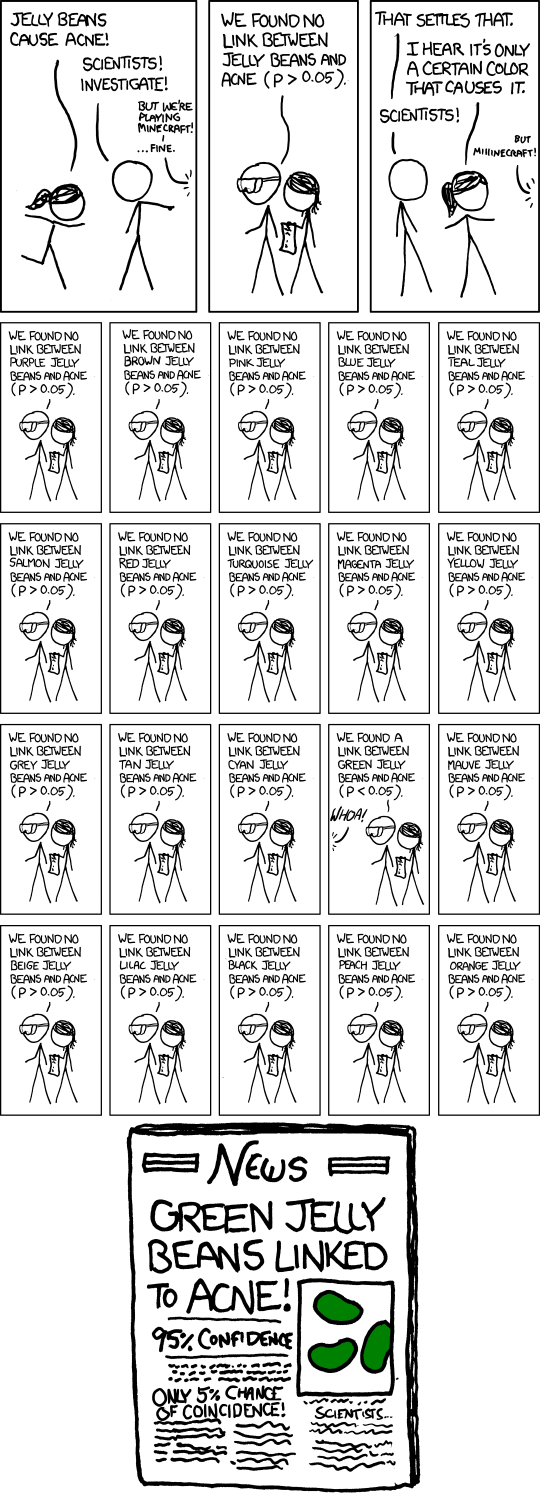
And finally, we discussed p-hacking. You can try p-hacking for yourself at https://projects.fivethirtyeight.com/p-hacking/
Fake News
Here are the statements from this week’s Fake News game:
- You have areas where there’s so much water you don’t know what to do with it. You turn on the shower, you’re not allowed to have any water anymore. I mean we do a lot of it. Dishwashers, we did the dishwasher, right? You press it — remember the dishwasher, you press it, boom, they’d be like an explosion. Five minutes later, you open it up, the steam pours out, the dishes. Now, you press it 12 times. Women tell me again, you know, they give you four drops of water.
- We have a situation where we’re looking very strongly at sinks and showers and other elements of bathrooms where you turn the faucet on — in areas where there’s tremendous amounts of water, where the water rushes out to sea because you could never handle it — and you don’t get any water. You turn on the faucet; you don’t get any water. They take a shower and water comes dripping out. It’s dripping out — very quietly dripping out.
- We’ve got the EPA look at — they’re looking at it on my suggestion — this toilet situation, where you flush and you get a tiny amount of water. They used to be so powerful, it was incredible and now you have to flush maybe 20 times and it still doesn’t work. It’s not me, but people tell me — they flush 20 or 30 times, they’re in there all day and it’s crazy. The water is there, so much water, but they don’t let you have it. We’re going to change that.
Click below for the answer
Spoiler
Statement 3 is fake news. Mark chose number 2.Mark got it wrong this week, so now he’s on 15/40, or 37.5%.
Psychic predictions are not a logical fallacy. No, wait, they totally are. My bad.
We then looked at some predictions for 2020 from Psychic Nikki, and learned what The Psychic Guild has to say about her.
The stories we really didn’t have time to talk about
- You’ve probably heard by now, but Trump authorised a drone strike killing Iranian General Qasem Soleimani. He did this, of course, as revenge for a rocket attack by a militia linked to Iran which killed an American contractor. No, wait, it was because Soleimani was planning on blowing up a US embassy. Which one? Er… Four of them. Which ones? Well, we don’t actually know precisely where or when the attacks were planned for, but they were imminent, and definitely not made up by us just now. What’s that? The Secretary of Defense, Mark Esper, has said that he wasn’t shown any evidence that embassies were under threat? Well, when Trump said embassy, he meant the one that was attacked last week. No, we didn’t mention the imminent threat to four US embassies when we briefed Senators after the drone strike. Yes, the briefing that even Republican Senator Mike Lee called ‘insulting and demeaning’ and probably the worst briefing he’d ever seen. No, wait a minute, all the Senators in the briefing claim we didn’t tell them about the imminent threat to embassies, but we totally did. Anyway, we do have evidence, it’s just super secret evidence that we can’t show anyone. Jesus, why don’t you guys just trust us? Look, he was a bad guy. If you Democrats love terrorists so much, why don’t you marry one? Ok, yes, the Wall Street Journal did report that Trump was telling his friends that Republican Senators who he wants to keep sweet for the impeachment trial had been pressuring him to do something about Soleimani, but that doesn’t mean he did it for personal gain. Those are all real things that happened this week.
- Okay just listen to this headline – Real estate broker taps Vanilla Ice to pitch Trump family on putting presidential library on site of trailer park – not from The Onion but The Hill so its real! Well it’s in the Palm Beach Post actually – Realtor James Arena (reminds me of The Rutles joke – Che Stadium) has a mutual friend he shares with Trump; that good ol’ boy and just as culturally-appropriating in the 80’s; Vanilla Ice – I know! Apparently he ran it by Don Jr who said “They’re really into it” The site is called Briny Breezes – it’s getting higher-brow by the minute – 43 acres in Palm Beach primarily consisting of mobile homes. Arena wants Trump to buy it for $1 billion – after a previous sale at $510 million fell through in 2007. The residents are in need of the money as Arena says in a not-so-upmarket turn of phrase “If we get caught with our pants down, we’re going to get much less money and we’re going to be told what to do”. You can see why he thought of Trump hey? And actually where better to put the Presidential Library – let’s face it it’s not going to take up much room – how big a building do you need to contain a sharpie and a mobile phone – so the residents need not fear demolition! Arena adds “He could even name the place Trump Town” – which for us in the UK is deliciously close to Trumpton a 1960’s animated puppet show – except the puppets there don’t speak Russian! The Trump Organization did not immediately respond to a request for comment from The Hill.
- During the whole Iran shitshow, Trump took a short break to commit war crimes on Twitter when he threatened to target 52 Iranian cultural sites with no military value. Administration officials quickly claimed that he didn’t mean that, and then Trump confirmed that yes, he totally did mean that, saying to reporters: “They’re allowed to kill our people. They’re allowed to torture and maim our people. They’re allowed to use roadside bombs and blow up our people. And we’re not allowed to touch their cultural sites? It doesn’t work that way.” Actually it works exactly that fucking way, according to the 1954 Hague Convention for the Protection of Cultural Property in the Event of Armed Conflict. It’s like: now he’s been impeached he thinks he can just commit all the crimes. What are they gonna do – impeach him?
- Whilst we’re on the subject of YouGov polls – a December 27 2019 poll reveals that Germans think Trump to be a bigger threat to world peace than Kim Jung Un or Vladimir Putin. No surprise really if you watch biker-based films or tv series its always the guy prospecting to join the gang that’s much more dangerous than the established gang leaders, cos he’s just showing off (which as we all know is the very worst thing your mum could accuse you of!) A keen believer in polls Trump should be gratified that he leads the Fear Parade with 41 percent of Germans thinking Trump is the most dangerous, followed by Kim at 17 percent, Khamenei and Putin at 8 percent and Xi at 7 percent. – Even with Khameni and XI being added to last year’s list Trump still comes out top. And once again YouGov showed it’s expertise cos this was just before the drone strike on now-not-able-to-be-added-to-next-year’s-list Qasem Soleimani some 7 days later! I for one am going to stop taking the piss out of predictions from now on. Where’s my Nostradamus gone…
- Presumably, Thanksgiving was a difficult time for the committee to reelect the President, with all the committee’s liberal relatives complaining about Trump as they passed the turkey, because just in time for Christmas, they brought out a new website, brilliantly called snowflakevictory.com which promised to help Trump supporters win arguments with their commie pinko grandkids who moved to California. The site contains videos of luminaries such as Lara Trump giving viewers talking points that they can yell at their family while ignoring any replies, but to be honest it would have been a lot quicker just to say “cherry-pick the facts, and if you can’t do that, lie. It works for the Donald!” And remember, the snowflakes are the ones who don’t need to be told what to say when someone challenges their political beliefs.
- Slate.com reports all that we suspected, nay knew for sure, that Trump knows fuck-all about business or trade or defecits or money or anything, when they looked into a report from the Federal Reserve into how well Trump’s tariffs have served US businesses and workers and the job market. Not at all well is the Fed’s conclusion – President Donald Trump said that increasing the use of import tariffs would help protect U.S. manufacturers. Turns out though, his tactics did exactly the opposite, causing job losses while also increasing prices for consumers – “We find the impact from the traditional import protection channel is completely offset in the short-run by reduced competitiveness from retaliation and higher costs in downstream industries,” Basically Trump is running the racket like it’s a hooch-running cartel in Chicago in the 30s but they say “Trump’s entire strategy of tariffs to make gains domestically is a thing of the past due to the way in which global supply chains are interconnected.” the trade war is hurting the very sector it was supposed to protect. As we have speculated out loud in past episodes – of course it is, just look where the money’s going – as George Orwell reminds us “War only happens when the moneyed classes think they will profit from it”
- Trump and Christmas will always be connected, thanks to his six second cameo in Home Alone 2: Lost in New York. That is, except in Canada, where national broadcaster CBC cut Trump’s appearance when it showed the film over Christmas. Trump, for once, genuinely took it quite well, joking that the film would never be the same, but his supporters freaked the fuck out, with Charlie Kirk claiming the clip was removed “because it humanizes a man the left loves to dehumanize”. Trump’s second favourite child, Don Jr, called it “pathetic” and an example of “virulent left wing media bias”. The fact that the edit was made in 2014, when CBC shortened the movie by 8 minutes to make room for more commercials, is presumably proof that the Deep State has a time machine. And they’re clearly using it in the most effective way possible.
- Okay Trump Playbook 2.0 being read from (well looking at the scribbly pictures) and enacted in the UK under Boris’ self-styled “Government of the People” part 1 – Appoint who you like: Nicky Morgan – she who can’t count nurses said she’d be standing down and wouldn’t be part of BJ’s cabinet under any circumstances was awarded a peerage – so she can sit in the House of Lords – the US Senate equivalent – and thus be appointed to the cabinet – which she has. No wonder she can’t count nurses she can’t remember from one day to the next apparently. And Zac Goldsmith who’d love to be in BJ’s cabinet but lost his seat in the election (second time he’s lost it in 3 years) got made a Lord too so he can be in the cabinet. The 2016 Brexit cry of “We’ve had enough of being governed by unelected politicians” ringing hollow enough yet? – as we were warned then “Take back Control” actually involved looking at who’s taking the control back!
Pt 2 – Control media scrutiny: The daily press briefings are being moved from the lobby of the Houses of Parliament to the reception rooms at Number 10 – cutting off the ability of the press to literally bump into random MP’s at their place of work and replacing it with timed and time-limited access to selected MP’s in another part of town thus meaning the press can’t be in two places at once and what’s being asked and answered can be carefully overseen. More depressing elected-dictatorship news next time, and for the following 5 long years…..!! Hey let’s join Harry and Meghan in Canada!
If you wanted to buy a T-shirt featuring this fallacy, you could click here. No pressure

And if you have some money left over after that, Jim’s book, 2000 Mules and One Big Lie: A Stubborn Conspiracy Theory is available now.
That’s almost all for this week, but here’s our AI-aided transcript, which is quite accurate, but not totally:
Texas Sharpshooter – FT#40 Transcript
Read the full transcript
00:13 Jim: Hello and welcome to Fallacious Trump, the podcast where we use the insane ramblings of a slurring warmonger to explain logical fallacies. I'm your host, Jim.
00:32 Mark: And I'm your other host, Mark. A logical fallacy is an error in reasoning that results in bad or invalid arguments. The logical fallacy we're looking at this week is the Texas sharpshooter fallacy, also known as the clustering illusion.
00:45 Jim: So the Texas sharpshooter is one of those fallacies that has a little kind of story attached to the name, and this one is of a person who is not a sharpshooter. They are, are inexperienced with a gun and they just fire lots of shots at the side of a barn. And, okay, inevitably there are areas where there are more holes than others, and that is where they then go and draw the target around and pretend that's what they were going for,
01:12 Mark: right, so okay, yeah, yeah.
01:16 Jim: Consequently, this fallacy is about, uh, and actually kind of a number of different things. One of them is is taking credit for something after the fact that you didn't predict or couldn't have predicted in advance, but mostly it's about clustering. It's about finding in a large amount of data, finding the bits that work for you, finding the bits that tell the story you want to tell, and drawing your target around there and saying: look, see, that proves my point – when actually, right, that kind of cluster, that kind of collection of of data that all seems to point in a particular direction is inevitable. If you look at enough stuff,
01:53 Mark: it's a kind of cherry picking,
01:54 Jim: yeah, it's kind of a cross between cherry picking and postdoc, ergo proctor, in a way. Yeah, yeah, there's definite elements of both and, and yeah, you'll see in the examples that we, that we choose it is that there's definite elements of both of those, and our first example, in fact, is from Trump, talking about job numbers.
02:13 Clip: Trump on job numbers in January 2017
— A couple of things happened this morning: 227 000 jobs, great spirit in the country right now, so we're very happy about that. I think that it's going to continue bigly. We're bringing back jobs, yay, bigly.
02:26 Jim: Yeah, there, it is continue bigly time, yeah and um, yeah. So the thing about this is that this was in January 2017, when obama had been president for most of the month, and and so trump's claim at the end that we're bringing back jobs because in In January, there have been 227 ,000 new jobs in the US. Obviously, it had nothing to do with him whatsoever. Even if he had put anything in place in his first few days that had a potential to have an impact on jobs, it wouldn't have had time to actually do anything. So, yeah, he is picking a number out of all of the things in the country. He's picking something that is good and saying, yeah, that was me.
03:12 Mark: And also, is there a bit of Texas sharpshooting going on in that he's saying these 270,000 new jobs is going to increase? It shows an increase, but it may well be that actually there are 270,000 new jobs, but there had been 500,000 layoffs. Then it's not a good spirit in the country. It's not an increase, that it's going to continue bigly, because he's just picking that number and then saying, and then telling us that that means an increase.
03:49 Jim: I don't know if that is new jobs or an increase in jobs from where they were. But one thing is certain that 227,000 new jobs in January, he's saying, is a really good thing. And – and you know obviously – signs of growth. When obama had 250 something thousand new jobs, uh, in a month, a few months previously, Trump was saying how terrible that was and how it was not nearly enough compared to what the? U .s needed to to continue to grow. So, yeah, he's definitely kind of cherry picking the bit. Well, he's not even cherry picking, he's just being hypocritical. He's just saying that this is a good thing now and it wasn't a good thing before. So our second example from Trump is actually from when he spoke at the UN General Assembly. This was his second time there. And he announced that in his first two years of presidency, they had achieved more than any other presidency in the past. And the entire UN laughed at him. And because it's obviously not true and and he was asked about that after the fact by a reporter and he said this, so I don't know if you can quite hear that, but he said he said that was meant to get a laugh. Nice, which is a really weird thing to say. Apart from anything else, yeah, it's a weird claim that that when you claimed you'd done good things, you were trying to make people laugh, yeah, yeah. But it's also betrayed by the fact that uh, immediately as people laughed, he said: well, I wasn't expecting that response. Yeah, so, yeah, um,
05:38 Mark: so he's definitely moved around, doesn't he to fit?
05:42 Jim: Yeah, but in saying, oh, yeah, I, I meant to get a laugh, basically he is. He is saying, yes, I totally intended to do that. That is, you know, whatever happened, yeah, uh, in in the process of of me kind of going through life. It was intentional, I didn't make any mistakes, I didn't kind of fire off target at any point. Everything was totally meant to happen exactly. It's a bit like when,
06:04 Mark: when a cat goes to make a jump and then fails and then just kind of styles it out and as if it meant to do it. So you know it will, it will overreach itself in jumping between the, the fridge and the sideboard or something, and then kind of crashes to the floor and then just gets up and saunters off as if it meant to do it. That's and you kind of you can't. It makes you wonder who Trump thinks he's looking at him. Who, who, who is he doing it for?
06:35 Jim: Is, yeah, I don't know.
06:37 Mark: And who's gonna buy it? Yeah, nobody buys it, and and nobody kind of just slaps him and says: what do you think you're doing? Who are you doing that for? Stop it.
06:49 Jim: So our third example, uh, from Trump this week is a tweet that he sent on January 22nd 2019, saying: merist npr pbs poll shows president trump's approval rating among latinos going to 50, an increase in one year of 19. Thank you working hard. And so this is an example of having a large data set. Yeah, so this was a poll that tested lots and lots and lots of different factors and picking the one bit, that that looks like a success. Yes, yeah, because actually, yes, that that, in fact, that wasn't true what he said, but it wasn't true, not in his favor. For once, he actually got it wrong. It was an increase in one month. Oh, wow, 19, which could be according to, to uh, to some polling organizations: uh, latino populations are notoriously difficult to poll and and their numbers go up and down more volatilely than certain other demographics. So it it was a kind of a moment when it was momentarily up at that point, but that poll also showed things like his: his overall job performance rating going down to 39 percent from 42 percent, which happened the previous month, and and him losing approval from suburban men, evangelicals and actually Republicans as a whole – 57 percent of the country at that point saying they will definitely vote against him in 2020. Just only 76 percent of Trump supporters saying they'll definitely vote for him. So, in only three quarters of the people who you know rapidly, yeah, support him saying, yep, yeah, we'll definitely go and vote for him. Wow, um, so it was, by every measure, a really bad poll for him, and he picked the one number, yeah, that made it seem like it was actually good.
08:46 [Sting: Mark's British Politics Corner] And now is the time, I think, for Mark's British Politics Corner.
08:51 Mark: So the uh, the. The example that occurred to me – and thanks, Jim for doing the initial research on this whilst I was ill – was that there must have been something that came out of the post -election that we had had over here. We've had five in the last three years, so difficult to point at any of them. But that, each and every time something comes out, somebody fits a meaning to these random sets of numbers in order to substantiate their particular argument. And uh. The one that we're going to focus on is that the uh. In the 2017 election, there was a new polling method that was used by you gov, and I was horrified earlier to find that I typed you gov, which um is quite ghastly, and then going back and just seeing it on the screen.
09:51 Jim: It's very specific polling organization just finds out what people think of michael gove
09:56 Mark: Or what Michael Gove thinks of people. We kind of know that every time. So they had unveiled this new polling method for the 2017 election, which was Theresa May's snap election that happened in June 2017. And they called it MRP, which stands for multi-level regression and post-stratification. Stratification, and the way it works is that, rather than just get a gather, a panel that represents the entire country, they conducted 50 000 interviews a week without worrying too much about who answered them, and then they used this statistical procedure – multi -level regression and post stratification – to adjust the results to be more reflective of the overall population. So they just kind of. I've heard these kind of statistical things for quantitative surveys and qualitative surveys in the work that I do in international development. They often survey the communities that we're working in in order to find out what it is that they're worried about most, and all that kind of stuff. And whether they engage with the programmes that my particular bit of BBC makes, and then to see whether A they engage in more healthy health behaviours or engage with more political bits. And they use these regression analyses in order to weed out people people who are already doing healthy things or already engaged with political stuff. So it was for me, it was quite a surprise that they hadn't been doing it that way forever. But it was hailed as an amazing thing because it correctly predicted in 2017 that there would be a hung parliament. And they also individually correctly predicted that Tory seats like Canterbury and Kensington would go to Labour, which was a shock at the time, and therefore this election polling method was hailed as a miracle thing. But I counted them and in 2017, there were around 88 different polls conducted throughout the election campaign, from the day she announced the election to the election day itself. So why did we just focus on the Yougov one? Because it just fitted this. There was a bunch of results that were really closely aligned with one of the polls, so everybody went, wow, look at that poll, um, and at that time, news scientist magazine reported that they slightly underestimated the number of seats in parliament. This would correspond to predicting 302, where the actual figure was 318. They also underestimated the vote share of the opposition party labor – 38 percent, when it was 40 in reality. Then they say, however, this is all within their self -stated margins of error. Other polls predicted as much as a 12 point conservative lead, all the way down to a one point conservative lead. So there's, basically, it's just saying, yeah, this poll was in the middle of the the range and it got fairly near. You know, though, even though they say they got it wrong in two places and it was within their self -stated margins of error. So they even said, well, this is within a margin of error. In order to kind of cover. Not only have they drawn the target around the barn, around the bullets on the barn, they've drawn the target on the entire whole side of the barn.
13:47 Jim: Um, yeah, I mean, the key there really is whether those margins of error were stated before the election. Um, and – and that's one of the things about the, the Texas sharpshooter. Fantasy is in science, it comes where people are, um, doing some experiments and then looking to to find what they can see in the data. Yeah, rather than starting from a point where they think, okay, let's examine this, let's see if we can find evidence for this or find evidence against this, and then do the experiment. And so, yeah, the question there is: if they, if they said, okay, we're going to do this, this methodology based on our analysis, this methodology will give us an accurate reading with within, you know, six points or ten points or whatever, then fair enough, if they do that, and then, and then they get to within that point. Yeah, if they were the only poll, if they're the only poll, all you're looking at that, that shows that they're accurate. Yeah, but, as you say it, when they are one of almost a hundred different polls, yeah, it's not surprising some of them are going to get quite close.
14:51 Mark: Yeah, I mean, and the um andy morris, the chief innovation officer at you gov, who kind of implemented this system, said it came as a bit of a surprise to much of the commentariat, but the result was very close to what we were expecting with our model. The science behind it suggested, suggested it was the way to do it. Yeah, really is there science behind that? But I think they're kind of confusing that with the cluster effects, because they're they're saying: oh well, the result was very close to what we were, what we had modeled. So the ultimate result was close to what we'd modeled. So we'll do it like that again. But that's, that's not science, that's post -hoc.
15:33 Jim: Well, yeah, I mean that's. And that is why in science, you need to replicate. You need to do your studies more than once and see if or need other people to do your studies using the same methodology and see if they get the same results. Because if you have a hundred people all doing something a bit different and one of them gets close, afterwards they can say, yeah, I knew it. Yeah, yeah, all of them thought it would be good before they started.
16:01 Mark: and – And it came as a bit of a surprise – that it was very close. Well, I guess the thing that they touted again in 2019. They said: you know the model which correctly called 93 % of the seats in 2017 currently shows that a small conservative majority is likely. And that was the poll that they put out on the 10th of December, two days ahead of the actual election last year. Year. So they're kind of saying, well, it shows a small conservative majority is likely. Well, they were wrong, because it was a massive conservative majority. And I think they're also putting in there's an argument from antiquity there saying, well, we did this in 2017 and it correctly predicted it, so we're using that again. And also, I think there's a little bit of an ad had Populum in there as well. After much anticipation, on behalf of who you know, we go, oh yeah, let's, this is the one.
17:01 Jim: Everyone is looking at this because they all think this is gonna do it.
17:04 Mark: Yeah, and actually, um, it predicted two days ahead that the Tories would win 339, uh, and that Labour would only win 231, um, and at the time of that time, Tom journalist Tom Chivers tweeted. Um, he actually said: is there a potential Texas sharpshooter fallacy here? There were dozens of polls projections forecast in 2017 – nearly 100. You'd expect some to be close by sheer chance. Afterwards we picked the one that was and say that was the right one, drawing a target around the bullet hole. So that's why everybody is in much anticipation. We've only got you gov's word for that, um, that we were looking forward to this one. So the numbers to remember were 339 and 231. And here is the exit poll being announced on the night of the election at 10 p .m, after polling stations closed by the bbc. Our
18:06 Clip: The 2017 election exit poll
— exit poll is suggesting that there will be a conservative majority when all the votes are counted after this election of December 2019: the conservatives on 368 seats and Labour way down on 191.
18:23 Mark: So nowhere near what YouGov had predicted. And actually that was the exit poll, which was different when the actual results came in, because the Tories were on 365 and Labour on 203. So the exit poll was wrong too. And then I did a poll. It was pretty close. Yeah, I mean, but way off YouGov. And um. So in my own quick poll of reports on the marvel of Mrp afterwards, no one seems to be lauding it like they did last time, and benjamin lauderdale, the professor of political science at ucl, noted in a series of tweets that day after the election that the overall performance was micked. Headline conservative seat prediction was too low. We over predicted the brexit party party. Um, we did, we. And then some of his questions are: did we ask the wrong people or did we ask him at the wrong time? Uh, and then he said we underestimated swings by leave share, um. And then he asked: did we? Were they the wrong kinds of leave supporters in the sample? Um, yeah, exactly, exactly. That was quite good. And there was differential turnout or mismodeling of relative turnout rates for leave versus remain, because there was a big thing, big kind: correlation between the constituencies that had voted more than 60 % leave in the referendum voted Tory, and those that had voted more than 60 % remain voted Labour. There was a correlation drawn there and the YouGov thing had kind of missed that. So Benjamin Lauderdale says he will will be returning to this in the new year, once sufficient data has been collected on reported votes to properly assess the details of any late swings. So to kind of work out where that bit in between the two days of their poll that they published – so it must have been from data that they had up to that day. So it could well be three days late, three days out of you know, a day out of date when they published it, and then they've got two more days to go to the election. So there will be a massive set of late swings in there. Possibly, or they got it completely wrong. It seems quite unlikely, doesn't it?
20:43 Jim: I mean, the main thing I remember from the last couple of days of election campaigning was Boris Johnson hiding in a fridge to avoid an interview with Good Morning Britain.
20:54 Mark: I don't know that there were…
20:55 Jim: Unless everyone thought, yeah, I hate Piers Morgan, well, I'd do that, and voted for him, then…
21:02 Mark: Well then, maybe, well, who knows? Yeah, which I think leads you to think that actually you can't poll this stuff. Yeah, but it's but the. The other thing I kind of um realize is I'd be quite excited to read that report, and then it did occur to me the stuff we read and the stuff we get excited about. So brit poll, example number two, just a quick one, which is another one that, uh, Jim found for me. Thank you very much. This is from new financial magazine dated september 2017. So this is post Theresa May's hung parliament, and it says: another week, another set of numbers that send completely contradictory messages about the impact of brexit on the city of london. This week, the recruitment firm robert waters said that the city had shrugged off concerns over brexit and that that hiring had surged 37 % in July compared to last year. Meanwhile, a rival firm, Morgan McKinley, published its own research saying recruitment had dropped by 11 % over the same period and that the city was hemorrhaging talent as a result of Brexit. So they got their own individual bits of survey and then they'd extrapolated to say what the city was doing. So it's both at the same time. It shrugged off concerns and yet as hemorrhaging talent as a result of brexit.
22:26 Jim: Yeah, essentially both those companies looking at the exact same data. You know there is a a real number of of how many jobs are being recruited in the city and how many people are leaving – um, and, yeah, they both looked at that data and picked some numbers that show what they want.
22:46 Mark: that that to me, yes, says exactly that the target is drawn wherever the drawer wants to draw it, to record the particular hits according to their own viewpoint. So, yeah, very much kind of cherry-picking kind of way of doing it. So, you know, actually, the thing to do is to not look at the data but to look who's picking it.
23:11 Jim: Well, look at the data, too, and get some context.
23:14 [Sting: Fallacy in the Wild (Cars – Gary Numan)]
24:01 Mark: There we go, Gary Newman there with cars. He's not going to say anything in particular. Well, as I was sitting waiting for the breakdown truck after I got um side swiped on Friday, um, I was thinking, yeah, I should do one about cars. And then that that popped into my head and and also I realized, on listening to it, it doesn't have a chorus all that time, you'll just keep going, it just you get a verse and then you get twiddly bits on the synthesizers.
24:30 Jim: So in the Fallacy in the Wild, we like to talk about the fallacy of the week from a non -political perspective, and this week our first example is from the excellent math -based fbi drama numbers and in this particular episode there has been a sinkhole opened up at a local school and there's some suggestion that it's the – the poor material that has been used to create the playground that has caused this issue. And the fbi are looking into it and charlie is helping them.
24:59 Clip: Numb3rs
— Okay, I have two cases of leukemia at the school now and three cases in children who attended in the past. Charlie, what are the odds of this many cancers in a small school?
— You're talking about cancer clusters, statistically rare. More likely, this is a case of Texas sharpshoot, I'd say. There's a guy who's never held a gun before and he aims at the side of a barn and he shoots and when he's done he draws a circle around the closest shots, ignores the others, and he declares himself and takes a sharp shooter. Right and cancer clusters are just like that. People over interpret the yeah, here we go.
25:31 Jim: So for anyone who hasn't seen this series, there's a group of fbi agents and the brother of the head of the department is a maths professor so he comes and helps out with with. Basically all their cases involve some kind of math problem that he needs to do some kind of technical modelling of, or something like that. And in this case, what they're looking at is a firm that has been fraudulently using actually toxic waste to put down tarmac on kids' playgrounds and has been causing. In fact, in this instance, the cancer cluster is real because they discovered that the toxic waste has not been properly processed and it is causing diseases in this local school. But what charlie's talking about is is absolutely a real situation. People massively over interpret areas where there seem to be more illnesses or more instances of cancer or leukemia and in fact, there's a very famous study, uh, out of sweden in, I think, 1992. Uh, where they looked at the idea that that power lines were causing leukemia in children. Right, but they didn't look at instances of childhood leukemia near power lines. Yeah, what they did was they looked at all of the people in sweden who live within 300 meters of a power line, right, and 800 different diseases, yeah, yeah, to see if there was any correlation, right, yeah, and when you look at that kind of massive amount of data you could going to, yeah, there is going to be some correlation. It's going to be because, because randomness is clumpy,
27:08 Mark: yes, exactly, because the power lines go to communities and people live in communities and people are the ones that get diseases.
27:17 Jim: So, yeah, and even if the spread of a disease or or a disorder is completely random, there are going to be areas where, um, it's it's stronger, And there are going to be, out of that number of things that you're looking at, areas where it seems more. And, in fact, what they found was a correlation of more than four times the expected average number of people who would have leukemia who lived near a power line. And that was at the time seen as practically evidence of this happening. But when they've tried to replicate that in other countries – and you know that there isn't a significant difference in the power lines or anything like that – what they found is it just doesn't replicate, because there wasn't an effect, it was purely random. It was an effect of looking at that many different things and then a data set that huge.
28:09 Mark: Yeah, actually it makes me think of those. Remember when we talked about that um website that does kind of random correlations between things like spurious, yeah, yeah, that. So there's that kind of it's almost an application of that, isn't it? You've got two random things that you're shoving together and then, because we're meaning making machines, we make the you know death spy shark correlate with matthew mcconaughey film releases, because the curve goes up at the same time.
28:43 Jim: Yeah, absolutely, that website totally relies on Texas sharp shooter, because what they're doing is comparing loads of different kinds of data – yeah, data of you know, film releases and accidents and different ways that people have died and the price of mayonnaise in maryland and all kinds of different things – and eventually they find stuff that correlates, and it doesn't mean they have any relationship whatsoever, they just look the same it's. It would be weird if, if you looked at that much stuff, you didn't get two things that seem to to go uh in the same direction at the same time. So our second example in this uh Fallacy in the Wild this week is from deron brown, and this is from a special that he did called the system. Um, the main point of this particular special was a horse racing system that he had come up with, where a woman thought that she was getting repeated good tips on horse races and what What they actually did was create different tips for 7 ,767 people, or 76 people, I think, on a six horse race, and then gradually narrowed them down as they got. Inevitably one in six of those people got a correct tip for the first race. Because they gave each of the groups a different tip and then they split them up into a group of six and gave them another tip. And by the end they had someone who had been given five tips in a row on six horse races that had all been correct, yeah, and, and it wasn't because they knew what they were doing. It was because, inevitably, someone is going to have the right answer if you just keep doing it that way. So, but this particular clip is from a method that he used to kind of demonstrate the inevitability of certain things happening. And what he did was he said: I will flip this coin – and it's a fair coin – heads on one side, tails on the other. I will flip it 10 times in a row and get 10 heads in a row. And he had a camera on a bowl that he was flipping it into. The cameras didn't cut away and he did it.
30:49 [Unclear]: And at the time,
30:52 Jim: at the beginning of the episode, you're looking at it and thinking, well that I mean, how can he do that? It's obviously a trick. But it wasn't a trick. He really did it. And then later on in the episode, he explained how he did it.
31:03 Clip: Derren Brown – The System
— What you saw was the final minute of what was an excruciatingly long day. We filmed for over nine hours until eventually a clear run of heads appeared. Nine heads. Last one. The impossible became inevitable. Ten. Ten heads in a row. Thank you very much indeed. So
31:26 Jim: that's the thing. It's incredibly unlikely to get 10 heads in a row until you do it a lot, and then it's definitely, definitely going to happen.
31:36 Mark: Yeah, and it's interesting that he said the final minute of filming. Well, it's only the final minute, because they've stopped after that. Yeah, exactly, yeah, there's also. There's youtube um clips of that kind of arrangement in a in a triangle of wine glasses and then somebody bouncing um ping pong balls into the wine glasses. So the camera is this side and there's one where there's like 18 glasses or whatever, this guy and he gets to the 17th one and he's going, yeah, and he bounces and the last one just hits the rim and goes off and he just goes: oh no, you're there all the way along. And actually there's something more accessible about the fact that it's failed, rather than if they all went in. It's like those ones where people have got their backs turned and they just fling the thing over their head and it goes through the basket, and that you see on those compilations of you know, like a boss videos and you think, well, how many times did they do it when he didn't go in? And they just submit the one where it does go in and that you know, that's the, that's the system that we – um, we're outside of that. There's the Texas sharpshooter going on right there, isn't it? You only submit bit the one way and and,
32:46 Jim: yeah, when, if you, if deron, had written down all of the heads and tails that he'd got on that day, basically, what essentially what he did was he wrote a long string of h's and t's and and then, when there was 10 h's in a row, he drew a circle around. Yeah, that's what he did. They edited that bit and showed that bit on tv and yeah, it's, it's, it's picking the bit where it and claiming that that was what you meant to do the whole.
33:14 Mark: okay, and – and that's the, the marvel of telly, and he's very good at subverting that, because you watch it and you know he, he sets you up and says I'm gonna flip 10 heads in a row, and then he says: and here, and he shows you. You know, we're not gonna cut. Here's the two cameras, you'll see it all in one shot. And you think, oh, blimey, he's done it. And how has he possibly done? Well, they just filmed it until he did it and then showed us that bit. So the edit was either end of the yeah, wasn't the uh, wasn't the bit in the middle yeah. So it also occurred to me, um, since since I got side swiped on Friday, the meaning making machine thing and how that works, and this will kind of lead through into possibly how a creationist views evolution as well. So bear with me, so in in the crap in my crash. Um, so given that in the Uk there are 38, .4 million cars on the road, what are the chances of one colliding with mine? And I figured well because there's two vehicles out of the total. Are the chances therefore halved? So is it 19, .4 million to one? Or is it because each and every car could, could possibly hit each and every other car? Is it 38, .4 million factorial, which is an enormous number, because one million factorial has 5, .5 billion figures in it? And given that the number of atoms in the known universe is a number which only has 82 figures in it, that's hugely improbable. So, given that this is enormous thing of millions and billions upon billions to one that I could be hit by this other car, you can see how it would possibly lead to seeking an explanation as to why me you think this is so um improbable that it must, the fact that it happened, it must, must be a conspiracy. It, it must have significance. It was ordained, it was foreshadowed, it was in the stars, but there is the meaning making target, being drawn around the data, and I I put it to you that it's because dumb luck is just too frightening. Um, the, the landmark forum, the landmark organization that does the landmark forum, has this tenet: empty and meaningless, which which they ascribe to the universe on the basis that, given that the universe is empty and meaningless, there is no meaning attached to what's happening to you in your life. You can make your own meaning. It's a frightening prospect that there is no one in charge of anything except for you, and given that there's no one in charge, you can do what you like. You can make your own meaning out of your life, and that's the whole basis of their philosophy.
36:08 Mark: And weirdly, despite the fact it's empty and meaningless, that same morning, on Friday, a truck ran a red light and nearly T -boned me, which, in the movie narrative of the day, would have been the foreshadowing moment. And if only we knew how to read those moments for the meaning they truly contained, we could live our lives slightly differently. And I think what that. So here's the evolution bit that I can. I think that's how the notion of a creator comes into talks about evolution, because you know, what are the odds that humans evolved? What are the odds of that? It's such an immense number, so highly improbable that and yet it happened. So there must be a creator's hand at work, because that's that's how you make meaning out of of it.
36:58 Jim: Yeah, and of course, the thing is that that we are only able to have that question because we evolved in the way that we did. And and it's the question is, it's about what are the odds of it happening if you were starting before all of it? That's the point. The odds are staggeringly small. If, before any of it starts, you go: okay, what are the odds of us getting to this end point? The odds of us getting to this end point from where we are now are one in one, because it happened and there were loads of other possible end points that equally, we would be saying, well, what are the chances of that? In the same way as, yeah, you, you getting hit by another car. If you'd said that morning, what are the chances of it happening, then the chance would be very small, but the chances of of someone getting hit are staggeringly huge. And you're only looking, is it? After the fact, from the perspective of someone who it happened to, in the same way as, basically, the anthropocentric model of the universe, saying, you know, the fine -tuning model essentially is saying: you know this, this is clearly, um, designed for us, this universe, because, because it fits us so well, despite the fact that by far the vast majority of the universe is incredibly hostile towards us, yeah, even the majority of the earth is incredibly hostile to us. But, um, yeah, it's like, it's like douglas adams puddle, yeah, where there's, you know, this is an interesting hole I find myself and it fits me rather neatly.
38:38 Mark: Yes, it must have been designed for me and only me, exactly. I'm perfectly suited to be in it, but it's got to have been made purely for my existence.
38:49 Jim: Yes, yeah, so when you look at things from after the fact, the, the odds of those things happening, look very much different from when you're looking before. And in fact, there's a, there's an xkcd uh comic that I wanted to mention that looks at the, the kind of scientific version of this, that of the Texas sharpshooter, and it starts with someone asking scientists to investigate whether jelly beans cause acne.
39:17 Jim: And so the scientists look into it and say no, with a p of uh greater than 0, .05, we have found that there is no link between jelly beans and acne. Yeah, and then they say, okay, well, I, I've heard that it's only a certain color. So then they test all of the colors and there's more than 20 different colors and the thing about the p value that the scientists generally use to look at significance is, although it's not exactly this, it's close to it. There's. There's a five percent chance or lower that the results you get are due to coincidence. And if you look at more than 20 things and look for the same result by chance, five percent of the time one of those is going to give you the result that you're looking for. If they're, if the chances of it happening by chance are 1, 20th, 5. So in the cartoon they find you know all of the other colors they don't have a link, but green jelly beans do have a link in. In science it's about having that hypothesis to start with and deciding what data you're going to look at and where you're going to stop and what method you're going to use and all of that stuff before you start doing your experiment. And and just finally in this section I just wanted to talk about a website which you can kind of go and do this yourself. There's a thing called p hacking, which is when, uh, that that p value, that 0, .05 threshold, um is, is what scientists say is is significance. There's a lot of kind of debate over whether it is the correct number to use, but it's, it's a threshold to say that that um, you know the results you're getting aren't probably due to chance. There's a, there's a low likelihood that actually the results you're getting a huge chance right. But with p hacking, what some scientists do, some of the less scrupulous scientists, is they they don't do that whole thing where they set up the experiment, advance, decide exactly when they're going to stop and what, what they're going to look at. Yeah, they will kind of monitor the results as they go and when the results get to a level where the p value is lower than 0, .05, then they stop and say, ah, we've achieved it, we found significance when in fact, if they'd continued with their experiment they may not do. Yeah, and there's, there's an, there's a website at projects .538, .com slash p dash hacking, yeah, where you can use a data set of um, the, the economy, so you can look at employment, inflation, gdp and stock prices, and then you can look at whether um, Republican or Democrat presidents, governors, senators or representatives were in power at the time. You can include or exclude recessions and you can factor in, uh, the, the more powerful positions, and what you can do, basically, is is mess around with those and click on the little checkboxes until you get a significant response, yeah, and result. And you will get a significant result. And it doesn't mean anything, it doesn't mean that you know when there's a Republican president, uh. So I've just – I've just literally clicking around – done one. Now, if you look at employment and stock prices, um, and Republican presidents, you find that there is a significant negative result that Republican presidents have on the economy. Maybe that's true, but you can't base it just on this, because what they've done is taken a huge data set and just messed around with the numbers until they find something that fits that criteria of being lower than 0, .05 significant.
43:00 Mark: So okay, yes, because what I did with that one immediately I kind of did it with the Republicans and then I switched to the Democrats. And then all of them came up, publishable and green, and I thought, ah, like, instantly my cognitive bias was satisfied. And then I, and then I kept clicking until I found one went: oh yeah, well, there you go. That's. Yeah, you can't publish that data because the year is wrong. Yeah, it's wrong, it's not wrong, it has no meaning. It's just below the threshold you would want to publish. That's, that's it. This is, uh, derren brown's flipping the coin in action, isn't it? So you just keep, um, he's not going to publish it until he's flipped 10 in a row, so you just keep tweaking the um, the inputs, until you get one that is publishable. And then you stop.
43:50 Jim: And it's a really good example, that of um, how people can manipulate figures using large data sets to to show what they want to show. And it doesn't necessarily mean it, although if you don't have the context, it looks like that thing has essentially been improved.
44:07 [Sting: Fake News] So we're gonna, we're gonna play fake news. Folks. I love the game. It's a great game. I understand the game as well as anybody. As well as anybody. Yes, it's time for fake news,
44:17 Jim: the game where I read out three Trump quotes, two of which are real and one I made up and Mark has to figure out which one is fake news.
44:22 Mark: And I realized that actually, in the playing of this game, there are moments – if you look at the overall, the distribution of when I win – those ones are clearly displaying the moments when the questions are a lot easier.
44:37 [Unclear]: So there's, there's clustering going on.
44:41 Jim: There are bits where you got three or four right in a row,
44:43 Mark: exactly yeah, so there's gotta be those sections. Yeah, those bits clearly show that I'm great at this game and, um, you know, it's just the bits in between, just to gloss over those because they have no meaning. Those bits don't mean anything. It's the, the bits where I've got three or four in a row. That's the important stuff to look at and that this score at the end. You know it's a, it's a woeful distortion of the truth.
45:14 Jim: so the theme this week is uh. Recently, before he found Iran as a good distraction from impeachment, he seems weirdly to be focused on, uh, the evils of conserving water. So, um, um, we've got, okay, we've got, we've got three quotes about uh, about appliances basically, and and how right, how things used to be better,
45:40 Mark: yeah, when they were on steam, weirdly, yeah, which, yeah, inconsistent with steam on the boats.
45:48 Jim: Statement number one: yeah, you have areas where there's so much water you don't know what to do with it. You turn on the shower. You're not allowed to have any water anymore. I mean, we do a lot of it. Dishwashers, we did the dishwasher, right. You press it, remember the dishwasher. You press it, boom, there'd be like an explosion. Five minutes later you open it up, the steam pours out the dishes. Now you press it 12 times. Women tell me again, you know they give you four drops of water. Statement number two: right,
46:18 [Unclear]: we have a situation.
46:20 Jim: Well, women tell him, we have a situation where we're looking very strongly at sinks and showers and other elements of bathrooms, where you turn the faucet on in areas where there's tremendous amounts of water, where the water rushes out to sea because you can never handle it and you don't get any water. You turn on the faucet, you don't get any water. They take a shower and water comes dripping out. It's dripping out, very quietly dripping out.
46:47 Mark: It's almost like a haiku. They take a shower and water comes dripping out. It's dripping out, very quietly dripping out. It's kind of them. And then the it's like spock's brain, that bit where they take his brain out and put it back in and he tells them how to fix it and eventually, you know, the knowledge just go, drips out of mccoy's head, in in much the same, quietly, very quietly dripping out, yeah.
47:12 Jim: And statement number three: we've got the Epa look at – they're looking at it on my suggestion – this toilet situation where you flush and you get a tiny amount of water. They used to be so powerful, it was incredible. And now you have to flush maybe 20 times and it still doesn't work. It's not me, but people tell me. They flush 20 or 30 times. They're in there all day and it's crazy. The water is there so much water? But they don't let you have it. We're going to change that.
47:36 Mark: It's gonna make flushing great again. But yeah, it's not me, but people tell me. So, yeah, it's not true, people have made it up. It's not that I'm making it. They flush 20 or 30, so they're in all day. It's a, it's a stand -up routine. Isn't it about how life was in the 50s? Yeah, you know, remember those machines. They were huge, they, yeah, and they put them on a turntable and we all looked at them. It's. There's a who's. There's a comic in the Uk called peter k who, who incenses me immensely because he's too young to be making gags about the things he makes gags about, because they're about life in the 50s and 60s, 20 years before he was born.
48:22 [Unclear]: Yeah, but he's a northern comic,
48:24 Jim: so you know all,
48:26 Mark: right, yeah, in the north it's like it's all 10 years out of date. Yeah, exactly, it's. It's exactly like that, where they're big dishwashers, um, and elements of bathrooms where you turn the faucet on. There's in areas where there's tremendous, tremendous amount of water, where the water rushes out to see because he's not well, okay, right, so I've got to try and make sense of.
48:49 Jim: He said two of these.
48:50 Mark: They're all just ridiculous, okay. And he actually said two of these, right, well, okay. So one of them's actually got some some agency in there looking at this toilet situation. Were there not, you know, the Environmental Protection Agency wouldn't be looking at toilets. That used to be so powerful. It's incredible, okay, that one, alright. We have a situation: we're looking strongly at sinks and showers and are there limits of bathrooms and you turn the faucet on over the tremendous amount of water. You turn on the faucet, you don't get any water. They take it's dripping, it's quietly dripping out. I like that one. That's very poetic, it's almost like somebody wrote it. Um, you have areas, there's so much water you don't know what to do with it. Turn on the shower and you're not allowed to have water anymore. I mean, we do a lot of it. Dishwashers: we did the dishwasher right, okay, right
50:05 Mark: I think the number two is the one you made up.
50:12 Jim: Okay, the dripping out, very quietly dripping out.
50:16 Mark: Yeah, because the other ones have kind of got appeals to crowds.
50:20 Jim: Of the other two, which do you think you're more confident about?
50:24 Mark: I think I'm more confident about the EPA, number three.
50:29 Jim: So number three, yeah is yeah, fake news.
50:35 Mark: Whoa, nice work. That's the one. Wow, that is so good because it's got that mid -sentence bit. When he goes, we've got the Epa, look at, they're looking at it on my suggestion there. Yeah, that is so good. They used to be so powerful. I can, can see where you got that from from the other two. Now, it was incredible. Now you have to flush, right, that is very good he has.
51:03 Jim: He has talked about flushing lots of times. He – I doubled it. He said he said 10 to 15 times. Um, he hasn't talked about them. I don't think he's talked about the Epa looking at it. Um, yeah, and and the fact that they're in there all day, that's just all that well made up.
51:20 [Unclear]: So, yeah, no,
51:21 Mark: it's really yeah,
51:22 [Unclear]: God damn you, that's excellent. Yeah, which means he did say number one: oh my God, oh no, so much water, you don't know what to do with it. You turn on the shower. You're not allowed to have any water anymore. I mean, we do a lot of it. Uh, dishwashers, did the dishwasher right, you press it. Remember the dishwasher? You'd press it, boom, there'd be like like an explosion. Five minutes later you open it up, the steam pours out the dishes. Now, you press it 12 times. Women, tell me again, you know they give you four drops of water.
51:54 Jim: Remember the dishwasher?
51:56 Mark: Yeah, yeah, you press it, it goes boom, they'd be like an explosion. It's what is he talking about? Why? Why is he talking about this there? Is it true that you only get four drops of it's? No, it's just huge amounts of hyperbole, huge, and I mean.
52:17 Jim: But why it's? It's a, it's an electronic switch. Why would you need to press it 12 times? Even if they did restrict the water that much, why would you need to turn the dishwasher on 12 times? He's never used the dishwasher.
52:30 [Unclear]: No, he thinks it's like a yeah, yeah
52:37 Mark: and no, he hasn't ever used the dishwasher, because you don't open it five minutes later you would have to have an explosion, you'd have to have some massive steam thing. That's what. He's seen it in a documentary. No, he's seen it in ratatouille – that, that movie where they put the rats through the thing and they steam clean them with the kind of big dishes. Yeah, the everything. You press it, the rats. Now you press it off the women. Tell me again, you know they give you four drops. It's just, this man is in charge of the country, yeah, and.
53:12 Jim: And he said, uh, number two, no, with the haiku at the end,
53:18 Clip: Trump, played during Fake News
— no, we have a situation where we're looking very strongly at sinks and showers and other elements of bathrooms, where, uh, you turn the faucet on in areas where there's tremendous amounts of water, where the water rushes out to sea, because you, You could never handle it and you don't get any water. You turn on the faucet, you don't get any water. They take a shower, and water comes dripping out. It's dripping out, very quietly dripping out.
— That is lovely, isn't it?
53:51 Mark: It just kind of trails off. It's dripping out. It's dripping out, very quietly dripping out. It sounds like William Shatner, doesn't it? It's dripping out, very quietly dripping out.
54:05 Jim: Where are there areas where there's so much water that it rushes out to sea because you could never handle it?
54:14 Mark: In something mind. What's that Jim Carrey movie?
54:16 Jim: Eternal Sunshine in the Sparkler's Mind.
54:18 Mark: Yes, where suddenly the sea is in the bathroom or is in the house. That's the only place. He's seen a bunch of movies that contain water. Big water. Ocean water. Big water. Ocean water. I'm surprised he didn't say: you know, we had the dishwasher, we had boats, we did boats. There was like a huge mechanical shark and he had to press it not once but 12 times before it would eat the boat. Yeah, that's just, I love that when he's trying to list things. We're looking for, A, nobody looks very strongly at things. That's not an adverb that you use to describe looking. and then he lists sinks and showers and other elements of bathrooms where you turn the faucet on. Apart from B-days maybe, sinks and showers, what else is there that you turn the faucet on? It's dripping out, very quietly dripping out. That's hilarious. Lovely set. Damn, I lost.
55:25 Jim: Yes, I'm afraid you did lose, which puts you at now, 15 out of 40, which is 37 and a half percent. Um, so that's still still above chance.
55:36 Mark: That was yeah, you see, I was just yeah, that's the bit I'm gonna get. Just, I'm way above chance in a you gov poll. That will be a significant result. So
55:54 Jim: it's time for the part of the show that this week at least, is called. Psychic. Predictions are not a logical fallacy. No way, they totally are, my bad. It's the beginning of 2020, it's the beginning of a new decade, so naturally, we want to know what's going to happen. What's going to happen and who should we turn to? But psychics, because they, they will tell us, obviously, what, what will happen in the future, yes, yeah. And and so the psychic that I have chosen to to tell us what's going to happen in the next year is: is a woman called psychic nikki,
56:25 [Unclear]: psychic to the stars, who, uh, handy, that's her name. Yeah, she's moved into this profession – quite a coincidence,
56:33 Jim: yeah, yeah, among her, um, her clients, she claims our share: tom cruise, roger whittaker, which is a bit weird, uh, matt dylan dead. Yeah, rod stewart – um, okay, yeah, Yeah. So she's clearly very successful.
56:53 Mark: Whistling South Americans. No, South Africans.
56:56 Jim: And on her website, she has a list of predictions for 2020. And at the top of the page, she lists the ones she got right for 2019. And it's pretty impressive. She lists over 60 things that she got right. So clearly this woman knows what she's talking about. Out: um, there's, there's no,
57:16 Mark: but if you look, if you look more closely, you'll notice in the brackets after each one, she puts the number yeah in the list of predictions from whence it came.
57:26 Jim: That's to prove that last year she made these predictions and in her list last year that's where where they came.
57:31 Mark: So, yeah, but we don't know how many she did in total last year. She could have just done an infinite number of them. Well, she wouldn't have done an infinite number because she would still be doing it, but we can have a look at how many she does,
57:45 Jim: because this year she's done over a thousand for 2020,
57:49 [Unclear]: right, okay, so a little bit of Texas sharpshooting going on.
57:57 Jim: Yeah, 60 correct out of a thousand predictions is already not fantastic if you're psychic,
58:04 [Unclear]: but yeah, if we we actually look at she saw that coming, yeah.
58:09 Jim: If we look at what some of the ones that she's claiming she got right were, yeah, then we see that actually sometimes things come up twice. Um, such, oh really yeah, such as um. Duke of edinburgh has to watch health number 12 in royals predictions. Also, in world predictions, duke of edinburgh, prince philip, has to watch his health number 367. So she predicted that twice last year and it came right both times, um, that the 94 year old duke of ennebra might have some health issues. That was, yeah, that was something she, she predicted. I mean nobody, nobody could have known that was going to happen. That is obviously proof that she, She is a psychic.
58:56 Mark: The other one I like is Earthquake in San Francisco.
59:01 Jim: I mean, that never happens, does it?
59:04 Mark: Is it near San Andreas in particular? She does, yeah. And next to that, Earthquake in LA. Also pretty near San Andreas, isn't it? Yeah, she does predict
59:15 Jim: a lot of earthquakes on fault lines. That's interesting. Yeah, a lot of also just things like protests and riots worldwide generally. But then if you actually look at it, some of these things are things like a large earthquake in Anchorage, Alaska.
59:34 [Unclear]: Now, I don't know, maybe.
59:37 Jim: I don't pay enough attention to Anchorage, Alaska news to know whether it happened in 2019. I've not got it on my feed, on my phone. The fact that Nikki has got this in her list. I mean, I assume that means it definitely happened, came true in in 2019, like one of the other things on her list, vesuvius erupting, which she claims was a correct prediction from 2019, definitely didn't happen, didn't? No, did not erupt in 2019.
1:00:04 Mark: So no, no, nor did it.
1:00:09 Jim: So it does does make me wonder whether some of the other things, like many shipwrecks found not sure whether that happened.
1:00:17 Mark: Yeah, I like the. I like the one. A huge chunk of ice coming off the antarctic shelf – yeah,
1:00:23 Jim: no one could have predicted that.
1:00:24 Mark: No, um, or or a typhoon hits australia? Well, they happen most of the time. Yeah, during typhoon season, particularly that that that is known to happen,
1:00:37 Jim: and things like Like a member of the Rolling Stones rushed to hospital.
1:00:44 Mark: Member of the septuagenarian Rolling Stones who have taken a lot of drugs in the past and spend late nights jumping about, rushed to hospital.
1:00:55 Jim: So it seems like Nikki's predictions not only possibly haven't actually come true – the ones that she claims has come true – but several of them are either incredibly obvious, definitely going to happen, or every year, or, yeah, multiple um versions of the same thing happening. Yeah, um, so it kind of does, does reduce her hit rate slightly,
1:01:18 Mark: and also some of the very specific ones look like they've been filled in afterwards.
1:01:23 Jim: Yeah, now, interestingly, nikki uh is not necessarily necessarily one of the more um trusted psychics. Even in the psychic community. The psychic guild says uh of nikki that, um, she, she should not be trusted. Basically, they, they are they, they are not in favor of her. Because they say, although she claims to be a psychic to the stars and has listed numerous famous hollywood actresses and actors and as her clients, nikki's website is one of the worst low budget, low quality websites you've ever seen. Shade from the psychic guild. It says, um, and if her list of clients does include shirley mclean, share rod stewart, matt dylan, tom cruise, etc. Then wouldn't her budget allow for her to have a better designed website with all the required information and easy to navigate menu? So, yeah, that is the psychic guild doing a bit of critical thinking.
1:02:25 Mark: Yeah, and, and, to be fair, she should have seen that coming. Yeah, and actually updated her website way ahead of them doing that, unless her psychic powers don't, you know, extend to the digital world.
1:02:40 Jim: Yeah, and one of the other accusations, uh, about nikki is that actually she does sometimes update, update her lists after the fact with things that happened that year, like, um, if you look at the internet archive version of her site before heath ledger died, it doesn't mention anything about him on her death watch list, but after he died, it does suddenly say that she claimed that he would, and has her on his her list, yeah, of, uh, people to watch. So, you know, in her defense,
1:03:18 Mark: did she say: well, I knew it was gonna happen, I just forgot to write it down?
1:03:20 Jim: Yeah, maybe, so, yeah, I think this is, as, as you said, a very classic Texas sharpshooter she is. She is firing bollocks in all directions and some of it occasionally, yeah, something happens. Usually the things that were almost – is definitely going to happen anyway, yeah, yeah, yeah. One of her examples, uh, one of her predictions for this year: a famous divorce in washington, nice. Yeah, a famous politician will resign.
1:03:50 [Unclear]: Yeah, I like that one.
1:03:52 Mark: Yeah, yeah, yeah, a large Earthquake in napa valley was again in california.
1:03:56 Jim: Yeah, more royal scandal, that's one.
1:04:00 Mark: Yeah, um, yeah, I love the ones a crocodile will eat a movie star and the grizzly bear will maul a movie star to death.
1:04:08 Jim: Yeah, she's got some weirdly specific ones which I think a lot of them – she puts in her list every year. Um, okay, on the off chance, you never know. If it happens, then she can point to it and say: look see, I I've been saying this is gonna happen. Yeah, she's. Yeah, so she's got things like a serious horse injury around a country music star. A live dinosaur will be found near a university.
1:04:31 Mark: Wow, oh, that is brilliant, isn't it? That is so good that that even sounds like somebody looking at your palm in a in a tent – carnival – yeah, brilliant.
1:04:45 Jim: Um, and obviously she's got some of the ones that are extremely likely, like health issues for donald Trump. Yeah, right, yeah, big surprise. Um, she's got scotland becoming independent. So there you go,
1:05:00 Mark: that's definitely gonna happen. Okay, sean spicer will be asked to do another reality.
1:05:05 Jim: Yeah, I don't know about that after dancing with the stars.
1:05:09 Mark: Well, maybe I'm a celebrity. Get me out of here.
1:05:12 Jim: Yeah, maybe, good, there's a real mixture of things which she's got about 20 different cities where she said a terror attack might happen. Yeah, um, chicago, just name them all – La paris, las vegas, basically all the big cities. Um, lizzo becoming an actress, which she's interestingly predicted after lizzo was in hustlers. So, ah, um, that's, that's weird. Um, kanye west will have a meltdown. I mean, if there was ever a prediction that was more guaranteed to come true, that's excellent.
1:05:46 Mark: I like the other one. Uh, a town in where is that? A town in the arctic will melt due due to extreme heat. Town in the arctic? No, yeah, an arctic town melts due to extreme heat. They don't make the towns out of snow.
1:06:03 Jim: There's that hotel that they make out of ice, but that's it.
1:06:07 Mark: It, yeah, yeah, yeah, and then they light fires in it. So, and then, yeah,
1:06:13 Jim: and then she ends the page, uh, with a section she calls death and health watch, which presumably means that if they die, that's a hit, and if they have any kind of health related issue, that's a hit, and then she's basically listed every famous person she can think of.
1:06:28 [Unclear]: Oh, yeah, there we go. There's like just everyone who's alive – 200 names at least in there.
1:06:35 Jim: Yeah, um, including some, you know, very old people like: yeah, uh, the duke of edinburgh, he's in there. Betty white, um sean connery, who we know – a lot of these people we already know, oh, he's also listed.
1:06:49 Mark: He's also listed in. Uh, a former james bond actor will die. Yeah, that's in there too. Harry belafonte. Isn't he dead already?
1:06:56 Jim: I think maybe. Yeah, dick Dick Van Dyke, he's 94.
1:06:59 [Unclear]: Yeah, so that, this is… Ruth Bader Ginsburg, she's in there.
1:07:04 Jim: Don't die, don't die, don't die. Yeah, so this is Psychic Nikki's. Her methodology is to fire at the side of a barn and then, the following year, draw a target around the things that she can even vaguely claim or pretend happened.
1:07:24 Mark: And finally, some things we really don't have time have to talk about.
1:07:28 Jim: You've probably heard by now, but Trump authorised the drone strike killing Iranian General Qasem Soleimani. He did this, of course, as revenge for a rocket attack by a militia linked to Iran, which killed an American contractor. No, wait, it was because Soleimani was planning on blowing up a US embassy. Which one? Four of them. Which ones? Well, we don't actually know precisely where or when the attacks were planned for, but they were imminent and definitely not made up by us just now. What's that? The Secretary of Defence Mark Esper has said that he wasn't shown any evidence that embassies were under threat? Well, when Trump said embassy, he meant the one that was untaxed last week. No, we didn't mention the imminent threat to four US embassies when we briefed senators after the drone strike. Yes, the briefing that even Republican Senator Mike Lee called insulting and demeaning and probably the worst briefing he'd ever seen. No, wait a minute, all the senators in the briefing claim we didn't tell them about the imminent threat to embassies, but we totally did. Anyway, we do have evidence – it's just super secret evidence – that we can't show anyone jesus. Why don't you guys just trust us? Look, he was a bad guy. If you Democrats love terrorists so much, why don't you marry one? Okay, yes, the wall street journal did report that Trump was telling his friends at Republican senators who he wants to keep sweet for the impeachment trial, had been pressuring him to do something about solomani, but that doesn't mean he did it for personal gain. Those are all real things that happened this week.
1:08:46 Mark: Brilliant, okay, just listen to this headline. Real estate broker taps vanilla ice to pitch Trump family on putting presidential library on site of trailer park. Nope, it's not from the onion, but it is from the hill, so it's real. Well, they're reporting. It's in in the palm beach post, actually realtor james arena, which reminds me of the ruttles joke. Shay's stadium, named after the uh, the revolutionary leader, shay's stadium, as a mutual friend he shares with Trump, that good old boy and just as culturally appropriating in the 80s. Vanilla ice – oh no, apparently he ran it by don jr who said they're really into it. The site is called briny breezes. It's getting higher brow by the minute. 43 acres in Palm Beach, primarily consisting of mobile homes. Arena wants Trump to buy it for a billion dollars, after a previous sale at 510 million dollars fell through in 2007. The residents are apparently in need of the money. As Arena says, in a not so upmarket turn of phrase, if we get caught with our pants down, we're going to get much less money and we're going to be told what to do. Well, you can see why he thought of Trump and actually where better to put the presidential library. Let's face it, it's not going to take up much room. How big a building do you need to contain a sharpie and a mobile phone? So the residents need not fear demolition, arena ads. He could even name the place, Trump town, which for us in the Uk is deliciously close to trumpton, a 1960s animated puppet show. Except the puppets there don't speak russian. The Trump organization did not immediately respond to a request for comment from the hill.
1:10:36 Jim: During the whole Iran shit show, Trump took a short break to commit war crimes on twitter when he threatened to target 52 Iranian cultural sites with no military value. Administration officials quickly claimed that he didn't mean that, and then Trump confirmed that yes, he totally did mean that, saying to reporters: they're allowed to kill our people, they're allowed to torture and maim our people, they're allowed to use roadside bombs and blow up our people and we're not allowed to touch their cultural sites. It doesn't work that way. Actually it works. It works exactly that fucking way. According to the 1954 Hague Convention for the Protection of Cultural Property in the Event of Armed Conflict. It's like now he's been impeached, he thinks he can just commit all the crimes. What are they going to do? Impeach him?
1:11:17 Mark: And didn't Kellyanne Conway say they're hiding military installations underneath cultural sites? Did she? I didn't see that. That's amazing. All right. Yeah, no more true, but quite amazing. Whilst we're on the subject of you gov polls, a December 27 2019 poll reveals that germans think Trump to be a bigger threat to world peace than kim jong -un or vladimir putin. No surprise, really. If you watch biker -based films or tv series, it's always the guy prospecting to join the gang. That's much more dangerous than the established gang leaders, because he's just showing off, which, as we all know, is the very worst thing. Your mum could accuse you of A keen believer in polls. Trump should be gratified that he leads the fear parade, with 41 % of Germans thinking Trump is the most dangerous, followed by Kim at 17%, Khomeini and Putin jointly at 8 % and Xi at 7%. Even with Khomeini and Xi being added to last year's list, Trump still comes out top. And once again YouGov showed his expertise, because this was just before the drone strike on now not able to be added to next year's list, Kazim Soleimani, some seven days later. I, for one, am going to stop taking the piss out of predictions from now on. Where's my Nostradamus gone?
1:12:39 Jim: Yeah, Nostradamus is another one for Texas sharpshooter. He's not even alive. He wrote tons of quatrains and now people look at individual ones and go: well, if I can just kind of twist this to mean something that is quite similar to something, I'll just draw a circle around that.
1:12:57 Mark: Yeah, that Meghan and Harry's baby was called Archie was predicted by Nostradamus in 1104. Four, presumably.
1:13:06 Jim: Thanksgiving was a difficult time for the committee to re -elect the president, with all the committee's liberal relatives complaining about Trump as they passed the turkey. Because just in time for Christmas they brought out a new website brilliantly called snowflakevictory .com, which promised to help Trump supporters win arguments with their commie pinko grandkids who moved to california. The site contains videos of luminaries such as lara Trump giving viewers talking points that they can yell at their family while ignoring any replies lies. But to be honest, it would have been a lot quicker just to say: cherry, pick the facts and if you can't do that, lie, it works for the donald. And remember the snowflakes are the ones who don't need to be told what to say when someone challenges their political beliefs. That's brilliant.
1:13:49 Mark: I'm going to go and download every single one of those videos and set them to music. Brilliant slate .com reports all that we suspected. Nate knew for sure that Trump knows fuck all about business or trade, aid or deficits or money or anything when they looked into a report from the federal reserve into how well trump's tariffs had served u .s businesses and workers and the job market. Not at all well, is the fed's conclusion. President donald Trump said that increasing the use of import tariffs would help protect u .s manufacturers. Turns out, though, his tactics did exactly the opposite, causing job losses while also increasing prices for consumers. Quote: we find the impact from the traditional import protection channel is completely offset in the short run by reduced competitiveness from retaliation and higher costs in downstream industries. Basically, Trump is running the racket like it's a hooch running cartel in chicago in the 30s, but they say trump's entire strategy of tariff to make gains domestically is a thing of the past. Due to the way in which global supply chains are interconnected, the trade war is hurting the very sector it was supposed to protect and, as we've speculated out loud in past episodes, of course, just look where the money's going. As george orwell reminds us, war only happens when the moneyed classes think they will profit from it.
1:15:12 Jim: Trump and Christmas would always be connected, thanks to his six second cameo in home alone. 2 lost in new york, that is, except in Canada, where national broadcaster cbc cut trump's appearance when it showed the film over Christmas. Trump, for once, genuinely took it quite well, joking that the film would never be the same, but his supporters freaked the fuck out and charlie kirk claimed that the clip was removed because it humanizes a man the left loves to dehumanize, while trump's second favorite child, don jr, called it pathetic: an example of virulent left -wing media bias. The fact that the edit was made in 2014, when cbc shortened the movie by eight minutes to make room for more commercials, is presumably proof that the deep state has a time machine and they're clearly using it for the most effective way possible.
1:16:01 Mark: Trump playbook 2: .0 being read from well, looking at the scribbly pictures – and enacted in the Uk under boris's self -styled government of the people. Part one: appoint who you like. Nikki Morgan – she who can't count nurses, said she'd be standing down and wouldn't be part of bj's cabinet under any circumstances. Circumstances: she was awarded a peerage, so she can sit in the house of lords, the? U .s senate equivalent, and thus be appointed to the cabinet which she has, without being voted in. No wonder she can't count nurses. She can't remember from one day to the next what she said, apparently. And zach goldsmith, who'd love to be in bj's cabinet but lost his seat in the election second time. He's lost it in three years, by the way, got made a lord too, so he can be in the cabinet. It the 2016 brexit cry of we've had enough of being governed by unelected politicians ringing hollow enough. Yet, as we were warned, then take back. Control actually involves looking at who's taking the control back. Part two: control media scrutiny. The daily press briefings are being moved from the lobby of the houses of parliament to the reception rooms at number 10, cutting off the ability of the press to literally bump into random mps at their place of work and replacing replacing it with timed and time -limited access to selected MPs in another part of town, thus meaning the press can't be in two places at once and what's being asked and answered can be carefully overseen. More depressing elected dictatorship news next time and for the following five long years. Hey, let's join Harry and Meghan in Canada.
1:17:41 Jim: I'm OK with taking back control, so long as we can take back alt and delete at the same time. And just restart everything. Nice. So that's all the bad arguments and faulty reasoning. We have time for this episode. You can find the show notes at fallacious Trump .com and if you hear Trump say something stupid and want to ask if it's a fallacy, our contact details are on the contact page.
1:18:00 Mark: If you think we've used a fallacy ourselves, let us know. And if you've had a good time, please give us a review on apple podcast stitcher or wherever you get your podcasts. And you can support the show on our Patreon page at Patreon .com. Slash f Trump.
1:18:13 Jim: You can connect with us and other listeners in the Facebook group at Facebook .com. Slash groups. Slash fallacious Trump.
1:18:19 Mark: All music is by the outburst and was used with permission. So until next time on fallacious Trump, we'll leave the last word to the donald.
1:18:27 [Outro] That's right. Go home to mommy. Bye.