Show Notes
Moving the Goalposts occurs when someone changes the rules after their initial criteria have been met.
Trump
We started out by discussing the strike on the Iranian nuclear facility which started with a claim of total obliteration, and ended with this clip of Tom Cotton and Lindsay Graham:
Then we talked about the shifting excuses related to the Epstein files.
Mark’s British Politics Corner
Mark talked about this clip of Scarborough voters reacting to the budget:
Then he looked at this clip of an LBC listener definitely not being racist:
And finally this clip of Owen Paterson blaming the badgers:
Fallacy in the Wild (Sting: Moving on Up – M People)
In the Fallacy in the Wild we looked at this clip from Futurama:
Then we discussed this clip from Battlestar Galactica:
And we finished up with this clip from Selma:
The details of the Louisiana literacy test given to Black voters in the 60s can be found here: https://slate.com/life/2013/06/voting-rights-and-the-supreme-court-the-impossible-literacy-test-louisiana-used-to-give-black-voters.html
Fake News
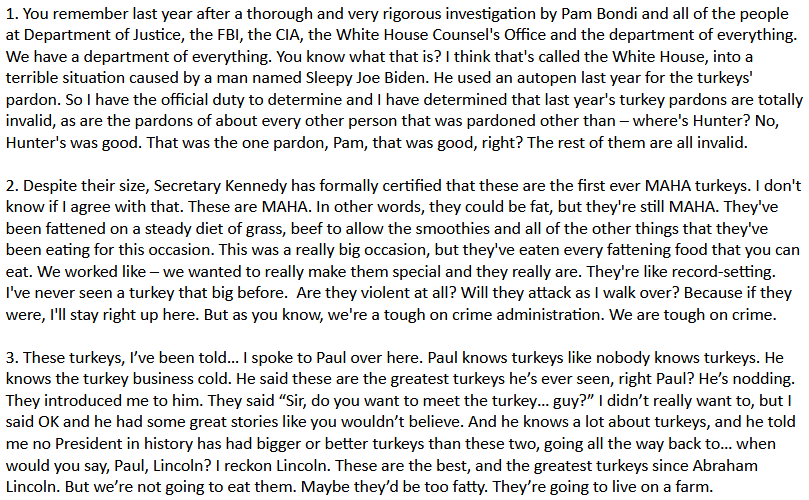
Here are the statements from this week’s Fake News game:
Spoiler
Statement 3 is Fake News. Mark chose number 2Mark got it wrong again this week, and is on 48%!
The Body of Evidence is not a logical fallacy
Jim guested on the Body of Evidence podcast and talked to Christopher and Sophie about logical fallacies, so we played the episode in this segment.
The stories we really didn’t have time to talk about
- On November 20th, a group of six Democratic lawmakers, all former military or intelligence personnel, released a video and accompanying statement reminding active members of the military and intelligence community that they can, and must, refuse illegal orders. This is, of course, completely accurate. U.S. service members take an oath to uphold the Constitution. In addition, under Article 92 of the Uniform Code of Military Justice, service members must obey lawful orders and disobey unlawful orders.The only reason anybody would have any issue with this at all is if they were already issuing illegal orders, or planned to do so. So naturally, Trump freaked the fuck out, accusing them via Truth Social of “SEDITIOUS BEHAVIOR, punishable by DEATH!” He also reposted several responses including one that said “HANG THEM GEORGE WASHINGTON WOULD !!” Some people saw this as a bit of an overreaction to lawmakers restating laws, and even suggested it might be inciting violence, but not spokesBarbie Karoline Leavitt, who just flat out lied that the Democrats were telling people to disobey lawful orders. Meanwhile, Secretary of War and former Fox and Friends weekend host Pete Hegseth told the Pentagon to investigate one of the lawmakers, Arizona Senator Mark Kelly, and consider recalling him to active service so that he could be court-martialled. Pete might have overestimated how easy it is to intimidate a former astronaut who flew over 30 combat missions as a Navy fighter pilot, but then Pete also overestimates his own ability to do a single pull-up. It makes sense that Pete would be feeling a bit sensitive about the issue, especially after the Washington Post reported last week on one of the war crimes he ordered people to commit in September. It seems that under Pete’s instruction, Seal Team 6 were having a normal one firing missiles at small boats in the Caribbean because they totally definitely were trafficking drugs, honest, no, you can’t see the evidence, it goes to a different school. Anyway, the boat was blown to pieces, but two of its occupants survived, clinging to the wreckage. Pete’s orders, according to the post, were to “kill everybody”, so a second strike was ordered on the survivors. Since that’s against the Geneva Convention even if the ad hoc war Trump has declared on supposed Venezuelan drug cartels was real, that would be exactly the kind of illegal order military personnel are required to disobey, and if they are later held accountable, “I was just following orders” isn’t going to cut it.
- Yeah, remember when Mamdani was running for Mayor of New York and in his election victory speech called Trump a “despot”. And Trump called Mamdani ‘My Little Communist and Liddle Communist and Mamdani the Commie’ in that irritatingly shit way he has of coming up with atrocious nicknames to belittle anyone he perceives as being a threat to him, and Leavitt billed Mamdani’s visit as a “communist coming to the White House“. Well Mamdani did visit and Trump was all cringey and pally and not shouty like he was with Zelenskyy – also not a communist. And also weird that when he did meet an actual communist – hmm is Putin a communist? Not really, well possibly as much as Stalin ever was – when he did meet Putin he was equally as fawning and cringey. Perhaps cos, like your least favourite Uncle who’s bound to say something outrageous about someone over Thanksgiving and Christmas, Trump just goes on the same shallow one-sided views fed to him by the Fox network as the basis for his thinking. We then get into the rabbit spiral of Fox fawning over Trump and spouting Trumpisms and Trump taking that as the truth and spouting that which gets reported by Fox and round and round the echo goes. Anyway having actually met Mamdani he’s all smiley and “this is my favourite nephew”y and starts waxing lyrical about how he loves New York and Mamdani will be great and if things had been different Trump would’ve been Mayor of New York, and said surprising things like ‘he’ll be a great mayor’ and he was “confident that he can do a very good job“. At one point the press asked Mamdani if he still believes Trump is a fascist, he began answering and Trump interrupted to say ‘it’s okay to say yes, it saves having to try to explain’. What is going on? Has Trump – and we live in hope for our Thanksgiving Uncles – actually got to hear about what Mamdani’s policies actually were, and what an earnest guy he is, and changed his mind? Or is it that he can’t help himself but pal up to winners? Or does he see a way to appease voters by having Mamdani tackle the tough cost of living environment that Trump himself has created, and then take all the credit? It has a similar feel to me to that of the Mayor of London nearly always being from the opposite party to the one in power, though at the moment Sadiq Khan is Labour and so is the government in power, and there’s a strange grudging detente between Starmer and Khan, notwithstanding the disastrous Labour campaign in Boris Johnson’s old seat pre-general election when Starmer endorsed a labour candidate that was opposed to Khan’s extension of the low emission-zone across London to include that constituency. I can’t work out what Trump’s doing, I suspect he doesn’t know, he’s just defaulting to appeasing New York Mayors like he used to when he donated to the Democrats in order to get preferential real estate deals in the 80s and 90s. I hope Mamdani keeps the affability card up his sleeve to throw back at Trump next week when Trump starts watching Fox again and sees good things being done for New Yorkers and starts worrying about his own popular appeal.
- Ignoring decades of science showing vaccines to be safe, the CDC’s website was changed last month to say: “The claim ‘vaccines do not cause autism’ is not an evidence-based claim because studies have not ruled out the possibility that infant vaccines cause autism.” Unsurprisingly, this follows a direct order from Felchy McBrainworm himself, RFK Jr, who insists this is based on the Gold Standard of science, which these days is presumably based on the idea that the person with the most gold gets to set the standard for science. The FDA’s getting in on the act too, with their top vaccine regulator, Dr Vinay Prassad, telling staff via email that for the first time, the agency “will acknowledge that COVID-19 vaccines have killed American children,” According to the email, he told the agency’s biostatistics and pharmacovigilance team to analyze 96 reported deaths from 2021 to 2024, and they determined no fewer than 10 children’s deaths were related to the COVID vaccine, and “the real number is higher”. The evidence cited was the highly reliable “trust me bro”. Real experts, like Dr. Paul Offit, who directs the Vaccine Education Center at the Children’s Hospital of Philadelphia, are skeptical, saying “Because he doesn’t provide any evidence, he is asking us to trust him on an important issue. All this will do is scare people unnecessarily. At the very least, he should provide all the evidence he has so that experts in the field can review it and decide whether he has enough data to prove his point.” Prassad and FDA Commissioner Marty Makary say that they will change how the FDA approaches vaccine regulation, such as requiring manufacturers to prove they reduce disease rather than show they generate antibodies but Dr. Jesse Goodman, who had Prassad’s job at the FDA until 2009 says that measures such as “immunologic endpoints like antibody levels… have helped provide children and adults with timely access to safe and effective vaccines, saving many lives.”
- Okay so this is a bit scary, and also a bit progressive? The US Coast Guard on Thursday issued a memo that reclassifies swastikas and nooses as “hate symbols” in a rapid about-face after facing intense scrutiny for a previous policy change which downplayed their display as merely “potentially divisive.” Scary cos that was the previous policy – can you be a bit Nazi, like being a bit pregnant?! A bit progressive?, well perhaps its so in the current Trump environment cos the newest memo expressly prohibits the display of nooses, swastikas or “any symbols or flags co-opted or adopted by hate-based groups as representations of supremacy, racial or religious intolerance, anti-semitism, or any other improper bias.” Before you go ‘yeah Coast Guard stick it to the good-people-on-both-sides fascist orange stroke-dodger’, the newest memo was released only hours after a Washington Post article pointed out that whilst since 2023, Coast Guard policy had said displaying the symbols “constitutes a potential hate incident.” In the updated policy first reported by The Post on Thursday, and issued by the Coast Guard last week, that language had been changed to referring to those symbols simply as “potentially divisive.” That policy had been set to take effect in December. Defense Secretary and GI Joe-wannabe Pete Hegseth has dismissed the idea of there being an issue with extremism in the military. During his confirmation hearing in January, Hegseth said a focus on extremism has “created a climate inside our ranks that feels political when it hasn’t ever been political.” Was this what gave permission for the Coast Guard – which is under the purview of Homeland Security – to feel able to relax its view a little? Hard to say, certainly agency spokesperson, Tricia McLaughlin, denied in a post to social media on Friday that the Coast Guard was “backtracking” by issuing the latest memo. “The 2025 policy is not changing—USCG issued a lawful order that doubles down on our *current* policies prohibiting the display, distribution or use of hate symbols by Coast Guard personnel”. Okay perhaps the Washington Post does still have some power over the Trump administration, and perhaps there are some inalienable truths when it comes to the wrongness of swastikas and nooses and other hate symbols. Eventually maybe the word Trump will join that list.
- A federal judge on Monday dismissed the criminal cases against former FBI Director James Comey and New York Attorney General Letitia James, concluding that Lindsey Halligan, the former Miss Colorado runner-up turned US Attorney who brought the charges at Donald Trump’s urging was illegally appointed by the Justice Department. I want to be very clear. I’m not questioning Lindsey’s legal expertise or experience because she’s a former beauty pageant contestant. It would be offensive and sexist to assume she’s not up to the job because she’s an attractive woman, or to conclude that her looks are the only reason she is in the job. Questioning a woman’s abilities based on how pretty she is, is wrong. However, when a president with a history of hiring attractive female lawyers who routinely demonstrate their ignorance of or disdain for the law, makes a Florida insurance lawyer with no prosecutorial experience at all, US Attorney for the Eastern District of Virginia, there are three possible reasons. Either she’s secretly amazing at law-talking stuff, he likes the way she looks, or she’s prepared to indict anyone he tells her to, regardless of whether they’ve done a crime. Turns out it’s probably those last two, since even before the cases were dismissed because her appointment was unlawful, she was badly tanking the case against Comey. She fucked up the Grand Jury proceedings so badly that Judge William Fitzpatrick ordered the DOJ to hand over all Grand Jury materials to the defense, writing his 24-page opinion that he had identified at least two statements Ms Halligan made to grand jurors that could be seen as “fundamental misstatements of the law that could compromise the integrity of the grand jury process”. One statement Halligan made, the judge noted, “suggests” that the grand jury “did not have to rely on only the record before them”, and that there was “more evidence – perhaps better evidence” that the government had that would be used at trial. Two days later, in a hearing about whether the prosecution against Comey was due to Trump’s animus towards him, it was revealed that the full Grand Jury never even reviewed the final set of charges. After they declined to approve one of the three counts she presented to them, instead of presenting them with a new indictment, Halligan simply took an altered version to the jury foreperson to sign it. According to CNN’s reporting, Judge Michael Nachmanoff, despite appearing exasperated and taking several seconds of silence to take in what the prosecutors admitted, did not give away whether he viewed the issue as a procedural or fatal error. In the end, it doesn’t really matter, as the cases have been dismissed, although that was done without prejudice, which leaves the door open for the DOJ to take another swing, should they ever get their ducks in a row. Fortunately, the DOJ’s ducks are the kind who prefer to kick each other in the face for a piece of bread than line up all tidily.
- Nursing home magnate Joseph Schwartz – no not like the childcatcher from Chitty Chitty Bang Bang, scouring the ‘burbs to entice elders into care home by means of a giant red metal horseshoe shape with N and S on the ends, he owes a lot of nursing homes – He was sentenced in April to three years for defrauding the government of $38 million. Schwartz was alleged to have overseen a “collapsed nursing home empire” and “willfully” failed to pay employment taxes – I know what you’re thinking ooh sounds like the kind of a guy Trump would love to hang around with – his kind of a fella – well you’re way ahead of me – cos around that time, Schwartz paid $960,000 to two lobbyists “seeking a federal pardon,” according to their lobbying filing. And who were the lobbyists making the filing? – yeah our old friends right-wing provocateurs and political-slapstick idiots Jack Burkman and Jacob Wohl. It is not clear what Burkman and Wohl did for Schwartz. But on Nov. 14, seven months after Schwartz’s conviction, Trump granted Schwartz a “full and unconditional” pardon. There you see Schwarz is his kinda guy alright. Liz Oyer, a former U.S. pardon attorney who was fired by Trump in March, said the involvement of the lobbyists — and the huge payment — heightens concern that there is “a special tier of justice for people who can afford to pay.” The pardon went against a March recommendation by Trump’s Justice Department, which cited the seriousness of Schwartz’s crime in seeking a sentence of a year and a day. The judge rejected that recommendation and in April imposed a three-year sentence. Schwartz had served three months when he was pardoned, according to his attorney. Burkman whose company JM Burkman & Associates is listed as receiving the payment, declined to discuss his role in the case. Though in an email, he called Schwartz “a wonderful human being and man of God who had been unfairly accused by the Biden DOJ.” I guess Trump’s God is on the side of Mammon and not on the side of caring for one’s elders, one’s employees or about paying taxes – yep yep yep “a special tier of justice for people who can afford to pay.” indeed.
- I was distressed to discover today that there’s a British branch of Turning Point USA, the Hitler-youth-esque political group previously fronted by tiny-faced dead person Charlie Kirk. It’s imaginatively named Turning Point UK, and they’ve made the news with a typically right-wing mix of bigotry and ignorance, by having a shit-fit about a drag queen in a panto. I realise pantomimes are a curiously British thing that many of our non-British listeners might be confused by, but basically every Christmas pretty much every regional theatre up and down the country puts on very broad comedic versions of familiar stories like Cinderella, Aladdin, Goldilocks, and so on. The main male character, known as the Principal Boy, is played by a woman, and a significant older female character, the Pantomime Dame, is played by a man in exaggerated drag, with huge wigs, over the top make up, and plenty of camp innuendo. It’s a beloved tradition, and enjoyed by all ages, usually starting very young. And that, of course, is the issue for the 17 year old Turning Point UK representative, who literally calls himself Young Bob, and was presumably never taken to a panto as a kid, when he appeared on Talk TV to decry a Christmas drag show in Richmond, which is aimed at kids. Young, dumb, and full of right-wing buzzwords, Young Bob described the show he hasn’t seen as “woke nonsense”, pushing a “marxist delusion” which is “hypersexualising children through transing them”, adding: “Five-year-olds are too young to explore this material, and even teenagers.” Can we please let these idiots know about Mrs Brown’s Boys on the BBC. Maybe they can make enough fuss to get it cancelled.
- In a similar vein about being a bit pregnant, is it possible to be a bit racist but not the bit where it actually is racist, kind of racism light? Racist adjacent? Super fucking racist Nigel Farage responded to allegations in the Guardian made by several of hs contemporaries at Dulwich college where he went to school in the 70s. The allegations are that Farage joked about gas chambers in earshot of Jewish pupils, asked non-white pupils where they were from and told them to go back there, and put another pupil in detention, when he was a prefect, for the colour of their skin. When asked about the claims, Farage responded: “Have I said things 50 years ago that you could interpret as being banter in a playground, that you can interpret in the modern light of day in some sort of way? Yes.” He added: “I’ve never directly racially abused anybody. No.” The word ‘directly’ is blushing to the roots of its hair with embarrassment at the amount of work it’s having to do there. Pressed on whether he would say categorically that he did not racially abuse fellow pupils, Farage said: “I would never, ever do it in a hurtful or insulting way.” So I did do it, yes, but I did it gently? Yeah I’m sure it didn’t hurt him one bit to say to a Jewish classmate ‘the nazis had the right idea’ – but you see Nige the hurt and the insult are not on your side of the words, it’s the effect of those words deliberately said to someone, the hurt and the insult is theirs to measure and attest to – not yours. Where’s the Reform spokesman echoing Tricia McLaughlin’s Coast Guard doubling down on the fact that this stuff is not tolerated and it’s a hate crime? Ah yeah probably facing 10 years in jail for having taken pro-Russian bribes like former Welsh Reform UK leader Nathan Gill. And where’s Farage just ‘fessing up and saying sorry and he was young and ignorant and he’s of course changed in the intervening years and will ensure he and his party do everything they can to ensure that no hints of racist behaviour could ever be construed from any of their actions, policies, speeches or broadcasts? Yeah nowhere cos there is of course a reason why he hasn’t done that – fundamentally anger and hatred pays his bills, that and he’s a fucking racist. Meanwhile, Police have arrested two men in connection with a mobile phone hidden in the House of Commons that was reportedly planted there to play sex noises during Prime Minister’s questions…. and that’s all I’ve got to say about that.
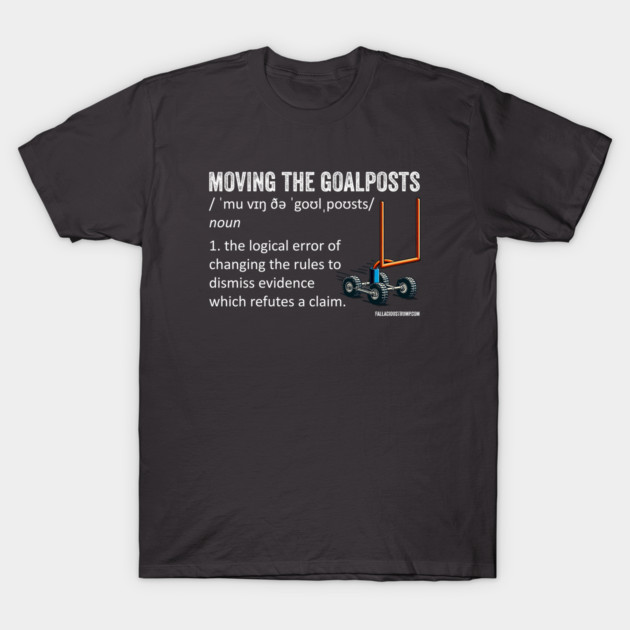
You can now buy Jim’s book, 2000 Mules and One Big Lie: A Stubborn Conspiracy Theory, and you can buy all our t-shirts, mugs, hats and more at our TeePublic Store, including this week’s fallacy:
That’s almost all for this week, but here’s our AI-aided transcript, which is quite accurate, but not totally:
Moving the Goalposts (Redux) – FT#186 Transcript
Read the full transcript
00:23 Jim: Hello and welcome to Fallacious Trump, the podcast where we use the insane ramblings of President Piggy to explain logical fallacies. I'm your host, Jim.
00:30 Mark: And I'm your other host, Mark. A logical fallacy is an error in reasoning that results in bad or invalid arguments. And the logical fallacy we're taking another look at this week is moving the goalposts. And yeah, President Piggy, there was a really good thing on The Onion. I think it was where CNN put out a kind of cod BBC statement that they'd edited the speech so that he'd said: when he said be quiet, Piggy, he said be quiet, something, something, something, something. And I really like, of all the Muppets, Miss Piggy. They'd obviously edited it together.
01:01 Jim: Yeah, it was something like, be quiet, everyone, I'm trying to listen to this very intelligent female reporter's question. Also, by the way, I really appreciate the work of Miss Piggy.
01:12 Mark: Yeah, obviously, you're suing the Muppets.
01:18 Jim: Yeah, so, moving the goalposts. We talked about this back in, I think, episode eight. In brief. Yeah, it was a while ago. This is when someone States their case And when confronted with evidence that refutes their case, they just change the rules or just set new criteria for proving them wrong. In our first example related to Trump, we have the strikes on the Iranian nuclear facility which, when it had happened, Trump and Hegseth both said that they had completely obliterated the facility in Iran. And then reporting came out from the national security infrastructure, the intelligence infrastructure and fake news media saying that actually, no, they hadn't completely obliterated it. And not only was it probably only set back a bit, but it was also noted that before the strike had happened, there were loads of lorries at the site that were potentially taking away the enriched uranium.
02:21 Mark: Yeah, because he said with glee, he said, yeah, we're going to strike in a couple of weeks time. So they just kind of, you know, all you got to do is follow social media. The Iranian government, you know, have they checked whether the Iranian government is a member of Truth Social? That would be the first thing you want to do, wouldn't it?
02:40 Jim: So, in response to that reporters asked questions about: are you sure that all of the enriched uranium that you claimed was obliterated was actually obliterated and not taken away? And Pete Hegseth got very angry and complained at the reporters. And then he talked about how well planned the attack was. That was what he kind of shifted to. And also claimed that even people like the UN were saying that the Iranian nuclear had been badly damaged and set back years and things like that, which is not the same as completely obliterated. And then other Republicans started saying that actually completely destroying it was never the point, was never what they were trying to do anyway. So here's Tom Cotton and Lindsey Graham being interviewed after the fact.
03:29 Clip: On the strike on Iran's nuclear facilities
— It's not part of the mission to destroy all their enriched uranium or to seize it or anything else.
— I don't know where the 900 pounds of highly enriched uranium exists, but it wasn't part of the target set.
03:41 Jim: So they're just changing what it was supposed to be about. Because initially they were trying to destroy, completely obliterate in Trump's own words, Iran's nuclear program. And they didn't, but they had damaged it. And then their allies were saying, well, we were never intending to actually destroy it completely.
04:00 Mark: It's a bit sharpshooter fallacy as well, isn't it? So, you know, yes, we've actually obliterated. No, no, let's have a look at what the evidence is. And then we'll just draw around that and say, oh, yeah, well, that was always the plan.
04:13 Jim: So other example in the Trump world is the whole Epstein thing.
04:18 Mark: It's just Epstein.
04:20 Jim: It's just Epstein. I don't have clips for this because there's so much of it. There was no real way to narrow down things.
04:27 Mark: Remember, well, the last time we did this, it was the Russia conversation. Yeah, it was the meeting in Trump Tower. The timeline just went on and on and on and just moved and moved and moved.
04:38 Jim: Yeah, so I've got another timeline about Epstein. The main thing obviously with Epstein is the whole connection between Trump and Epstein and all of the evidence against him, the potential possible client list, the documents that the DOJ have that they are. Now. Currently we're waiting for them to be released. They've been ordered by a judge to release them towards the end of December and we are in that 30 -day period where they have to to release them. So of course we know that they were longtime friends and Trump at one point said that Jeff's a great guy. It's even said that he likes women more than I do and on the younger side and that kind of thing. Yeah, and Epstein said that he was, was Trump's best friend. But that's years back, that's going into the past. More recently, in 2024, when Trump was on the campaign trail, yeah, he appeared on Fox news and was asked if he would declassify the Epstein files and he said he would and compared to the jfk stuff, he said probably less so for the Epstein files because you know there's. If there's phony stuff in there, then it could damage people, could affect people's lives. He was asked by lex friedman in september 2024 – 2024 – if he would release the files, if he would declassify everything to do with Epstein and he said that he probably would and that it's very interesting the case, especially you know the way he died. He said I'd be inclined to do it with Epstein, I'd have no problem with it. He gets into power January 30th. Kash patel – oh yeah, who has previously done lots of conspiracy. Yeah, pushing about Epstein.
06:07 Mark: Yeah, release files – why are they being released? And he says they could release least
06:12 Jim: them right now when I'm in charge of the fbi lb. Yeah, they were recent. He says I'll do everything if confirmed as fbi director because this was still during his confirmation process. Yeah, to make sure the American public knows the full weight of what happened in the past and how we're going to countermand missing children. Not sure that's how you'd normally use countermand. Yeah, but um, yeah, uh, but yeah, he, he vowed to expose Epstein and his connections. Uh, in february, february 21, pan Bondi um were told Fox news that the client list was sitting on her desk right now. Yeah, it's a directive by President Trump to release it and they were just kind of going through the details and they were going to release. The end of that month, february 27th, she invited lots of maggot influencers to the white House and handed them binders that were labeled the Epstein files, phase one. Yeah, yeah, that was supposedly new information – actually didn't really contain anything that hadn't already been released. Yeah, and there were no further phases after that. Yeah, but but the performative bit of it was: look, we're releasing it, here are some hastily labeled lever arch files.
07:18 Mark: Yeah, yeah, that we just got from walmart. Yeah, over the next
07:22 Jim: few days she told Fox and sean hannity that Americans would get the full Epstein files, that the Doj had received a truckload of evidence from the fbi, that everything is going to come out to the public. She told Fox on March 23rd: we're releasing all of these documents as soon as we can get them redacted to protect the victims. At some point in May, according to reporting by the Wall Street Journal. Later on in the year, Bondi told Trump that his name appeared multiple times in the Epstein files and then all of the stuff that people were saying about how they're definitely going to release. Everything kind of changed a bit. So they start downplaying the conspiracies. Kash Patel and Dan Bongino go on Fox News again on May 18th to say that Epstein didn't die of suicide. There's no conspiracy, it's all fine right. On July 7th the DOJ released a memo clarifying that Epstein's death was a suicide. There's no client list. There's no credible evidence that Epstein blackmailed prominent figures or anything any weird mysterious stuff about his death. It's all fine, nothing to see here.
08:28 Mark: Yeah, move along long.
08:29 Jim: Yeah, yeah, basically they. They're saying there's really no, there's nothing for us to do anymore.
08:34 [Unclear]: Everything is humanly just everyone shut up.
08:36 Mark: Yeah, I remember cash patel saying: yeah, I've petitioned for all these files to be released, but there are no files. Uh -huh, he said, even after pan bondia said yeah, yeah, there's loads of files and trumped in them. And then he was saying: well, there's no files. What can I tell you? No, there's no files. Sorry to disappoint. Yeah, he must have have been really disappointed to find that either there were lots of files and he couldn't tell anyone about them, or there were no files.
09:06 Jim: So the day after the DOJ memo comes out saying there's nothing to see here, reporters understandably are asking questions. They ask Bondi and Trump what was going on. What were you talking about only two months ago? And this was the time when he said, are you still talking about Jeffrey Epstein? This guy's been talked about for years. Years are people still talking about this guy? That is unbelievable. It's like a day after they just announced that the biggest pedophile that they've ever arrested was, yeah, like there's nothing. There's nothing in his documents that anyone wants to see.
09:41 Mark: No, still still banging on about this guy. Surely it's time to move on.
09:47 Jim: So that was july 8th, july 12th. He sends a huge Truth, Truth saying what's going on with my boys and, in some cases, gals, going after attorney general pan Bondi, who's doing a fantastic job in all caps. Basically, he says: why are we giving publicity to files written by Obama, crooked hillary comey, brennan and the losers and criminals of the Biden administration who conned the world with the Russia, Russia, Russia, hoax 51 intelligence agencies, the laptop from hell, etc. Wow, he says they created the Epstein files just like they. They created the fake Hillary Clinton, Christopher Steele dossier. They used on me. He says, let Pam Bondi do her job and not waste time and energy on Jeffrey Epstein, somebody that nobody cares about.
10:36 Mark: I forgot it kind of pivoted to it's a Democrat hoax. If in doubt, it's a Democrat hoax.
10:42 Jim: So this is like less than a week after the DOJ have said we've gone through everything. Thing there's. There's no evidence that would lead us to prosecute people like third parties who have, who are currently unindicted. There's nothing to see and now Trump is going. It was all written by, yeah, the Democrats, the stuff that there is none of.
11:02 Mark: Yeah, yeah, all of that.
11:03 Jim: Yeah, wow, it's weird that the Democrats – two presidents and hillary and uh comey, who ran the fbi at the time, and brennan who who ran the CIA – it's weird that they wrote a thing that then didn't have any evidence in it or lead to any reason to investigate any other third parties. That's a bad job that they did. But three days later he decides that it's not important that there was a conspiracy involving two presidents, the CIA and the FBI – to falsely connect him to a criminal pedophile who died suspiciously. Because it's just too boring. It's such a boring story. Story. Yeah, he said it's pretty boring stuff. He said that Bondi should release whatever she thinks is credible on Epstein. Okay, uh, which which gives her quite a lot of leeway. Yeah, and yeah, it's pretty boring stuff. He's dead for a long time. He was never a big factor in terms of life. Okay, yeah, yeah, and uh, he says I don't understand what the interest or what the fascination is. I really don't. And the credible information's been given. There you go. So everything credible is already out. You don't need to know anything. It's all very boring. But Bondi's going to look into
12:18 Mark: and release anything that's credible.
12:25 Jim: The next day he gets angry again on Truth Social July 16th and complains about the fact that his followers, the ones who – people like Cash Patel and Dan Bongino, you know – riled up into the conspiracy in the first place, are believing this hoax by the Democrats. And he says he doesn't want to have anything to do with them anymore. These people who believe this, his supporters, he says, let these weaklings continue forward and do the Democrats' work. Don't even think about talking of our incredible and unprecedented success because I don't want their support anymore. He says. So he abandons any of his followers who still believe that there's anything to see in the Epstein files.
13:04 Mark: It wasn't the conspiracy that there was stuff in the Epstein files and when Trump got into office, he would sort it out. He would bring to justice all of these.
13:14 Jim: And he'll come back to, it proves that Clinton and Larry Summers and people like that all did bad things.
13:19 Mark: Oh, right, and the cartel and the adrenochrome and all that kind of stuff.
13:24 Jim: Yeah, yeah, but at this point, none of it proves anything.
13:27 Jim: There's nothing there. Nothing there. It's all very boring.
13:32 Jim: So the next day, July 17th, the Wall Street Journal reported the letter that Trump wrote to Epstein. The 50th birthday thing about the: may every day be another beautiful secret thing. The weird fucking letter. Framed by Trump's drawing of a naked woman slash girl. The next day he said he was suing them for $20 billion. But on the same day, he asked Bondi to unseal the grand jury transcripts. And it's a pretty safe thing to do because, first of all, courts aren't going to do that because there's a long -standing tradition that grand jury transcripts are secret to the grand jury because it doesn't form part of the trial. It is right how they get an indictment and then all of the evidence comes out of trial. Yeah, so testimony is typically sealed and also, whatever was in there was quite unlikely to be anything about third parties, because it was stuff that was going to be talking about Epstein himself and Ghislaine Maxwell. So even if the DOJ had been successful in getting that released, it probably wouldn't have led anywhere, but it does have the handy benefit of suggesting pretending that they're doing something.
14:43 Jim: And that he's happy about them releasing stuff.
14:46 Jim: That was actually ruled on by Federal Judge Paul Engelmayer in August, August 11th. He ruled against it. He ruled against unsealing the Grand Jury materials and said that most of the records were already public. He added that an observer might conclude that the government's motion for their unsealing was aimed not at transparency but at diversion, aimed not at full disclosure but the illusion of such Nice. So, yeah, I think that's accurate.
15:11 Mark: It's sounding like people, it's like the thick of it, or the US version, the beep, where they're just kind of you can almost see what's been going on behind the scenes, because they're panicking about it and they go: alright, what can we do? That makes it look like we're doing something? Yes, absolutely we could do that and that.
15:31 Jim: Yes, so it's yeah, yeah, this is a combination of performative work and denying. That's basically what they're doing that whole time. Yeah, 6th of October, moving forward a bit, yeah, the Supreme Court declined to hear Ghislaine Maxwell's appeal of her prison sentence for sex trafficking. Yeah, and so people started asking Trump about whether he planned to pardon her, because that's basically her only chance now, way out. Yeah, his answer was – I haven't heard the name in so long, weirdly channeling uh obi -wan and said I, I can say that I'd have to have a look at it. I'll speak to the Doj. So he didn't say: no, I won't pardon the convicted sex trafficker who was an associate of the person who I definitely had nothing to do with for years and years and years. Yeah, yeah, he said I'll look at it. A month later, Later, November 12th, Caroline Leavitt ruled out him pardoning. Maxwell said it's not something he's talking about or even thinking about at this moment in time. He did not, however, rule it out. He has continued to say, I'll look at it, you know. But that was the same day that the shutdown ended and Adelita Verhalva was sworn in. She signed the final vote in the request by the House to release the Epstein files by the DOJ. At this point, when it became clear that they were definitely going to be released, Trump said that House Republicans should vote to release the files and the Senate should vote to release them, because it was clear he was going to lose. There's no way around that. So he flipped to the winning team.
17:04 Mark: In the hope that he'd be exonerated or that that participation would be taken into account in the inevitable court case.
17:15 Jim: The files haven't been released yet. We don't know how much they have been redacted. I do know that the paper that was passed by the House did have quite strict rules about redactions, about what's allowed to be redacted and about when you do redact things, giving reasons and explaining what has been redacted and what you know, giving a summary, basically, of what's been redacted and also why you redacted it. And specifically saying that it's not enough to redact something just because it makes someone look bad.
17:44 Jim: But we don't know. We don't know what the results of that will be. We don't know what it will look like when it comes out yet. But we do know that he not only flipped to the winning team, but when it was then passed by the House, and passed by unanimous consent in the Senate, he took credit for the fact that it was now being released. And again the fact that he was saying: yes, you should release it, I want you to release it. He didn't have to do that at all. He at any point could have said: release it. He could have told the DOJ to release them,
18:16 Mark: but he wasn't convinced that he was going to lose up until that point, so
18:21 Jim: he only did it when it became clear that he couldn't. And, of course, part of the reason why Adelita Grijalva had not been sworn in during the the government shutdown – because she absolutely could have been – was to delay that vote. And I know that Mike Johnson, when that happened, he did pass, you know, he held the vote and they passed it. When it was then taken direct to the Senate and they didn't even vote on it, they just passed it by unanimous consent. Which is a different process. He was interviewed when that happened and he was not happy about that. He expected the Senate to look at it and make changes to it before they voted on it. The shifting narrative of how bad it is for everyone other than Trump, how actually it's all Democrats. Yeah, he's claimed that it's going to make them. Lots of Republicans online have claimed that it's going to make Democrats look bad, to which all Democrat supporters have said: good fine, whatever Democrats are in there, fucking look them up. We don't care. We're not on a team with them. Our team is people who don't fuck kids. So if they're on that list, They're on the other team, Fuck them, We don't care. So that's been one argument. Other people have said that He was only staying close to Epstein, Even when they were constantly pictured together At parties and stuff, So that he could gather evidence To bring him down Because he's got to remain squeaky clean.
19:56 Mark: Well it's, the entire thrust of the QAnon thing was that he was going to come in there and bring everybody out and lock people up and get rid of the elites. And of course, if he's one of them, they will have to change the story so that he remains the God King Messiah. Of course. The squeaky clean one. And justifying building the largest, beautiful ballroom ever. So we've heard the goalposts whistle by as they move from one end of the playing field to the other, so they could just be stocking out with coal because I've gone from a V8 motor to a steam train metaphor now, because the V8 is not fast enough when they're released.
20:44 Jim: That's when we'll see the next stage of claiming that. But I almost certainly can guarantee that they will claim Caroline Leverett will claim Trump will probably claim that they completely exonerate Trump. No matter what they say. The claim will be that he's completely exonerated by the release.
21:04 Mark: Completely exonerated. So we don't need to release it to people to see it, especially the fake news media, who will just point at me and tell me I'm a bad guy.
21:17 Jim: One thing we do know is that they have spent quite a lot of time and effort, as I think I've made clear, trying to avoid these coming out and trying to downplay the significance of them if they were to come out, yeah, um, and given the other stuff that's come out already and how bad that looks, yeah, yeah, it suggests that the stuff that is yet yet to come out is probably also bad.
21:45 Mark: Well, it's certainly not boring, I suspect.
21:48 Jim: No one cares.
21:49 Clip: "No one cares about Epstein"
— No one cares about Epstein.
21:51 Mark: Move on.
21:52 Clip: "No one cares about Epstein"
— Nothing to see.
[Sting: Mark's British Politics Corner] And now is the time, I think, for Mark's British Politics Corner.
21:56 Mark: So my first example, the Budget. Last week Rachel Rees gave her Budget that she'd been kind of preparing us for for a month or so. And then the Office of Budget Responsibility leaked it an hour before she stood on her feet and talked about it. Consequently, the head of that has resigned. There you go, Trump. Take note. Yes, it's an ignoble act, so he fell on his sword. But in the Budget last week she increased the state pension allowance but froze the threshold above which the higher rate 40 of income is paid, effectively, meaning that pensioners in receipt of the raised pension could cross that higher threshold and end up paying income tax on their pension payments. Because the goalposts of the retirement age – for women, for example, it had been moving since 2010, from age 60 to 65. By november 2018 it went up to 66, to be in line with men. By october 2020 it's going to go up to 67, between 26 and 28, and then 68 between 2044 and 2046. So take note, listeners. So yeah, if you're in the Uk, the retirement age is going up and up and up. So by the time you get there, you'll be paying the high rate of tax. Residents of pension capital of the Uk, scarborough, identify what the problem is.
23:23 Clip: Scarborough voters reacting to the budget
— They just keep moving the goalposts, don't they? You don't mean so. I'm 64 now. I should have retired four years ago. That's what my plan was, you know, when I was started work, when I was 16, and now, uh, and now it's like getting further and further away. So it's going to be 67 now. I guess you know it's like: oh, my word. So even though I'm his full -time carer, I've still got to keep on working.
— Pensioners here in scarborough, some people saying they haven't yet reached that age yet for being eligible for the pension because those goal posts keep changing and with the rising cost of living could they be giving in with one hand and taking from the other?
23:58 Mark: So there's, the goalposts are moving. It's the retirement age, so you can't actually retire to get your state pension. And when you get your state pension, they move the goalposts such that you'll be paying tax on the very stuff that you paid into in order to receive and then, when you receive it, you'll be taxed on that. Goalposts moving all over the place. Also quite enjoyed the gb news journalist mangling moving the goalposts to changing the goalposts. They're not moving them, they're just changing them entirely Riley, from rugby ones to hockey, I don't know. And also giving in with one hand and taking from the other. That well-known phrase has lots of people say. So our second example, in the aftermath of the patriotic, but actually just racist recent campaign of hanging union flags and the cross of St. George on lampposts and across roundabouts in bits of Britain, bits of Britain that are not very diverse in the first place. They were fundamentally to protest about the invasion of migrants and take back our Britain and England, in a sense fermented by the professional racists like Farage and yaxley lennon, which was just to distract from the actual equalities. If you've got equalities, what do you do? You blame the migrants, blame people that aren't the same as you, and also, in that distraction, that it prevents elected politicians like nigel Farage from having to engage properly in politics and do something about tackling those inequalities. Well, in the wake of all that, a library exhibition featuring an interpretation of the Union flag celebrating the diversity of the UK was pulled in Brighton over concerns that it may cause offence to visitors. Basically, it featured an artist who was called Gil Mwalim Doran, who'd created an artwork called The New Union Flag, which champions the rich cultural variety found in the country, and was created actually in collaboration with Stand Up to Racism, and it was due to go on display at the Jubilee Library in Brighton alongside, importantly, two other reimagined flags: a Union Jack with the words The English were migrants, slash English were German along the crosses, and a St George's flag with St George was Palestinian and St George was a migrant emblazoned across it. But Brighton councillor Bella Sankey, leader of Brighton and Hove City Council, kind of dealt with it, as the left so often does, in a nuanced way to try and capture and represent the interests of all the diverse communities that Brighton is known for, said. Said, our libraries have been recognized as libraries of sanctuary, something we're very proud of and keen to maintain, given the fears that minority communities have expressed to me in recent weeks and months. There are particular concerns that displaying national flags could be taken out of their artistic context. Customers who do not or cannot read the signage could see the artwork of the flags as a statement by the library and therefore the council. As council buildings, Our libraries need to remain neutral spaces and a safe space for all our customers, which sounds pretty nuanced and thought through. However, long time listener and first time caller to LBC Radio, Lorna knew better.
27:28 Clip: An LBC listener definitely not being racist
— The mayor of Brighton is a Muslim.
— Amanda Grimshaw. Pardon? Amanda Grimshaw is the mayor of Brighton. No, no.
— No, no. Well, in which case it's the deputy, who is a Muslim. And he is, and he speaks very little English. Perhaps he's had some comment. We don't know, do we?
— Are you talking about the former mayor of Brighton, Lorna? Ah, did… Mohammed Asaduzaman.
— Ah, Mohammed… Well… He's Bengali.
— He's lived in Brighton for 30 years. He does speak English.
— Well, it's not very… Well, not terribly… He has an accent. Not terribly… No, no.
— He speaks English perfectly well, but he's got an accent.
— A bit more than an accent, but anyway. I don't know. All I'm saying is I think there must be an awful lot of people.
— No, but what you're saying is that you think the Muslim man who's got an accent must be somehow behind this. That's what you're saying.
— No, no, no, no. No, I'm not. No, no.
— It sounds like it because you've called in and you've inferred that because he's Muslim and he speaks with a foreign accent, then maybe he was involved. That was your point.
— What I'm saying is also there are an awful lot of students down there who are very left-wing.
— Yeah, but they don't run the council, Laura, do they?
— No, they don't, but they obviously have a great… And order disco. But also the council's probably very left-wing as well.
28:50 Mark: Amazing, isn't it? So, incidentally, when she said, oh well, it's definitely the deputy, then if it's not the mayor, who is a middle -aged white woman, Amanda Grimshaw, most un -Muslim name – the deputy mayor, ty galvin, who was a former deputy mayor, he's, who was 85. He's an 85 year old white man and I'm appalled to look at him and I was thinking I'm gonna look like that when I'm 85. Yeah, that's like, maybe not very wearing deputy mayor robes, but yeah, um, and muhammad, as a dozen man. Yes, he was bengal. It's amazing that she kind of went: ah well, there you go, muhammad, that's it, it, there it is. You know, he got elected mayor in may 2024 unanimously by the councillors. Um, oh, and bella sankey, who's the leader of the council, also a white woman in her 30s. So, and the so? Well, there's a lot of left institutions, as she points out. Well, they don't run the council, oh, yeah, but it's a a really left, a very left -wing council. Well, it isn't because it's labor, so it's not, but it's just the hurtling goalposts. Brilliant, isn't it? Or did she just? Well, you're just an outright racist. No, no, that's not what I'm saying. What do you? That's exactly what you said when, when I pointed out that none of those people that you've said could be successfully racially profiled in the the way that you're inferring. You've just moved on, you've alighted on something else and then, when he's no longer the mayor, he had nothing to do with this decision, which was taken two weeks ago. Yeah, yeah, well, it's, it's the students. Yeah, fantastic. And our third example, which isn't contemporary nor an example that came, since we did it yonks ago. Um, in fact, I just don't. I don't know why we didn't light on it before, but it is brilliant. Owen Patterson, who was then the Tory Department of Environment, Farming and Rural Affairs Minister, was asked on BBC's Spotlight programme in October 2013 about the apparent multiple changes and backtracks in the then policy of badger culling, which was undertaken in order to tackle outbreaks of foot and mouth disease in cattle.
31:05 Clip: Owen Paterson blaming the badgers
— I'm very satisfied that we've proved that in Somerset that this method is safe. The badgers have been shot cleanly. and have died very quickly in a humane manner, and I think that's very important for the future. And on effectiveness. They've achieved in six weeks 60 % of the current numbers and our chief vet is absolutely clear that that will lead to a significant reduction in disease.
— What you describe there as success, the critics will argue, has been a failure on all levels. You didn't estimate the number of badgers in the area correctly in the first place. You haven't reached the 70% target of killing badgers that you set yourself at the beginning of this. Now the trial has to be extended. You're moving the goalposts on all fronts.
— No, that's not right at all. The badgers have moved the goalposts. They're dealing with a wild animal subject to the vagaries of weather and disease and breeding patterns, which, of
31:56 Mark: course, in my, to my visual mind, whole bunch of badgers in masks doing it at night time, absolutely just like like picking them up, scurrying along. Yeah, but the Badgers moved the goalposts. Want that on a T-shirt. And people there, of course, with Moving On Up.
33:24 Jim: So in the Fallacy in the Wild, Why would we like to talk about the fallacies of the week from a non-political perspective? And our first example this week comes from Futurama. Yay! And for Scathing Atheist fans. This is the episode, and this is just a couple of minutes after. This is the episode where Professor Farnsworth says that we did in fact evolve from filthy monkey men. Ah, I've heard. And so this is about evolution. This is where Farnsworth has a debate with Dr. Banjo, an orangutan scientist, about evolution versus creationism. Creationism.
33:53 Clip: Futurama
— If your elitist east Coast evolution is real, why has no one found the missing link between modern humans and ancient apes? We did find it. It's called homo erectus. Then you have proven my case, sir, for no one has found the link between apes and this homo erectus. Yes, they have, it's called homo habilis. Aha, but no one has found the missing link between ape and the so -called Homo habilis.
— Yes, they have! It's called Australopithecus africanus! Ho-ho!
— I've got you now! Fair enough. But where, then, is the missing link between apes and this Darwinius massali? Answer me that, Professor!
— D'oh! Okay, granted, that one missing link is still missing. But just because we haven't found it doesn't mean it doesn't exist! For sure! Things don't exist simply
— because you believe in them. Thus saith the almighty creature in the sky.
34:51 Mark: Nice. For sure. For sure. That fade where he goes, bling, bling. There's the graphic, and they've kind of been doing it so long. Yeah, they've been at it a while. The crowd's gone, yeah. And they're all lying on the floor waiting. And the links, the list, the kind of little evolutionary graphic is miles long because he's found all of them. There's the essence of the argument, isn't it? They'll keep going: okay, yeah, but this bit, yeah, but that bit and that bit, and you can provide all the proof. Yes, we found that, we found that, we found that, found that. And there's one bit. They will alight on the people making this using this vanity, and they say, ah, and if you can't provide that bit of evidence, that dismisses all of the rest of it that you have provided?
35:37 Jim: Because, yeah, because they set the criteria for what is, yeah, proof? Yeah, and they keep changing the criteria. Yes, and that is Part of good critical thinking: when you are having a debate with someone, if you pre -select what you would be convinced by and that is then provided to you, even if emotionally you feel, well, I'm still not really sure about it, you have to accept intellectually that they have fulfilled the criteria that you set previously, and at least that should make you change your opinion about something. And this is something that happens in scientific papers. When people do scientific studies, one of the best things to avoid kind of pseudoscience creeping in or p hacking or those kinds of things is when people pre -register the details of the study: how they're going to do it, what they expect to find, what criteria would be a success or would disprove the null hypothesis and so on. Yeah and, And when they do that and they register those, then that improves how much you can rely on how well that study has been done. Because you can see that they set the criteria in the first place, they ran the study and then whatever came out of it, that's what they reported. As opposed to sometimes, when they don't do that, and then you'll find that they've actually kind of sliced up the data in so many ways that it is kind of meaningless now and would inevitably have shown some positive thing.
36:58 Mark: Yeah, yeah, and then yes, and you move the goalpost to redefine what shows the success: yeah.
37:06 Jim: Our next example, one classic example of this, is darth vader talking to lando calrissian: yeah, telling him that he's altered the agreement. Yeah, that they had. Lando complains and he says: I've altered the deal, pray, I don't alter any further. Yeah, yeah, but I haven't got that clip. What I've got is one from the pilot episode of Battlestar Galactica, the 70s version, because Battlestar Galactica gets a lot of shit talking about how much it's an obvious rip off of Star Wars. Yeah, and it 100 % is. It absolutely is. Star Wars came out in 1977. Glenn A. Larson saw it and was like I could do something like that on TV. And in 1978 Battlestar Galactica came out. But that interchange between Darth and Lando comes in. A empire strikes back, which is 1980, and this is from 1978. Welcome balta.
38:01 Clip: Battlestar Galactica
— I have grave news. A handful of colonials prevail, but we will soon find them. What about bargain? My colony was to be spared. I now alter the bargain. How can you change one side of a bargain when there is no other side?
— That's a very familiar voice. It's Patrick McNee.
38:22 Jim: Ah, yes, there we go As the Imperious Leader. They called him the Imperious Leader Because they didn't bother looking up The word Imperious, Which just means arrogant. Basically, Yes, But they thought He runs an empire. He's the Imperious Leader. They didn't want to go with Imperial Because it had already been used by Star Wars. So Anyway, Anyway, nearly George Lucas watched Battlestar Galactica following his success and was like: oh, who are these people ripping me off? Saw that scene and was like, oh, I could use that. That's pretty good.
38:58 Mark: A bit of goalpost moving. I love that.
39:01 Clip: Selma
— Yeah.
39:03 Jim: So our final example in this section is from the film Selma. Oprah Winfrey's character is trying to register to vote.
39:12 Clip: Selma
— You work for Mr. Dunn down at the rest home. Ain't that right? Yes. I wonder what old Don will say when I tell him one of his gals down here is stirring a fuss.
— I ain't stirring no fuss. I'm just here trying to register the vote.
— It's all right this time. It's right when I say it's right. Recite the Constitution's preamble. Know what a preamble is?
— We, the people of the United States, in order to form a more perfect union, establish justice, justice, ensure domestic tranquility, provide for the common defense, promote the general welfare. How many county judges in alabama? 67, if
40:26 Jim: you didn't catch that last bit, he says name, name them. Yeah, and this is extremely accurate in terms of the kinds of literacy and knowledge tests that were imposed on black voters trying to register to vote in the South during this period. Annie Lee Cooper was a real person. This represented her fifth attempt at registering to vote. And the tests that almost entirely white administrators would give and would be the final arbiters of whether the voter had passed the test would vary from place to place, would sometimes just be ad hoc, like that one. But in some cases, were written tests deliberately designed to be complicated? Yeah, they were designed to be hard to understand. There's a test in louisiana – literacy test – that was given to to anyone who couldn't prove a fifth grade education which, as you can imagine from the differences in education afforded to black communities and white communities pre -civil rights, that was more likely people of color. Yeah, and in the one test which I will link in the show notes, there's 30 questions and getting one question wrong would result in you not being able to register to vote, and the questions were written in a way that makes it difficult to be sure exactly what's being asked of you. Yeah, like one of the one of the questions is spell backwards forwards. Wow, not clear which? Yeah, which one you're supposed to be doing? There's things like in the space below. Write the word noise backwards and place a dot over what would be its second letter, should it have been written forward.
42:08 Mark: Whoa. And these tests were the same tests that were demanded of white voters. Well, there was no test.
42:16 Jim: If you could prove a fifth grade education.
42:20 Jim: Or you could just turn up with your white skin. Or if the administrator just believed that you probably had a fifth grade education. Then, yeah, it's fine. Because you're white. One of the questions. Draw a figure that is square in shape, divide it in half by drawing a straight line from its northeast Corner to its southwest Corner, then divide it once more by drawing a broken line from the middle of its western side to the middle of its eastern side. The other thing I should mention here is this 30-question test, you were given 10 minutes to do it. Jesus. So there wasn't time to think about how to do these ambiguously worded things. Yeah, you basically had to kind of work through it as quickly as you could. This is just louisiana in. In alabama there was – it was more a kind of trivia test – on civic procedure and, and like you had to name the attorney general of the United States, uh, answer questions about what various punishments were for different crimes, things like that. And across the South, these were again administered by white administrators to black voters. Yeah, and even if you did it perfectly, they could often find a way of saying, like if you were asked, for example, to draw a line around a letter in a series of letters and you drew a circle around the letter, they would say, oh, it asks you to draw a line, not a circle,
43:36 Mark: you just want to go. Okay, you show me how to do that, tell me how to do that.
43:41 Jim: Then, oh, you do that, you get arrested for causing trouble.
43:43 Mark: Oh, yeah, because being uppity, yes, yeah, wow, moving
43:47 Jim: the goalposts to make sure that you don't get to register to vote was, Well, oddly, a practice
43:53 Mark: that's been continued to be carried on by the Republican Party.
43:57 [Sting: Fake News] So we're going to play fake news, folks. I love the game. It's a great game. I understand the game as well as anybody. As well as anybody.
44:05 Jim: Yes, it's time for fake news. The game where I read out three Trump quotes, two of which are real and one I made up, and Mark has to figure out which one is fake news.
44:12 Mark: So with this game we ought not to concentrate too much on the actual score, more on the effort that goes into playing, which is far more measurable. Or, failing that, simply the number of brain cells that I'm putting to use. But if that doesn't yield an advantage to me, then simply the molecules of air that I'm consuming during the task. And then we need to measure the number of heartbeats, or the gallons of blood pumping, or the hairs on the back of my hand or anything, basically anything, until the moment that I win without having to who, even if I'd lost.
44:46 Jim: Well, we'll start work on measuring those things. Just in case this one doesn't go so well for you. So these statements come from the annual turkey pardon. Ah, right. Because that's a thing that happens in the US for Thanksgiving. I forgot about that. So, yeah, Trump did his thing. It's, you know, usually a kind of humorous, joyful occasion. But Trump was involved.
45:12 Mark: Oh yeah, didn't he try selling something last year? You might be thinking of the Easter egg roll.
45:20 Jim: There are plenty of opportunities for grifting through fun family activities at the White House. But this one particularly was about turkeys. These are reasonably long because there was a lot of bullshit to fit in. So, statement number one. You remember, last year, after a thorough and very rigorous investigation by Pam Bondi and all of the people at the Department of Justice, the FBI, the CIA, the White House Counsel's Office and the Department of Everything. We have a Department of Everything. You know what that is? I think that's called the White House. Into a terrible situation caused by a man named Sleepy Joe Biden. He used an auto pen last year for the turkey's pardon. So I have the official duty to determine – and I have determined – that last year's turkey pardons are totally invalid, as are the pardons of about every other person that was pardoned, other than where's Hunter. No hunters was good. That was the one pardon, Pam, that was good, right, the rest of them are all invalid.
46:14 Mark: Wow, there you went from turkeys to other people – every other person.
46:23 Mark: Statement number two: suspicious about the Hunter.
46:26 Jim: Okay, yeah, despite their size, Secretary Kennedy has formally certified that these are the first ever Maha turkeys. I don't know if I agree with that. These are Maha. In other words, they could be fat, but they're still Maha. They have been fattened on a steady diet of grass beef to allow the smoothies and all of the other things that they've been eating for this occasion. This was a really big occasion, but they've eaten every fattening food that you can eat. We worked like we wanted to really make them special, and they really are. They're like record setting. I've never seen a turkey that big before. Are they violent at all? Will they attack us as I walk over? Because if they were, I'll stay right up here. But, as you know, we're a tough on crime administration. We are tough on crime.
47:08 Mark: Grass beef to allow the smoothies and all the other things to allow the smoothies. Okay, yeah, are they violent?
47:19 Jim: Yeah, statement number three: hmm, these turkeys, I've been told. I spoke to Paul over here. Paul knows turkeys like nobody knows turkeys. He knows the turkey business cold. He said these are the greatest turkeys he's ever seen. Right, Paul, he's nodding. They introduced me to him. They said, sir, do you want to meet the turkey guy? I didn't really want to, but I said okay. And he had some great stories, like you wouldn't believe. And he knows a lot about turkeys. And he told me: no President in history has had bigger or better turkeys than these two. Going all the way back to when, would you say Paul lincoln? I reckon lincoln, these are the best and the greatest turkeys since Abraham Lincoln. But we're not going to eat them. Maybe they'd be too fatty. They're going to live on a farm.
48:02 Mark: Okay, yeah, see, I'll see what you've done there. Either you've picked one that's got sir in it or you've written one with sir in it. so the bit, yes, the bit in the – that's my spidey sense – is going on that one. But the gag about mahal turkeys and then the admission that he wouldn't want to walk over there in case they're violent, given the fact that this is the man that he said he would throw himself in front of a gunman the next school attack? Yeah, I'm not sure he'd admit to being afraid of violent turkeys. And then the pardoning of Hunter, auto pen pardons. Well, they're all fake because they're all preposterous, okay. So which am I going to go with? The one with sir? No see, I think that's going to turn out to be the real one, because cause, just cause. Okay, I'm going to go with. Number two is the one that you made up because
49:16 [Unclear]: the violent turkeys, yeah.
49:18 Jim: So if the other two, which are you more convinced by? Number one?
49:23 Mark: The pardon everybody, Pam Bondi, one.
49:27 Jim: And number one, yeah, israel.
49:31 Clip: Trump, played during Fake News
— You remember, last year, after a thorough and very rigorous investigation by Pam Bondi and all of the people at Department of justice, the fbi, the cia, the white House counsel's office and the Department of everything – we have a Department of everything – you know what that is, I think that's called the white House – into a terrible situation caused by a man named Sleepy Joe Biden. He used an auto pen last year for the turkeys pardon. So I have the official duty to determine, and I have determined that last year's turkey pardons are totally invalid, as are the pardons of about every other person that was pardoned other than where's Hunter. No, Hunter's was good. That was the one pardon, Pam, that was good, right? The rest of them are all invalid.
— So I think
50:29 Jim: this is supposed to be a joke. You know how when they do the White House Correspondents' Dinner and presidents who aren't Trump go along and do jokes? And the people who work for them, who normally do speechwriters, write them some jokes. And sometimes, if they're cool like Obama, they'll write some of their own jokes. And then they'll do the jokes, and everyone will realise they're doing jokes. And enjoy it. Because it's different to how they normally talk. And they'll do funny bits in them. And people will laugh. This, I think that's what's happening here. But the people he works for aren't any better at comedy than he is. No, the people who work for him – the people he works for – aren't any better at comedy either, but the people who work for him aren't any good at comedy. He is the worst at delivering anything as a joke, so he is delivering it like it's an attack on Biden rather than as a joke. I think it's intended to be funny,
51:38 Mark: also because he's reading off an autocue. What he normally does does is riff. He goes off the autocue.
51:47 Jim: He riffs a little bit, but yeah.
51:49 Mark: And the riffs are the bits where he normally relaxes and makes a joke-shaped statement, and people kind of appreciate that. But here he's being trammeled into having to use up all of his brain to read and then say the stuff that he's not.
52:09 Jim: And he still goes with the Department of Everything.
52:13 Mark: Is that because he went off-piste, off-piste, off-piste? Yes, I think he did.
52:18 Jim: But, yeah, he followed this by talking about Peach and Blossom, who were the turkeys from last year. And he claims that they kind of tracked them down and they were on their way to be killed, but they saved them and he's pardoned them now, which wouldn't make any sense because they were pardoned last year. they would have been killed last year if the pardons weren't valid. The only reason that their pardon would be rescinded is if he rescinded it because of the auto -penn thing and therefore he wouldn't need to pardon them again. Anyway, it's meaningless. It doesn't make any sense.
52:57 Mark: And the fact that that kind of, oh yeah, no, Hunter's is a good pardon, that's the one that was good. There's a gag that, well, it's given that And two caveats, Trump can't deliver anything to save his life and the right doesn't do funny.
53:14 Jim: Yeah, the Hunter one would have been a better dig at Biden if he'd claimed that that was the one he made sure he signed himself.
53:24 Mark: There you go, yes. He didn't do that.
53:26 Jim: He was just like, oh, yeah, we'll let the Hunter Biden one go, but everyone else, no. That's not either funny or an attack on Biden. Yeah, yeah, yeah, yeah, yeah. Ah, man. Yeah, it's all very shit.
53:46 Jim: So, you also think that number three is real.
53:51 Jim: And number three is fake news.
53:54 Mark: Oh, bollocks. I should have gone with the, sir, do you want to meet the turkey? Because there's the gag. It's jumping out at me now. Now, sir, do you want to meet the turkey dot dot dot guy? I didn't really want to, but I said, okay, yeah, soon as the sir turns up. The other – are we talking myself into a double bluff? There should have just gone with it's got a sir in it.
54:17 Jim: I did think it would be pretty amusing if he was like right in front of Paul. He was like I don't want to meet that guy.
54:24 Mark: Well, that'd be the kind of thing because he's completely unaware of what's going on. Like who was it fainted in the the White House? And he just stood there like completely. There is a theory that's because he's either pre -stroke or had a stroke and he's just, you know, he's not aware of what's going on around him. Yeah, he does. But it's just down to the fact he's a callous bastard, doesn't care about anybody other than himself.
54:50 Jim: He did claim that these were, if not the biggest, among the biggest that there's ever been of turkeys. They are like top top five. The thing is this hasn't been going that long. The other thing I kind of added in there was the idea that it's been going since lincoln. Yeah, yeah, it's actually only really been an official thing since bush senior, so it's not that long, um, but even even going back that far, uh, these, these two were like 50 and 52 pounds turkeys, which are big turkeys. Yeah, Clinton had one that was 60 pounds. Good God, they really fatten these ones up beyond the ones that you would normally get in the in in the stores and consequently, after they're pardoned, they rarely last very long. Because they, because they've, because, yeah, because they're not bred for longevity, they're not well,
55:40 Mark: no, because you only breed them to be eaten at Christmas or Thanksgiving, at Thanksgiving, not even making it at Christmas
55:48 Jim: and weirdly, they don't feed them grass, beef or smoothies or all the fattening foods you can eat.
55:54 Clip: Trump, played during Fake News
— No, despite the fact that number two is a thing he says, Despite their size, Secretary Kennedy has formally certified that these are the first ever Maha turkeys. I don't know if I agree with that. These are Maha. In other words, they could be fat, but they're still Maha. They've been fattened on a steady diet of grass beef to allow the smoothies and all of the other things that they've been eating for this occasion. This was a really big occasion. But they've eaten every fattening food that you can eat. We work like we wanted to really make them special. And they really are. They're like record setting. I've never seen a turkey that big before. Are they violent at all? Will they attack as I walk over? Because if they were, I'll stay right up here. But as you know, we're tough on crime administration. We are tough on crime.
— That's a segue, isn't it?
— Yeah, exactly.
56:50 Mark: Violent. Are they violent? Yeah, speaking of violence, we're tough on that. Beef to allow the smoothies. I mean… I want that on a T-shirt as well.
57:04 Jim: I feel like maybe, again, assuming this is supposed to be funny, because it's a light occasion. This is not a state occasion. He's not announcing the death of a terrorist. It's like he's pardoning a couple of fucking turkeys. So this is supposed to be lighthearted. I assume either there was a gag about Maha turkeys that he trammeled and just went off on his own thing.
57:31 Mark: He believed everything he was reading. I agree with that.
57:37 Jim: Or that was the gag. Secretary Kennedy has formally certified these are the first Maha turkeys. Which means nothing. No, it's. That's a terrible, incomplete joke. It it could be a setup to something, yeah, but it didn't go anywhere and it's nothing as it is. No, and he took it in a weird direction by by reading it and thinking,
58:03 [Unclear]: by disagreeing with the setup.
58:08 Jim: With the feed line, yeah, and the and the diet of grass, Grass and beef to allow smoothies can't have been what was written down.
58:16 Mark: No, he's got to have. How can it be?
58:21 Jim: I don't know what's going on.
58:26 Mark: Just what beef to allow the smoothies. But I want that. I do want that on a T-shirt. I've been fanned on a steady diet of grass beef to allow the smoothies.
58:38 Mark: And on the back, the badgers have moved the goalposts.
58:43 Jim: Yeah, so that's. That's the thing he said. Yeah, we have got some social contestants, of course. On Patreon, One Eyed Nick says: what the fuck did? I just read. Two of these are real. Can anyone smell toast exactly? I am literally lost for words. Fuck it. Number three is fake. Someone fetch grandpa. Maybe one of those turkeys could be President. They sound more or coherent and have a higher level of intelligence than their waddles are less gross to look at.
59:22 Jim: Richard Thunder Hopkins said, OK, you've nailed this one, Jim. I'm very sure number one is real as I've heard most of it. The other two, though, absolute gobbledygook. See what I did there? I'm going to have to plump for number two is fake news. He might not like referencing Maha because it wasn't his idea, I think. I quite like these, though. He wasn't mean to anyone except Biden, but that's normal. Renee Z says I listened to parts of his ridiculous turkey pardon speech. As usual, he talked about almost everything except the topic of the speech. He was foul and this was a family event. No surprise there. I'm fairly certain I heard at least parts of one and two. I don't remember anything about President Lincoln, so I'll choose three as fake news. Scott says: holy shit, I have no idea. They're all equally horrific. A Department of everything. And it's the White House, probably real. Is he afraid of turkeys now or has his stream of unconsciousness become worse? I think three is the one Jim made up, because the fattest turkey there was Donald, hey, Nice. And anders says: ranking from rambling to delirious, I picked the one that might be from an old person with a tinge of melancholia instead of a clear diagnosis. Number three is the one Jim made up.
1:00:33 Mark: Yeah, yeah, Nice. Nobody spotted the sir. Tell I should have just jesus. Yes, I've got to stop interrupting myself and just go. Well, yeah, got sir in it. That's the one. Yeah, yeah, see now, I said that out loud. Are you going to move all the uranium, aren't you?
1:00:52 Jim: Oh, anyway, finally, uh, on Facebook, andrew says number one is fake. I'm not believing he had issues with Biden pardoning turkeys, even as maybe a joke. I'll have to skip this part of the podcast so I can continue to believe this.
1:01:05 [Unclear]: Sorry,
1:01:11 Mark: very good, we should record a warning, just to say you might want to skip this bit
1:01:16 [Unclear]: too, in case it makes you believe something you didn't want to believe, in case it makes you believe something you didn't want to believe.
1:01:20 Mark: Yeah, you can't make something exist just by believing in it.
1:01:25 Jim: Yeah, so saith the creature in the sky. So it's time for the part of the show that, this week at least, is called the body of evidence is not a logical fallacy, because I was lucky enough to go on the podcast, the body of evidence, yeah, where I talked to Chris and Sophie about logical fallacies and their application in medicine, largely because that's what they talk about. They talk about, yeah, medical pseudoscience and all of that kind of stuff debunking that. It's great podcast I listen to all the time and I was very happy to go on and be the kind of the logical fallacy expert. Yeah, when Chris talked to Sophie, this was put out as an episode on their feed, just like a week ago, I think, but they were very happy to allow us to play it here.
1:02:11 [Unclear]: Yay!
1:02:17 Chris: Hello podcast listeners and welcome to another edition of The Body of Evidence. The show prepared to alienate half of its listener base because today we are talking politics with none other than Jim Cliff from the Fallacious Trump podcast. Hello, Jim. Hello, Chris.
1:02:34 Jim: Thank you very much for having me.
1:02:35 Chris: And joining us, of course, is Sophie, who has no idea what's about to happen, because I have deliberately kept her in the dark about the planning for today's episode. Hi, Sophie.
1:02:46 Sophie: Hi, happy to be here and in the dark.
1:02:49 Chris: So we are going to do something a little bit different today. The backstory to this is that Jim had reached out, I think back in the summer, about, you know? Oh, I love the show, which I always love to hear. I am a sucker for flattery, as most people know. And we had talked about doing some sort of collaboration episode Because Jim has his own podcast, The Fallacious Trump Podcast. So if you're interested in how logical fallacies intersect with politics, I guess, is that a good way to describe your podcast there, Jim?
1:03:21 Jim: Yeah, we look at different fallacy every episode and kind of use political quotes, for example, to show how it fits.
1:03:29 Chris: And so that sort of got me thinking is like, well, I mean, a lot of these same concepts also apply in medicine. And I thought, OK, well, maybe we could do the same thing with medicine. So we have a quiz now for Sophie about some of the more common logical fallacies that we see in the pseudoscience sphere. And of course, you can play along at home. So without any further ado, let's get right into it. All right. So here's our first logical fallacy. So what I'm going to do is, Sophie, I'm going to explain the medical myth. And then I want you to tell me what the logical fallacy is. If you don't know the specific name, it doesn't really matter. You can describe it. And then afterwards we'll bring in Jim to sort of explain how this logical fallacy tends to permeate in pop culture and in the world in general. So the first one's an easy one, Sophie, because I'm throwing you. We're starting with an easy underhanded pitch.
1:04:24 Sophie: You can't say it's easy before I've answered the question.
1:04:27 Chris: Well, it's a subject that we've already talked about, and it's about red light masks. So the thing that I love about red light masks is – and we've done a whole episode on this so people can go back in and listen to it if they're interested specifically in this subject matter . But they are a device that is sold, purports to decrease wrinkles and, you know, cure all kinds of skin ailments. and you see a lot of testimonials. And after the episode came out – I can't remember if I mentioned this on the podcast episode or not – I have a friend of mine send me a bunch of like TikTok videos to say: but look at all these people who say it works. Look at all these dermatologists who say it works. And I find that my acne has gotten better if, you know, ever since I used it. And if I stop using it, my acne tends to come back. So what is the logical fallacy that my friend, who may or may not be listening to this podcast right now. Hi, Anne. But what is the logical fallacy that my friend has committed here?
1:05:27 Sophie: So you said it was easy and I'm not stumped because I can recognize that there's like a false equivalency. That your friend is trying to say that one person's experience is of equal quality of evidence as the body of evidence that we talked about on a recent episode. But I don't know what the name is.
1:05:50 Chris: Well, you sort of hinted around it because a single episode is an example or an anecdote. And this thing is often called the anecdotal fallacy. So I mean – and we see this a lot in medicine – where people are like: yeah, but look at, you know, little Jimmy was cured by drinking this miracle sauce. But then again, what happened to the 999 other people who didn't and didn't get better? And as the old joke is, the plural of anecdote is not evidence.
1:06:20 Sophie: That's a good one.
1:06:22 Chris: That's a good one. I think that's good.
1:06:25 Jim: And of course, it can be if the anecdotes are collected in a systematic way with kind of your hypothesis put before beforehand. Essentially, data and evidence is built up of a lot of anecdotes, really. But yeah, it's how those anecdotes are collected. And one of the key things to this being a fallacy is that often people will use an anecdote. They're kind of. What they're doing is they're cherry picking the little bit of evidence that supports their case to support a conclusion that they've already come to.
1:07:00 Chris: Right, because they're leaving out all the examples where something didn't work, obviously. There is a very famous example where actually collecting anecdotes did make a difference. And, okay, Sophie, this is part 1B of the question. This was a collection of anecdotes that led to the diagnosis of a new disease. And I'll give you a hint. It happened in California in the 1980s.
1:07:25 Sophie: In the 1980s, was it AIDS and HIV?
1:07:28 Chris: It was. Do you know what the history of that is?
1:07:32 Sophie: Yeah, my mom actually is a pharmacotherapist who specializes in HIV. So she started her career in the 1980s. So me and my sister have grown up a little bit immersed in that history – um, not immersed, but we've watched lots of documentaries, read lots of books. But yeah, there was basically doctors in emergency rooms. There was like some really weird symptoms of the disease that were rare in the populations beforehand, was my understanding, and then they were all of a sudden cropping up – um, very commonly, wasn't one of them like some sort of sore?
1:08:07 Chris: Well, no, actually, so it's. I mean, there was that obviously. Obviously, that came later. But the first reported description of HIV or AIDS – because the virus hadn't been isolated yet in the medical literature – was this one physician working in San – I'm pretty sure it was San Francisco. He saw six young men who all presented with atypical pneumonia. Pneumonia and he thought, huh, he's like how weird to see six young men in a row to have this form of atypical pneumonia and he just published it. He said: I don't know what caused it, but maybe they have some sort of acquired immunodeficiency. And as more and more cases started to pick up, they realized that it was Aids and that's where it got his name – acquired immunodeficiency syndrome – and that atypical pneumonia was what they were calling at the time – pcp pneumonia, but then that later got got renamed to P. Girovici pneumonia. Anyways, the bacteria has gone through several names, but it was the first. And again it was an anecdote, or a collection of six anecdotes, and yet it did turn out to be true. So yet sort of a meta example of the anecdotal fallacy, just because it worked once does not mean that it's going to work consistently.
1:09:21 Sophie: I don't know if this is a say, but it kind of reminds me of the argument of anti -vaxxers and the argument that vaccines cause autism and the anecdote of: well, my child got a bunch of vaccinations around the same time as my child started presenting symptoms of autism.
1:09:39 Jim: That absolutely is, yeah, that's very much an anecdotal fantasy. And that's one of the examples we used when we talked about it on our show with Trump, because he brought up probably an imagined example. I doubt he knows many people with small children who he can kind of talk about their development. But yeah, he described a kind of an acquaintance of his who had a child who got vaccinated and then exhibited symptoms of autism. And yeah, it is. It's something that's very commonly put out. The other interesting, the other one we looked at with Trump was also kind of medical because it was the hydroxychloroquine use during COVID. And he, he was kind of promoting pretty much any wacky cure that came along to distract from the fact that he's, his administration, wasn't really doing very much. Um, and so yeah, hydroxychloroquine he was saying lots of people are using it. Seems it's working. People tell me it's working. A friend of mine got better after using it. Um, and this is obviously um kind of more common with things that that are likely to go away on their own, like in many cases. COVID was because you can take a thing and then you can get better and you can say, oh well, it's because I took that thing.
1:10:54 Chris: I mean, we see this with a lot of cold remedies, right? Oh, I started to feel better after a few days. I'm like, yeah, but you would have felt better anyways. A lot of anecdotes in the world. All right. So good job. So I'm keeping score. Sophie, I'm going to give you a point for the first one. I think you got it even though, and that's the thing. Yeah, you got it. It's an example, anecdotal fallacy. The other thing, too, I should point out is that a lot of these fallacies are sometimes known by different names, so the general concept is the same. So knowing the name is is, I think, less important than knowing the underlying concepts that you can apply to everyday life. Because I don't know, Jim, I don't know if you've seen this, but I see like sometimes somebody will describe something. I'm like, oh, but I've learned it by that name and but it's the same same, same idea.
1:11:34 Jim: There's no kind of central database of what they're supposed to be called.
1:11:38 Chris: Yeah, that's true, because I was doing research to try to come up up with some, some examples for this episode. I was seeing, like you know all these lists and stuff, and then I was like, oh, but wait, you're describing the same things and calling them differently. So just keep that in mind when you read around this issue. Okay, number two: Sophie, get ready, I gotta keep the streak going. So the second medical myth is about vitamins, because I see a lot of people who come into my office and I ask them: are you taking any medications? And they say no. And then, because I've learned, because I'm a good doctor, I've learned to ask them the follow up question: are you taking any natural health products? And then they'll tell me that they're taking vitamin D and vitamin C and biotin and all kinds of stuff. And what's the logical fallacy here? Because people will come to me and say I refuse to take medication, I don't like taking medication, and yet they will happily take vitamins and supplements. So what's the error in their thinking here?
1:12:41 Sophie: Is it like they're more like the appeal to nature fallacy, like they're more comfortable with a product being – quote -unquote – natural and they view medicines as unnatural?
1:12:53 Chris: Yeah, that's exactly, and that's exactly what it's called the appeal to nature, you know.
1:12:57 Sophie: So that one I think I do a lot of thinking about as someone who writes. It's about supplements quite often.
1:13:04 Chris: Yeah, but it's very common, right? We are more likely and more willing to accept something that we see as natural of having come from nature, often neglecting the reality that you know: the companies making your vitamins are the same companies that are making your pharmaceuticals, right. Pfizer has various divisions, some of which are prescription drugs, some of which are vitamins and supplements. And this is just a product that they're selling to us. And the only reason that they're, you know, regulated differently in Canada, the US and across the world is that a lot of these products are older products that were grandfathered into the current market before rules and agencies actually existed. And so the fact that they are regulated differently is historical rather than scientific. And, of course, now they've gotten enshrined into sort of the public, thinking that it's actually very hard to push for greater regulation.
1:14:01 Jim: Yeah, they're also ignoring the fact that a lot of those pharmaceuticals come from nature. Yes, yes, they are, are often derived from naturally occurring things, and all that the pharmaceutical companies are doing essentially is kind of um, making sure you're getting the right dose of the right compounds that are from that natural source. So all right. So here's the. Yeah, they could be. They could be appreciating the nature of the, The pharmaceuticals.
1:14:27 Chris: Here's a bonus question for either of you now. Ozempic, one of the most successful pharmaceuticals of at least the current era, at least the last few years. What is its provenance? Where was its base molecule? I mean, Ozempic is obviously made in a lab, right? I'm not going to claim otherwise. But where was its originator molecule first discovered in? Anybody want to know? I don't know that. You don't know that?
1:14:52 Sophie: I feel like it was in like some crazy, like random, it's either like a lizard or like a sea creature.
1:14:59 Chris: You are right. It's actually in a lizard. It's the… Whoa, well done. It's the Gila monster.
1:15:07 Sophie: That's what I was going to say, but I was like, if I say that and it's wrong, that is going to sound, I'm going to sound so stupid.
1:15:13 Chris: See, Sophie, you forget we are not live. We could have easily edited around this.
1:15:19 Sophie: You could have just bleeped it.
1:15:22 Chris: Oh, well. But there you go. The gila monster, it's a venomous lizard native to the southwestern United States. And that's where they discovered a molecule that would eventually get developed to be the GLP -1 agonists, of which Ozempic is by far the most popular at this point, just because of its success in treating weight loss. So, yeah, there you go. Good job.
1:15:47 Sophie: The appeal to nature fallacy really gets me, because I feel like some of the most often times that we hear about it are raw milk, especially in the last few years. Vaccines, of course. And it's like, oh, what do you want to return to? More death? Like. Do you know what the average human lifespan was before we discovered pasteurization and before we had vaccines and before we had running sewage through our towns? It's just like, it's so absurd. Like, what are we going back to, guys?
1:16:19 Chris: I don't know. I don't know. You're right. You're absolutely right.
1:16:21 Jim: And on that, one of the arguments that came up a lot – I mean still comes up a lot, but came up during COVID – was natural immunity being better than vaccine immunity. Ignoring, of course, the fact that to get that natural immunity, you have to have had the potentially fatal disease compared to getting the vaccine.
1:16:41 Chris: There was a great cartoon XKCD did. I don't know if people are familiar with XKCD. He does these stick figure cartoons. So I wish I had thought of that because I love cartoons. I think they're a great way to communicate science. My one shortcoming is that I can't draw. But had I known that stick figure cartoons would have taken off, I I could have become rich and famous. But he had one cartoon during Covid which was: um, you know, these two stick figures talking. The first one saying is like you need to get infected, and the second one goes: why, in order, so you can prevent infection. Then dot dot, dot, and he was like: oh wait, yeah, so there was this thing of like get infected to prevent infection.
1:17:16 Sophie: You're like what if there was a way around that?
1:17:18 Chris: What was what if there was a way around?
1:17:19 Sophie: What if we could get, like, Like, the benefits of getting infected but didn't have to get infected?
1:17:26 Chris: And that is what vaccines are.
1:17:28 Sophie: Harness the power of our natural immune system.
1:17:31 Jim: My favorite example of the appeal to nature is when you see things advertised as chemical free.
1:17:38 Chris: Which is incredible. Which is impossible.
1:17:41 Sophie: That's a classic. That's a classic one.
1:17:44 Chris: Jim, I'm curious, in the UK, has there been the same difficulty in getting stricter regulations for natural health products? Because this has been tried in Canada and there is surprising pushback from the lobby in terms of changing the laws to give our government agencies the power just to take unsafe products off the shelves. Has the same sort of thing been happening where you are?
1:18:06 Jim: I think they have in terms of unsafe products. There is a definite pushback in terms of kind of making sure that those aren't on the shelves. And we have the NICE guidelines they're called in this country. I don't know exactly what that stands for, something to do with clinical excellence. But yeah, in terms of just kind of useless things like homeopathy, Yeah. That's something that the skeptical community in this country has done a lot of good work on in terms of at least stopping the NHS from funding certain alternative medicines. But yeah, there's still such a lot of it about and it is really, really popular.
1:18:46 Chris: Yeah, yep, all right. Third logical fallacy. So get ready, Sophie. Okay, so this is a claim that I get often. Uh, I wrote an article about cell phones. This was many years ago, but the question that came to me from interviewers and from other places was proof to me that cell phones are safe and that that they don't cause cancer. And that's the thing. It's like, okay, well, you show me that cell phones are safe. You send me the evidence that cell phones are safe. And, of course, this could be with, you know, vaccines are safe or whatever you want. What is the logical fallacy here?
1:19:25 Sophie: Oh, I remember this from our conference, I think. Is it having impossible expectations? Like you can't prove a negative? Like you can't – wait, how do I describe this? Is like, if cell phones are safe, like all you're looking for is one instance for the of them to be unsafe, for you to like the whole entire argument to be invalidated. But there's no way to prove that they're safe, because you could always make the argument like you could always collect more data, you could increase the length of the time that you're observing the effects of cell phones. So I feel like it's kind of you're asking for something that I don't know if we can necessarily necessarily quantify to 100%. Like, what does it mean for it to be safe? Anyway, that's my guess.
1:20:14 Chris: Yeah, no, I think you've got it. I mean, you are right. It's impossible to prove a negative. And the great sort of example of that is proof to me that reindeer can't fly, right? You can't prove that reindeer can't fly, because no matter how many reindeer you toss off a tall building and you watch hurl to the ground, there could always be a flying reindeer out there somewhere. There's a specific name to that. So I'm going to let Jim sort of reveal it to you. But I think you got the basic concept of it.
1:20:37 Jim: Yeah, this is shifting the burden of proof. So, yeah, the burden of proof lies with the person who's making the claim. And so if someone makes a claim like, um, you know, cell phones cause cancer, for example, it's on them to show that with evidence. Uh, instead people tend to say, well, show that, prove me wrong, show that they don't. And that's not. That's not how that works.
1:21:03 Chris: I'm guessing there's many examples of this in the political sphere. Jim right, oh, such a lot.
1:21:09 Jim: Yeah, uh, I mean, it's not just politics. This is, this is pretty big among flat earthers as well, as there's a um, kind of people who believe the earth is flat will claim that nasa etc. Haven't proven it's round, you know, and any proof that you offer isn't enough. Um, because there's other fallacies that go along with it, like moving goalposts, which is about shifting what you, what you see to be acceptable proof of something, and you can say, well, show me this and then I'll believe you. And then you show them that and they say, oh well, that's I don't believe. Because of this reason, because of a shift in what they're actually looking for, but, yeah, give, making you prove them wrong when they're the one making the claim, especially when they're making a um, an unlikely or extraordinary claim is uh, is not how logic works.
1:22:00 Chris: I mean, I see this a lot on social media too – right. Where somebody will come at you and be like, prove to me that this thing, and I'm like, dude, I have a day job. I do not have time for this. So I mean, and you'll see this, Sophie, more and more, as you, as you write more and you sort of you know, have more, um, uh, public communication with, with people, people will come to you and be like: well, prove to me that it's safe. like, listen, I do not have a responsibility to debate you. You know, I've written my article, it stands on its own, you can read it, you can disagree with it, and that's fine. But at a certain point you either have to read it and sort of internalize the evidence on your own. To keep asking me to refute every single one of your claims no longer becomes an efficient use of my time.
1:22:44 Jim: I think one of the things that came up with in terms of politics for this was the 2020 election, with uh Trump making the claim and his allies making the claim that it was stolen by the Democrats and – and they, understandably, were asked to provide evidence – could not provide sufficient evidence and some of them – uh replied with, essentially proved that it was a legitimate and fair election.
1:23:07 Chris: And I mean, you can see, with more benign stuff right whenever lynn, this is true across the political spectrum, where people are like, oh, crime is going up. We to crack down on crime is like, well, like, do you have evidence that crime is going up? And they're like: well, you show me that cities are safer? Like no, no, you're the one making the claim that the cities are more dangerous. You have to provide some sort of statistics. You can't just say that, oh, it's not safe to ride the subway or it's not safe to ride the metro anymore. Like, well, are there more stabbings going on? Like you know it's? It's not enough to just say something, you have to prove it, and the person making the claim is the person who should provide the proof. That's that's. That's the way that sort of thing works.
1:23:45 Sophie: Yeah, that is such a bizarre way to try and have a conversation.
1:23:48 Chris: Well, and that's why you can't have conversations on social media. It's so artificial and I'm not. I'm not going to say that real life is that much better, but it's. It's slightly better in real. In the real world, people are at least back -footed a little bit when you tell them, like, why are you saying that? That's true, that's not really true. But on social media – because because conversations are so asynchronous – a tweet or a post like that is like: aha, I've got you proved to me that it's safe. And that happens a lot. So Sophie, here's another example of a logical fallacy. Patient goes into the doctor's office, doctor tells them to quit smoking. And the patient says, Yeah, but you smoke. If you smoke, why should I quit smoking? Or, you know, you tell me to to eat healthy, but you don't eat healthy. You have obesity, you don't exercise all that much, you're not in shape. And you do see this when you know, you have physicians who are not always in the best of shape that that does always happen. So what's the logical fallacy that people are committing in this circumstance? You know, don't tell me, like doctors don't practice what they preach, right? You say eat healthy, but you don't eat healthy yourself. You say exercise, but you, you don't exercise yourself. What's the logical fallacy?
1:25:01 Sophie: I don't know. Like I, I think it's like a patient saying to a doctor: like I, shouldn't believe the body of evidence because you clearly don't exemplify it. So it must not be true, because if it was true you would follow it and you wouldn't be sitting in front of me smelling like cigarette smoke, maybe a little bit chubbier than That's not the right idea.
1:25:29 Chris: I will also mention to people: when I was in medical school, which was not that long ago, the armchairs in the amphitheater where we had our lectures had ashtrays on the armrests.
1:25:42 Sophie: At McGill?
1:25:44 Chris: Yeah, they had ashtrays. Which harkens back to the time when students would sit in class smoking. And when I was a student we had attendings – tell us that what they used to do again back in the day is they would have the cart with the patient's charts and they would take it from room to room and they would have an ashtray on the cart and everybody would smoke and then they would leave the cigarettes on the ashtray, go into the patient's room, examine the patient, come back out and then continue smoking while they wrote in the charts and went from patient room to patient room. So yes, smoking in hospitals.
1:26:20 Sophie: That's insane.
1:26:21 Chris: Not that long ago. Within living memory. So there you go. So doctors did smoke, right? And for a lot of people, a lot of patients, it was like, well, if doctors are smoking, why you know it can't be that bad. So, but yes, Yes, there is a specific logical fallacy here. So I will let Jim tell you what it's called.
1:26:42 Jim: So this is called Tu Quocque, which is Latin for you too. A lot of logical fallacies have Latin names, kind of because some of them were written many, many thousands of years ago. Like Aristotle probably came up with a lot of the early ones. And so the early writings and stuff were done in Latin. And so they came up with. Technically, this is a form of ad hominem, which is a to the person, attack to the man, because you're attacking the person rather than the argument itself. And in what you're doing here is attacking the argument or the person by saying they're a hypocrite. You're saying that you do bad stuff or you do this thing that you're saying I shouldn't do so. Yeah, essentially what you're saying. Why should I take your word for it? Why should I believe you? Why should I trust you? And it doesn't necessarily have to be the exact thing that they're being accused of or that they're accusing you of. It can just be saying you're also, you also do bad things. The kind of Trump example that we focused on probably most when we talked about this was the the whole uh, distraction tactic of talking about hillary's emails before the um, before the election, because it kind of took away from anything that anyone accused Trump of. The first thing that people would say: oh, but look at hillary, she's crooked, she's bad, bad at, you know email etiquette. She stored her emails on a private server and all that kind of stuff. And it just meant that they derailed the conversation, started talking about that stuff, said other people do bad things. So it didn't involve actually denying the wrongdoing that Trump was accused of. It just changed the conversation and said, you know, it's not as bad because other people do bad things too.
1:28:25 Chris: Now, Sophie, if you don't like speaking Latin – Latin, because my understanding is that the kids these days are not big on Latin anymore. Um, it's also something that's referred to as the appeal to hypocrisy. Um, so you're basically – you're basically accusing the person of hypocrisy and saying, well, therefore, I don't have to listen to anything you say. So you're attacking the person, not the idea, and, of course, it's done to Trump a little bit too, and that always makes me a little bit uncomfortable. So I mean, this is not a politics podcast, but I am. I'm curious to hear what you think about this, Jim, because people do this to Trump as well. They will point out, you know, some of the many horrible things that Trump has done rather than attacking his actual policies or ideas. And I've always sort of I'm never quite, I'm never quite sure how I feel about that, because I feel like if you're going to maintain the high ground, then you have to Guard against committing some of these fallacies – fantasies yourself, right. Because it doesn't matter if Trump is, it doesn't matter if Trump is a bad person. It only matters if the idea is a good one or a bad one. And so if you attack the idea, I think you get further. But then again, I understand why it's so popular, right? It's a very emotional argument and that's why it is so successful in politics as in medicine.
1:29:43 Jim: It definitely happens as most fantasies really happen on both sides. I think think it's more about the frequency and the volume, uh, which we happen, and that's the which they happen and that's why we kind of focus on Trump's use of them and Trump's allies use of them, because it does seem to be a lot more prevalent, but absolutely they happen on the Democrat side as well. I think what we try and do is talk about how bad his policies are and everything he's doing and also then, having talked about that, refer to what an awful person he is as well. So the the fact that he's a terrible person doesn't mean he's wrong about things. It's just he's wrong about them and he's a terrible person.
1:30:24 Chris: The two are, the two are unrelated. This happens a lot, uh, in the medical field, especially when people say it's like: oh, doctors have ties to the pharmaceutical industry, therefore none of your advice can be taken. You know, yeah, I can't accept your advice because you have ties to the pharmaceutical industry and it's the same sort of thing. Right, it's this idea of guilt by association. You're not attacking the recommendation to quit smoking, exercise whatever, or, you know, take Ozempic because it's going to help with obesity. Oh, you're only saying that because you have pharmaceutical ties. So you're sort of not, you're not debating the point, the person, you're not you're. You're sort of trying to shift the debate onto something else and, um, it's something that, of course, I see a lot, But, and you know it's a tough. It's a tough argument to defend against, because the only thing you can say is: well, I don't take money from the pharmaceutical industry, which is why you know we don't sell supplements on this show, like many other podcasts do.
1:31:23 Jim: Yeah, that link to the pharmaceutical industry can also take in a fallacy called ad hominem circumstantial, which is attacking the person based on the specific circumstance. In this case, their ties to the pharmaceutical industry, and saying, therefore, their reasoning is motivated, that what they're saying is based on some benefit they get from their connection.
1:31:43 Chris: So I don't know if you guys are fans of South Park, but I've gotten back into the show after a decade -long hiatus where I had not watched it. And I started seeing the episodes where I think it was Butters, he became like a right-wing podcaster. And Karkman got very upset because he's like, hey, you're stealing my shtick. Because if you go back to season one of South Park, you know, Karkman was doing it, you know, long before it became popular. So, um, it was funny. So Butters was doing was was doing this thing, and then halfway through he stops and starts selling a protein powder. And I just started laughing and kelly was like I don't understand, why are you funny? I'm like, because that's what they do, these, these popular podcasters. They just start selling protein powders. And, um, yeah, that, you know the, the ties that some people have to private industry always makes me funny, even though I'm the one who's always accused of taking money from the pharmaceutical industry, even though I get not a red cent. All the funding for this podcast comes from our wonderful patrons. So thank you, patrons. This is a three quarters of the way through the episode, mid -ad break to thank you for your contribution. Okay, let's move on to the next fallacy, number five. Um, so I hear some version of this: like, well, we don't need to vaccinate everyone, let's just vaccinate some people. Um, you know, some junk food is okay, you can indulge yourself. If you don't smoke too much, it's okay. What is the? It's sort of like: okay, well, there's the ideal, but let's compromise and let's find some sort of, you know, compromise position in a variety of medical topics, so, like, we don't have to vaccinate everybody. Not everybody has to to wear their seatbelt. Uh, you know, you can come up with multiple examples. What is the logical fallacy that is going on here, Sophie, like why is it? Why is it not? I mean, it's obviously okay to eat ice cream sometimes, but what's the problem with trying to convince yourself that eating ice cream is okay as long as you don't do too much of it?
1:33:45 Sophie: I think the example that you gave about vaccination – vaccination, um – is really good, like we, I think. In my, my immunology class, we learned that like 95 or 92 percent or something of the population needs to be vaccinated for herd immunity to be achieved within a population. So when you say that, okay, well, not all of us need to be vaccinated, like technically, you're right. There's like a little bit of a leeway, yeah right, like five, eight percent, whatever it is. But that removes this individual responsibility, um, towards this greater good right of. If you're thinking about vaccination, you're thinking about public health and protecting people, and it's like we should reserve that eight percent for people who can't get vaccinated, right? People who are immunocompromised, very young children who aren't vaccinated, people who, um, um, you know there are some like like not mormon, but quakers, like I don't know, the ones who like choose not to. What is it? Yeah, there's like certain religious denominations that choose not to receive any medical treatment, for better or for worse, um, so I don't know exactly. Usually for worse, probably always for worse in the cases that you're seeing them in the hospital. Um, yeah, I don't know, I don't know. I feel like it's a slippery slope, right? Because it's like, well, how far can we go with saying not everyone needs to do it? Well, then who does do it? Why do I get vaccinated if I don't need to get vaccinated? It's inconvenient for me to go to the doctor. The things going on in my life are important. Why can't I be released of this responsibility to the greater good?
1:35:26 Chris: Yeah, I mean, that's sort of the problem. The slippery slope argument is usually where, you know, one condition leads to another one, which leads to another one, which leads to another one. So it's sort of like there's a chain reaction going on. This is a little bit different. It's this whole idea of, you know, I'm going to give it away if I say this, but I guess I will. Well, so it's like it's. It's like: oh, you know, the the extremes are bad. Moderation is always the key. Moderation is always the key. We've got to find a middle ground and the name of the fallacy is called the middle ground fallacy. So because – and I guess the prototypical example of this, no, some things are just actually true, right, something like the world, you know, the earth is round, it's not flat – the middle ground fallacy be like: well, maybe the earth is slightly curved, like no, No, the Earth is not a perfect sphere, right? I know it's flatter at the poles and bulges out at the equator, but it's round. It's a globe. There is no middle ground there. Some things are just true. And the problem with the middle ground fallacy is people are like, well, let's compromise. Let's find like, no, some things are just true. Like you can't compromise with people that are just actually wrong. Wrong and, um, I, I I'm sort of of two minds of this, because compromise is an important thing. Right, in politics, it's important to compromise, and yet there are there's obviously at some point you have to draw a line in the sand. So I don't know, Jim, I'm imagining yeah and no, it can.
1:36:56 Jim: It can be very important to compromise, um, when the compromise is the best solution for the greatest number of of people, and sometimes that can be the case if, if one extreme end is going to harm some people in some way and the other extreme end is going to harm some other people in a different way. But by compromising you can actually help most people, that's great. Where it becomes difficult is when you're trying to compromise with a party who is who wants to take people's rights away way, for example, it's not a good idea to just take some people's rights away or take some of everyone's rights away. That's the. So, if the yeah, some ideas are truthfully right and some are morally right, and so take compromising away from those ideas towards the one that people are just arguing without evidence or that isn't um kind of supported, is not necessarily the best way to go, and arguing that compromise is always the best solution is definitely not true, because in some cases it just isn't um, and this – uh, yeah, you said it's – it's a middle ground fallacy. It's sometimes called the appeal to the, the argument to moderation as well, um, one of the other things that you were were saying of, of like, if we can't achieve, um, the the ideal situation, like everyone getting vaccinated or everyone getting, you know, wearing seatbelts or whatever, then it's okay. It also kind of brings in the nirvana fallacy, which is suggesting, like, if you accept that you can't get the perfect situation, then you shouldn't bother, really it's not worth worrying about um that's. That's usually not true, because it's usually worth trying to get as close to the perfect situation as you can in many cases, especially when doing that helps the most number of people.
1:38:55 Chris: I mean, you often see this when you're trying to do a vaccination campaign. It's like, well, we can't reach everybody. I'm like, well, no, but why can't we? I mean, yes, it requires outreach. You have to go into communities. It takes effort. But it's like, you know, it's like sometimes people just give up before they can even try. And you see a lot of this with vaccination campaigns. Well, it'll never work, so let's just focus on. The people in long -term care homes are the most at risk, and the rest can figure themselves out. And it's like, no, you can try. We can aspire to achieve. You know what? We're never going to achieve 100% success with anything in life, right? Because the world is a drastically imperfect place. But you can still try. And I think that's often the middle ground policy is often used as a justification to give up early with public health interventions, which are very hard and take a lot of time and take many, many years of consistent efforts to be successful. But some people are like, ah, let's compromise and let's find the middle ground. Like, no, you should be aspiring to make things better for each generation. But that doesn't seem to be… Anyways, it's something that comes up often enough, I think.
1:40:03 Sophie: I think you also see it not quite a bit in climate change arguments, But there's a there's a party of climate change. They're not denialists, but they're the opposite where they're like, well, we've already gone too far. So let's just invest like more in fossil fuels. Let's invest more in oil and just accept the fact that our planet is is screwed and we're not going to make it. We're not going to get out of this. Yeah, I went to a talk recently where the guy was talking a lot about that. And he was like, it's very depressing, but it's not true.
1:40:39 Chris: Like: well, and here's the thing. Like there is an argument to people making like they're going to suffer economically if you, you know, don't build a pipeline or you shut down an oil refinery or you shut down a coal mine – I mean, if the coal mine is what's employing everybody in your community – yeah, there's going to be economic hardship, but the solution to that is not to compromise and allow some pollution. The compromise to that is find a way to give these people the economic benefit that they need. Right, if they're wholly dependent on one industry, then you've got to go in retrain. People provide financial support. Like there are solutions to this. The. The compromise is really just the easy way out. But you're right. You see that a lot with climate change, where it's like, well, we need to support the economy, I'm like no, agreed, of course we need to support the economy. People need jobs, people need to have a livelihood. Slipping into poverty not good for your health, but that doesn't mean you just start polluting. You have to find a third option that not satisfies everybody but addresses the underlying problem, which is people need an alternative way to power their lives and, you know, fund their economy which isn't also damaging to the environment and yeah, maybe we're not ready to completely transition off fossil fuels right now, but unless unless we start working on it, we're not going to get there unless we actually take the relevant steps.
1:42:04 Jim: And you saw that with lockdown as well, with talking about you know, try not locking down completely so that you can, uh, not lose that economy and not not lose businesses and stuff. That is important to some extent, but it doesn't mean that kind of doing an an insufficiently useful lockdown was was a good solution. You know, sometimes you need to focus more on one than the other, even if it's only for a short time, so that you can actually achieve something.
1:42:33 Chris: If you have an incomplete policy, then it's not going to satisfy anybody. It's just going to be ineffective and damage the economy. So you haven't actually accomplished anything. All right, Sophie, the last one. Are you ready? I'm ready. This happens to me a lot. I'm a cardiologist, obviously. So I have a lot of people who come in and say, I don't want to take statins. Statins are cholesterol medication because I don't want to get muscle cramps. This is the argument to come to me. I don't want to take statins because I don't want to get muscle cramps. So what is the logical fallacy here?
1:43:14 Sophie: Well, if I'm a patient telling you that like there's no, like that's not equivalent, like getting muscle cramps isn't as bad as having high cholesterol and having a higher risk of heart disease.
1:43:29 Chris: That's true, although I here's the thing so, so I'll play devil's advocate here. But here's the thing, like muscle cramps can hurt, right, and I mean if you've, I mean if you've ever had a very bad cramp, so somebody's, like you know this medication is making me sick, like okay, and again it's hard because you don't feel anything when you have high, high cholesterol. You're right. Long -term, you're better off not having a heart attack or a stroke, but it's very hard to tell somebody take this medication that is causing you pain, even if it's not actually damaging your muscles and it's not going to leave you paralyzed. So there is that. So it's not an irrational fear because it is a real thing. Like that is a known side effect of statins, a very rare side effect, but it is a known side effect. Yeah, but what's the logical fallacy that they are committing?
1:44:18 Jim: So I just want to jump in and be clear that this is before they've. They haven't experienced this side effect. They are saying they don't want to take. They're like because they've heard that this is a side effect that they might get.
1:44:30 Sophie: Oh okay, so they have. They're not on the medication. They're not on the medication, so they're afraid of like this potential reality. Instead of the like. Like, if you start taking statins, you might have cramps, but like what's? Like, if I start taking statins, am I definitely going to get my cholesterol managed after that? And that's going to be a positive thing.
1:44:51 Chris: Yeah, I mean, I mean, there's always some people for whom it doesn't work. But yes, as a general rule, your cholesterol is going to go down with statins. Some people need multiple medications but that's sort of you know everybody's going to. Most people are going to see some benefit from taking medication to lower their cholesterol.
1:45:09 Sophie: So it's like I'm not going to do this unless there's zero risk, or like it kind of reminds me of like I don't know, like I don't want to get a vaccine because I don't want to have an adverse reaction to it. Like, yeah, I've heard that you can get heart problems after taking the vaccine. So I don't want to take the vaccine.
1:45:25 Chris: So there's a there's a name to this logical fallacy because the vast majority of people don't suffer vaccine side effects. The vast majority of people don't suffer side effects from statins. There's a, there's a name to this particular logical fallacy.
1:45:41 Sophie: I don't think I know the name.
1:45:43 Chris: All right, Jim, you want to tell her what it is.
1:45:46 Jim: So this is hasty generalization, which is extrapolating from a small sample to assume that that holds true for a larger number of people or for everyone. Um, it's, it's quite linked to the anecdotal fallacy, because really an anecdote is a form of hasty generalization in a way, um, you're just generalizing from one example, but but where it differs, as I mentioned, with anecdotes, uh, often people are using that cherry -picked example – which may not even be true or may not, it may be a correlation, that isn't causation or something like that um to support the conclusion they've already come to. With hasty generalization, what we're usually talking about is, um, a genuine effect that is still a small sample size, and people are then actually basing their conclusion on that um, on generalizing from that small sample. So they are. It is affecting how they're not kind of using it to support a conclusion they've already come to. It is what they're drawing their conclusion from, but it's not good enough evidence, It's not sufficient evidence to base that conclusion on.
1:46:56 Sophie: You must see this so much, Chris, in the clinic.
1:47:01 Chris: Well, and again, yeah, and I understand because I was like, well, I don't want it to become me. And of course, I think it largely depends on what the side effect is, right? So if you tell somebody there's a 1 % chance that this medication will cause, you know, a fatal allergic reaction that will kill you. You know reasonable, reasonable. Reasonable. But if it's a side effect that is reversible, because if you stop the medication it's like I'm afraid this medication is going to give me a rash. Well, if you stop it, the rash will go away. With statins, you stop it, the cramps will go away. So it's about managing risk. And it's this idea is like, well, it happened to other people. It's going to happen to me. And I think the best way to think about it is like: just because other people are allergic to peanuts doesn't mean you have to give up peanuts. Right, just because other people had side effects with the statin doesn't mean you have to give up on a statin. And I see it sometimes with people who are already on the medication, don't have the side effect and then stop it because they're worried about the side effects. I'm like, but you were taking it and you weren't getting the side effect. So this fear of side effects is, I think, a real problem. It's not that side effects don't exist, but they are generally pretty rare and they are often manageable. You know, with you know some exceptions, but I think that's the problem, you see, with a lot of people. A lot of people are scared off taking their medications because they're so worried about rare outcomes that may not even happen to them. There was one example during the pandemic that always stuck with me. I don't know if people remember the AstraZeneca vaccine, which didn't get used very much, at least here in Canada, but it had this rare side effect of fatal blood clots that was happening. And you know it was pretty rare. But I think at that point people looked at it like yeah, it was rare, but it was serious enough and there were alternative vaccines available that you know what, even though most people were going to be fine, maybe we should just not use that vaccine. And that's essentially what what happened. So yeah, it's always depends on the side effect risk profile and how severe that side effect is. But there is a lot of hasty generalization out there.
1:49:02 Sophie: Yeah, no, I mean, it makes sense, right? Like when it comes to your health, you obviously don't want to be uncomfortable. So I can understand how, how people get to that point.
1:49:11 Chris: Yeah, and it's tough. And it's tough when the condition you're treating doesn't have any symptoms. Right, preventative care is the hardest care of all because the people feel fine. They're like: but why do I need this? Nobody feels high blood pressure, nobody feels high cholesterol.
1:49:26 Jim: Yeah, I think it also might have been part of the whole tylenol autism thing that rfk, Kay and Trump and Dr. Oz, etc., put out quite recently that they did find some data that kind of supported that argument. And then from that, basically went, okay, well, we found it. We found what the solution is, ignoring all of the other data and also not really looking that hard into the data that they had found.
1:49:53 Chris: We did a whole deep dive with Sophie on that. So anybody who's interested, you can go back to our archive and check out that episode, like unpacking the whole tylenol autism thing, and then the whole second part to that which everybody forgot about, which is lucuvorin, which was supposed to be a treatment for autism. So you can listen to part two of our episode on that one. Um, yes, so there we go, Sophie, I think a near perfect score there. You didn't quite get the middle ground fallacy one, but you were sort of dancing around the issue, so it was pretty close, but overall you did. You did very well, not bad, not bad, not bad at all. So there you go, I. I thought this was an interesting episode to do, because we all fall prey to these fallacies, right. All of us, the way in which we think and the way in which we approach medical care. So it's very hard to guard against these fallacies. Jim, I don't know what you think about this, but like, you know, we all do this, right? Our brains are hardwired to sort of like do these sort of intuitive jumps. And they are very useful in some circumstances of life, but sometimes they lead us down dark alleys. And I think you just have to be aware of them, because if you see other examples of it, then maybe you can say to yourself: oh wait, I'm doing the exact same thing. Because that's the hardest part, right to hold up a mirror to yourself and realize like, oh, I'm doing the same thing I'm accusing other people of doing.
1:51:17 Jim: I mean, I've been talking about these on the show for almost eight years now. I absolutely still use all kinds of logical fallacies, but hopefully I do then recognize those patterns of thinking. Um, and certainly when I'm kind of looking at how uh well supported the evidence for things that I agree with or disagree with, I try and evaluate it to see if the actual logic holds up or if it's just something I like the sound of. And yeah, the more you know about them or the more you look into them, I think it does become a little bit easier to try and avoid using them in your own arguments. But it's pretty much, it's like cognitive biases. Even when you know about them, it's really hard to avoid falling into those logical traps.
1:52:04 Chris: Oh God. Well, I hope everyone enjoyed it. Jim, thank you for joining us. And I'd just like to say this episode, sort of the body of evidence, is brought to you by ag1, the high protein powder that you can. No, it's not. It's not. I'm sorry. Sophie almost fell off her chair on that one, sorry. No, we have no corporate sponsorship on the show by design. All of our support comes from our patrons. Thank you once again, patrons, for keeping this show alive.
1:52:29 Jim: So, Chris, thank you very much for having me on your show. It was great fun, really enjoyed it. Um, where can listeners find more out about body of evidence?
1:52:37 Chris: So you can come to my home address, which is at 26. No, I'm kidding. The best way you can find the show on any podcast app, just search for the body of evidence. If you get to the Madonna movie, you've gone to the wrong place. But just body of evidence, Christopher Labos, anywhere you'll you'll find that the website is body of evidence.ca. And I'm on all the social medias, either my name or the podcast name. Just Google me, I will be there. or send out the bat signal. That's another alternative as well.
1:53:10 Jim: That's great. Thank you very much.
1:53:12 Chris: Thank you, Jim. And on that note, I will wish you all a good night. We will see you all again in seven days with another episode. And until then, remember, don't get sick.
1:53:34 Mark: And finally, some things we really don't have time to talk about.
1:53:38 Jim: On November 20th, a group of six Democratic lawmakers, all former military or intelligence personnel, released a video and accompanying statement reminding active members of the military and intelligence community that they can, and must, refuse illegal orders. This is, of course, completely accurate. U.S. service members take an oath to uphold the Constitution. In addition, under Article 92 of the Uniform Code of Military Justice, service members must obey lawful orders and disobey unlawful orders.The only reason anybody would have any issue with this at all is if they were already issuing illegal orders, or planned to do so. So naturally, Trump freaked the fuck out, accusing them via Truth Social of “SEDITIOUS BEHAVIOR, punishable by DEATH!” He also reposted several responses including one that said “HANG THEM GEORGE WASHINGTON WOULD !!” Some people saw this as a bit of an overreaction to lawmakers restating laws, and even suggested it might be inciting violence, but not spokesBarbie Karoline Leavitt, who just flat out lied that the Democrats were telling people to disobey lawful orders. Meanwhile, Secretary of War and former Fox and Friends weekend host Pete Hegseth told the Pentagon to investigate one of the lawmakers, Arizona Senator Mark Kelly, and consider recalling him to active service so that he could be court-martialled. Pete might have overestimated how easy it is to intimidate a former astronaut who flew over 30 combat missions as a Navy fighter pilot, but then Pete also overestimates his own ability to do a single pull-up. It makes sense that Pete would be feeling a bit sensitive about the issue, especially after the Washington Post reported last week on one of the war crimes he ordered people to commit in September. It seems that under Pete’s instruction, Seal Team 6 were having a normal one firing missiles at small boats in the Caribbean because they totally definitely were trafficking drugs, honest, no, you can’t see the evidence, it goes to a different school. Anyway, the boat was blown to pieces, but two of its occupants survived, clinging to the wreckage. Pete’s orders, according to the post, were to “kill everybody”, so a second strike was ordered on the survivors. Since that’s against the Geneva Convention even if the ad hoc war Trump has declared on supposed Venezuelan drug cartels was real, that would be exactly the kind of illegal order military personnel are required to disobey, and if they are later held accountable, “I was just following orders” isn’t going to cut it.
1:55:43 Mark: Yeah, remember when Mamdani was running for Mayor of New York and in his election victory speech called Trump a “despot”. And Trump called Mamdani ‘My Little Communist and Liddle Communist and Mamdani the Commie’ in that irritatingly shit way he has of coming up with atrocious nicknames to belittle anyone he perceives as being a threat to him, and Leavitt billed Mamdani’s visit as a “communist coming to the White House“. Well Mamdani did visit and Trump was all cringey and pally and not shouty like he was with Zelenskyy – also not a communist. And also weird that when he did meet an actual communist – hmm is Putin a communist? Not really, well possibly as much as Stalin ever was – when he did meet Putin he was equally as fawning and cringey. Perhaps cos, like your least favourite Uncle who’s bound to say something outrageous about someone over Thanksgiving and Christmas, Trump just goes on the same shallow one-sided views fed to him by the Fox network as the basis for his thinking. We then get into the rabbit spiral of Fox fawning over Trump and spouting Trumpisms and Trump taking that as the truth and spouting that which gets reported by Fox and round and round the echo goes. Anyway having actually met Mamdani he’s all smiley and “this is my favourite nephew”y and starts waxing lyrical about how he loves New York and Mamdani will be great and if things had been different Trump would’ve been Mayor of New York, and said surprising things like ‘he’ll be a great mayor’ and he was “confident that he can do a very good job“. At one point the press asked Mamdani if he still believes Trump is a fascist, he began answering and Trump interrupted to say ‘it’s okay to say yes, it saves having to try to explain’. What is going on? Has Trump – and we live in hope for our Thanksgiving Uncles – actually got to hear about what Mamdani’s policies actually were, and what an earnest guy he is, and changed his mind? Or is it that he can’t help himself but pal up to winners? Or does he see a way to appease voters by having Mamdani tackle the tough cost of living environment that Trump himself has created, and then take all the credit? It has a similar feel to me to that of the Mayor of London nearly always being from the opposite party to the one in power, though at the moment Sadiq Khan is Labour and so is the government in power, and there’s a strange grudging detente between Starmer and Khan, notwithstanding the disastrous Labour campaign in Boris Johnson’s old seat pre-general election when Starmer endorsed a labour candidate that was opposed to Khan’s extension of the low emission-zone across London to include that constituency. I can’t work out what Trump’s doing, I suspect he doesn’t know, he’s just defaulting to appeasing New York Mayors like he used to when he donated to the Democrats in order to get preferential real estate deals in the 80s and 90s. I hope Mamdani keeps the affability card up his sleeve to throw back at Trump next week when Trump starts watching Fox again and sees good things being done for New Yorkers and starts worrying about his own popular appeal. repeal.
1:58:48 Jim: Ignoring decades of science showing vaccines to be safe, the CDC’s website was changed last month to say: “The claim ‘vaccines do not cause autism’ is not an evidence-based claim because studies have not ruled out the possibility that infant vaccines cause autism.” Unsurprisingly, this follows a direct order from Felchy McBrainworm himself, RFK Jr, who insists this is based on the Gold Standard of science, which these days is presumably based on the idea that the person with the most gold gets to set the standard for science. The FDA’s getting in on the act too, with their top vaccine regulator, Dr Vinay Prassad, telling staff via email that for the first time, the agency “will acknowledge that COVID-19 vaccines have killed American children,” According to the email, he told the agency’s biostatistics and pharmacovigilance team to analyze 96 reported deaths from 2021 to 2024, and they determined no fewer than 10 children’s deaths were related to the COVID vaccine, and “the real number is higher”. The evidence cited was the highly reliable “trust me bro”. Real experts, like Dr. Paul Offit, who directs the Vaccine Education Center at the Children’s Hospital of Philadelphia, are skeptical, saying “Because he doesn’t provide any evidence, he is asking us to trust him on an important issue. All this will do is scare people unnecessarily. At the very least, he should provide all the evidence he has so that experts in the field can review it and decide whether he has enough data to prove his point.” Prassad and FDA Commissioner Marty Makary say that they will change how the FDA approaches vaccine regulation, such as requiring manufacturers to prove they reduce disease rather than show they generate antibodies but Dr. Jesse Goodman, who had Prassad’s job at the FDA until 2009 says that measures such as “immunologic endpoints like antibody levels… have helped provide children and adults with timely access to safe and effective vaccines, saving many lives.”
2:00:29 Mark: OK, Okay so this is a bit scary, and also a bit progressive? The US Coast Guard on Thursday issued a memo that reclassifies swastikas and nooses as “hate symbols” in a rapid about-face after facing intense scrutiny for a previous policy change which downplayed their display as merely “potentially divisive.” Scary cos that was the previous policy – can you be a bit Nazi, like being a bit pregnant?! A bit progressive?, well perhaps its so in the current Trump environment cos the newest memo expressly prohibits the display of nooses, swastikas or “any symbols or flags co-opted or adopted by hate-based groups as representations of supremacy, racial or religious intolerance, anti-semitism, or any other improper bias.” Before you go ‘yeah Coast Guard stick it to the good-people-on-both-sides fascist orange stroke-dodger’, the newest memo was released only hours after a Washington Post article pointed out that whilst since 2023, Coast Guard policy had said displaying the symbols “constitutes a potential hate incident.” In the updated policy first reported by The Post on Thursday, and issued by the Coast Guard last week, that language had been changed to referring to those symbols simply as “potentially divisive.” That policy had been set to take effect in December. Defense Secretary and GI Joe-wannabe Pete Hegseth has dismissed the idea of there being an issue with extremism in the military. During his confirmation hearing in January, Hegseth said a focus on extremism has “created a climate inside our ranks that feels political when it hasn’t ever been political.” Was this what gave permission for the Coast Guard – which is under the purview of Homeland Security – to feel able to relax its view a little? Hard to say, certainly agency spokesperson, Tricia McLaughlin, denied in a post to social media on Friday that the Coast Guard was “backtracking” by issuing the latest memo. “The 2025 policy is not changing—USCG issued a lawful order that doubles down on our *current* policies prohibiting the display, distribution or use of hate symbols by Coast Guard personnel”. Okay perhaps the Washington Post does still have some power over the Trump administration, and perhaps there are some inalienable truths when it comes to the wrongness of swastikas and nooses and other hate symbols. Eventually maybe the word Trump will join that list.
2:03:06 Jim: When I saw this story – yeah, I mean you want to try and give people the benefit of that if possible, don't you? Yeah, like most of the time, ideal in an ideal world, you're like: okay, I don't want to just assume. Yeah, they're all not. Yeah, it like they give us a lot of evidence. But, yeah, start from a position of maybe they're idiots. Hanlon's razor is a good one. Yeah, yeah, maybe it's it. Maybe it's stupidity rather than the mouth. Yes, yeah, um, but but who the fuck looks at a policy which says, as swastikas and nooses are hate symbols and goes, yeah, we can water that down a bit. We can that a bit, can't we? That's a bit strange.
2:03:50 Mark: What the fuck? Is it that thing about? Well, actually there isn't extremism in the thing, so we don't need to worry about stamping it out. Because if we are stamping it out. Just leave it, anyway.
2:04:04 Jim: Just for safety.
2:04:05 Mark: Just leave it as it is. Just, like, there's no…
2:04:07 Jim: Actively changing it to something and then to less strong, rapidly changing it divisive.
2:04:14 Mark: Yeah, yes, yeah, and then doubly, and then saying, oh no, it was always in place.
2:04:20 Jim: A federal judge on Monday dismissed the criminal cases against former FBI Director James Comey and New York Attorney General Letitia James, concluding that Lindsey Halligan, the former Miss Colorado runner-up turned US Attorney who brought the charges at Donald Trump’s urging was illegally appointed by the Justice Department. I want to be very clear. I’m not questioning Lindsey’s legal expertise or experience because she’s a former beauty pageant contestant. It would be offensive and sexist to assume she’s not up to the job because she’s an attractive woman, or to conclude that her looks are the only reason she is in the job. Questioning a woman’s abilities based on how pretty she is, is wrong. However, when a president with a history of hiring attractive female lawyers who routinely demonstrate their ignorance of or disdain for the law, makes a Florida insurance lawyer with no prosecutorial experience at all, US Attorney for the Eastern District of Virginia, there are three possible reasons. Either she’s secretly amazing at law-talking stuff, he likes the way she looks, or she’s prepared to indict anyone he tells her to, regardless of whether they’ve done a crime. Turns out it’s probably those last two, since even before the cases were dismissed because her appointment was unlawful, she was badly tanking the case against Comey. She fucked up the Grand Jury proceedings so badly that Judge William Fitzpatrick ordered the DOJ to hand over all Grand Jury materials to the defense, writing his 24-page opinion that he had identified at least two statements Ms Halligan made to grand jurors that could be seen as “fundamental misstatements of the law that could compromise the integrity of the grand jury process”. One statement Halligan made, the judge noted, “suggests” that the grand jury “did not have to rely on only the record before them”, and that there was “more evidence – perhaps better evidence” that the government had that would be used at trial. Two days later, in a hearing about whether the prosecution against Comey was due to Trump’s animus towards him, it was revealed that the full Grand Jury never even reviewed the final set of charges. After they declined to approve one of the three counts she presented to them, instead of presenting them with a new indictment, Halligan simply took an altered version to the jury foreperson to sign it. According to CNN’s reporting, Judge Michael Nachmanoff, despite appearing exasperated and taking several seconds of silence to take in what the prosecutors admitted, did not give away whether he viewed the issue as a procedural or fatal error. In the end, it doesn’t really matter, as the cases have been dismissed, although that was done without prejudice, which leaves the door open for the DOJ to take another swing, should they ever get their ducks in a row. Fortunately, the DOJ’s ducks are the kind who prefer to kick each other in the face for a piece of bread than line up all tidily.
2:06:53 Mark: Nursing home magnate Joseph Schwartz – no not like the childcatcher from Chitty Chitty Bang Bang, scouring the ‘burbs to entice elders into care home by means of a giant red metal horseshoe shape with N and S on the ends, he owes a lot of nursing homes – He was sentenced in April to three years for defrauding the government of $38 million. Schwartz was alleged to have overseen a “collapsed nursing home empire” and “willfully” failed to pay employment taxes – I know what you’re thinking ooh sounds like the kind of a guy Trump would love to hang around with – his kind of a fella – well you’re way ahead of me – cos around that time, Schwartz paid $960,000 to two lobbyists “seeking a federal pardon,” according to their lobbying filing. And who were the lobbyists making the filing? – yeah our old friends right-wing provocateurs and political-slapstick idiots Jack Burkman and Jacob Wohl. It is not clear what Burkman and Wohl did for Schwartz. But on Nov. 14, seven months after Schwartz’s conviction, Trump granted Schwartz a “full and unconditional” pardon. There you see Schwarz is his kinda guy alright. Liz Oyer, a former U.S. pardon attorney who was fired by Trump in March, said the involvement of the lobbyists — and the huge payment — heightens concern that there is “a special tier of justice for people who can afford to pay.” The pardon went against a March recommendation by Trump’s Justice Department, which cited the seriousness of Schwartz’s crime in seeking a sentence of a year and a day. The judge rejected that recommendation and in April imposed a three-year sentence. Schwartz had served three months when he was pardoned, according to his attorney. Burkman whose company JM Burkman & Associates is listed as receiving the payment, declined to discuss his role in the case. Though in an email, he called Schwartz “a wonderful human being and man of God who had been unfairly accused by the Biden DOJ.” I guess Trump’s God is on the side of Mammon and not on the side of caring for one’s elders, one’s employees or about paying taxes – yep yep yep “a special tier of justice for people who can afford to pay.” indeed.
2:09:17 Jim: I was distressed to discover today that there’s a British branch of Turning Point USA, the Hitler-youth-esque political group previously fronted by tiny-faced dead person Charlie Kirk. It’s imaginatively named Turning Point UK, and they’ve made the news with a typically right-wing mix of bigotry and ignorance, by having a shit-fit about a drag queen in a panto. I realise pantomimes are a curiously British thing that many of our non-British listeners might be confused by, but basically every Christmas pretty much every regional theatre up and down the country puts on very broad comedic versions of familiar stories like Cinderella, Aladdin, Goldilocks, and so on. The main male character, known as the Principal Boy, is played by a woman, and a significant older female character, the Pantomime Dame, is played by a man in exaggerated drag, with huge wigs, over the top make up, and plenty of camp innuendo. It’s a beloved tradition, and enjoyed by all ages, usually starting very young. And that, of course, is the issue for the 17 year old Turning Point UK representative, who literally calls himself Young Bob, and was presumably never taken to a panto as a kid, when he appeared on Talk TV to decry a Christmas drag show in Richmond, which is aimed at kids. Young, dumb, and full of right-wing buzzwords, Young Bob described the show he hasn’t seen as “woke nonsense”, pushing a “marxist delusion” which is “hypersexualising children through transing them”, adding: “Five-year-olds are too young to explore this material, and even teenagers.” Can we please let these idiots know about Mrs Brown’s Boys on the BBC. Maybe they can make enough fuss to get it cancelled.
2:10:43 Mark: because the entire British listenership will be shouting as he says it won't nonsense. Oh no, it isn't. Oh no, it isn't.
2:10:56 Mark: Your future as a leader of a political party, young bob, it's behind you.
2:11:03 Jim: Also, in a moment of irony for talking about drag stuff, isn't young bob exactly what black adder calls kate when she is, yes, pretending to be a boy.
2:11:17 Mark: I think we should send him clips endlessly. In a similar vein about being a bit pregnant, is it possible to be a bit racist but not the bit where it actually is racist, kind of racism light? Racist adjacent? Super fucking racist Nigel Farage responded to allegations in the Guardian made by several of hs contemporaries at Dulwich college where he went to school in the 70s. The allegations are that Farage joked about gas chambers in earshot of Jewish pupils, asked non-white pupils where they were from and told them to go back there, and put another pupil in detention, when he was a prefect, for the colour of their skin. When asked about the claims, Farage responded: “Have I said things 50 years ago that you could interpret as being banter in a playground, that you can interpret in the modern light of day in some sort of way? Yes.” He added: “I’ve never directly racially abused anybody. No.” The word ‘directly’ is blushing to the roots of its hair with embarrassment at the amount of work it’s having to do there. Pressed on whether he would say categorically that he did not racially abuse fellow pupils, Farage said: “I would never, ever do it in a hurtful or insulting way.” So I did do it, yes, but I did it gently? Yeah I’m sure it didn’t hurt him one bit to say to a Jewish classmate ‘the nazis had the right idea’ – but you see Nige the hurt and the insult are not on your side of the words, it’s the effect of those words deliberately said to someone, the hurt and the insult is theirs to measure and attest to – not yours. Where’s the Reform spokesman echoing Tricia McLaughlin’s Coast Guard doubling down on the fact that this stuff is not tolerated and it’s a hate crime? Ah yeah probably facing 10 years in jail for having taken pro-Russian bribes like former Welsh Reform UK leader Nathan Gill. And where’s Farage just ‘fessing up and saying sorry and he was young and ignorant and he’s of course changed in the intervening years and will ensure he and his party do everything they can to ensure that no hints of racist behaviour could ever be construed from any of their actions, policies, speeches or broadcasts? Yeah nowhere cos there is of course a reason why he hasn’t done that – fundamentally anger and hatred pays his bills, that and he’s a fucking racist. Meanwhile, Police have arrested two men in connection with a mobile phone hidden in the House of Commons that was reportedly planted there to play sex noises during Prime Minister’s questions…. and that’s all I’ve got to say about that.
2:14:01 Jim: So that's all the bad arguments and faulty reasoning we have time for this week. You'll find the show notes at Fallacious Trump .com and if you hear Trump say something stupid and want to ask if it's a fallacy, our contact details are on the contact page.
2:14:10 Mark: If you think we've used a fallacy ourselves, let us know. And if you've had a good time, please give us a review on apple podcast or wherever you get your podcasts, or simply tell one other person in person about how much they'd like our podcast and you can support the show at Patreon .com. Slash f Trump, just like our newest patron, Bloody Josephine. Our straw man level patrons: Chuck Gray, Mike Smyth, eltee Colleen Lyerla, Richard Thunder, Hopkins, Will M. Scott, Mark Reiche and Amber R. Buchanan, who told us when we met her at QED we could just call her Amber, and last year at QED I met the listener I recognised at QED the year before because we keep using her full name all the time. And this year we were confronted with capitalism's exploitation of working people in the Cotton industry, whilst contemplating the interconnectedness of all things and our true, True Scotsman level patrons – Renee Zed, Melissa Sitek, Stephen Bickle, Janet Yuetter, Andrew Houck and our top patron, Kaz Toohey. Thank you so much and welcome, Bloody Josephine. Thank you so much for your support. It's very, very much appreciated.
2:15:08 Jim: You can connect with those awesome people, as well as us and other listeners, in the Facebook group at Facebook .com slash groups – slash Fallacious Trump, or in the Discord at Fallacious Trump .com slash Discord.
2:15:17 Mark: All music was by the outburst and was used with permission. So until next time, on Fallacious Trump, we'll leave the last word to the Donald.
2:15:26 [Unclear]: That's right, go home to mommy. Bye. Bye!