Show Notes
The Slippery Slope fallacy is committed when a person assumes if one bad thing happens, then more, and often worse, bad things will inevitably follow. It is often applied to changes in the law that some groups are campaigning for, and others find distasteful.
It is fallacious because to accept the Slippery Slope argument, you must ignore the possibility that the single change will happen and then everything will calm down unless there is a genuine reason to call for further change.
Trump
We started out with Trump talking about Confederate statues:
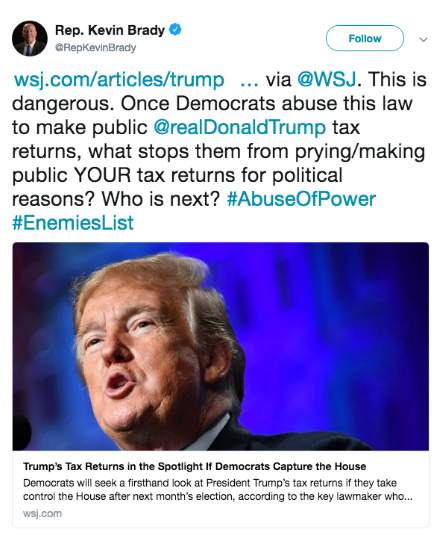
We followed that with this tweet from Kevin Brady:
Mark’s British Politics Corner
Mark talked about Boris’s attack on the Chequers proposals:
Fallacy in the Wild (Sting: Wild Thing by The Troggs)
In the Fallacy in the Wild we looked at this clip from Friends:
Then we talked about this Direct TV ad:
Fake News
Here are the statements from this week’s Fake News game:
- I’ve been talking to some people, some very smart people, and they’re telling me. This is quite a wind. I guarantee, you’ve never seen anything like it.
- This is a tough hurricane, one of the wettest we’ve ever seen from the standpoint of water. Rarely have we had an experience like it and it certainly is not good.
- The response and recovery effort, probably has never been seen for something like this. This is an island surrounded by water. Big water. Ocean water.
Click below for the answer
Spoiler
Statement 1 is Fake News. Mark chose number 1Mark got it right this week, and is currently on 22%
Anger is not a logical fallacy
We talked about the Kavanaugh hearings.
The stories we really didn’t have time to talk about:
- At a rally in West Virginia, Trump publicly declared his love for Kim Jong Un [clip] but, as everyone who’s watched a proposal on a jumbotron knows, that’s a dangerous move. What if Kim doesn’t feel the same way?
- Another thing Trump loves is claiming his rallies are record-breakingly yuge. The fact that Beto O’Rourke’s rally in Austin, Texas had an audience of over 55 thousand – far larger than any of Trump’s – would probably really annoy him, so we definitely shouldn’t keep mentioning it. Or tweeting it at him. And we shouldn’t mention the fact that it was actually the largest single candidate political rally since Obama in 2008 – ( someone rather conspicuous by their absence Donnie)
- Having complained during the campaign about the world laughing behind America’s back, Donald addressed the UN General Assembly, where the world laughed right in his orange face instead [clip]. Trump later claimed that the speech was supposed to get a laugh, which means he must have been wondering why nobody laughed the last 15 times he said it at his rallies.
- The New York Times claimed this week that self-made billionaire Donald Trump actually received at least $413 million in today’s money from his father’s real estate empire, mostly through shady and probably illegal tax dodges during the 90s. That of course is the true meaning of American Family Values!
- Trump finally got rid of NAFTA, the trilateral North American Free Trade Agreement with Mexico and Canada, and replaced it with a nearly identical trilateral North American Free Trade Agreement with Mexico and Canada. But this time, it’s called the USMCA. Because Obama’s version wasn’t called that, so Trump wins.
- Always committed to valuing business profits over human lives, the EPA plans to reduce regulations on radiation exposure. To justify this, they have turned to the work a couple of fringe scientists who say a little bit of radiation is good for you. The biggest mystery is, when did they decide to even pretend to justify things with science?
- As if to prove that last bit, the EPA is dissolving the position of Science Advisor. That’s the person whose job it is to explain the science that underlies their policies to the EPA administrator. Because why even bother? In a slightly more sinister turn, the Head of the Office of Children’s Health has been put on administrative leave without explanation. That’s the person who makes sure the EPA are not endangering the lives of children. Their next step must be to try to figure out how to change their name to SPECTRE
- And finally, an impact statement from the National Highway Traffic Safety Administration, which was written to justify Trump freezing car emission standards, says on our current course the planet could heat up by 7 degrees C by the end of the century. How does this justify doing nothing to reduce emissions you ask? By claiming it’s too late to do anything about it. But of course it’ll still be much cooler than the place Trump’s gonna be burning in by then!
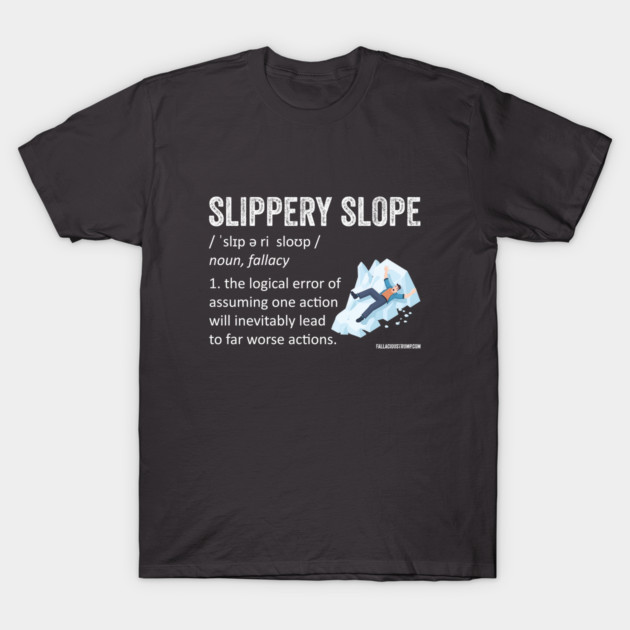
If you wanted to buy a T-shirt featuring this fallacy, you could click here. No pressure
And if you have some money left over after that, Jim’s book, 2000 Mules and One Big Lie: A Stubborn Conspiracy Theory is available now.
That’s almost all for this week, but here’s our AI-aided transcript, which is quite accurate, but not totally:
Slippery Slope – FT#10 Transcript
Read the full transcript
00:23 Jim: Hello and welcome to Fallacious Trump, the podcast where we use the insane ramblings of a global laughingstock to explain logical fallacies. I'm your host, Jim.
00:31 Mark: And I'm your other host, Mark. A logical fallacy is an error in reasoning that results in bad or invalid arguments, and the logical fallacy we're looking at this week is the slippery slope fallacy, also known as the thin end of the wedge and absurd extrapolation.
00:46 Jim: So the slippery slope is a really common fallacy. You've definitely heard it referred to. You've probably seen it used. Used. It's when someone suggests that if you take a particular action, if you take a step in one direction – usually a direction they don't like – then that will inevitably lead to more steps further on in that direction and a series of events that will ultimately lead to something very undesirable for everybody, or that probably everyone can agree is bad. Yeah, and it's. It's not not a difficult one to counter, to be honest. It's. It's quite simple because the people who are committing the slippery slope fantasy are ignoring the fact that it doesn't necessarily lead to those things. In some cases it might, but it's not, it's not inevitable. So, um, that is the kind of test for, for whether it is in fact a fallacy is whether the things that are likely to lead on from it are inevitable are in fact, likely to happen if you, if you go in a certain direction, or if they're just, um, fear -mongering. Really, yeah, yeah, so, uh, our Trump example this week comes from the events in charlottesville in august 2017, which ended with clashes between neo -nazis and anti -fascist protesters, but began with a protest about the removal of a statue of confederate general Robert E. Lee from a public park. While defending the white supremacists several days later, Trump also invoked the slippery slope.
02:15 Clip: Trump talking about Confederate statues
— This week it's Robert E. Lee. I noticed that Stonewall Jackson's coming down. I wonder, is it George Washington next week? And is it Thomas Jefferson the week after? You know, you really do have to ask yourself, where does it stop?
02:27 Jim: So Trump is suggesting there that if you're going to take down statues of Confederate generals, then anyone in history, basically whoever did anything wrong, is going to have their statues taken down. And yeah, and it's going to get eventually to someone you don't want to have their statue taken down or you don't think that they deserve to have their statue taken down. Yeah, but of course that's not necessarily,
02:52 Mark: not necessarily, the truth, true, no, no, in fact,
02:55 Jim: john oliver um had a great response to this. All right he's. He said.
03:00 Clip: John Oliver
— Anytime someone asks where does it it stop? The answer is: always fucking somewhere. You might let your kid have twizzlers, but not inject black tar heroin. You don't just go well, after the twizzlers, where does it stop?
03:14 Mark: Yeah, so yeah, yeah, and people can stop it. You know the same people that would legitimately say: we need to pull down this statue because what it is is representing slavery and the that kind of pre -Civil War stance. The people that would tear that down would then stop other things being torn down, not just because there are statues of people that they admire, but because their point has been made. They would just go, well, that's it. We were only campaigning to take this one down, and here are our reasons for doing that.
03:55 Jim: Yeah, and that's the thing. It would stop somewhere.
03:58 [Unclear]: Yeah, it would. Just there are.
04:00 Jim: There are reasons to take down some statues and not other statues. Um, when Trump is invoking, uh, he mentions Robert ely and tom and Stonewall jackson. Those people are famous primarily for trying to defend slavery. That's really. The only reason there are statues of them is because they fought in a war on the side of the people who wanted to be able to have slaves. Now, Thomas Jefferson and George Washington had slaves, as did many wealthy landowners at the time. They, they are known for and famous for many other things. Yes, so, yeah, if they, um, if I mean they, first of all, they didn't fight to keep the slaves, but if they had, then arguably at least there would have been a reason to keep their, their statues, even if they had been on the side of the confederates. Yeah, because, because they did other stuff as well.
05:01 Mark: Yeah, and they're famous for other things. The statues weren't erected because of their wanting to keep slaves.
05:08 Jim: And, uh, even today, we – we had, literally today, there was a tweet from texas congressman kevin brady. This is about a wall street journal article that suggested that that if the Democrats get in, if they, if they control congress after the midterms, then they will go after Trump's taxes and they will get him somehow to release his taxes. And he said: this is dangerous. Once Democrats abuse this law to make public donald Trump tax returns, what stops them from prying slash, making public your tax returns for political reasons? Who is next? Well, what?
05:44 Mark: Yeah, well, what stops them is because they're only doing it to find out Trump's tax returns. Once they've done that, yeah, stop.
05:51 [Unclear]: They're doing it because,
05:53 Jim: yeah, he's the president. Yeah, and every president for the last 70 years, except Trump, has released their tax returns. And he said he was going to release his tax returns. And he said that the only reason he didn't was because he was under audit from the rs, which wasn't necessarily true. It doesn't seem to have stopped this irs audit and if it has, nothing's come of it. Nothing's been made public and he hasn't released them. And the only reason he hasn't released them since he got made president is because he said, oh, everyone's forgotten about that now. No one wants to know about my taxes.
06:26 [Unclear]: Yeah. No, we do. Yeah. Yeah.
06:28 Mark: We still do. We always have. We all know what's in there anyway. It's stuff you're trying to hide.
06:36 [Unclear]: Russian stuff, I'm guessing. Russian stuff. There are payments in rubles. Mostly Russians.
06:42 Mark: Mostly rubles. That's what it is. Is there one where you might say, we've got to do this. If we don't do this, then we won't get out of the mess.
06:56 Jim: Definitely, you can use it to say, if we don't do something, something bad will happen. Because I mean, for example, Trump used it to say something along the lines of: if Europe doesn't get a handle on their immigration, then it'll be the end of civilization as we know it.
07:13 [Unclear]: It, yeah, yeah,
07:15 Mark: that's like a slippery slope, but up the other way is it?
07:19 Jim: Yeah, it's a really fast slope as well. That one, yeah, yeah,
07:22 Mark: two steps, it's a.
07:24 Jim: It's a good time probably to to talk about the difference between formal logical fallacies and informal logical fallacies here, because the reason that we talk about stuff and and often I will say yeah, I'm not really sure that's exactly this or or this might kind of cross over with another logical fallacy and then a bit of overlap – is because most of what we're talking about on this show, so far at least, has been informal logical fallacies. Formal logical fallacies are ones which take a particular form, um, a particular logical form – like last time, in fact, we talked about denying the antecedent – which takes the form of: if p, then q, not p, therefore not q. So you might say: if it's raining, my garden will be wet. It's not raining, therefore, my garden is not wet, yeah, and that's not necessarily true. Yeah, that doesn't logically follow, because I might have a sprinkler on my garden, yeah, yeah. Or it might have been raining recently, yeah. Or there might be a burst pipe under my garden, yeah, well, my garden might be wet for multiple other reasons, and that's a formal logical fallacy because it always takes the same form and it's always a failure in logic when someone presents something in that way. Right, yeah, with informal logical fallacies, a lot of time it can look like the logical fallacy, but because of the context actually it's not. Um, or people can disagree about what the definitions.
09:01 Mark: So that which is sometimes why we overlap them when we're kind of trying to unpick which one it is because they are. Would it be a fair description to say they kind of sit in the gaps between formal logical fallacies?
09:20 Jim: They can do and and in fact, a lot of them – sometimes, um, they are, although they don't necessarily um, follow logically, sometimes it can still give you a reasonable answer to something or a reasonable probability of something being right or not. For example, with the – uh, the argument from popularity, we talked about a scientific consensus. Yeah, now, it's not logically valid to accept the fact that you know, except a theory, because lots of people think it. Yeah, but if those people have a, have a specific expertise, then it increases the probability that that thing is going to be right. So that is sometimes an okay thing to do. Yeah, it really depends on context. Yeah, it's not not always wrong to do that. But the fact that these are informal logical fallacies means that they they aren't as well defined all the time. And what we're talking about on the show for the most part is my understanding of, yeah, and my opinion of what these fallacies are and what they mean. Yeah, yeah, and largely based around how they're generally used. But sometimes I'll say, well, I'm not really sure that fits, and it's just my opinion. With this one, the reason I brought this up is because there's another logical fallacy called reductio ad absurdum, and that kind of takes away most of the slope right, says, if we do this, it's the end of the world, yeah, yeah. And it takes it immediately to a ridiculous conclusion. And you could say, and I might say that a slippery slope argument generally needs kind of more stages to get for it to be as slow where you, where you are, to the really undesirable place,
11:11 Mark: yeah, yeah, there's got, there's almost, almost got to be a uh, some semblance of, uh, apparent logic for it to to be kind of hidden away. So there's got to be, uh, first this will happen, then that will happen, and then the other, which are like tiny steps when you can kind of go, oh, yeah, well, I could see why those are joined together. But if you just went from the beginning to the end, then that would be just absurd, if it's, you know, and they're quite laughable. In fact, one of the – the example I'm going to do later on – does exactly that and it's, it's, it's just funny. You fail to listen to them because they just jump straight to the absurd ending and it almost becomes like a non -sequitur because it's difficult to see how it follows.
12:00 Jim: It's less, it's a less convincing argument when you go straight from something: um, that is a small step, yeah to a huge,
12:10 Mark: massive step stepping off the cliff.
12:13 Jim: Yeah, and when you have those little steps in between, even if they're only implied by how you talk about it, then it it's more easy to to fall victim to the to it and think, oh yeah, actually that is possible, that that would happen, and
12:34 [Sting: Mark's British Politics Corner] And now is the time, I think, for Mark's British Politics Corner.
12:38 Mark: Well, I'm glad we got Boris back on the thing, because I wanted to play a clip from his speech that he made at the Tory party conference just this last week. It was billed as the speech that would bring down the Prime Minister. It's Boris doing his blustery stuff and undermining the Chequers Agreement that was mooted by Theresa May. A broken meeting of the cabinet, and it lasted for about six hours before Boris resigned as a result of it. And within that speech, I'm suggesting that he does a little bit of a slippery slope, and here it is.
13:19 Clip
— And what the Chekhov's proposals show is that the United Kingdom, for all its power and might and network of influences around the world, for all its venerable parliamentary history, was unable ultimately to take back control. And instead of reasserting our ability to make our laws, the UK will be effectively paraded in manacles down the Rue de la Loire like keraticus.
13:50 Mark: There you go. So it kind of sets… It's almost in my mind. It looks like a playground slide. So there's a set of stairs at one end, which is where he sets us up with um. You know the Uk for all its power and might and network of influences around the world, for all its venerable parliamentary history. So you're climbing up the the stairs and then you're at the top of the top of the helter skelter, and then we are unable to take back control. We didn't reset, reassert our ability to make our own laws, and the consequence will be that we're effectively done about that, effectively paraded in manacles down the rue de la war, like caractacus, and immediately I thought of caractacus potts, the guy that built exactly yeah, so the uh. So there's a little slippery slope. I did, I did listen to the entire speech knowing that he would do it or he would do something. And you can. And it made me realize you can spot them coming, because you get a little list, you get first this, then that, then the other, and it will lead to and, and you kind of you're, you're taken by the hand down these stairs and then let go at the end for the inevitable crash at the bottom, um, and it's almost say: see, that's what will happen? And, and of course it's, it's not true. It isn't true. It's a nice thing that,
15:26 Jim: basically, not only are we, have we not got what we want, but he's now comparing us to a, to a manacled prisoner. Yeah, being paraded through this, exactly, yeah.
15:38 Mark: So my other example is um, one that does do the, I think, probably a reductio ad absurdum, and it is from. Let me just call it up: it is a uh, a tweet from march the 7th this year by owen jones, who is a left -wing uh commentator. He's a writer and a presenter and a big supporter of uh – jeremy corbyn's progressive politics, and he, on march the 7th this year, posted a – a picture of himself raising a glass to the leader of Britain First, which is a right -wing organisation. Their leader was jailed for hate crimes and inciting racial hatred, and there's a picture of Owen raising a glass, going big cheers to Britain, First getting locked up. And then the here's. Here is the reductio ad absurdum: uh, it's a slippery slope. So it's a slippery slope with no slope, it's just a vertical drop. Um. So this is a reply from someone posting: as socialism is fascism, you think okay, um. And it says a warning for everyone: if cunts like owen jones end up in charge of this country, we'll have gulags by tea time,
17:06 Jim: and gulags by tea time is my, uh, my cover band name.
17:10 Mark: Yes, exactly, yeah, and uh, so it's also kind of yeah. So he misses out all the steps in between um, which is somehow, I think, reflected in that conflation: uh, of socialism is fascism. He's missed out all the steps of his argument to lead you from the left to the right. But I really also like the, the delightfully English tweeness of tea time. And so here he is excoriating a left -wing um progressive commentator for uh, calling out the right -wing leader. So he's, I think this guy must be from the right um, so he's calling him out, but he's doing it in a very kind of English afternoon way. I said, I say, sir, there'll be gulags by tea time. It's just so good, isn't it? So in the middle of… Put that crumpet down and… In the middle of a kind of class war, everything still stops for tea time.
18:16 [Sting: Fallacy in the Wild (Wild Thing – The Troggs)]
18:45 Jim: I think we found it. I think we found the right stigma. No, I can't believe it took me
18:50 Mark: that long to think of that one.
18:51 Jim: I've been waiting for the troggs to come out. Oh, have you?
18:56 Mark: Ah, yeah. No, it suddenly occurred to me today. I wondered when you were
18:59 Jim: going to do that.
19:00 Mark: Yeah, there we go. Yeah, well, just hold off the tension, you know.
19:03 Jim: Yeah, where to go after that? Yeah, that's true. It is the ultimate one. You're going to have trouble topping that. I know, I know. That's great. So in The Fallacy in the Wild, we like to talk about the fallacy of the week from a non-political perspective. We've got a couple of examples this week which do that using popular culture. The first one is actually the first thing I thought of when we talked about doing this. Yeah, this show and this fantasy particularly – and it's an example from friends:
19:29 Clip: Friends
— hey, chandler, monica just broke my seashell lamp.
— Neat, I'm gonna die alone.
— Okay, you win, chandler, you are not gonna die alone.
— Janice was my safety net, okay, and now I have to get a snake. Uh
— huh, why is that?
— If I'm gonna be an old, lonely man, I'm gonna need a thing. You know a hook, like that guy on the subway who eats his own face. So I figure I'll be crazy man with a snake. You know, crazy snake man, and I'll get more snakes. Call them my babies. Kids won't walk past my place, they will run, run away from crazy snake man. That's job.
— So.
20:14 Jim: So there's a few steps in there that aren't explicitly spoken, but chandler goes from um being dumped by janice – or dumping janice, I think, possibly in this, on this version – to being crazy snake man, because obviously the steps that aren't spoken are that he is never going to find someone else to be with, and so he's going to be old and lonely and he's going to need a thing.
20:42 [Unclear]: Yeah, so snakes, but he kind of,
20:45 Mark: he does it, he, he says I'm gonna die alone, and then he. Then he explains his workings out in between, which is the, So he's already at the bottom of the slope, and then he describes how we got there.
20:59 Jim: Yeah, it was great. So an example that explains it step by step in much more detail is a brilliant set of ads for DirecTV. The whole series runs along these same lines, and they use this fallacy specifically and knowingly for comedy value.
21:16 Clip: DirecTV ad
— When you have cable and can't find something good to watch, you get depressed. When you get depressed, you attend seminars. When you attend seminars, you feel like a winner. When you feel like a winner, you go to vegas. When you go to vegas, you lose everything. And when you lose everything, you sell your hair to a wig shop. Don't sell your hair to a wig shop. Get rid of cable and upgrade to direct tv. Call 1: -800, direct tv.
21:45 Jim: So that does it in exactly the opposite way to the friends example. They, at the end, they, They reiterate it.
21:52 [Unclear]: I like that, yeah.
21:53 Jim: Get cable, don't sell your hair to a wig shop. They're directly juxtaposing the two extremes, but they lay out every step in between. And the steps, as you go along, think, yeah, how about that? That kind of makes sense. Yeah, cool. So it gradually, like you said, they kind of take you by the hand and lead you down the slippery slope.
22:09 Mark: And then they show you how far you've come. Or how far you've descended, yeah. But I guess also the thing is that a way to counter these arguments would be to say: well, that isn't. The only consequence of getting depressed is to go to seminars. That wasn't the thing I thought. You know, when you go to depressed, you go to seminars. Yeah, when you go to seminars you feel like a winner, but only if you go to those seminars and then when, of course, when you feel like a winner, you go to vegas and that's. You know that? Yeah, so there are, there are steps in there that are, uh, unexplained. There's a whole bunch of assumptions,
22:45 Jim: yeah, and I I think that's fair. I think that characterizes slippery slopes quite well. I think, generally speaking, when people use this particular kind of fallacy, they do express uh overconfidence in what the inevitable result is going to be.
23:02 [Unclear]: Yeah, because, as
23:04 Jim: we know from life, you never really know how something is going to turn out when you do something. But the people who invoke the slippery – pretty slow, pretty much do – they generally say, oh, this, you know, if you do that, this will happen. Sometimes they say, like with the, the tweet from the kevin brady earlier on who's you know who's going to be next. It's it's implying that there will definitely be someone next and the same, with Trump saying: where does it stop? About charlottesville? He's suggesting that you, you don't want to find out where it's going to stop because that's going to be bad.
23:39 Mark: So he's suggesting a,
23:41 Jim: a particular level of kind of precognition about how, about what it is going to result in.
23:46 Mark: Yeah, so part of the taking you by the hand is is that you're buying into the fact that you, that they are your guide and you're trusting them to know where they're taking you. So the voice of God in the tv advert is just telling you how things are and they and the guy, sure enough, goes through with it, and Boris johnson is doing it from a position of authority, not the as much any more. Um, and Trump is, you know, taking up that position. I am your president, I know what's good for you and I will. I can see what's going to happen to you and I'm going to protect you from that.
24:25 Jim: Um, and this is this fantasy is very often used by legislators or by people who are, who are worried about rules, changing of rules, often becoming more relaxed in some way, and they're saying: you know, that's just going to lead to more relaxation of the rules, um, or that that if you don't legislate against something, then inevitably more bad things will happen, um, one of the ways it's been used in the past quite a lot is with gay marriage, for example. Um and uh. Bill maher in his book, uh, new rules, polite musings from a timid observer – said: new rule: gay marriage won't lead lead to dog marriage. It's not a slippery slope to rampant interspecies coupling. When women got the right to vote, it didn't lead to hamsters voting. No court has extended the equal protection clause to salmon. Yeah, yes, which which answers it? Yeah, yeah, because, because, genuinely, people have said: if you let gay people get married, what's to stop people from marrying their pets?
25:27 [Unclear]: Yeah, and you, You go. Well, the fact that those are completely different things. That's what's to stop. Yeah, that's to stop.
25:36 Mark: Yeah, it's got nothing to do with that.
25:40 Jim: It's completely unrelated.
25:43 Mark: Yes, it's a thinly disguised non sequitur, which insofar as these things don't necessarily follow. In fact, they don't follow at all. But they're given the veneer of following one after another, because the the steps are quite logical,
26:02 Jim: ironically, and it artificially suggests a protective shell around a particular thing, in this case the sanctity of of traditional marriage. It's. It suggests that once you break that shell, yeah, it's, it's opening pandora's box and suddenly everything is possible. Yeah, yeah, yeah, which is, of course, bollocks.
26:23 [Sting: Fake News] So we're gonna, we're gonna play fake News. Folks, I love the game. It's a great game. I understand the game as well as anybody, as well as anybody.
26:31 Jim: Yes, it's time for fake News. The game where I read out three Trump quotes, two of which are real and one I made up, and Mark has to figure out which one is fake News, or fail to, yes, or fail to, which has been, generally speaking, what's happened. Yeah, but you did have one success I did recently. So that was so. It's not all. Complete failure. It's not all.
26:53 Mark: It's not a slippery slope to utter: um, yeah, I'm not gonna have to sell my hair for money quite yet.
27:01 [Unclear]: Yeah, no, so, um,
27:04 Jim: the theme this week is is hurricanes and stupid things Trump has said about hurricanes. Okay, yeah, so, uh, number one with regard to this was hurricane harvey in texas. I've been talking to some people, some very smart people, and they're telling me this is quite a wind. I guarantee you've never seen anything like it.
27:30 Jim: Number two, this is about Florence, which was quite recent. He said, this is a tough hurricane, one of the wettest we've ever seen from the standpoint of water. Rarely have we had an experience like it, and it certainly is not good.
27:45 [Unclear]: Mm-hmm. Or number three.
27:47 Jim: This one is about maria in Puerto Rico. The response and recovery effort probably has never been seen for something like this. This is an island surrounded by water,
27:58 [Unclear]: big water, ocean water.
28:00 Mark: There is water at the bottom of the ocean. Okay, well, as per usual, they all look very convincing: um, see, um, okay, I have my doubts about the third one, because I think you've taken the idea of water and then done a trumpism thing with it, because the it wouldn't. Yeah, see, I think that one of those, one of the things he would like to be to say is to over explain what he meant by my wettest, insofar as it involves water. Yeah, so it's wettest we've ever seen, from the standpoint of water rather than the standpoint of fire.
28:48 [Unclear]: What, yeah, yeah, yeah,
28:51 Mark: um, okay, all right, we always. Where was the first one, josephine?
28:58 Jim: No, uh, harvey, texas,
29:01 Mark: texas, there we go. Right, I'm very smart, they're Italian. It's quite a win guarantee. You've never seen anything like it. Okay, I think I think you made up number I want the other, I want the two water ones to be true. So I think you made up number one,
29:25 Jim: okay, so, so you think that um, number two is real? Yeah, which was about, uh, Florence, yeah. And number two, yeah, is real.
29:43 Clip: Trump, played during Fake News
— This is a tough hurricane, one of the wettest we've ever seen from the standpoint of water. Rarely have we had an experience like it and it certainly is not good.
29:58 Mark: It's kind of there. He is being all presidential, standing there. People are homeless, they're, you know, they're without power, they don't know where to get some fresh water, don't know where the next meal is coming from, and he's trying to be all presidential. All he can say is: it's certainly the wettest we've had from the standpoint of water. What, what? Yeah, I mean, if you were trying to trying to script a bad president, you wouldn't come up with that, would you? It would no, well,
30:30 Jim: exactly, I didn't, no, I know. that is quite amazing.
30:35 Mark: It, uh, and you can. You kind of like trying to add some sort of gravitas to his voice and everything.
30:41 Jim: It's not. It's like saying: My sofa is the comfiest I've ever seen from the standpoint of comfort.
30:48 Mark: The standpoint of cushions, yeah. The standpoint of foam, yeah. It's the hottest I've ever had from the standpoint of heat, yeah.
31:04 [Unclear]: It's nonsense. Okay.
31:08 Jim: So, yeah, you think number one is fake News and what really one is fake News. You're correct.
31:20 [Unclear]: He did not say this
31:24 Jim: is quite a wind about hurricane harvey.
31:27 [Unclear]: He did.
31:29 Jim: He did make a claim about harvey. That was nonsense. He said that people went, lots of people went out on in their boats to to watch the hurricane and that's why they all needed rescuing by the coast guard, which which was just not true.
31:48 Mark: well, he's such a he's, he's determined to blame the victim, isn't he?
31:53 Jim: He's that kind of absolutely. But that means also that, apart from the fact that you've won, which is very exciting, it means that number three is:
32:01 Clip: Trump, played during Fake News
— is real, wow,
32:03 Mark: does he actually says ocean water.
32:05 Clip: Trump, played during Fake News
— Listen to this. And big water love. The response and recovery effort probably has never been seen for something like this. This is an island surrounded by water, big water, ocean, Ocean water.
32:28 Jim: It sounds like he's setting up the speech from Jaws where the shark has come. It's like, we were in water.
32:36 Clip: Trump, played during Fake News
— It was big water. Ocean water. Ocean water. And he had teeth, big teeth. Shark's teeth.
32:45 Jim: It can only be that he only recently discovered Puerto Rico was an island. And now he's trying to make it sound like he knows what he's talking about out when, yeah, when he says island,
32:54 Mark: yeah, because it's not just like, it's not just a bump in a lake, not, you know, it's surrounded, it's.
33:03 Jim: So get this island proper. Unlike all the other islands, this island is surrounded by water,
33:07 Mark: not just any old water, big water, ocean water at that, not fresh water. You know, it's not, it isn't just something sitting in the bathtub. This is big, this is proper of big water.
33:21 [Unclear]: Oh, what? So you? That means I won, that.
33:26 Mark: That means that that final switteroo at the end, thinking you'd done two water ones and then went for the wind, wow, and that one,
33:36 Jim: actually, very good, that is now what? Seven, two, yes, all
33:42 Mark: right, well, uh, yeah.
33:44 Jim: So we're gonna have to start doing percentages.
33:45 Mark: I think, okay, why not to make it look bigger?
33:49 [Unclear]: All right, yeah, yeah, yeah.
33:53 Mark: Oh well, that's pretty good, given that the third one is just utter rubbish. The – uh, the first one, you know, is very good indeed. I wouldn't be surprised if he did, if he says that next week,
34:07 [Unclear]: yeah, yeah, well, that is kind of the point of the game. Oh yeah, oh no,
34:13 Mark: I've realized, you see, yeah. So, podcast listeners.
34:17 Jim: I need your help to full Mark. If you think that you can make up a convincing fake Trump quote, then share this episode on twitter. Include your quote and the hashtag Fallacious Trump and I'll pick the best one. Uh, actually, I always say I'll pick the best one, but you may have noticed we've been low on on quotes – yeah, posed by the audience. So you have a really good chance, if you propose one, of getting picked, uh, yeah, and becoming podcast famous. So, uh, this is the part of the show, uh, where we like to talk about all the crazy stuff that's going on in the Trump orbit. But we don't have time to talk about everything, so we pick one story and so this show this week is called: uh, anger is not a logical fallacy because we have to talk about the Kavanaugh hearings, because it's it's all that's been in the News really for for more than a week now, and it was. It was kind of insane and interesting and scary and amazing all in one go.
35:24 Mark: Yeah, yeah, I mean interesting that they called the Kavanaugh hearings for the longest time. It was called the Christine blaisey Ford hearing and that, yeah, you know that seemed for about four hours. Yeah, yeah, and you think, all right, yeah, this is it. For that moment there was another um, you know it was, yeah, jane fonder could have been, you know, channeled for the feminist thing it was. You know it felt like things were actually going to be slightly different. And then all hell broke loose and, you know, men who don't get their own way got angry.
35:58 Jim: Yeah, basically really really angry, yeah. But, yeah, Christine blaisey Ford came across amazingly, uh, sympathetic and and as a really good witness, a really powerful, brave, trustworthy kind of person and and, whereas with kavanagh, the, the, the take on his performance seems to very much be split along party lines, with, with Dr Ford, it seemed to be, um, actually pretty universal. Even the people who don't believe, or say they don't believe, that kavanagh did this also say they believe that she went through this experience. So they're selectively choosing not to believe the bit where she knows who did it, but they claim that they believe all the rest of it. Yeah, and and the fact that she's a psychology professor and was able to talk about how traumatic memories are encoded in the brain and stuff made her particularly well um suited to to give this kind of testimony and and be trusted and and seen as an expert in, in that she was expert witness,
37:08 Mark: yeah, even by Trump himself, who's at one point said: she's a good witness. You know She will be a solid, truthful I don't suppose you use either of those words, because they've got more than one syllable.
37:23 Jim: No, he did say he was apparently cross that his staff hadn't prepared him for how well she was going to come across. That people hadn't told him, essentially, that it's possible to talk without being an arsehole because he didn't know that. No, no, still not. And so this was, yeah, it was completely new to him.
37:47 Mark: That people can know stuff and talk about it, yeah.
37:50 Jim: Fox News was saying that she was very credible, she was very sympathetic. Chris Wallace said it was a disaster for the Republicans, her testimony. And then Kavanaugh came out. And have you seen the SNL sketch, the Saturday Night Live sketch with Matt Damon? He captures it absolutely perfectly. It's really impressive. You should definitely watch it. But one of the things he says he starts off almost with. I'm going to start at 11, I'm going to go up to 15 real fast. That's like, that's what, he started out angry. He wasn't, he didn't kind of get angry because people asked him difficult questions. No, he was straight out of the gate. He had an angry, prepared 45 minute introduction. It was quite bizarre. And to be I'm going to kind of play Kavanaugh's advocate slightly, not because I believe him or don't believe Christine Ford. But yeah, because a lot of people are saying that his temperament of of being angry disqualifies him per se to be on the Supreme Court. And I don't completely agree with that. I think there's a lot of things that do disqualify him, such as his amazing partisanship, his claims of Democratic conspiracies and anti -Clinton rhetoric, and also the very likely possibility that he is a sexual abuser. Um, but just the anger itself. I don't know that necessarily. Uh, is is not okay for a supreme court justice. He is, especially in this case. He's defending himself. He – he may well, because I expect he was blackout drunk frequently – yeah, he may well not remember this. He may believe he is is being wrongly accused and he is indignant and angry about it, and that's not the same as when you argue about a, you know, a legal case or something like that.
40:01 [Unclear]: Yeah, yeah, I personally,
40:02 Jim: if I'm in an argument with someone and they accuse me of something which I didn't do or I don't think I did, I will lose my temper at that kind of thing. Yeah, but I had a job a few years ago where a lot of my job was debating with people about stuff and and and being on different sides of an argument about things, and I was kind of known for unemotionally being logical about stuff,
40:28 Mark: right, yeah, yeah, because even even on subjects that would trigger you – well,
40:33 Jim: because they wouldn't trigger me, because they weren't about me, I wasn't personally being accused of stuff, right, yeah, yeah, I, I was arguing facts and and things like that. So, so I'd never got angry at work. I never, ever got crossed with someone for having a different viewpoint to me, because they were making their points and I was making my points and I disagreed with their points. But I could back up what I was saying and they could sometimes back up what they were saying. And if they did back it up and they had a logical argument, I would say, okay, yeah, that's a good point, I'll get it. Yeah, you know, because that's what you do when you're on a, in a job, like being on the supreme court, where, yeah, you know you, you might have a difference of opinion about facts or parts of the law where you can say, well, that's not how I read the law. Or you know Kavanaugh's way to have a particularly originalist version of seeing the Constitution. You make your arguments. You make your points. You write a concurrence or a dissent. You don't get really angry because it isn't personal.
41:35 Mark: And because you want to be able to make a judgment. You want to be seeing to make a judgment as a Judge, based on the consideration of opposing points of view and seeing which one weighs in the balance more to one side of the argument than the other, and then back up your reason for making the judgment that you're making.
42:01 Jim: Yeah, so for that reason, I don't think that the pure fact that he got angry at something that people are accusing him of is disqualifying. Yeah, however, he got angry in a job interview,
42:18 [Unclear]: yeah, yeah, at
42:22 Jim: that point there's a different set of rules. Yeah, people are not, are not. He's not on on trial. No, you know the, the realistically, the. I don't. I expect the statutes of limitations for this is up, so he's not going to be charged, even if there was some evidence that that, um, you know, really did corroborate what, yeah, Dr Ford was saying. Yeah, um, realistically, the very worst thing that could happen to him is that he gets, uh, removed from the dc circuit court. But that's probably not going to happen, because impeaching a Judge – he's, he's a federal Judge, he's got a lifetime appointment to the dc circuit court of appeals. Yeah, he's, he's. It's. Impeaching a Judge is not easy and it probably won't happen. So, realistically, the worst thing that's going to happen is he won't get a job that he's going for. But, yeah, all the the senators who are saying, oh, you've ruined this man's life, no, no, you're just saying maybe we shouldn't make him one of the most important judges in America.
43:26 Mark: Yeah, yeah, just based on his interview style: yeah, if nothing else, you know if yes,
43:32 Jim: even if it is just on that,
43:33 Mark: yeah, if he was coming in I said: you know, I want you to be a salesman for my car showroom, um, and people will come in, they will want to uh, buy cars and things like that. If you then exploded in the interview, uh, just to say, I know how to sell cars, You don't have to tell me what to do. Would you hire that guy? And you go, not really. Yeah, because he's. Yeah, even if he's, or even if you just poked him, triggered him in such a way. So, you know, call yourself a car salesman, you're driving a VW Beetle from 1974 and then he got really angry, you'd go well, yeah, you're not our kind of candidate, even if you were talking to him about something thing that wasn't really particularly job related but calls into question your character like a historic sexual assault accusation. That's calling into question your character not just as a slanderous thing, but this actually happened. We went to college together. You did this to me – yeah, you know, and – and it might be that you can't remember because you were blackout drunk, you know, but you did do this to me,
44:51 [Unclear]: um, yeah, and that he's, he's been.
44:55 Jim: So I mean, he can't admit that he drank to the point of of not remembering what he did, because if he does, then he can't realistically say this never happened.
45:07 Jim: So and the the clear, obvious lies that he – He told again and again about how his drinking you know he really liked beer.
45:18 [Unclear]: He really liked beer.
45:19 Mark: It was very clear how much he liked beer. He was a great fan, a big fan of beer.
45:24 Jim: But he used non sequiturs and red herrings and things quite a lot when senators specifically asked him about his drinking. And, you know, did you ever drink to the point of blacking out? And he said, I went to Yale. I was like, what? That's not what I asked.
45:43 Mark: No, and if anything, that's a yes, isn't it? Even if they weren't senators, you pay them the respect that they are your interviewers. They are the people offering you a job.
46:02 Jim: I've got a couple of clips from one with his interaction with Senator Klobuchar, who asked him about his drinking.
46:09 Clip: The Kavanaugh hearings
— So you're saying there's never been a case where you drank so much that you didn't remember what happened the Night before, or part of what happened?
— You're asking about blackout.
— I don't know. Have you? Could you answer the question, Judge? That's not happened. Is that your answer? Yeah, and I'm curious if you have.
46:31 Jim: What? He turns the question around on a U.S. senator to say, have you ever drunk to the point of blacking out? Yeah, this is. This is a Senator, especially in this case, who – who started her questioning by trying to show empathy to him and saying that her, actually her father, was an alcoholic. So that's especially not okay. Yeah, in this case, yeah, but – and he did, coming back from the break, he did apologize to her for doing that, but still, I
47:03 [Unclear]: mean that is yeah.
47:04 Mark: Is that because somebody in in the break said: for god's sake, what are you doing, christ?
47:08 Jim: You can't. Yeah, you can't do that, yeah, yeah.
47:11 Mark: And you kind of think, well, no wonder Trump likes him, because he's just, as you know, blunt and uh and unmindful of other. He just he had no sense of well, but Trump and Kavanaugh, they've got no sense of the right things, of diplomacy. They, they don't know how to behave in a situation such that you get what you want without upsetting people.
47:40 Jim: Yeah, Trump apparently loved this performance. Yeah, of course he did. He said: um, this is exactly why I nominated him.
47:49 Mark: because he's uh, he just turns it off, he goes: well, are you? It's a bit like when you go you, you get that question at the end of an interview: where do you see yourself in five years' time? And if you stood up and pointed at the questioner straight in the face and said, where do you see yourself in five years' time? You know, you would not get the job. Trump loves that because Trump thinks that is the time.
48:14 Jim: I mean, that is, yes, but in a way it's more like if they say, you know, have you ever been convicted of a crime? Yeah, have you? And you say, I don't know, have you?
48:27 [Unclear]: Because you know the answer is yes, if you do that. Yeah, yeah, yeah.
48:37 Jim: But he really obviously disrespected, particularly, I think, the female Democratic senators. But also Pat Leahy, who was just asking him. Quite, he was asking him mostly about yearbook stuff, about whether, um, Mark judge's – uh, in Mark judge's book there's a character called bart o kavanagh, um, who, who drank to excess, and and he was asking kavanagh if, um, if that was based on him, obviously yes, and and kavanagh said I'd know you'd have to ask him, lee. He said I wish we could, yeah, but he was also asking about his yearbook and these calendars and stuff, and and they, uh, this was the exchange in your yearbook.
49:23 Clip: The Kavanaugh hearings
— Uh, you talked about drinking and sexual exploits, did you not, Senator? Let me, uh, let me take a step back and explain. Uh, high school, I was number one in the class and I thought, no, no, no, no, no, I thought You got this up. I'm going to talk about my high school record if you're going to sit here and mock me. I think we were all very fair to Dr. Ford. Shouldn't we be just as fair to Judge Kavanaugh? I busted my butt in academics.
50:02 Jim: Now that's Chuck Grassley at the end saying we were fair to Dr. Ford. Dr. Ford didn't answer a question with something completely unrelated. So being fair to them both would be expecting Kavanagh to actually answer the question he was asked, which was in your yearbook. Did you talk about drinking and sexual exploits?
50:23 Jim: And he wants to start talking about his high school record.
50:28 Mark: He wants to just kind of go, let me take a step back. No, just answer the question. We know why you want to take a step back, because it's a bit of a question that's directly to the point.
50:41 Jim: Also because each Senator only has five minutes to ask their questions. Yeah, so leaky, quite reasonably when he, when Kavanaugh, starts going completely off topic and answering a question that was never asked, starts to try and get it back on track and say, no, no, we're going to talk about what I want to talk about. And and he says no, no, no, no, no, no, no. He's, he's really, yeah, active and says no, I'm going to talk. If you're going to mock me, I'm going to talk about what I want to talking about. That's not how this works.
51:09 Mark: Yeah, and at what point is he being mocked? Hello, where was, where was the mock? It was just a in your book. It talks about getting drunk and sexual exploits, which seem to be completely apposite to and central to the discussion we're having today. You know where is the mocking going on. You know if they held up the picture and gone, oh my God, oh, look at your haircut from 1973 or whenever he was at college. You go: yeah, that would be mocking, but there is no mocking. It's fake mocking, it's false mocking, it's the mocking that Trump makes up and says, they all mock me. Well, we do.
51:49 Jim: To the FBI. This was a week ago. We're recording this on a Thursday, a week after the hearings. The FBI investigation that eventually actually Jeff Flake decided that he would ask for before agreeing to vote on Kavanaugh as a Judge has now concluded. It's been a week. We don't know yet what that will mean, but we do know that for at least the first few days, and possibly for the entire length of the investigation, their scope was severely limited by the White House. Trump has tweeted a couple of times this week that the FBI has full scope to to investigate whatever they see fit, but that has not been the instructions that the white house gave the fbi. We've heard a number of reports that initially, the fbi were only allowed to interview four witnesses, which didn't even include Ford and Kavanaugh and just and their. The scope of their investigation was extremely limited. So, realistically, we know that there are witnesses who have come forward and who have, who have sent signed affidavits to to the senate judiciary committee, who they have said I've been waiting, I've been trying to contact the fbi, I've been trying to get them to come and talk to me. They haven't come and talked to me. So I'm I'm sending in this, yeah, this statement, and people have come out who are his college roommate, his contemporaries at Yale and at georgetown prep, and said, yeah, he got drunk all the time. He was frequently incoherently drunk, he was stumbling, he was belligerent and aggressive. I can't believe that he didn't ever have memory lapses through his drinking because he was in a frequent aggressive drunk there. There's been a lot of evidence come out that the stuff he was saying about how you know he had a few beers and that was it is is lies, and he has committed perjury, essentially by lying in front of the senate judiciary committee. Whether any of that is going to make any difference, I doubt it. Yeah, yeah, I think he will end up on the supreme court, so don't know what to do with that, really. And
54:06 Mark: finally, some things we really don't have time to talk about.
54:10 Jim: At a rally in West Virginia, Trump publicly declared his love for Kim Jong Un
54:15 Clip: Trump
— I was really being tough, and so was he, and we'll go back and forth. And then we fell in love. Okay, no, really. He wrote me beautiful letters and they're great letters. We fell in love.
54:28 Jim: [clip] but, as everyone who’s watched a proposal on a jumbotron knows, that’s a dangerous move. What if Kim doesn’t feel the same way?
54:35 Mark: Another thing Trump loves is claiming his rallies are record-breakingly yuge. The fact that Beto O’Rourke’s rally in Austin, Texas had an audience of over 55 thousand – far larger than any of Trump’s – would probably really annoy him, so we definitely shouldn’t keep mentioning it. Or tweeting it at him. And we shouldn’t mention the fact that it was actually the largest single candidate political rally since Obama in 2008 – ( someone rather conspicuous by their absence Donnie)
55:08 Jim: Having complained during the campaign about the world laughing behind America’s back, Donald addressed the UN General Assembly, where the world laughed right in his orange face instead
55:18 Clip: Trump
— In less than two years, my administration has accomplished more than almost any administration in the history of our country. America is so true. Didn't expect that reaction, but that's OK.
55:39 Jim: [clip]. Trump later claimed that the speech was supposed to get a laugh, which means he must have been wondering why nobody laughed the last 15 times he said it at his rallies.
55:52 Mark: And how does he manage to claim that he meant it to be funny when he said I wasn't expecting that reaction?
55:59 Jim: He's just being like a skateboarder who face plants and then goes: yeah, I meant to do that, that's part of the trick.
56:04 Mark: Yeah, uh, okay, yeah, yeah, he styled it out without any style at all. Yeah, yeah, nobody noticed. If you know, they don't know, no, you just get up and bleed it, but in a in a flamboyant way. People go: oh yeah, good trick man. Yeah, that that was the very trick I was doing and I did it successfully. The New York Times claimed this week that self-made billionaire Donald Trump actually received at least $413 million in today’s money from his father’s real estate empire, mostly through shady and probably illegal tax dodges during the 90s. That of course is the true meaning of American Family Values!
56:43 Jim: Trump finally got rid of NAFTA, the trilateral North American Free Trade Agreement with Mexico and Canada, and replaced it with a nearly identical trilateral North American Free Trade Agreement with Mexico and Canada. But this time, it’s called the USMCA. Because Obama’s version wasn’t called that, so Trump wins. Yay.
57:01 Mark: Always committed to valuing business profits over human lives, the EPA plans to reduce regulations on radiation exposure. To justify this, they have turned to the work a couple of fringe scientists who say a little bit of radiation is good for you. The biggest mystery is, when did they decide to even pretend to justify things with science?
57:21 Jim: As if to prove that last bit, the EPA is dissolving the position of Science Advisor. That’s the person whose job it is to explain the science that underlies their policies to the EPA administrator. Because why even bother? In a slightly more sinister turn, the Head of the Office of Children’s Health has been put on administrative leave without explanation. That’s the person who makes sure the EPA are not endangering the lives of children. Their next step must be to try to figure out how to change their name to SPECTRE
57:54 Mark: And finally, an impact statement from the National Highway Traffic Safety Administration, which was written to justify Trump freezing car emission standards, says on our current course the planet could heat up by 7 degrees C by the end of the century. How does this justify doing nothing to reduce emissions you ask? By claiming it’s too late to do anything about it. But of course it’ll still be much cooler than the place Trump’s gonna be burning in by then!
58:21 Jim: Yeah, they've they've gone from saying global warming isn't real to saying, well, it's too late. Too late. There's no point in doing anything. You can't. It's too far advanced by now.
58:34 Mark: It's in the same model as, well, there was no collusion, but even if there was, it's legal. There's no global warming, but even if there was, we can't do anything about it now. So let's just not bother. Let's just chuck another car on the fire.
58:48 Jim: They have very much moved the goalposts on that.
58:52 Mark: Yes, they have. And set fire to them and put them under the arctic circle.
58:57 Jim: Douse them with gasoline. Yeah, so that's all the bad arguments and faulty reasoning. We have time for this episode. If you hear Trump say something stupid and wonder if it's a fallacy, email us on Fallacious Trump at gmail .com or find us on twitter at Fallacious Trump.
59:11 Mark: If you think we've used a fallacy ourselves, let us know. And if you've had a good time, please give us a review on itunes stitcher or wherever you get your podcasts. You can support the show on our Patreon page at Patreon .com. Forward slash f Trump, just like our newest patron, tankard. Yay, how many is that now? That's brilliant. Thank you for swelling our ranks, I think. Yeah, nice.
59:33 Jim: And we also have a pledge edit this week from hugh randolph, who presumably wanted to make sure he didn't miss out on our new series of bonus episodes where Mark and I work our way through bob woodwood's new book fear Trump in the white house. We're recording the second episode straight after this and it will be out next week exclusively for patrons who pledge two dollars or more. So head on over to Patreon .com slash ftrump if you want to join in.
59:57 Mark: All music is by the outbursts and was used with permission. So until next time on Fallacious Trump, we'll leave the last word to the Donald.
1:00:06 [Outro] That's right. Go home to mommy, bye, bye.