Show Notes
When someone supports their argument by making a statement that is significantly more emphatic than can possibly be supported by evidence, they may be committing the Hyperbolic Fallacy.
As a rule a hyperbole is not meant to be taken literally. When someone says they had the worst morning ever, you
know they are being dramatic rather than literal. However, when someone uses hyperbole to defend or bolster their position in the absence of other evidence, their reasoning is not sound, because it is not possible to support such an extreme view with evidence – and often there is easily available refuting evidence.
Trump
We started out with this from the Donald:
Then we played this compilation of some of his ‘best’ moments:
Mark’s British Politics Corner
In Mark’s British Politics Corner, we talked about this over-optimistic claim from Liam Fox:
And this unfortunate choice of adjective from Boris Johnson
Fallacy in the Wild (Sting: The Look of Love by ABC)
In the Fallacy in the Wild, we talked about this clip from American Dad:
And then we discussed the claims of Angelina Jolie’s cancer doctor, Kristi Funk. All the details can be found in this excellent post by David Gorski on Science Based Medicine.
We briefly talked about Dan Rice and The Ballad of John and Yoko before moving on to play Fake News.
Fake News
Here are the statements from this week’s Fake News game, all of which were from Trump’s insane, rambling Rose Garden press conference announcing the national emergency:
- They’re saying that Mexico isn’t paying for the wall, and that’s just a lie. I never said they would write a big check, like bing bing bing. They’re paying indirectly, through the money we’re saving through the USMCA. Frankly, we made such a great deal with the USMCA, I think it’s one of the best trade deals ever made, especially compared to NAFTA, which was one of the worst. We’ll pay for the wall five times over with the money we save.
- We had certain funds that are being used at the discretion of generals, at the discretion of the military. Some of them haven’t been allocated yet. And some of the generals think that this is more important. I was speaking to a couple of them. They think this is far more important than what they were going to use it for. I said, “What were you going to use it for?” And I won’t go into details, but it didn’t sound too important to me.
- Their criminal list, a drug dealer gets a thing called the death penalty. Our criminal list, a drug dealer gets a thing called how about a fine? And when I asked President Xi, I said do you have a drug problem? No, no, no, I said you have 1.4 billion people, what do you mean you have no drug problem? No we don’t have a drug problem. I said why? Death penalty. We give death penalty to people that sell drugs, end of problem.
Click below for the answer
Spoiler
Statement 1 is fake news. Mark chose number 1.Mark got it right this week, so he’s now on 32%.

Killing Journalism is not a logical fallacy
Jim interviewed Joe Strupp, author of Killing Journalism: How Greed, Laziness (And Donald Trump) Are Destroying News And How We Can Save It. Jim and Joe talked about how the internet has affected newsgathering, the impact that Trump has had on the news cycle, the rise in fact checking, and the future of journalism.
Click on the book cover below to find out more about Joe and his writing, and buy his book –
It’s an in-depth look at the real problems with today’s news media — from staff cutbacks and 24/7 demands for content to reduced advertising revenue, less support for press legal defense and fewer in-house watchdogs to keep the news fair and honest. And, of course, the impact of Donald Trump’s constant war on the press and false claims of “fake news.”

The stories we really didn’t have time to talk about
- Trump’s latest medical results are in, and we’re all pretending that he’s only 243 pounds and that he’s six foot three – which means he must be standing in a small hole any time Obama or Trudeau are anywhere near. The best part of this year’s fictional doctor’s report is where Dr Conley says the President is in very good health, and then predicts that “he will remain so for the duration of his Presidency, and beyond”. Honestly, some people can’t afford basic healthcare, but the White House gets psychic doctors!
- The troller-in-chief and Greatest-Humble-Bragger-of-All-Time has apparently been nominated for the Nobel Peace prize – by Japanese Prime Minister Shinzo Abe but what for – well apparently for being president at the same time as a gap in nuclear testing by North Korea. Delightfully when asked in his own parliament if he had been asked by the US Administration to nominate Trump, Abe said “I’m not saying that it is not the fact,” Which we know by using Trump’s measure of veracity: “I don’t think anyone’s denied it” must mean its true. “Oh Obama got one can’t you get me one too-ooo? I’ll be your best friend.” Needless to say Trump didn’t get it!
- A federal judge has ruled that Paul Manafort intentionally lied to Special Counsel Robert Mueller’s office, which is just the latest of the crimes he’s committed since being arrested. On the plus side, since it invalidates his plea deal and means he’ll probably spend the rest of his life in prison, he can just keep on committing crimes now and there’s not much more they can do to him.
- Trump’s latest tweet about Native American genocide in a slur against the latest to join the presidential race “Elizabeth Warren, “sometimes referred to by me as Pocahontas” which ends “see you on the TRAIL” – in capital letters – a not-too-veiled reference to the Trail of Tears – caused outrage this week as per usual, and Fox News analyst Brit Hume dismissed the outrage as per usual, this time however using an unusual defence maintaining that Trump is too ignorant of 19th Century history to have known it’s a joke! Hume explained that Trump “says ignorant and offensive things regularly, but he is not noted for veiled references to historical events.” But being stupid still doesn’t mean it’s not offensive – ignorance is no defense in the eyes of the law – and also Jeremy Clarkson!
- A MAGA hat wearing Trump supporter attacked a BBC cameraman at a Trump rally in El Paso. Nobody knows what motivated the attack, which came just a few days before Trump called the press the Enemy of the People for the 50th time.
- Goodloe Sutton the editor and publisher of a local paper in Alabama – The Democrat Reporter wrote an editorial on Valentine’s Day entitled “Klan needs to ride again.” in a piece of writing you’d thought you’d only get to read in a museum’s chamber of horrors he writes: “Democrats in the Republican Party and Democrats are plotting to raise taxes in Alabama. This socialist-communist ideology sounds good to the ignorant, the uneducated, and the simple-minded people. If we could get the Klan to go up there and clean out DC we’d all be better off. We’ll get the hemp ropes out, loop them over a tall limb and hang all of them. It’s not calling for the lynchings of Americans. These are socialist-communists we’re talking about.” However Sutton also told the paper he did not believe the Klan was a violent organisation. “They didn’t kill but a few people. The Klan wasn’t violent until they needed to be.” oh so that’s alright then – it’s only Fake Noose!
- Trump has come up with an idea for an event which he hopes will become an annual tradition. It’s a brilliant idea, a totally original concept, and nobody has ever done anything like it before. He’s suggested having a parade in Washington DC on July 4th to celebrate America. Details are still being worked out, and there’s no word yet on how this will affect the National Independence Day Parade that has been held in Washington DC for over 20 years.
- It’s probably no coincidence that Trump trails declared 2020 election Democrat contenders by several percentage points in the polls, he even trails Joe Biden by 12 points- and he’s declared nothing beyond thinking about running he is spending much of his executive time making up nasty nicknames for the Democrats. If he had even one iota of self-awareness he would realise that the enormous amount of name-calling that has gone in the direction of the fetid, orange,small-minded, short-dicked, brain-farting, mealy-mouthed, cunt-faced, pube-headed, mother-fucking arsehole himself hasn’t actually unfortunately made any impact on someone continuing to be in power, and he he might give it up and concentrate on statesmanship?
Thanks to our newest Patron, Eric Toffolo. If you’d like to inflict “Ghosts Can’t Do It” on us, then head over to Patreon and sign up.
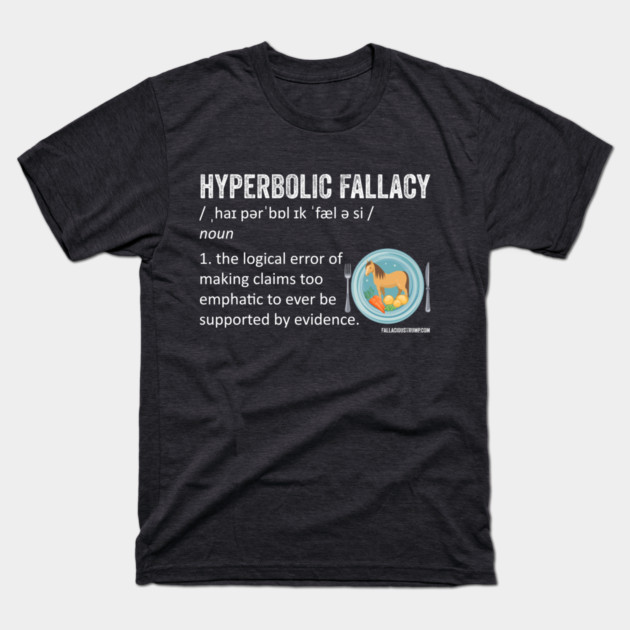
If you wanted to buy a T-shirt featuring this fallacy, you could click here. No pressure
And if you have some money left over after that, Jim’s book, 2000 Mules and One Big Lie: A Stubborn Conspiracy Theory is available now.
That’s almost all for this week, but here’s our AI-aided transcript, which is quite accurate, but not totally:
Hyperbolic Fallacy – FT#20 Transcript
Read the full transcript
00:23 Jim: Hello and welcome to Fallacious Trump, the podcast where we use the insane ramblings of a national emergency to explain logical fallacies. I'm your host, Jim.
00:30 Mark: And I'm your other host, Mark. A logical fallacy is an error in reasoning. The results in bad or invalid arguments, and the logical fallacy we're looking at this week is the hyperbolic fallacy, also known as inductive hyperbole.
00:43 Jim: So Trump is the best in the world at using this fallacy. He is absolutely tremendous at it. Yeah, he's, yeah, the best ever. And, to be completely honest, I'm not sure I'm being hyperbolic there, because because when you commit the, the hyperbolic fallacy, it is because you are expressing a conclusion that is way in advance or way too much. Um, yeah, that then you can back up with evidence. There's, there's much more that you're expressing than than actually you can kind of follow up, and sometimes it's it's based on a piece of evidence or a study that you just then take to an extreme, yeah, and sometimes it's based on just stating something with really very little evidence to back it up, or no evidence in some cases, or sometimes in in the face of of evidence to the contrary, right, but it can't be seen as good reasoning because there's just there's no hope that you can really back it up. There's, there's certainly not based on the evidence that you have to hand.
01:42 Mark: It's also very difficult to kind of maintain that stance in the face of the history of comedy or, uh, or even the history of top gear. Just with um, with Clarkson saying everything is the best in the world. Yeah, it's become a kind of cliche. Even he takes the piss out of himself on the grand tour. It's the ultimate in hyperbole to maintain this hyperbolic state in the face of all of that's gone before?
02:14 Jim: Yeah, absolutely, and the more you do it, the more ridiculous it becomes. And yeah, and we all do it sometimes we all say: you know, I've had the worst morning ever and and people know that you're not being genuine in that, they know that you're being dramatic and not not trying to tell the truth. But when it's used in an argument where you don't have other things to back it up or other other points to make and your only claim is no, this is the best ever, then it becomes your argument and and it's obviously not a good argument. So one example we have from Trump is when gold star widow maisha johnson claimed that when the Donald called to express his condolences for her husband, le david um, he couldn't remember her husband's name. He didn't. He was like so uninterested in in making it a good call. He didn't even remember her name. Now Donald could have – uh, I mean, it's obviously he's never going to admit this. No, he could at least have said she was very emotional. She probably doesn't remember what I said, or something like that, but of course, instead he had to claim that he has one of the great memories of all time.
03:24 Clip: Trump claiming one of the great memories of all time
— So so it's not.
03:28 Jim: It's not possible for him to forget things like that. Literally, he pointed to his head and said: yep, now I have one of the great memories of all time.
03:35 Mark: It's just so childish, isn't it? It's, ultimately, he doesn't want to take responsibility for anything and he does that by just being just saying that he's the best at stuff rather than being the best at stuff. And if he would just admit that he isn't, isn't the best at these things. And it was a very emotional moment and you know, I was feeling emotional, she was feeling emotional, and you go well, that there's, there's a properly humane human, but no, because he, because somehow, Somehow, that's a, that's a sign of weakness. So what he does is overcome that by saying it's not possible for me to be that and be weak, because I'm the best at everything. And in in the thought that people would believe him.
04:24 Jim: Yeah, that's he just he just takes it to a completely unnecessary extreme.
04:30 Jim: He's not just saying, oh, no, you know, I did remember. Remember I have a very good memory. Um, no, he's not. He's not even saying that he's. He's comparing himself to all of the people in history,
04:41 Mark: yeah, even people that have won awards for being memory men. You know the people that can kind of remember 52 packs of cards in order. There's got to have been victorian performers who were memory men, who are known for. If only we had the best memory ever, we'd remember their names. But you know people whose job it is to teach people mnemonics and here, how to remember this stuff and what. And then he said: no, I've got the best memory ever. He does this a lot.
05:12 Jim: Yeah, I mean, it's one of his main traits really is is saying how great he is and how he's the best at everything and how he's the biggest expert in things and he knows more about War than generals and more about medicine than doctors and all that kind of stuff. Yeah, so I made a little compilation – okay right – of some of the moments that that he has come out with this stuff over the last few years,
05:35 Clip: A compilation of Trump's 'best' moments
— having a drone fly overhead, and I think nobody knows much more about technology – this type of technology certainly – than I do. Nobody knows politicians better than I do is nobody bigger or better at the military than I am. Nobody's better to people with disabilities than me. There's nobody that's done so much for equality as I have. There's nobody Nobody that understands the horror of nuclear better than me. Nobody knows more about trade than me. Nobody loves the Bible more than I do. Nobody knows more about taxes than I do. Nobody builds walls better than me. In the history of this country, who has ever known so much about infrastructure is Donald Trump. Nobody knows more about debt than I do. I am the least anti-Semitic person that you've ever seen in your entire life. I know more about drones than anybody. I know about every form of safety that you can have. There is nobody that respects women more than I do. I think nobody knows more about campaign finance than I do. There's nobody more conservative than me. I was the one that really broke the glass ceiling on behalf of women. I understand money better than anybody. I know more about ISIS than the generals do, believe me. I know more about courts than any human being on earth. I think I'm much more humble than you would understand.
06:50 Mark: And despite all that, he's most humble and and military, or what was?
06:57 Jim: Yeah, I'm one's biggest and the best at military,
07:00 Mark: military, yeah, yeah, and also I've. You know, nobody understands the horror of nuclear. Yeah, well, nuclear, what you know,
07:11 [Unclear]: the yeah, and
07:13 Jim: I mean just just using that as an example: um, there was a guy who, who was close to hiroshima when the bomb was dropped, who, who was evacuated, who let kind of left the area and went to nagasaki. Oh, yeah, he survived that as well.
07:33 [Unclear]: Wow, I'm pretty sure he knows.
07:35 Mark: He probably knows more about the horror of nuclear, yeah, than anyone else else on earth. Yeah, quite justifiably, anyone else on earth. So is that the? So so the the inductive when it's? It's called inductive hyperbole? Yeah, is that the sense that the it's called inductive because it calls upon itself as proof of itself?
08:00 Jim: It's about inductive reasoning. Um, so the the two, two main types of reasoning: deductive and inductive reasoning. Sherlock holmes is is supposedly the most famous deductive reasoner, but actually he doesn't use deductive reasoning at all. Oh right, deductive reasoning is where you can definitely decide something is true based on the facts or the situation. Yeah, holmes hardly ever does that. What holmes does is takes some evidence or some a situation, and comes up with probability and says this is probably true, this is likely to be the case due to the the evidence, yeah, and so that's an inductive reasoning. Is: it is basing your guess, basically your best hypothesis, on on the evidence that you have right. And so this is: you're looking at the evidence, yeah, and you're not kind of making a good hypothesis. You're you're making a ridiculous hypothesis based on the evidence. You're not taking it to a natural conclusion. You're going much, much further than that.
09:02 [Unclear]: It's a supernatural conclusion. So that's inductive hyperbole. Yeah, yeah, yeah.
09:06 Mark: And how would you go about, I'm always interested in how do you counter this stuff? So if somebody's coming at you like Trump would you know, blasting at you and saying there's nothing you can tell me about Peace wall building? He's the best at building walls – better than a bricklayer, really. You know, if that was true, why did he employ people to build all his buildings rather than do them himself? You know, because he knows more about real estate.
09:34 Jim: It's. It's one of those things where people very rarely push back when when he says to an interviewer: you know, nobody knows more about the infrastructure – like in the history of of America – than I do, yeah, nobody talks about. You know, the people who built the railroads across America in the 1860s? Um, or they just don't. They don't bring it up it's. It's almost not worth arguing about, because I mean, apart from a few people, it's not going to fool anyone.
10:04 Mark: One place I worked the network, the it network manager, and when he was putting stuff out to tender to organizations, he he would say, okay, this must be SRF compliant. And if people came back and said, oh yeah, it's SRF compliant, he knew that they were bullshitting, because all it meant was small rubber feet. So you would make up something, give it to Trump, and he would go, yeah, I know all about that. Yeah, I'm absolutely the best at SRF compatibility. And you just go, well, that doesn't actually mean anything.
10:36 Jim: Well, he tweeted recently that he wanted to make sure that um, America has 5g and even 6g technology as soon as possible. Um, obviously, there isn't any 6g. There's no 6g moment. Um, and – and I did see some of the replies to that tweet where, like, I will give 10 to the first journalist who asked Trump to explain 5g – yeah, yeah, the explanation.
11:01 Mark: The space where an explanation would be offered by any normal person would just be filled up by Trump saying: I know all there is to know about 5g. I'm the leading expert on it, you know, I know more about it than I know, more about 5g than anybody. And, yeah, you will. Telecommunications expert: yes, so I can't even. You know, I can't even find the language that you would be able to understand, because I understand language. I have the all the best. Yeah, nobody, nobody understands it like I do.
11:30 [Unclear]: No, no, so yeah, absolutely.
11:33 Jim: That is his answer and that's that's how he uses it is to avoid actually having to answer on any of these topics is just say, oh, you know, you don't need to worry about that, I know everything there is to know about that, yeah, yeah, that compilation that was like 21 examples that there's so many more I didn't barely scratches the surface. We could have made a whole episode just him saying yeah, yeah, I mean he's, yeah, he's, obviously. He said he's the the least racist person anyone's ever met. He is, um, he has the best words. Then we will know that, absolutely.
12:07 Mark: We know that. Yeah, yeah, yeah, oh dear.
12:08 [Sting: Mark's British Politics Corner] And now is the time, I think, for Mark's British Politics Corner.
12:15 Mark: Well, um, over this side of the pond, the example I've chosen now is, uh, because we are some 30 odd days away from leaving the eu. I hesitate to use the words crashing out of the eu, because apparently there's no deal yet made. And the example that I've got is from Liam Fox, who is Secretary of State for Trade and Industry, still is, I think. And he made this statement on the Today programme on the 20th of July in 2017.
12:52 Clip: Liam Fox on a free trade agreement with the EU
— You know, the free trade agreement that we will have to come to with the European Union should be one of the easiest in human history. We're already beginning with zero tariffs and we're already beginning at the point of maximal regulatory equivalence, as it's called. In other words, our rules and our laws are exactly the same. And the only reason that we wouldn't come to a free and open agreement is because politics gets in the way of economics.
13:17 Mark: So what I love about that, yeah, so there you go. A lot of politics must have got in the way. And it still is. And the fact that he says it's the easiest one in human history and you think, really in the whole of human history. One of the easiest trade agreements in human history is one I did in a playground once when I had some collecting cards and I had two of them that were the same and I wanted another one from a friend of mine and I said, okay, well, I'll give you one of mine for that one. Surely that was quite an easy trade agreement. That's quite a lot easier. You know, and that's that's part of human history. So Liam Fox tries to sort of propose that there are some some evidence for him saying it will be one of the easiest in human history because we've got zero tariffs at the moment and we've got regulatory equivalents. So our rules and laws are exactly the same as they are with the EU, except part of the politics that's got in the way of the economics is that that's the whole point of getting out of the EU. Apparently was to take back control of borders and immigration and trade deals, which would mean that the regulatory equivalents – the fact that the rules are the same, is the thing that means we need to leave, because we want to be in charge of having them. We want to be able to make them different if we want to. OK, cool. So the other example is Boris talking about the self-same Brexit. And actually this was at a an award ceremony for where he was awarded the best comeback of the year by the Spectator magazine, because he had been on the side of leave for the referendum and had won the referendum and then had resigned his position. No, he was going to go for leader and then he said he wasn't going to go for leader. So he was kind of minister without portfolio. And then he was made foreign secretary. So as a result of that, the spectator, I think with some tongue in cheek, awarded him the best comeback of the year. And during that speech of acceptance, he made this statement about Brexit.
15:37 Clip: Boris Johnson on making a 'titanic success' of Brexit
— Brexit means Brexit and we are going to make a titanic, titanic success of it. So thank you. Thank you.
15:45 Jim: Because when you think success, you think titanic.
15:48 Mark: The first thing you think of is titanic. So he's doing that. He's doing the. Um, I'm the smartest man in the world, the most educated person ever and a lovable buffoon, and I'm going to use a word that should actually. He goes on to correct himself via some really bad allusion to the titanic exhibition in northern ireland: um, and changes it to colossal. But what I love is that the, the, the audience is so damn quick. Before he's even got to, he said: we're going to make a titanic success of it. Before he's even got to thank you, people are shouting it sank, and not just one person. Several people have shouted it sank. Yeah, so there you go. So there's, there's the, the hyperbole. It's going to be a titanic success and the terms of its own disaster are within that metaphor. Just excellent. And, yeah, and it continues to be the Titanic success.
16:49 Jim: Yeah, he wasn't wrong.
16:51 [Sting: Fallacy in the Wild (The Look of Love – ABC)]
17:15 Mark: There you go.
17:17 Jim: Is that Spandau Ballet?
17:18 Mark: No, it's ABC. Oh, Abc, Abc, Abc, the, the look of fallacy. My mind turned with our 80s theme that we were talking about straight to that one and uh, yeah, so much so I recorded that immediately after the last, the last episode.
17:35 Jim: So, in the Fallacy in the Wild, uh, we like to look at the fallacy of the week from a non -political perspective. When the first example we have this week is from American dad,
17:43 Clip: American Dad
— you ruined everything, everything.
— Oh, that's the hyperbole police coming to take you away and lock you up in exaggeration traz. I think I made my point.
17:56 Mark: I love, I love exaggeration traz. That's great, yeah, so so,
18:04 Jim: yeah, arguably, stan does some kind of calling out on hyperbole there and and points out that that she is being hyperbolic and exaggerating and that's not not realistic.
18:15 Mark: Yeah, it kind of. It kind of ruins it by doing the exaggeration traz. But you know, if you were to kind of the integrity of your position, you just go. Yeah, that's actually just really everything that's. You think you're you're guilty of using hyperbole there, but where's the fun in that?
18:33 Jim: Yeah, one of the um ways that the hyperbolic fantasy is used quite frequently is in overblowing claims of alternative medicine, because the claims of alternative medicine often need to be overblown in order to make them sound good, because you can't. If you rely just on the evidence and on the studies, then then you wouldn't be able to sell your woo, basically. Yeah, one example that is is from, uh, angelina jolie's cancer doctor, who is um doctor – I think christy funk – not funke but funk – and she's an actual doctor. But she kind of stopped doing actual science stuff, yeah, a few years ago and focused much more on things like homeopathy and diet and makes significantly overblown claims about how much diet can actually reduce your risk of getting breast cancer. She claims that you can just just by giving up meat and dairy, basically, and going on a vegan diet, you can reduce, decrease your risk of breast cancer by up to 80, which is way above any actual evidence that you can point to. One of the the examples that she cites in terms of of the vegan diet is a study that she says shows that a high saturated fat diet in puberty spread up breast cancer in adult women. So basically saying, don't have, like, whole milk, don't have full fat milk. Uh, when you are in puberty, because it's, it's going to basically set the stage for illness when you're older. Okay, the thing is she's stating this as a as if it's a fact, but the study that she's stating was a pre -clinical study done in mice. Okay, yeah, so yeah, and this was a study where pre -pubescent mice basically were fed a low -fat or a high -fat diet and then given a chemical that would induce breast cancer, right, um, so it wasn't just kind of seeing whether they developed,
20:43 [Unclear]: it was introduced into them.
20:46 Jim: It's a preliminary study that gave some interesting results but definitely can't be directly translated into human puberty, human breast cancer. You know it's, it's a model, basically, yeah, and a huge amount more needs to be done before you can start saying don't drink milk in puberty because you'll get breast cancer.
21:06 Mark: It makes me think that it's an argument from small numbers, it's that kind of stuff, but without the, without the numbers, it's. It's kind of using the hyperbole to take, you know, a small sample, like we talked about the, the MMR sample, and that kind of scandal. Where it becomes. It becomes ramped up, you know, you know, in a hyperbolic way of saying, yes, this stuff will do that to you.
21:38 Jim: Yeah, absolutely, and it's that's just one example of of where she is pushing her kind of vegan diet thing as as the cure. Well, not the cure even, but the prevention, the, the way of, of stopping yourself from getting breast cancer. Yeah, so this? This is based on a? Uh, an article by david gorski in science -based medicine, which is really good and breaks down all of the details of this cancer surgeons claims that she put in in Sunday times and and in various other publications. We'll put a link to the article in the show notes, this episode on our website, and you can see all of the different things that this woman claims and why they are hyperbolic at best in in the claims that they make and dangerous at worst.
22:24 Mark: Because if you think,
22:25 [Unclear]: absolutely, yeah, if, if,
22:26 Mark: in a way, they'd applied that to angelina jolie, given her – um, you know – genetic predilection for breast cancer and hadn't done the, the, the prophylactic surgery, and just did the, the mouse -based woo, she might, I've got it might fall.
22:48 Jim: Well, yeah, absolutely it is. It is um dangerous in that sense if people do. I mean, this is the thing about alternative medicine. It's dangerous if people use it instead of real medicine, um, but it's also it's really negative that what this woman is basically saying is, for a lot of women who get breast cancer, it's kind of their own fault, right she's. She's saying that in in basically 80 of cases, the reasons that you get it are because of your diet or your lifestyle or whatever, and and it's something you could have done something about but didn't, which is really negative because that's not true. In many cases it's definitely there are factors people should be given correct in information about this stuff so that they know the choices that they can make, but also so that they're not made to feel bad about something they didn't really have any control over.
23:36 Mark: So my examples I was interested in when we were talking about doing this episode, the. The first thing that jumped into my mind was the greatest show on earth, which you know, in a way, is a very trumpian kind of phrase. So I was looking up the history of of where that came from and where some really nice parallels. So it was once said about a guy called Dan Rice. He had a circus between the 1830s and the 1860s, which was the first to be described as the greatest show on earth. And so looking up Dan Rice, he was an American entertainer of many talents, famously as a clown, preeminent for the American Civil War. He was a leading personality in the new American pop culture brought on by the technological changes of the Industrial Revolution and result in mass culture. Who would have thought there was pop culture in the 1850s? Rice became so popular he ran for president in 1868. But with changes in circus venues and popular culture after the Civil War, his legendary talents gradually slipped into almost total historical obscurity. So that in 2001, a biography was done by a guy called david carlian and he called him the most famous man you've never heard of, which is in itself a great, hyper, hyperbolic statement. But I was suddenly thinking, oh, it's just Trump. You know he was that, but he was so popular, he was literally a clown who ran for president, exactly, yeah, yeah. On the back of the then pop culture, yeah, yeah. And and about whom it was said that it was the greatest show on earth. Yeah, so that that I found found that very fascinating. And then my other example. Then there's a bumper crop of ones in the wild. It occurs to me that, apart from the sting, we are well for this bit, we hardly ever look at music. Um, but the uh, 22nd of march this year would have been the 50th anniversary of of John and Yoko's wedding, and it occurred to me that the ballad of John and Yoko contains a hyperbole at the end of the chorus, I guess. So I think the hyperbole in there is twofold. One, that things are getting so bad they're going to crucify me. And I think the other hyperbole is that he likens himself to Christ. We just kind of go: Christ, you know it ain't easy, you know how hard it can be. So he's kind of in that way – not for the first time, not for the first time – yeah, 1965, we're bigger than Jesus. He said yes, exactly, yeah, yeah, but I think they're typically Beatle fashion. They're kind of doing it with their tongue in the cheek. They know exactly what they're doing and saying this stuff is going to provoke people. And the other interesting fact about this one is that only John and Paul played on it. So that's Paul playing the drums drums. Just when you thought ringo was the worst drummer in the beatles, just listen to paul's drumming. Someone said: is ringo the best drummer in the world?
26:46 Jim: And john? He said he's not even the best drummer in the beatles.
26:49 Mark: Yeah, turns out he is.
26:51 Jim: So before we move on to fake news, this week we have a favor to ask. Yeah, we are involved in a competition to win some, some podcasting gear, some better kind of microphones and mixers and all that kind of stuff. So if you have just five seconds to spare, because that's all it takes, this it really is. Really, is that quick? Please go to fallacioustrump .com vote and it'll take you to a page where you can scroll down and and find a bit where it says vote now and you can click on it and you can vote for us, and if enough people vote for us, then we might win some cool podcasting stuff and our excellent show will sound even more excellent.
27:31 [Sting: Fake News] Yes, so we're gonna. We're gonna play fake news folks. I love the game. It's a great game. I understand the game as well as anybody. As well as anybody.
27:40 Jim: Yes, it's time for fake news. The game where I read out three Trump quotes, two of which are real and one I made up, and Mark has to figure out which one is fake news and and fail mostly at it.
27:51 Mark: I am the. I am the best at failing at this. Yeah, ever, you know,
27:57 Jim: for all time in human history. I don't know if you saw, but Trump declared a national emergency. Oh yeah, this week and last week actually. And he, he did it in one of the weirdest rose garden press conferences ever. Yeah, it was so rambling and bizarre and just off topic and during the thing, he, he, he pointed out that actually it wasn't really emergency, he didn't need to do it and it was just so weird. So all of these quotes are from that press conference.
28:36 Jim: So statement number one: they're saying that mexico isn't paying for the wall, and that's just a lie. I never said they would write a big check like bing, bing, bing. They're paying indirectly, directly through the money we're saving through the USMCA. Frankly, we made such a great deal with the USMCA. I think it's one of the best trade deals ever made, especially compared to NAFTA, which was one of the worst. We'll pay for the wall five times over with the money we save.
29:02 Mark: Statement number two. Got enough hyperbole in there for it to be feasible.
29:07 Jim: Statement number two. We had certain funds that are being used at the discretion of generals, at the discretion of the military. Some of them haven't been allocated yet. And some of of the generals think that this is more important. I was speaking to a couple of them. They think this is far more important than what they were going to use it for. I said: what were you going to use it for? And I won't go into details, but it didn't sound too important to me.
29:26 Mark: Okay, all right.
29:29 Jim: And number three – this was just a tangent he went off on about the chinese. Okay, he says: their criminal list a drug dealer gets a thing called the death penalty. Our criminal list a drug dealer gets a thing called how about a fine? And when I asked president xi, I said: do you have a drug problem? I said you have 1, .4 billion people. What do you mean? You have no drug problem? No, we don't have a drug problem. I said: why death penalty? We give death penalty to people that sell drugs. End of problem. Okay, okay, this was during a speech about how about the national emergency on the southern border?
30:09 Mark: Yeah, so, yeah, which? Which is all about drugs? Okay, yeah, fair enough. Because, yeah, the main themes would be too many drugs coming in. We need to spend the money and we – I didn't say that that mexico wouldn't pay for it okay. So the yeah. So there's that, that deal where, where it's all been. Yeah, he's kind of saving face there, yeah. Best trade deals ever made, especially compared to NAFTA, which was not. Certain funds being in his discretion as generals. So that's a typical Trump thing. I wouldn't go into details, you know, but I've saved you the trouble of having you having to go through all this. I've just dismissed it because it didn't sound too important to me. Okay, criminalist, drunk dealer, it's a thing. Okay, well, I think you made up number one. Number one is the one you made up because lots of hyperbole and references to the other deals. Yeah, I think number one is the one you made up.
31:28 [Unclear]: Okay, so which
31:30 Jim: of the other two are you more confident about? Out.
31:32 Mark: Uh, I, I'm more confident about the drug dealer one.
31:36 Jim: Okay, so we'll go with that one, we'll start with that one. Yeah, number three, yeah, you think is real, yeah, and number three is real.
31:45 Clip: Trump, played during Fake News
— Their criminal list a drug dealer gets a thing called the death penalty. Our criminal list a drug dealer gets a thing called how about a fine? And when I asked president she, I said: you have a drug problem. No, no, no. I said, you have 1.4 billion people. What do you mean you have no drug problem? No, we don't have a drug problem. I said, why? Death penalty. We give death penalty to people that sell drugs. End of problem.
— So well.
32:22 Jim: So Trump is kind of advocating back at this, saying, yeah, he he very much said we can solve the debt, the, the drug problem, a lot easier than people think. Yeah, basically say we should kill drug dealers,
32:37 [Unclear]: yeah, that is no problem. Ultimately, his end of his conclusion.
32:42 Mark: I suspect he's doing a lot of a little bit of cherry picking, insofar as when president g says we don't have a drug problem, he's gone okay and that's the end of the discussion, rather than saying yeah, but you do have a drug problem and they do.
32:59 Jim: Yeah, it is not, it's not a thing in China that they don't have a drug problem. No, compared to um, to less populous countries, by capita they actually have quite a small drug problem because it's such a huge country, but they put their people who are convicted – convicted of drug offences – in mandatory rehab. Basically. And they record those people, they register them as drug users. And there are over two and a half million registered drug users in China.
33:31 Mark: Yeah, so it's definitely not no problem.
33:36 Jim: And that's just the ones who have already been convicted, basically, in the last three years of drug offences. So, you think Statement 2 is real? I do. And statement two is real.
33:52 Clip: Trump, played during Fake News
— We had certain funds that are being used at the discretion of generals, at the discretion of the military. Some of them haven't been allocated yet, and some of the generals think that this is more important. I was speaking to a couple of them. They think this is far more important than what they were going to use it for. I said, what were you going to use it for? And I won't go into details, but it didn't sound too important to me.
34:16 Mark: It just gets smaller, doesn't it? Or you know, yeah, there are. There are certain funds being used at discretion of generals. So basically, what he's saying is: there's all this military funding – we, we could divert it to the wall, and so there's certain funds being used at the discretion of generals. Okay, yeah, some of those funds haven't been allocated and some of the generals think that this is more, but I was speaking to a couple of some of those about some of the allocation and they think it's far more important. I won't go into it, but I don't think it's important.
34:51 Jim: So, the thing that the money was going to be used for, yeah, uh, that didn't sound too important. Yeah, Trump was aiming to get three and three point six billion dollars from uh military construction funds. Okay, um, and, and most of that that hasn't currently been allocated is that they've said they're not going to use anything that is kind of impacting the, the readiness of the, the military, but it's basically it's for building houses for for uh on bases, for military families and things like that. All right, and and there is significant underfunding that has been going on for years in that area, to the point where military families on on U .s bases are. They have kind of black mold and they have rising damp and all kinds of issues with the, the current buildings that they have. They really do need to to have some of that money put into constructing new facilities for them. They're taking that way. That's fine. That wasn't important because she's not important.
35:46 [Unclear]: And two – yeah, not important,
35:48 Jim: two and a half billion is um from a military drug interdiction fund, which is basically aimed at interrupting the drug trade. The interesting thing about that is, though, of that 2, .6, uh 2, .5 billion that he wants, they've actually spent almost all the money that they've got in that fund, so they've only actually got about 85 million dollars left in the fund. Right, right, and, and to get more into the fund to, to put towards the wall, they have to go to congress to get to to reallocate money. Yeah, so, weirdly, that's not gonna be interesting. Yeah, yeah, congress, Congress might have something to say about that.
36:35 Mark: So that money is kind of doing the same kind of job of interrupting the drug trafficking Industry that apparently the wall is supposed to do.
36:49 Jim: That money lets the Pentagon, through the military, support federal, state, and also foreign agencies to prevent drug trafficking.
36:58 Jim: So basically stopping drugs coming in over the southern border, for example.
37:02 Mark: Yeah, weirdly. So, yeah, well so, and that's not important.
37:06 Jim: So you're going to divert that money? That doesn't sound important.
37:10 Mark: No, no, it doesn't sound like it's much more effective than steel slats.
37:16 Jim: All of that means that you won.
37:19 [Unclear]: Oh yeah, oh, oh yeah,
37:21 Mark: oh yeah, I forgot about that.
37:23 Jim: Hey, yeah, oh right, so so, uh, you are now up to 32 percent, yay, which is dangerously close to, yeah, um, actual chance and,
37:36 Mark: and probably a value higher than any amount of money that will ever get spent on the wall.
37:41 Clip: Trump, played during Fake News
— Oh, yeah, yeah, definitely,
37:44 Mark: yeah, yay, all right,
37:48 Jim: there's one more clip from that press conference that I just had to play.
37:52 Clip: Trump, played during Fake News
— I'll sign the final papers as soon as I get into the Oval Office and we will have a national emergency and we will then be sued, and they will sue us in the Ninth Circuit, even though it shouldn't be there, and we will possibly get a bad ruling, and then we'll get another bad ruling, and then we'll end up in the Supreme Court and hopefully we'll get a fair shake and we'll win in the Supreme Court. Just like the ban. They sued us in the ninth circuit and we lost, and then we lost in the appellate division and then we went to the supreme court and we won. What the fuck was that?
— It's? It's? It's so bizarre. Yeah, it's on.
38:41 Jim: I think, um, I think it was seth myers, on on his show, said it sounds like a kind of an eight -year -old telling you what he saw at the zoo. It's like, yeah, and we saw elephants, we saw a monkey, and then we saw a camel,
38:54 Mark: and then we had some potato chips.
38:59 [Unclear]: It's so weird that and it's just,
39:03 Mark: and it's kind of, even before you've announced the emergency, you know state of emergency, you know that the people are going to go. Well, yeah, we're just not not going to do that. We're going to sue you, yeah, and or we're going to take it to task or he's.
39:18 Jim: He said: you know, many presidents have done this in the past – signed national emergencies. They very rarely get sued. I shouldn't be sued, but the in the past they haven't done it to to fund something that they couldn't agree with congress to fund. They haven't. They haven't done something where later, in the same announcement, they've said: I didn't need to do it this way that it's not an emergency. Then yeah, and this is the part of the episode that, this week at least, is called Killing journalism is not a logical fallacy because we have a guest this week. It's a, the veteran reporter and author of Killing journalism: how Greed, Laziness and Donald Trump are Destroying news and how we can save it. It's Joe strupp. Joe, welcome to Fallacious Trump.
40:06 Joe: Good to be here. Thanks for having me.
40:08 Jim: So, as I said in the intro, you're a veteran reporter. I hope that's not insulting in any way.
40:12 Joe: No, I'll take it as I've been called worse.
40:14 Jim: Okay, how long have you been in the journalism game?
40:17 Joe: I've been a reporter for just over 30 years. I started at several newspapers and then I went to editor and publisher magazine, which covers the newspaper Industry, and then at media matters for America, which is a journalism and media watchdog group, where we cover basically conservative media media and essentially keep an eye on them, expose their wrongdoing and let people know when they're not doing what they're supposed to, which, as you know, is often. And I left there about a year ago and I've been doing freelancing and also wrote this book because I really wanted to get information out about what I thought was wrong with the news media – not that it was fake news, as Trump believes, or that it's left -leaning biased liberal hackery, as some people have long believed. But there are other problems: with financing, with cutbacks, with the way it covers news, overly covering things that may not deserve it and undercovering things that do deserve it, and many other things. But, of course, Trump is a big part of that, and he's essentially the first chapter of the book. And he's sprinkled throughout, as you can imagine, because he does have an influence on a lot of coverage.
41:35 Jim: I know in the UK there's a lot of changes happened with obviously the internet coming along and the different ways that newspapers, for example, can do advertising and can bring in revenue. Has that had a massive impact on the press in the US as well? In terms of the bottom line, basically what they've got to focus on .
41:56 Joe: One of the things I do go after in the book is the situation involving revenue with the Internet. Competition has come in, obviously, and with cable television and online outlets, there's so much more competition. There's so many more places for people to get news and advertisers that the advertising revenue stream was cut severely just 10 or 15 years ago. Ago, starting with the internet, with the internet taking away things like classified advertising, taking away retail advertising in a way that in print newspapers would get large ads and they would get a big audience. Online, as you know, advertising is very different. The revenue is very low and the competition is very high. So news outlets have had to do a lot to try to get audiences, whether it's online or in print or on broadcast or cable. And I believe it's forced them to grab what is known as clickbait or other sexy stories, eye -grabbing stories – and really cut back on in -depth coverage. And in terms of the revenue stream, that's been cut. That's just notable anywhere if you just look at the numbers, but also the cutbacks in people. I go through the book that the number of journalism jobs in the U.S. had dropped by 14,000 from about $58,000 in 2005 to about $38,000 just two years ago. And it's gone down even more. So that's the real cutback is revenue has cut back the resources, the manpower, but also the choice of stories, because they are desperate for audience. They'll basically keep hacking away at anything that they know will get eyeballs, whether it's a Trump story story, whether it's a story about the bachelor or some other pop element or even weather – I mean, the weather over coverage is amazing. They go on and on for hours. If there's some kind of storm, whether it's big or little, as long as they know people will watch it and they will not go after more in -depth things that take more time and reporting and maybe not grab as many eyeballs, but be as important as important or more sure,
44:05 Jim: and I guess, with the reduction in staff, each reporter has to to put out more content in the same amount of time. So they can't spend as much time researching or writing a story.
44:15 Joe: We have fewer people doing more news because not only is there are there fewer resources to do the coverage and editing, but there's more time to fill. You have 24 hour news outlets. You have essentially 24 hour websites because there is no more deadline. The deadline is every minute. If something happens right now, it gets quickly written up or edited or chopped together video and it's bang, it's out on the internet years. You know, years ago you would have until the five o 'clock, six o 'clock, eleven o 'clock news show or the deadline for the daily paper or the print product. You'd have time to review, fine -tune, edit and get the story out. But now it's instantaneous and there are a few people to do it.
45:04 Jim: So in this, In this new landscape, what kind of impact has Trump had, coming along and affecting news in what way?
45:12 Joe: Well, he did it in two ways, which is kind of interesting. First off, during the campaign in 2016, he initially was given almost over coverage. You know, news outlets, especially the cable news channels, would put anything he did on the air. They'd leave the camera on at his rallies for hours and just let him speak. And then when he started to lie about so many things – just outright untruths – they wouldn't really be able to correct them and fact -check them, because they weren't ready for it. They weren't expecting it, and they really weren't set up for it. And then when they started to do some in -depth reporting and started to call him on things – a lot of it – his sexual harassment, sexual abuse allegations and just straight lying on his part. Then he turned on a lot of the press, as you may recall. He would go to the rallies. He would put out his untruths. Then they would correct him and he would point to the reporters as fake news. And many of his followers and supporters started to believe that that what he said was true and what the press and many mainstream press – MSNBC, NBC, CNN, New York Times – he would make people believe they were the ones that weren't telling the truth, when in fact he was. that built a real opposition and almost danger to some reporters. Katie Turr of MSNBC writes in her book about being verbally harassed and pushed around. And in an interview I did where with Olivier Knox, the White House Correspondents Association president, a couple months ago on my podcast he told me he knew of at least three White House correspondents who had personal security details hired because they were so fearful of their lives. So Trump did a double impact where he would get all this coverage from news outlets. Then he turned on them when they started to actually criticize or question him and made many people think he, they were the fake news, when in reality much of what he says is the? Uh untruth and the the problem with accuracy.
47:14 Jim: What kind of impact do you think fact -checking organizations, uh like politifact, or even the, the Washington Post fact -checking department, have on the general conversation? Do you think people believe Trump over them? I mean, certainly some of them, some of his base seem to.
47:32 Joe: Yeah, I mean, his base is so loyal to him and so misled into thinking that what he says is the truth and that the press – you know, the press – has had, as you know, a difficult image problem for a while. I mean, going back, you know, centuries even, because there's the old saying, shoot the messenger, blame the messenger. There's been times when the press has been had credibility issues. You know, the early days of the of the yellow journalism with Hearst and Pulitzer papers. newspapers, that's what coined the term, the yellow journalism, and having problems based on political views or trying to get audiences. You go back to Benjamin Franklin's days when he ran, he owned a few newspapers. He would make up letters to the editor and put them in his paper to support his views. For the most part, though, in recent years, maybe since the 50s and even the the 70s, I think there was a real effort. There's a lot of history out in newspapers and the news media in the book. I do a whole chapter just looking back on sort of where we got to how we got to today. There really was an effort in the recent decades to just be professional and put out accuracy, incredible work. And I think one of the things the Internet does is it allows even reporters to get access to information quicker and people can see more news outlets. I think that's one of the positives of the internet. When I did research for the book and I'm sure when you do research and others you go online. You can look up things so quickly and in a diverse way. It's a real helpful tool for journalists. But at the same time, of course, it allows falsehoods to be spread. But I think most journalists, as I say in the book as well, want to be accurate. They want to get information out. I got into journalism, I think most people people did because we're curious, nosy people who like to get information and news out. We pride ourselves on balance. We pride ourselves on accuracy. I would rather get a big scoop that might hurt a politician or a political view that I agree with rather than help one. I would rather get the truth out no matter who it affects because that's the job of a journalist. I think I think most journalists do that. I think that's one of the misconceptions people have, that reporters left or right are trying to slant news, are trying to sway public opinion improperly. I think most people want to get the story out, like telling a good, honest story, and like getting the impact from it. So for Trump to say there's fake news, he knows that isn't true. He's not stupid, but he knows it's a good way to gin up opposition in a frenzy rather than focus on the issues.
50:27 Jim: Do you think Trump's accusations of fake news have led mainstream media sources to be more cautious in reporting in case they are caught out in a mistake? And then it kind of validates what he's saying.
50:40 Joe: I don't think they've really been more careful in what they consider to be accurate, because I think all along most of the good mainstream quality news sites have always followed efforts. efforts. I think some are maybe double checking a little more. And that's a good thing. More fact checking can only lead to better reporting and better accuracy. But since Trump's claims are so falsely based, you know if there was some data he brought out and said: look, news outlets are getting less and less accurate because of this fact or that survey or whatever. But it just he pulls these things out of whole cloth. You know, he makes them up. So for a news outlet to say, well, he's saying we're fake news, so we better not be so fake. Well, they're not being so fake. But in some cases, and some editors have told me that in the book, that they are having to be as accurate as possible. And that's a good thing to be fact checking consistently. When I was at Media Matters for America, since we were a watchdog for conservative media, keeping an eye conservative outlets. They would come after us for any even mild inaccuracy. So we were double and triple checking our facts. And in the end, that was a good thing, because we had rarely a need for corrections. And almost all of what we reported was true. And if something wasn't completely confirmed, we wouldn't go with it. And I think that's a good thing. I think news outlets need to wait and check things out. I don't know that that That would help Trump in any way, because if you're fact checking more than you're confirming, you're reporting better. And if it's a report that is critical of Trump, that's not going to make a difference to him. He'll call it fake news just because he doesn't want anyone to believe it.
52:25 Jim: Yeah, that sounds about right. OK, Joe's book is Killing Journalism, How Greed, Laziness and Donald Trump are Destroying News and How We Can Save It. Joe, how can people find more out about you?
52:36 Joe: Good question. You go to my website, JoeStrupp.com. That's J-O-E-S-T-R-U-P-P.com. You can also go to Amazon.com or BarnesandNoble.com to order the book. And ask your local bookstore to order it. We are out on all the book print systems and places where the books are purchased by bookstores. And on my website as well, you can see some other interviews I've done and events I'm going to be having in New York and New Jersey and Washington. And my main website, joestrup .com, has a lot of that background.
53:10 Jim: Great, thank you very much for joining us, Joe.
53:12 Joe: Thank you and
53:20 Mark: finally, some things we really don't have time to talk about.
53:23 Jim: Trump’s latest medical results are in, and we’re all pretending that he’s only 243 pounds and that he’s six foot three – which means he must be standing in a small hole any time Obama or Trudeau are anywhere near. The best part of this year’s fictional doctor’s report is where Dr Conley says the President is in very good health, and then predicts that “he will remain so for the duration of his Presidency, and beyond”. Honestly, some people can’t afford basic healthcare, but the White House gets psychic doctors!
53:51 Mark: The troller-in-chief and Greatest-Humble-Bragger-of-All-Time has apparently been nominated for the Nobel Peace prize – by Japanese Prime Minister Shinzo Abe
54:02 Clip: Trump
— Prime Minister Abe of Japan gave me the most beautiful copy of a letter that he sent to the people who give out a thing called the Nobel Prize. He said, I have nominated you or respectfully on behalf of Japan. I am asking them to give you the Nobel Peace Prize. I said, thank you. Many other people feel that way, too. I'll probably never get it, But that's OK. They gave it to Obama. He didn't even know what he got it for.
54:32 Mark: That's so much of that is made up, isn't it?
54:35 [Unclear]: Or. Yeah.
54:36 Mark: but what for – well apparently for being president at the same time as a gap in nuclear testing by North Korea. Delightfully when asked in his own parliament if he had been asked by the US Administration to nominate Trump, Abe said “I’m not saying that it is not the fact,” Which we know by using Trump’s measure of veracity: “I don’t think anyone’s denied it” must mean its true. “Oh Obama got one can’t you get me one too-ooo? I’ll be your best friend.” Needless to say Trump didn’t get it!
55:13 Jim: A federal judge has ruled that Paul Manafort intentionally lied to Special Counsel Robert Mueller’s office, which is just the latest of the crimes he’s committed since being arrested. On the plus side, since it invalidates his plea deal and means he’ll probably spend the rest of his life in prison, he can just keep on committing crimes now and there’s not much more they can do to him.
55:31 [Unclear]: Might as well.
55:34 Mark: He loves it. He loves it. Just keep going. Trump’s latest tweet about Native American genocide in a slur against the latest to join the presidential race “Elizabeth Warren, “sometimes referred to by me as Pocahontas” which ends “see you on the TRAIL” – in capital letters – a not-too-veiled reference to the Trail of Tears – caused outrage this week as per usual, and Fox News analyst Brit Hume dismissed the outrage as per usual, this time however using an unusual defence maintaining that Trump is too ignorant of 19th Century history to have known it’s a joke! Hume explained that Trump “says ignorant and offensive things regularly, but he is not noted for veiled references to historical events.” But being stupid still doesn’t mean it’s not offensive – ignorance is no defense in the eyes of the law – and also Jeremy Clarkson!
56:29 Jim: A MAGA hat wearing Trump supporter attacked a BBC cameraman at a Trump rally in El Paso. Nobody knows what motivated the attack, which came just a few days before Trump called the press the Enemy of the People for the 50th time.
56:41 Mark: Yeah, who knows what caused that then? It's a mystery.
56:45 Mark: Goodloe Sutton the editor and publisher of a local paper in Alabama – The Democrat Reporter wrote an editorial on Valentine’s Day entitled “Klan needs to ride again.” in a piece of writing you’d thought you’d only get to read in a museum’s chamber of horrors he writes: “Democrats in the Republican Party and Democrats are plotting to raise taxes in Alabama. This socialist-communist ideology sounds good to the ignorant, the uneducated, and the simple-minded people. If we could get the Klan to go up there and clean out DC we’d all be better off. We’ll get the hemp ropes out, loop them over a tall limb and hang all of them. It’s not calling for the lynchings of Americans. These are socialist-communists we’re talking about.” However Sutton also told the paper he did not believe the Klan was a violent organisation. “They didn’t kill but a few people. The Klan wasn’t violent until they needed to be.” oh so that’s alright then – it’s only Fake Noose!
57:50 Jim: Trump has come up with an idea for an event which he hopes will become an annual tradition. It’s a brilliant idea, a totally original concept, and nobody has ever done anything like it before. He’s suggested having a parade in Washington DC on July 4th to celebrate America.
58:05 [Unclear]: Oh, yeah, that'd be good.
58:06 Jim: Yeah, good idea. Details are still being worked out, and there’s no word yet on how this will affect the National Independence Day Parade that has been held in Washington DC for over 20 years.
58:16 Mark: On July 4th.
58:20 Mark: It’s probably no coincidence that Trump trails declared 2020 election Democrat contenders by several percentage points in the polls, he even trails Joe Biden by 12 points- and he’s declared nothing beyond thinking about running he is spending much of his executive time making up nasty nicknames for the Democrats. If he had even one iota of self-awareness he would realise that the enormous amount of name-calling that has gone in the direction of the fetid, orange,small-minded, short-dicked, brain-farting, mealy-mouthed, cunt-faced, pube-headed, mother-fucking arsehole himself hasn’t actually unfortunately made any impact on someone continuing to be in power, and he he might give it up and concentrate on statesmanship? escalated quickly.
59:11 Jim: So that's all the bad arguments and faulty reasoning. We have time for this episode. You can find the show notes at Fallacious Trump .com, and if you hear Trump say something stupid and want to ask if it's a fallacy, our contact details are on the contact page. You can also connect with us and other listeners in the Facebook group at Facebook .com – slash groups – slash Fallacious Trump.
59:29 Mark: And if you think we've used a fallacy ourselves, let us know. And if you've had a good time, please give us a review on iTunes, Stitcher or wherever you get your podcasts. And you can support the show on our Patreon page at patreon.com slash F Trump. Just like our newest patron, Eric Toffolo, which is just a brilliant name, which makes me think of Mark Ruffalo. So, yeah, thanks, Eric. That's great. I hope you're enjoying being a patron.
59:54 Jim: And we have a new Patreon goal to tell you about. Cast your minds back to the Christmas special, where we talked about a terrible film called Ghosts Can't Do It, for which Donald Trump won a Razzie for Worst Actor. It's the Razzies this weekend, actually. When we hit our next milestone, Mark and I will watch that film and mercilessly break it down in a special episode for patrons only. You can check it out on YouTube. It looks really awful. So, if you want to inflict that on us, head on over to the Patreon page and sign up.
1:00:25 Mark: Don't do it. No, no, do do it. No, we're caught in a dilemma there, aren't we? Yeah, yeah, sign up so we can watch that film. All music is by The Outbursts and was used with permission. So until next time, I'm Fallacious Trump. We'll leave the last word to the Donald.
1:00:43 [Outro] That's right, go home to mommy. Bye. Bye!