Show Notes
The Appeal to Flattery Fallacy is committed when someone uses flattery in the place of an argument when convincing someone to accept their point of view.
Trump
We started out with this Trump tweet about A$AP Rocky:
Just spoke to @KanyeWest about his friend A$AP Rocky’s incarceration. I will be calling the very talented Prime Minister of Sweden to see what we can do about helping A$AP Rocky. So many people would like to see this quickly resolved!
— Donald J. Trump (@realDonaldTrump) July 19, 2019
Then we looked at this clip of Trump telling his supporters how smart they are:
Mark’s British Politics Corner
In Mark’s British Politics Corner, Mark talked about this clip of Boris thanking people for voting Conservative:
And then we talked about Boris’s own father claiming that uncooperative crusties’ (Boris’s term for extinction rebellion protesters) is actually a compliment:
Fallacy in the Wild (Sting: I Will Survive – Gloria Gaynor)
In the Fallacy in the Wild, we looked at this old L’Oreal ad:
Then we discussed this clip from South Park:
Finally, we talked about H.G. Wells’ book “Little Wars: a game for boys from twelve years of age to one hundred and fifty and for that more intelligent sort of girl who likes boys’ games and books”
Fake News
Here are the statements from this week’s Fake News game:
- I like this stuff. I really get it. People are surprised that I understand it. Every one of these doctors said, how do you know so much about this? Maybe I have a natural ability. Maybe I should have done that instead of running for President.
- Over the last long period of time, when people have the flu, you have an average of 36,000 people dying. I never heard those numbers. I would have been shocked. I would have said does anybody die from the flu? I didn’t know people died from the flu. 36,000 people died.
- We’re going to have a vaccine and really we’re going to have it done very quickly and the whole world is relying on us. It’s going to be a beautiful vaccine — of course, it takes time to get it approved and make sure it’s safe but we’re going to see what we can do about speeding that up.
Click below for the answer
Spoiler
Statement 3 is Fake News. Mark chose number 3.Mark got it right this week, so now he’s on 18/45, or 40%.
This week’s sponsor was Escape the Crate, a subscription box where you can do an escape room in your own home! Click here to sign up!

Simon Chadwick is not a logical fallacy
Then Jim talked to Simon Chadwick, author of For the People: A Citizen’s Manifesto for Shaping Our Nation’s Future, You can find out more about Simon on his website and get his book from Amazon:


The stories we really didn’t have time to talk about
- Shocking nobody nowhere, Trump continued to lie about and downplay the coronavirus last week, at various points likening it to the flu again, suggesting on Fox that many people who get it are fine still going to work, and even blaming Obama, saying “the Obama administration made a decision on testing that turned out to be very detrimental to what we’re doing. And we undid that decision a few days ago”. Nobody knows what he was talking about. Factcheck.org reached out to the FDA, the CDC and the White House and got no response, and the experts who would speak to them said there was no such decision. Peak Trump, though happened during his aforementioned visit to the CDC, when he blithely announced that his personal preference would be to leave American citizens on the cruise ship The Diamond Princess because letting them off the ship would make the US infection numbers look worse.
- Surely what you need in a crisis – especially a health crisis is trusted, accurate accessible information – hmmm from the White House? Well, Reuters ran reports from government officials that staffers without high-security clearances were excluded from the coronavirus response meetings held by the Department of Health and Human Services as they took place in classified rooms, even the virtual video conference ones. Of course if the information’s classified then it doesn’t get beyond the select bunch who have clearance, and given the bunch who have clearance aren’t at all qualified to run the country let alone deal with an global health crisis this very possibly slowed down the Trump administration’s response. Maybe it’s a bit naughty of Reuters to poke the grumpy bear like that by pointing this out cos he’s just gonna spend a lot of time roaring about how its fake news that and he’s not being inaccurate or opaque and “ner I’m the President”, rather than out fixing things – actually yeah that’s probably for the best – good work Reuters!
- At the height of the Administration’s denial that anything was really wrong, large numbers of Republicans gathered together in a room at CPAC – the Conservative Political Action Conference. Mick Mulvaney, Trump’s now former Chief of Staff, told conference attendees that the only reason the coronavirus was even in the news was because Democrats thought it would bring down the President. Days later, when an attendee tested positive for coronavirus, several prominent Republicans announced they were going into self-quarantine for a couple of weeks, including Ted Cruz, Doug Collins, and body language expert Paul Gosar, who immediately went insane and tweeted that he’d rather die gloriously in battle than from a virus. The final quarantined representative was noted drunkard and desperate attention seeker Matt Gaetz, who only a week before had mocked people’s concern by wearing a full gas mask on the House floor during the vote on appropriations for combatting the virus. After karma caught up to him and smacked him in his oh so smackable face, his team announced on Twitter that “Congressman Gaetz had expected COVID-19 to impact Congress, given the elevated frequency of travel and human contact, and demonstrated his concern last week on the House Floor.”
- Democrat Representative Katie Porter reminded CDC director Robert Redfield probably nothing short of the modern application of the Hippocratic Oath recently when she totted up at a House hearing the cost of getting tested for coronavirus – about 4 grand per household. She then simply asked Redfield “Do you want to know who has the coronavirus and who doesn’t?” “Yes,” Redfield replied. “Not just rich people, but everybody who might have the virus?” Porter asked. “All of America,” Redfield replied. But it took her 3 goes to get Redfield to “commit, right now, to using the authority that you have, vested in you, under law, that provides in a public health emergency for testing, treatment, exams, isolation, without cost, yes or no?” All he had to do was say yes – Porter pointed out he didn’t have to do any work other than that. Finally he relented – I can’t believe that’s the right word even! – topped giving “thoughts and prayers” non-answers and said yes. “Which as Porter said is indeed “Excellent!” – “Everybody in America hear that? You are eligible to go get tested for coronavirus and have that covered, regardless of insurance.” there you have it people a victory for the 99% – not be sneezed at!
- Finally, as the number of cases rose exponentially even in the absence of proper testing, Trump seemed to get the idea that bullshit can only take you so far when people are dying, and he addressed the nation on Wednesday from the Oval Office. Without acknowledging that maybe this wasn’t quite like the flu, he announced that he was putting a 30 day ban on travel from Europe, including on goods and cargo. Despite the fact that this was poorly read aloud from words that had been written down for him and put on a teleprompter, presumably more than 30 seconds before he went on TV, what he said wasn’t actually what he meant, and Trump himself various agencies tweeted corrections quickly afterwards. The ban would not in fact cover goods and cargo, just people. And not all people – American citizens were still free to travel from Europe. Presumably because citizenship imbues you with some kind of immunity. Also, the ban wouldn’t cover all of Europe, only the places which don’t contain Trump golf courses – so the UK and Ireland are fine. Just hours before this recording, Trump held a press conference in the Rose Garden to declare a National Emergency which will free up billions of dollars to combat the virus, and give hospitals significant authority to do whatever they need to do to help patients. During the press conference Trump said “When America is tested, America rises to the occasion” If America actually manages to get tested, that is.
- Health and Finance Advisory expert Eric Trump woke up bright and early – well 11:30ish on Feb 28th and not particularly bright, then tweeted some deeply researched advice to his fiscally-minded followers – “In my opinion” Uh-oh “its a great time to buy stocks or into your 401K. I would be all in…let’s see if I’m right…” well we didn’t have to wait that long to find out – by the end of same day the Dow Jones plummeted 350 points yeah that’s about 25% – and wrong tool or not that’s a pretty accurate measure of how wrong a tool Eric is – as one person commented “Eric doesn’t understand the difference between, buy on the dip, and, buy some dip!” Needless to say Eric has implemented his own social distancing by deleting the tweet and blocking a whole bunch of followers. Also I’ve just noticed his twitter banner is a massively faked picture of the massively fake crowd at the inauguration and everyone of them is his frieeeeennndd!!
- In news which is both good, and not coronavirus related, paedophile judge Roy Moore has resoundingly lost the Alabama GOP senate primary because he’s a garbage person. Moore came a distant fourth in the race for Jeff Sessions’ old senate seat, and in other good news, Sessions also didn’t win his seat back, although his race isn’t over, because he’s now in a runoff with the fantastically named Tommy Tuberville.
- Over here Boris has appeared at a presser for the first time since calling an emergency cobra meeting about two weeks too late, and after his health minister herself tested positive for coronavirus. And what measures are his government implementing to protect his swathes of new voters? – oh and the rest of us – well given that we are probably 4 weeks behind where Italy are now, if we were China we could build 4 hospitals in that time, but no – he’s not yet implementing anything that might actually prevent the infection curve from sky-rocketing, but rather distracting us from the last 10 years of wilful underfunding of the Health Service by perpetuating the damn-fool Dunkirk spirit of Keep Calm and Carry On – go to school, we walked to school during the Blitz, go to work, go on the tube, we survived the Luftwaffe you know, but most importantly wash your hands whilt whistling God Save the Queen, and get to grips with the notion that you might lose some loved ones before their time. Yes he actually said that! If only someone, anyone, loved Boris then would that mean he’d go before his time? Yeah love him but don’t kiss him eh unless you have a new and continuous cough.
If you wanted to buy a T-shirt featuring this fallacy, you could click here. No pressure
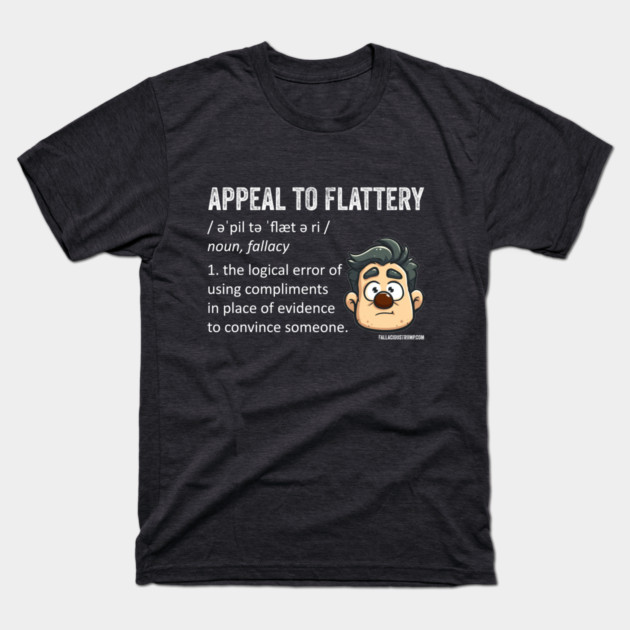
And if you have some money left over after that, Jim’s book, 2000 Mules and One Big Lie: A Stubborn Conspiracy Theory is available now.
That’s almost all for this week, but here’s our AI-aided transcript, which is quite accurate, but not totally:
Appeal to Flattery – FT#45 Transcript
Read the full transcript
00:23 Jim: Hello and welcome to Fallacious Trump, the podcast where we use the insane ramblings coming from the orange presidential facehole to explain logical fallacies. I'm your host, Jim.
00:32 Mark: And I'm your other host, Mark. A logical fallacy is an error in reasoning that results in bad or invalid arguments. And the logical fallacy we're looking at this week is the appeal to flattery, also known as the appeal to vanity, apple polishing and argumentum ad superbium.
00:48 Jim: Trump, obviously, flattery and vanity is a big thing for Trump. But usually it's going in the other direction. It's. It's him expecting his kind of cabinet members to to sit around the table and treat him like their dear leader and the rest of the world to do well.
01:03 Mark: Yes, obviously, yeah, yeah.
01:04 Jim: But flattery coming from Trump to other people happens, as part of this fallacy, in a very specific way. It's really only when he wants something from them, it's only to try and convince them that actually, what they should be doing is what he wants. And Our first example is from a tweet that he sent in july 2019, when asap rocky was imprisoned in sweden after a kind of altercation, and he tweeted: just spoke to kenya west about his friend asap rocky's incarceration. I will be calling the very talented prime minister of sweden to see what we can do about helping asap rocky. So many people would like to see this quickly resolved. So he very talented prime minister of sweden, yeah, yeah. Now, as this kind of rolled on a bit and and asap rocky didn't immediately get released after this bit of flattery, he turned less nice right and and started saying about how you know, it was very disappointing that the prime minister wasn't doing any more than war and it was. You know, America does lots for sweden and doesn't seem to work in the other direction, which is a weird kind kind of foreshadowing of what he said to the ukrainian, uh, prime minister, um, yeah, so at the beginning, when he thought it would kind of grease the wheels, uh, polish the apple, he, yeah, um, he was calling the the prime minister very talented and yeah, that's basically this fantasy is. It is it's not sincere flattery, it's not sincere praise or, um, saying what you actually like about someone. It is entirely to to try and get them to see you more pleasantly and do what you want them to do.
02:45 Mark: Right, that's really what I kind of – I actually, I think I find myself doing that a lot when I'm trying to, um, get a bargain on ebay. When you end up and you kind of do all this flattery stuff in order to, um, sneak in an outrageously low bid or, uh, you know, when you're making an offer and you kind of go, oh, it's a lovely thing and you've kept, you've obviously looked after it so well, you know, you've described it and I'm really interested in the story behind it. Would you take one pound fifty for it, you know, instead of the listed forty eight thousand dollars?
03:19 Jim: Yeah, and then – and you're using it essentially in in the place of an argument. You're not actually making any logical uh steps to say why you should have it or, in this case, why rocky should be be released, but, um, it's just, instead of doing that, you just go for the flattery.
03:37 Mark: Yeah, and I think actually he's also kind of he's talking about the prime minister of sweden and his talent in the same breath as kanye west and asia rocky, who are, um, you know, equally talented nordic politicians, just like, just like he's an equally talented urban rapper.
03:57 [Unclear]: Yeah, yeah, it was.
04:00 Jim: It was kind of weird that he got involved with this. Really it was. It was during the period where kanye was, you know, the kind of crazy where he was interested in Trump, as opposed to his usual kind of crazy, and, um, and kim kardashian was going into the white house and getting Trump to listen to her about people who should be released from prison and and things like that, and and he just seemed to be kind of caught up in that celebrity, yeah, interest world thing, which was very much. I think what what essentially kim and kenya were doing to Trump was was the flattery thing to say: yeah, yeah, you, we need you, you're brilliant, we need you to come and help us with this thing that you're,
04:41 Mark: you're a rock star. Yeah, yeah, you know you're a rock star, um, and we're – you're kind of Our kind of people. It's a bit like the the cool britannia thing in the 90s when all the pop stars went to visit um Tony Blair in number 10, so like oasis and blur and paul weller, and that would all just turn turn up at number 10 and he absolutely loved it and you know he thought he was. Finally, he got to hang out with the guitarist that he'd been emulating for years and years and they felt like they were influencing policy. And I don't know that that's true. I think they've all just turned out to be slightly right of center after, I suspect morrissey turned up at one point and said, yeah, that, that, that thatcher, she was great that,
05:32 Jim: yeah, so it is. It really is about the, the kind of vanity that they, that they get out of it, rather than anything else. And Our Second example from Trump is, uh, at one of his rallies – and it's aimed at his followers, his supporters: you're
05:47 Clip: Trump telling his supporters how smart they are
— the smartest us they don't like to say that about. Hey, I went to great colleges, you went to great schools and colleges. You people are successful as hell. They like to try and demean always by the world this and that. Let me tell you, we're winning, you're smarter, you're better looking, you're sharper, and they call themselves elite. But if they're elite then we're the super elite.
06:15 Mark: So let's see, kind of gone, gone from you know, yeah, you went to colleges, they went to college. But you've been to college, you know they've got good jobs. You've got good jobs, you're sharper, you're better looking.
06:27 Jim: I mean, I know, I know it's just kind of a given, but yeah, um, the his him, saying: you know, I went to to great schools and colleges, you went to great colleges. 29 percent of his base are college graduates, of his, of his supporters, compared to like 66 percent of hillary's supporters. So yeah, you definitely can't say to those people: you all went, you went to great colleges, you're really smart and well educated and and brilliant.
06:53 [Unclear]: It's just yeah, and he's,
06:59 Mark: and he's also trying to do the same the thing, I'm just, I'm just like you, I went to good schools. Yeah, because, because you bought your way in, yeah, so he's kind of doing the, the flattery of them so that he, they will count him as one of them and vote for him. Basically, do what, do what he wants them to do, and yeah.
07:23 Jim: So he just, and he does that really weird thing where he claims that the Democrats call, call themselves elite, which is not how that works at all. The the elite moniker is given to them as a kind of as a negative thing. Yeah, by their enemies saying they are, yeah, yeah, east coast elites and so on, yeah, um, and so Trump is weirdly claiming that they call themselves elites, but they're not elite. We're more elite than they are. They are yeah, so he's claiming it yeah, as a, yeah as a thing. That's good.
07:58 Mark: Yeah, well, that was the thing that was bandied around ahead of the last election: that the uh, corbyn and the corbynistas, the kind of the champagne socialists, were all called metropolitan liberal elites and were out of touch with the rest of the country, and this was leveled at them by the metropolitan liberal elite in the Tory party, who for sure have never a – you know, step foot outside of westminster. Lots of them, you know. So their, their thing is very london focused. That was well, in fact, that's the text of my dissertation, the other side of this sting,
08:35 [Sting: Mark's British Politics Corner] And now is the time, I think, for Mark's British Politics Corner.
08:40 Mark: Yeah, so this is about um. My first clip is where Boris won. This is from his election winning speech the day after he won Won the last election in December last year, mainly because people that never normally vote for the metropolitan liberal elite – the Tories – don't normally vote for them – voted for them.
09:04 Jim: Surely they're the metropolitan conservative elite.
09:08 Mark: Aha, very good. That's what you did there. The metropolitan liberal Democrat elite. With a little L. So Boris aware that lots of people – basically he was aware that his campaign had won. His campaign of having no policies other than get Brexit done was a successful thing because he tapped into all the people that were disenchanted – sufficiently disenchanted to have voted leave in the referendum in 2016. And then were increasingly disenchanted that we hadn't left the European Union by 2019, glossing over the fact that they were disenchanted sufficient to vote leave because of seven years up till then, of Tory austerity and London -centric policies. So they disenfranchised them sufficient to vote leave and then capitalized on their disgruntlement with their disenfranchisement by saying: yes, we will manage to leave now. Now, having also successfully deflected all of the blame for the austerity and the London centric – you know, denuding of industry in the northern parts of London, northern parts of England – having successfully deflected all of that onto Europe so that people said, well, it's all Europe's fault. So having won, Boris then flattered the hell out of the voters by saying this.
10:49 Clip: Boris Johnson thanking people for voting Conservative
— I have a message to all those who voted for us yesterday, especially those who voted for us Conservatives: One Nation, Conservatives for the first time. You may only have lent us your vote and you may not think of yourself as a natural Tory. And you may intend to return to Labour next time round. And if that is the case, I am humbled that you have put your trust in me and that you have put your trust in us. And I and we will never take your support for granted. And I will make it my mission to work night and day flat out to prove you right in voting for me this time and to earn your support in the future. And I say to you that in this election your voice has been heard.
11:44 Mark: And about time to see – I don't know why they're clapping there, because who he's addressing are basically the Tory party, faithful um in that room and they're all going: yeah, great, yes, yeah, we. You know you let, I'm humbled by the fact that you lent us your vote and you know we will do all we can to um to live up to your, your expectations. Of course they won't um, and you know he said your voice has finally been heard about time too. Only insofar as it's got him into power. He is notorious for um setting stuff up so that people trust him merely to further his own career. Or there's a great article in the uh in the guardian and it says: unreliability is johnson's business model, as is attested by everyone who's misplaced trust has been incinerated to fuel the engine of his, of his ambition. And he's we've known that he's done that when he became the mayor of london and did all all sorts of claimed all sorts of great things from his mayorship which were based on the previous mayor's stuff, the Ken Livingstone stuff. So the whole of the Olympics, Boris claimed as his own. He did none of that. The things that he then went on to do, like building a new bridge over the Thames, which never came to pass, but he spent 53 million pounds convincing people that he was the guy to do this. He was held up in front of various select committees as the mayor to find out what had gone on with housing schemes around the docklands and around the olympic park. That didn't come to pass, and lots of money exchanged hands. So there's people trusting him left, right and center, and he's saying: yes, thank you, for that is. He successfully got people able to vote for him on the basis of being ever so humble. He's prostrating himself in front of these people that have never voted Tory in their lives, these people that he's disenfranchised, made disgruntled with politicians and then voted for him, and he's just going to drop him, as you know, because he has got where he wants, which is to be king of the world. So he's he's done. He's got a a large enough majority in Parliament to get through anything. He can ignore all of those promises and nobody will stop him. Nobody will hold him to account because his enormous majority will allow him to put through any policies that will ignore those. So people will kind of stick their hand up and go: yeah, but what about the Northern Powerhouse that all voted for Tories and got you into office? Nobody's going to say that, because they're all in and they're all happy and they're all on the gravy train. So, yeah, um, it's not a hundred percent convinced,
14:56 Jim: okay, that it's an appeal to mastery, I think I I don't. I didn't see anywhere in there that he was kind of trying to get something out, because he's already, essentially, he's had their vote, he's got what he wanted, yeah.
15:08 Mark: So I was trying to find an example from the speech he gave just before the election. But he kind of tones it down. He's not. He doesn't actually say, um, I don't know why, because he could have promised all sorts of stuff, um, you know, he doesn't say you're, you're great, you know you're, you know you'll be, uh, I will do everything that you need. So this is kind of after the fact, this is what he. If he just said this before the election, then he would have been appealing to them to get something out of them. What he's doing is more, maybe he's kind of assuaging some sort of collective guilt on the part of the top. No, what am I saying? No, he's, he's not. So all right, yeah, okay. But yeah, it's kind of because it's after the fact, he's kind of not trying to get anything out of them he's already got,
16:02 Jim: yeah, and he's almost exactly saying: you know, I don't even really really expect you to vote for labor first next time. Yeah, so, yeah, yeah,
16:13 Mark: so, yeah, thanks very much. Goodbye, yeah, yeah, not doing anything you want? Yeah, all right then. So the Second example then is um, so this is a couple of instances. So Boris in I can't remember the last summer during the, the Extinction, Rebellion, climate activist demonstrations that were going on in London, Boris was trying to get to the offices of the Daily Telegraph where Charles Moore was launching the latest in his Margaret Thatcher biography series, and he was held up from getting there in time and was disparaging to the audience of Daily Telegraph off grandees, uh, about the uh climate activists, and he's he's. So what we're going to hear now is Boris, and then it's followed by boris's dad, stanley Johnson, who is talking to the very activists that he was disparaging about.
17:17 Clip: Stanley Johnson on Extinction Rebellion protesters
— My own team didn't want me to come to this event tonight because they said that there were some uncooperative crusties and protesters of all kinds littering the road. When we are waylaid in the streets, as I'm sure we will be, by unfortunate nose -ringed, dreadlocked climate change protesters, and the best thing possible for the education of the denizens of those heaving hemp -smelling bivouacs that now litter Trafalgar Square and Hyde Park and the rest of London, the best thing for them would be to stop blocking the traffic and buy a copy of charles's magnificent book. I wear that badge with pride.
— It's one of the nicest things which I've been said about me for a long time. A non -cooperative crusty – absolutely superb. Do they taste good? That's my thought. I think they do. Look on this point, on this point of language, you've got to understand that sometimes you need to get a point across now. Now this particular point was actually Boris saying that you know he'd been a bit late for Charles Moore's book launch. You know, and he works for Telegraph. Charles Moore works for Telegraph. You don't expect people who work for Telegraph to be late for each other's book launches anyway. But the real point, Boris said, the real point, Boris said, was he absolutely supported the objective.
18:43 Mark: He absolutely didn't say that. That wasn't all we heard. So not only do his private office warn him against these things, his own bloody family is kind of apologizing on behalf of him for using such language. So, again, Boris, a bit like Trump, is a failed, awful stand-up comic. You know all that Eton and Cambridge education just has given him a large dictionary of insults that he can string together in a very flowery way.
19:18 Jim: But at least it is a large dictionary of insults instead of just Trump's tired, old, hacky phrases.
19:25 Mark: Mean and nasty. Yeah, that's true.
19:27 Jim: At least it's imaginative, calling the uncooperative crusties in hemp some bivouacs.
19:32 Mark: Grasping at straws.
19:34 Jim: Yeah, it's just as appalling, but it's entertaining.
19:38 Mark: It's entertaining. So I think, in order to get the uncooperative crusties to be a little more cooperative, and almost kind of later on, the thing is in that speech Stanley Johnson equates, um, the climate activism with Tory policy, and Boris Johnson actually in the same speech – there's a bit more of it – that uh came before, what that, what he was saying. He he says thatcher was got there before greta thunberg did. So they're kind of saying, yeah, do we? We're not in. He's not not insulting you because you are really, uh, at the heart of conservative policy. He's they're trying to get them on side by by a bit, like they call themselves the elite. Well, we must be the super elite. He's called you a uncooperative crusty. Well, I would wear that badge with pride. Um, and to get you on, to get them on side, basically, and to diffuse the the situation, because Boris doesn't give a shit
20:53 Jim: about and he does get a cheer at that point, doesn't he? Yeah, yeah, when he says that. So yeah, it seems to be working.
21:00 Mark: And then, and then he joins in. He goes, hey, as well, that's him going. Hey, that's the worst thing to do, isn't it? When people cheer, you don't cheer along with them, because that just makes you – yeah, you appear that you're not really listening – your way ahead, trying to get to of the you go. yeah, cheer there, yeah, yeah.
21:25 [Sting: Fallacy in the Wild (I Will Survive – Gloria Gaynor)]
22:01 Mark: There you go, Gloria Gaynor there with I Will Survive. I was kind of inspired by that one because I saw that she'd posted a short video on TikTok of herself washing her hands – uh, to counteract coronavirus to the – and singing the chorus of I Will Survive, because that's long enough to wash your hands by. Yeah, that was excellent.
22:38 Jim: I absolutely loved that video.
22:39 Mark: Yeah, Yeah, yeah, so good. Yeah, and there is, I will survive by washing my hands and not doing anything else, yeah.
22:49 Jim: So in The Fallacy in the Wild, we like to talk about the fallacy of the week from a non -political perspective, and this week Our first example is from an old L 'Oreal ad.
22:58 Clip: Old L'Oréal ad
— I use the most expensive hair colour in the world, preference by L'Oreal. It's not that I care about money, it's that I care about my hair. Hair. It's not just the color. I expect great color. What's worth more to me is the way my hair feels: smooth and silky, but with body, it feels good against my neck. Actually, I don't mind spending more for L 'oreal because I'm worth it.
— There you go, because you're worth it, yeah, yeah, because.
23:26 Jim: So this is where the because I'm worth it, which later turned into because you're worth it,
23:31 Mark: started started, which is even more flattery.
23:33 Jim: Exactly yeah, and – and it was, it was because I'm worth it for quite a while. And then one of the – the spokesmodels that they had doing their ads – decided that she didn't feel comfortable saying I'm because I'm worth it and would rather say because you're worth it. And they said, yeah, that works. And then it became that, became their slogan. And yeah, it absolutely is. This is the appeal to flattery, is saying: you know, I mean L 'oreal isn't one of the more expensive brands anymore, but when it, when it was, it was saying, yes, you, you should have that, so you should buy this, not because you know it's great or because it'll make your hair look nice, but because you're worth it. Yeah, there you go. Yeah, because you're such a great person, you deserve this,
24:14 Mark: you deserve this, and why wouldn't you? You know, yeah, and if you don't have it, are you saying that you're not worth it? Yeah, yeah, what was the name of the male cologne, like denim or something like that, when it was, and it was, was it? Was it old spice? I don't know
24:31 Jim: what you're talking about.
24:31 Mark: Yeah, no, because the strap line was for the man who doesn't have to try too hard, okay, so, so that was the thing you know, when you kind of go, probably it was, yeah, yeah, it was, but it's that, yeah, they are. It's all those implied things in there. You know, it's that. Are you? Are you saying, saying that you're, you're the one man that does have to really try, whereas if you, if you just use this, you would, yeah, you'd be worth it. And there is there's something completely narcissistic about I'm going to use this because I'm worth it, you go. Well, good for you.
25:09 Jim: So, um, Our Second example is, uh, one which is an example of how you can use it to distract someone if they are going down a path that you don't want to go down using right, and this is from an episode of South park called chin pokemon, where there's a craze, obviously based on pokemon, and it is these japanese toys that have an interesting malfunction.
25:30 Clip: South Park
— We understand you have big concern about Our fine product.
— Well, yes, do you mind telling me what the hell this is about?
— The American government fight for japanese.
— Well, that is so strange. I do not know how this could happen. But rest assured, I will make sure, Sure. It does not happen again.
— Well, now, come on. I don't think that that quite satisfies my…
— You are American? Yes. Oh, you must have very big penis.
— Excuse me? I was just asking you what you're up to with these toys.
— Nothing. We are very simple people with very small penis. Mr. Horse's penis is especially small. So smooth. We cannot achieve much with so small penis. But you, Americans, wow, penis so big, so big penis.
— Well, I guess it is a pretty good size.
— This man has a very big penis. What an immense penis.
— Well, it certainly was nice meeting you folk. I just wanted to bring that little malfunction to your attention. Bye-bye now.
— Goodbye. Thank you for stopping by with your gargantuan penis. Works
26:52 Mark: every time.
26:53 [Unclear]: So, yeah, absolutely so, the?
26:55 Jim: Uh, the makers of the chin pokemon successfully distract the? Uh, the American toy um toy shop owner uh, from complaining about their toy.
27:08 Mark: Well, it's a bit like that apocryphal tale that, uh, when um soldiers fighting wherever American soldiers got sent condoms, um, uh, they were all marked extra large just to kind of, you know, as flattery of, yeah, you've got to wear condom, and actually, you know, we know you need these things and we're going to put extra large on them.
27:31 Jim: So Our final example in Fallacy in the Wild this week is a book by hg wells, but not one of his kind of sci -fi or fantasy books. This was uh. This came came out of a situation where he was visited by a friend of his, jerome k. Jerome, who um was a poet, wrote uh, three men in a boat and he had some kind of toy soldiers and and after dinner jerome started kind of playing just absent -mindedly almost – with the with the soldiers, and um hg wells joined in and they had a bit of a battle with the toy soldiers and decided that it might be fun if they make up some rules for these war games. And so the first book of rules for playing with toy soldiers was written. It was by hqs, it was called little wars, but the full title was little wars, a game for boys from 12 years of age to 150 and for that more intelligent sort of girl who likes boys, games and books, nice. Okay, I'm sure that this was just a horribly misogynistic way of doing it for hg wells, but it represents, uh, another form of this fantasy, which is where you suggest that something is for a particular group of people, a particularly elite group, or a particularly clever or a particularly handsome group, and therefore, if you consider yourself, or would like to consider to yourself, part of that group, then this is a thing for you.
29:00 Mark: Yeah, nice.
29:01 Jim: So by saying yeah, by saying this book is for the more intelligent sort of girl, then that that's who is going to pick up the book is the ones who consider themselves to be that or like to see themselves that way.
29:15 Mark: It's like something for this is for the discerning gentleman. Absolutely, yeah, that kind of thing, yeah. So you, you immediately. Well, that, yeah, that's why you buy stuff, isn't it? Oh, my God, because if you,
29:29 Jim: yeah, if you look at that and think, well, you know, yeah, I'm not the more intelligent one, so I wouldn't enjoy that. That's just not how most people think,
29:36 Mark: so I'm not a discerning gentleman, so I'm not going to buy that particular shade of beard trimming dye or something whatever. I'm racking my brains to find out where that comes from. The discerning gentleman. It's probably a whiskey or something like that, or just like, well, it's almost a bit like probably the best lager in the world, or, uh, you know that, yeah, all of those things where there's a lot of this,
30:05 Jim: a lot of appeal to flattering vanity in in advertising, you know, yeah, so much of it is based on creating this situation where where an aspirational person or aspirational situation that you would like to see yourself in, or is the kind of person who uses this product.
30:24 Mark: Yeah well, even if it's not stated in the strap line, it's always people with fabulous hair driving open -top cars in the sunshine. And you think what is this advertising? And it turns out to be pile cream or funeral plans or something like that. But there's just this thing and you go, I want to be like that. You know, and if I buy that, yeah, well, there's that line that could be me, yeah, yeah, that line in rolling stone satisfaction, um, he can't be a man because he doesn't smoke the same cigarettes as me, that that like, which is straight out of an advert.
31:04 [Sting: Fake News] So, yeah, so we're gonna, we're gonna play fake news folks. I love the game. It's a great game. I understand the game as well as anybody. As well as anybody.
31:13 Jim: Yes, it's time for fake news. The game where I read out three Trump quotes, two of which which are real and one I made up, and Mark has to figure out which one is fake news.
31:21 Mark: Because week after week, Jim, you outfox me. It's because you're absolutely brilliant at writing these things. So out of the goodness and magnanimity of your genius brain, you could just, whatever happens this week, I could win.
31:36 Jim: Well, we'll see. So you may actually have a good chance this week, because the setting that these were said in has been on a lot of different programs and on the news and these kinds of quotes have been around normal obscure places – yeah well, yeah, like press conferences and things like that. But this has, this has been widely um put out because this is when Trump visited the cdc – uh, yeah, last week, just over a week ago – to talk to them about their coronavirus preparations, and he talked to the press while he was there and it was a fairly horrific um speech – that well, he wasn't even it was. He mostly answered questions, but he obviously didn't know anything and and the people that were around him were just complete sycophants and it was amazing. So, uh, he said a number of different things – and this is statement number one – mostly about himself.
32:37 [Unclear]: Yeah right, I.
32:40 Jim: He said: I like this stuff, I really get it. People are surprised that I understand it. Every one of these doctors said: how do you know so much about this? Maybe I have a natural ability. Maybe I should have done that instead of running for president.
32:53 Mark: That's the same old line that he always runs, isn't it? Everyone said: how come you're just such a genius, yeah, Yeah. A lot of people have said that. No one, not one of them have said, how come you don't know anything? All of them have said, you know nothing about this. Just leave it to us. Stop fucking it up by getting involved. Maybe I have a more
33:16 Jim: likely one of them said, how do you not fall down more?
33:24 Mark: Just from doing one thing. I mean, Gerald Ford couldn't chew gum and walk. Trump can't even think and speak. So, statement number two. Every one of them.
33:36 Jim: Statement number two. Over the last long period of time when people have the flu, you have an average of 36,000 people dying. I never heard those numbers. I would have been shocked. I would have said, does anybody die from the flu? I didn't know people died from the flu. 36,000 people died.
33:52 Mark: How come you know so much about this? After the last long period of time? What? Just after the first world war? Over the last long period of time?
34:04 Jim: Yeah, yeah, yeah, um,
34:05 Mark: when people say, okay, I never heard those numbers right, okay, okay, statement number three:
34:13 Jim: yeah, we're going to have a vaccine and we're really and really we're going to have it done very quickly and the whole world is relying on us. It's going to be a beautiful vaccine. Of course, it takes time to get it approved and make sure it's safe, but we're going to see what we can do about speeding that up.
34:27 [Unclear]: Okay, well,
34:35 Mark: they, the troubles are all so bloody convincingly right, I think the first one. Every one of these doctors said how much. That's kind of typical, so it's probably true. Uh, that's a lot of people died: 36 ,000. Okay, we're going to have a vaccine. It'll be a beautiful vaccine.
35:08 Mark: I think, despite the beautiful vaccine, I think number three is the one that you made up.
35:19 Jim: Okay, which of the other two are you more convinced by?
35:23 [Unclear]: I'm?
35:24 Mark: I'm neither of them. Uh, okay, I can hear him saying number one, so I've got to say number one.
35:33 Jim: So number one, yeah,
35:35 Clip: Trump, played during Fake News
— yeah, real well, I like this stuff.
— I really get it. People are surprised that I understand. Every one of these doctors said: how do you know so much about this? Maybe I have a natural ability. Maybe I should have done that instead of running for president.
35:49 Mark: You should have done anything instead of running for president. Yeah, oh, Jesus Christ, yeah, no, the trouble is it kind of reminds me of. Boris made a speech yesterday about. Well, he had a kind of press conference thing and he was flanked by two properly expert medical people and he just looked like a fucking idiot because he was just saying that he had no idea. You think, okay, for all your words, you can't actually string a sentence together. You don't know anything really. And he did have the good grace to just hand over to the experts. He didn't answer some of the questions, just sent them straight to them and but, and, and you get this,
36:38 [Unclear]: it's yeah, not, this has to be the best. Yeah, yeah, yeah.
36:45 Mark: And then make up stuff and say: oh, yeah, every single one of these doctors said: how much you know so much? They don't, they didn't, they didn't do that. No, as like one of them,
36:56 Jim: maybe like as a joke, when he said: so is it like a cold? Oh, how do you know so much about this, or so.
37:04 Mark: This is like a. This is like a glove, only it's made of rubber, and you like, you put it on your hand like that: yeah, and And it's oh. Okay, so it's like a condom, but with five bits on it.
37:17 [Unclear]: How do you know so much about this? How do you know so much about this?
37:20 Mark: Well, when I was in the army, you weren't in the army. We got sent condoms that were extra large. No, you didn't. No, you didn't.
37:29 Jim: This is the guy who, a week before, was sitting around a table in the White House with actual doctors and saying things like: Like, so could we just use like the flu vaccine for this. And all of the doctors were sitting there thinking, fucking course we can't use the flu vaccine. It's not the flu.
37:50 Mark: It's not the flu. And all of those doctors were thinking, how come he knows so little about this?
37:56 Jim: How do you know the amount you know about this? How is it possible to know that much about this?
38:04 Mark: Yeah, yeah, lived your life this long in this country and been exposed to as much television as you've been and yet know so little about so much.
38:18 Jim: Yeah, so right, um,
38:22 Mark: okay, so so you also think that number two, I do definitely want it to be real.
38:29 Jim: Yeah, and number two,
38:30 Clip: Trump, played during Fake News
— yeah is yeah real.
— Oh, my God, long period of time when people have the flu. You have an average of 36 000 people dying. I never heard those numbers. I would, I would have been shocked. I would have said: does anybody die from the flu? I didn't know people died from the flu. 36 000 people died.
38:50 Mark: How do you know so much about this? Literally in the same visit,
38:57 Jim: he is saying: yeah, I, I didn't know this thing. That basically everyone knows. Also, I know everything there is to know about this stuff.
39:04 Mark: Yeah, I've got a natural ability. Well, you're natural, in a kind of shakespearean sense of natural being idiot. Yeah, and then, but there's no I, he's, he has no sense. Okay, he's got no long -term memory, so it's just he's going. Oh, yeah, did I say something then I have no idea what it was. Anyway, I'm just expressing what everybody else is expressing: 36 000, really 36 000. Yeah, everyone, yeah, everyone knows that, yeah, more people than have died so far in the? U? .s from coronavirus have died of the flu already last year. Yeah, we know that. Yeah, yeah, I sounded a bit like jonathan, all of which means,
39:52 Jim: yeah, you have got.
39:54 Mark: Oh, oh, okay, aha, so yes, statement
39:58 Jim: number three was indeed fake news.
40:00 Mark: Oh, because he did say something about vaccine. That's why I was a bit bit doubtful about it. Yeah, sounds so. It sounds so normal and ordinary.
40:11 Jim: I mean, he's repeatedly said that that oh, yes, we're working on a vaccine. It's going to be very quick, it'll be, yeah, and everyone else is going, no, it's going to be a year. Yeah, year to 18 months, um, and and he said, um, basically, I think in that meeting where he was saying could we use the flu vaccine, he, he said something like, um, you know, could we get it done in two months? And they said, no, it'll be a year. And he said, oh, I like, I prefer for two months, like that matters.
40:39 Mark: Yeah, yeah, like it's not, you're not doing a deal, we're not kind of holding out, for, you know, 18 months, it's going to take 18 months. Three of those are getting it tested on humans, so we don't kill. People said: oh well, we'll just speed that bit up. Isn't bureaucracy, it isn't just government interference slowing the thing down, it's the the fact that we're not star trek and we can't just go: oh yeah, I'll just reconfigure that on the screen and then put it through. The replicator can't do that. It doesn't exist for sure. I've seen it on the telly. I know so much about this stuff.
41:20 Jim: Oh, so that means that you are now on 18 out of 45, which is, yay, 40. Oh, I've never been back up into the fours. The heady heights of – yeah, you were below average. 42, I think, was your peak. Whoa, yeah, you're getting back up there.
41:41 [Unclear]: Yeah, so,
41:50 Jim: Mark, have you ever been in an escape room?
41:53 Mark: No, I haven't, but I did once design one for my son's 10th birthday and I had to make up all the characters and then sort of work out out the plot. And they all arrived and they played the thing and then they had to work out this puzzle and it took forever, but it was great fun and, yeah, and I've not actually been to an escape room.
42:14 Jim: So my kids and I, we love escape rooms. We did Our first one last summer and, oh yeah, it was fantastic. And then we did another one beginning of this year. That's such a lot of fun and it's really kind of intense puzzle solving, yeah, finding thinking you have you have to think laterally and logically and it's like creative and you have to really keep an open mind as well, because my daughter, who's 11 – came up with a thing and said, maybe this is what we need to do, and I was like, right, that's not what we need to do. And of course, it was what we need because it was so brilliant. It's yeah, yeah, absolutely brilliant. So we love escape rooms, but the thing is they are really expensive because when you get your family all together and go and do it, you're paying, you know, a lot of money per person, yeah, and you have to go somewhere and find somewhere way to do it. But rather than spending a lot of money on each of your family members and taking them to a place, you can get escape rooms that you get sent to you, and we have a sponsor this week who is a company called crate joy and they do subscription boxes. One of the subscription boxes they do is called escape the crate – excellent, it's an escape room in your house. They send you a different escape room that you can do every two months and you can play it with your family. Many people is like really, yeah, yeah, enjoy all of the puzzle solving and clue finding and cipher solving and all of that stuff. Yeah, how do we get these? If you want to have some fun in your house with an escape room, then you can go to Fallacious Trump .com escape. And if you put in the discount code f Trump when you order, you have to subscribe for more than one box to get a discount. You'll get 20 off if you subscribe by the 22nd of march and put in f Trump in the discount code when you check out.
44:04 Mark: So hurry up and do it:
44:05 Jim: Fallacious Trump, .com escape. it's time for the part of the show that, this week at least, is called simon chadwick is not a logical fallacy, because this week we've partnered with the green leaf book group to bring you an interview with simon chadwick, the author of the new book for the people: a Citizen's Manifesto to Shaping Our, Our Nation's – future. Simon, thanks very much for joining us.
44:31 Simon: Thank you, Jim. I'm delighted to be here.
44:33 Jim: Why don't you start off by just giving us a little bit of your background?
44:36 Simon: Well, as you can tell, I've got a North Carolinian accent. And no, I'm actually, I was born in South Africa and educated in the UK. I've worked in Africa, Italy, the UK, the USA. So I've got quite a sort of background of different types of country, different sort of cultures. My father was a very prominent anti -apartheid activist in the 70s and 80s in South Africa until we as a family were exiled in 1982 subsequent to his arrest. And so I've actually experienced the totalitarian government up close and personal. Educationally. I have a master's from Oxford in philosophy for Politics and Economics, which has been an interest of mine, even though my career has really been in running companies and, for the last 15 years, my own consulting company here in the United States. So I wrote this book essentially because when Trump was elected, a lot of my family that that was still in the UK were saying: come home, come home. The guy's a maniac. I can understand that, yeah. Instead, I thought, hell no, I'm going to be part of the resistance. And I'd been here for 20 -something years on a green card and basically I decided to get citizenship so that I could have a say, and then to write this book, because I felt somebody needed to give a logical and perhaps broader view of not only the dangers that we face but how we can get out of it and how we could reestablish this country as something to which it aspired to in the beginning.
46:35 Jim: The book is called A Citizen's Manifesto, and it kind of works its way towards a manifesto at the end, doesn't it? And there's a lot in there explaining the concepts of democratic libertarianism. Can you kind of, in a nutshell, give us what that is, democratic libertarianism?
46:55 Simon: So it's really interesting, actually, when you think about the way in which we talk about politics, we think about left and right. What we don't think about so often is authoritarian versus libertarian. And being a management consultant, you know, I can't live without a two-by-two. So if you plot on a two -by -two the various forms of government in this world, both in recent history and today, you usually find that most governments are sitting in the top right -hand corner. That is, they are right-wing or center-right and pretty much in the authoritarian camp. That is true whether it's Boris Johnson or Tony Blair. It's true whether it's Obama or George W. Bush. Most democracies, most Western democracies today are in that top right-hand corner. Uh, in the bottom right hand corner, which is right -wing libertarianism. That's what I call right -wing sort of fantasy land. It's over here in the united states. It's what's promised in elections. I .e the government will get out of your hair and you know it won't cost you very much, but it's never delivered. Top left, obviously, is the failed communist states. Uh, you know ussr, Venezuela, places like that – but very rarely do people actually look at the bottom left quadrant, which is what I call democratic libertarianism. But this is where you know you have a left or left center approach to politics. But with you know an agreement that, yeah, we're going to set up a framework for you to be successful, to live your life, to be free of fear, but we're not going to to be a nanny state. We're not going to prescribe all the time. And I think if you look at governments around the world, you can see that many of the Scandinavian governments – perhaps sometimes the Dutch government, the Portuguese government and certainly New Zealand right now – fall into that category. And one of the most interesting things is that when you look at those countries, many of of them – not all, but many of them – are amongst the richest countries in the world and they're also amongst the happiest countries in the world. So that's what – democratic libertarianism, that's the definition of it, if you like, um. But the book started off really posing the question. You know, know, we've got a really horrible state of affairs in this country and maybe even in the Uk as well right now. Um, you know, how can we? You know, what is government about? What it should, what should it be about? And it really started from there, and I use maslow's hierarchy to try and answer the question.
50:10 Jim: So how does, how does maslow's hierarchy fit into that kind of concept of government?
50:14 Simon: Then, Well, if you're this side of the Atlantic and you go back and look at the Constitution and the Declaration of Independence, you see a couple of really interesting things. Number one. The Declaration of Independence was the first document of its type ever, maybe since Greek times, and even then, to use the word happiness, the pursuit of happiness, in its raison d. 'etre. Life, liberty, and the pursuit of happiness. Now, sure, the definition of happiness back then in 1776 was probably slightly different than it is now. It may have connoted sereneness or maybe societal calm. But nonetheless, you look around and you're not going to find it very often in a declaration like that. That liberty. Libertas in latin means broadly freedom, but in its most strict sense it means freedom from fear, which is really interesting, because if you then go across to maslow's hierarchy, what? What is that saying? Well, the top three, top two, top three layers of that are about belonging, love, self -esteem and self -actualization, which basically means achieving your dreams, and the bottom layers are about security, having a roof over your head, having food on the table and, at higher levels, being able to take care of your family, having a job, being educated, being in good health and really, really primarily, being free of fear that you will lose any of this. And indeed, the Bill of Rights makes that very, very clear. Freedom of assembly, freedom of religion, freedom from search, freedom of speech. So it struck me that this was uh fascinating in as much as we've moved away from a lot of that uh over the last few decades and really are moving away from it at a great speed right now, and in doing so, the united states is no longer an exceptional nation, it's actually a very mediocre nation in so many ways. So, using that as a lens, I really was interested in in saying, okay, so what should government be doing? It really should be setting up a framework of security for individuals and society as a whole, from which people can feel they belong in the widest sense and can actually strive for both self -esteem and achieving their dreams, and that the country itself can do so, because that's really what the country was founded on was that this was something different. This was something that people could aspire to, and it's part of the national conversation always, but it is very rarely these days delivered.
53:44 Jim: You talk in the book about ideology and and the problems that that creates, and part of the Manifesto is is abstaining from ideology. Um, how practical do you think that is? How realistic do you think that part of it is? Because I agree with you that that would be a great thing, but it seems to me that ideologies are so ingrained in a lot of people that that would be an extremely difficult part of the the process to to kind of put into effect.
54:14 Simon: I think that is true um, and in some countries, such as the u .s, you know, ideologies have become litmus tests to the extent uh that, you know, you get uh evangelicals, for example, supporting a man who is probably the most immoral um president that we've had, and in decades, if not centuries, because they see through him a way of making their ideology stick and forcing it upon others. That being said, there are examples, I think, where ideology is less prevalent. I think we've seen examples where, in democracies that are um highly active – highly, you know, involving uh new New Zealand is one of these – where it is possible for politicians to take non -ideological decisions and to lead through moral leadership in many ways to say no, you know, this isn't about ideology. This is about doing what makes sense and what's right. So yes, there is. You know, Ideology unfortunately permeates a lot of political life, but I think there are circumstances under which we can reduce that. It's such a Rubik's Cube in this country. For example, the ideology of the right is completely and utterly run by money. So the role of money in politics has to be looked at very, very, very closely. The degree to which, for example, you vote for or against the NRA on gun control is an ideological litmus test and is directly linked to how much money you get from the NRA. So you know, you have to kind of look at what's, uh, supporting ideology and supporting an ideological kind of stance and then try to work out how you can mitigate those, those influences.
56:43 Jim: The nra and gun control is a really interesting example actually of um what I would see as the difficulty of balancing freedoms. If you're talking about trying to give people liberty and freedom from fear. There are some people who would see freedom from fear as the ability to have guns – as many guns – as they like, and that will stop them from being afraid. Whereas other people's idea of freedom from fear would be that there aren't any guns or that, you know guns aren't as prevalent as they are. So how do you balance different people's concepts of their own freedom where those conflict?
57:24 Simon: The interesting thing here is that the Second Amendment was so vaguely written, so convoluted, that, depending on where you stand on the ideological spectrum, you can read pretty pretty much whatever you want into it. But in this case, I think, you know, it's like the old Irish joke. A guy comes to a fork in the road and asks an old man what direction to take and he says: well, if I were you, I wouldn't start from here. The fact is that we are starting from here. The Second Amendment is a fact. The Supreme Court has upheld it. Um. So okay, that's where we start from. We're not going to get rid of it. Um, thousands of constitutional amendments have been posited over the 200 years of the republic and only 25, I think, have ever got through. So it's very unlikely that we could ever? Um get rid of that, so we just have to say, okay, we start from here. That doesn't mean that we cannot regulate the way in which guns are bought, used and sold. And this is where there's a huge discrepancy between what the NRA, which is essentially a gun manufacturers association these days – believes and what left -wingers believe. But when you come down to the facts, they are horrific. And no government, I think, that really believes in a framework absent of fear should be sanguine about these facts. We have nearly 40,000 gun deaths a year in this country. That's more than traffic accidents could kill. We have 1,000 people killed by the police every year. And many of those gun deaths, by the way, are suicides and many of them are accidents in the home. You know where children have found guns and basically where they shouldn't. So if if you're saying as a as a politician, that you know my job is to to create a framework where people are not afraid, then there has to be some sort of regulation, there has to be some concerted effort to control that mayhem. And again, it's not easy because it means you have to deal. It means that you have to deal with gang culture. It means that you have to deal with people who believe that they can own AK -47s, that they shouldn't have to register or be controlled in any way, whilst at the same time registering their car and licensing it and passing tests to drive it. But, you know, all of that has to be dealt with. But nonetheless, you know, you cannot, I think, look at this situation and say, this is perfectly normal. Unfortunately, after every mass shooting, and in five months, the first five months of last year, there were 22 mass shootings in this country. You know, everybody sends out prayers and thoughts and condolences and nothing gets done. It's getting done at the local level and that's interesting, but it's not getting done at the federal level, and that's because of money.
1:01:05 Jim: Local government and local governing entities – uh, something that comes up as well in in your book as kind of an example of how government gets out of the way by leaving decisions beyond the kind of framework that they've set up to the smallest possible governing entity. Um, one of the ones mentioned is school boards in in the Manifesto and, and that made me wonder, in terms of this kind of ideal libertarianism, of allowing freedom and allowing those individual groups to make decisions, isn't there a need to decide that on a larger level and to regulate that? When you have, for example, school boards in texas and kansas and places like that saying it's okay or even buying textbooks to uh, to teach creationism over evolution, isn't there a need for the government to get involved at that point and at a federal level and say, no, we have to have these standards?
1:02:00 Simon: I I believe there is, and I make a distinction in the book between what I believe are social issues that follow moral ideology, abortion being one which I think really should be brought down to the county level. And you know, if you want to live in a county that does not allow abortion, fine, but maybe the county next door or the county next to that does allow it and that means people can – even poorer people can – have access to it if they need. Where education is concerned, it's not just about curriculum – although I think you know you hit on a very good point there – but it's about financing. Financing and we're still using the form of financing education that was used in, you know, the days of the migration to the great, uh wild west. You had a town on the prairie that had its schoolhouse and had its school teacher and they needed to be supported and that was supported through property taxes. Today we have this same system, which means that, essentially, if you're in a poor neighborhood, you are really screwed in terms of the quality of the schools that you have available to you. Whereas if you're in a very wealthy neighborhood, you have the best education going. And this – this actually results in a grotesque mutation of the property market, with people moving between you know their, their kids elementary school time they'll be in one neighborhood and then they'll move to another neighborhood and that take, you know that really screws with property prices. But essentially what it does mean is that there is no um equal right to education in this country, and I'm talking primarily secondary education here. Secondary education is a crapshoot and essentially is not going to it's it's not solving for social mobility. Social mobility in the States is an all -time low right now. So, yes, to answer your question, there needs to be a more state-driven, maybe even federally-driven approach to education, certainly to education funding. And I think where the federal government can come in is to say: look, we need to move away from a property tax -based system, probably more to an income tax -based system. We need to follow the Dutch example of where there are lower socioeconomic class families in a particular neighborhood or maybe immigrant families. We actually upweight the funding to their schools to encourage mobility. These are things that, again, they do fall within the democratic, libertarian framework, because essentially, the government is then leveling the playing field and removing the fear of people who otherwise see their kids trapped in the lowest structure of society. society, removing that fear and enabling them perhaps to build a better future for their kids.
1:05:31 Jim: The book is For the People, The Citizen's Manifesto to Shaping Our Nation's Future. Simon, where can people get the book and where can they find out more about you?
1:05:39 Simon: Thank you. Yes, the book is available at Amazon, both in the UK and in the US and elsewhere. You can also go to my website, simonchandrick.us and buy it through that website. Do leave a review – you positive or negative, whichever way you fall, and I'd love to hear from anybody who is up for a respectful conversation as to the merits or demerits of the ideas that I put forward.
1:06:08 Jim: Excellent, simon, thank you very much for joining us.
1:06:10 Simon: Thank you, Jim, it's been a real pleasure. I
1:06:19 Mark: like the way he kind of sets out the whole thing based on maslow's hierarchy of needs, but he kind of touches is on libertarianism in. So we – and we were talking about it earlier – that we've thought that, uh, it was a very, very thing, a thing about being small government, so you do hardly anything to interfere in, uh, the social fabric and you just let everything go to the free market. Um, but it's. But he's got some thoughts about that. Actually there are a lot of government needs to do.
1:06:53 Jim: Yeah, solutions to some of of the problems with libertarianism – and that are inevitable, I think – do seem to involve using more government regulation than I would have expected, um, given my previous ideas of what libertarianism is. So it's really interesting to talk to him and to read the book and,
1:07:14 Mark: yeah, actually they're kind of – and they're the kind of ideas that in in recent times in the Uk have have been dismissed as socialism and even worse, communism, uh, stalinism, leninism, you know the way off to the, to the left, but they're kind of just the things that enable a, uh, a stable and secure society in.
1:07:40 [Unclear]: Yeah, and he does talk in the
1:07:41 Jim: book as well about how that kind of socialism word has has become such a kind of bête noire of the right in America that they simply kind of refuse to look at the more democratic, libertarian socialism as opposed to the authoritarian one, which is countries like Sweden and New Zealand and places like that where actually they're doing pretty well.
1:08:06 Mark: No, good interview. And finally, some things we really don't have time to talk about. Out
1:08:12 Jim: Shocking nobody nowhere, Trump continued to lie about and downplay the coronavirus last week, at various points likening it to the flu again, suggesting on Fox that many people who get it are fine still going to work, and even blaming Obama, saying “the Obama administration made a decision on testing that turned out to be very detrimental to what we’re doing. And we undid that decision a few days ago”. Nobody knows what he was talking about. Factcheck.org reached out to the FDA, the CDC and the White House and got no response, and the experts who would speak to them said there was no such decision. Peak Trump, though happened during his aforementioned visit to the CDC, when he blithely announced that his personal preference would be to leave American citizens on the cruise ship The Diamond Princess because letting them off the ship would make the US infection numbers look worse.
1:08:59 Mark: Nice, because Surely what you need in a crisis – especially a health crisis is trusted, accurate accessible information – hmmm from the White House? Well, Reuters ran reports from government officials that staffers without high-security clearances were excluded from the coronavirus response meetings held by the Department of Health and Human Services as they took place in classified rooms, even the virtual video conference ones. Of course if the information’s classified then it doesn’t get beyond the select bunch who have clearance, and given the bunch who have clearance aren’t at all qualified to run the country let alone deal with an global health crisis this very possibly slowed down the Trump administration’s response. Maybe it’s a bit naughty of Reuters to poke the grumpy bear like that by pointing this out cos he’s just gonna spend a lot of time roaring about how its fake news that and he’s not being inaccurate or opaque and “ner I’m the President”, rather than out fixing things – actually yeah that’s probably for the best – good work Reuters!
1:10:04 Jim: At the height of the Administration’s denial that anything was really wrong, large numbers of Republicans gathered together in a room at CPAC – the Conservative Political Action Conference. Mick Mulvaney, Trump’s now former Chief of Staff, told conference attendees that the only reason the coronavirus was even in the news was because Democrats thought it would bring down the President. Days later, when an attendee tested positive for coronavirus, several prominent Republicans announced they were going into self-quarantine for a couple of weeks, including Ted Cruz, Doug Collins, and body language expert Paul Gosar, who immediately went insane and tweeted that he’d rather die gloriously in battle than from a virus. The final quarantined representative was noted drunkard and desperate attention seeker Matt Gaetz, who only a week before had mocked people’s concern by wearing a full gas mask on the House floor during the vote on appropriations for combatting the virus. After karma caught up to him and smacked him in his oh so smackable face, his team announced on Twitter that “Congressman Gaetz had expected COVID-19 to impact Congress, given the elevated frequency of travel and human contact, and demonstrated his concern last week on the House Floor.”
1:11:06 Mark: Democrat Representative Katie Porter reminded CDC director Robert Redfield probably nothing short of the modern application of the Hippocratic Oath recently when she totted up at a House hearing the cost of getting tested for coronavirus – about 4 grand per household. She then simply asked Redfield “Do you want to know who has the coronavirus and who doesn’t?” “Yes,” Redfield replied. “Not just rich people, but everybody who might have the virus?” Porter asked. “All of America,” Redfield replied. But it took her 3 goes to get Redfield to “commit, right now, to using the authority that you have, vested in you, under law, that provides in a public health emergency for testing, treatment, exams, isolation, without cost, yes or no?” All he had to do was say yes – Porter pointed out he didn’t have to do any work other than that. Finally he relented – I can’t believe that’s the right word even! – topped giving “thoughts and prayers” non-answers and said yes. “Which as Porter said is indeed “Excellent!” – “Everybody in America hear that? You are eligible to go get tested for coronavirus and have that covered, regardless of insurance.” there you have it people a victory for the 99% – not be sneezed at!
1:12:29 Jim: Katie Porter continues to be an amazing representative, and if you want to hear more about how much we think she's great and other stuff she's done, uh, in episode 28 you can hear all about that in Our. She's so good at numbers. Finally, as the number of cases rose exponentially even in the absence of proper testing, Trump seemed to get the idea that bullshit can only take you so far when people are dying, and he addressed the nation on Wednesday from the Oval Office. Without acknowledging that maybe this wasn’t quite like the flu, he announced that he was putting a 30 day ban on travel from Europe, including on goods and cargo. Despite the fact that this was poorly read aloud from words that had been written down for him and put on a teleprompter, presumably more than 30 seconds before he went on TV, what he said wasn’t actually what he meant, and Trump himself various agencies tweeted corrections quickly afterwards. The ban would not in fact cover goods and cargo, just people. And not all people – American citizens were still free to travel from Europe. Presumably because citizenship imbues you with some kind of immunity. Also, the ban wouldn’t cover all of Europe, only the places which don’t contain Trump golf courses – so the UK and Ireland are fine. Just hours before this recording, Trump held a press conference in the Rose Garden to declare a National Emergency which will free up billions of dollars to combat the virus, and give hospitals significant authority to do whatever they need to do to help patients. During the press conference Trump said “When America is tested, America rises to the occasion” If America actually manages to get tested, that is.
1:14:00 Mark: Or they can afford it. Well, they can now on insurance. Health and Finance Advisory expert Eric Trump woke up bright and early – well 11:30ish on Feb 28th and not particularly bright, then tweeted some deeply researched advice to his fiscally-minded followers – “In my opinion” Uh-oh “its a great time to buy stocks or into your 401K. I would be all in…let’s see if I’m right…” well we didn’t have to wait that long to find out – by the end of same day the Dow Jones plummeted 350 points yeah that’s about 25% – and wrong tool or not that’s a pretty accurate measure of how wrong a tool Eric is – as one person commented “Eric doesn’t understand the difference between, buy on the dip, and, buy some dip!” Needless to say Eric has implemented his own social distancing by deleting the tweet and blocking a whole bunch of followers. Also I’ve just noticed his twitter banner is a massively faked picture of the massively fake crowd at the inauguration and everyone of them is his frieeeeennndd!! friend. Small thing.
1:15:07 Jim: It's definitely not 25 percent, was it not? No, the dow is like: uh, it was on that day at least. It was about 28 000. So 350 points is uh, it's 1, .25 percent. Oh, that's, I don't know what you're talking about, but, um, yeah, it's. In subsequent days it has fallen by thousands of points that, like, in the next few days, fell by. It fell by a thousand, I think. One day it fell by two thousand points and it fell so quickly that the new york stock exchange shut down automatically because they hit a seven percent drop, which is a, an electronic trigger to stop trading for 15 minutes so that it doesn't just spiral into nothingness, and it's the first time that's ever been implemented.
1:15:57 Mark: Wow, that's like hell to on just going. I'm sorry, I'm sorry, don, I can't do that, so it's just kind of going right now, humans, just I'm not going to let you do anything else now, I'm just going to switch it off,
1:16:12 Jim: wow, so yeah, not the best day to buy,
1:16:15 Mark: no, or be advised by Eric to buy, so yeah.
1:16:20 Jim: In news which is both good, and not coronavirus related, paedophile judge Roy Moore has resoundingly lost the Alabama GOP senate primary because he’s a garbage person. Moore came a distant fourth in the race for Jeff Sessions’ old senate seat, and in other good news, Sessions also didn’t win his seat back, although his race isn’t over, because he’s now in a runoff with the fantastically named Tommy Tuberville.
1:16:49 [Unclear]: It's not, it's not like,
1:16:50 Jim: presumably it's a children's tv character: potatoes, yeah, or, or.
1:16:56 Mark: I imagine he's one of those, um, those kind of figures that's inflated by air that stand outside parking lots, that's kind of like made of tubes,
1:17:08 Jim: the crazy waving thing.
1:17:09 Mark: Yeah, exactly, yeah, Yeah, Tommy Tuber. That's him. And he'll turn up at the hustings. And that's all he'll do. And people will think he's a Trump devotee. And he'll still beat Jeff Sessions. And he'll still beat Jeff Sessions.
1:17:27 Mark: Over here Boris has appeared at a presser for the first time since calling an emergency cobra meeting about two weeks too late, and after his health minister herself tested positive for coronavirus. And what measures are his government implementing to protect his swathes of new voters? – oh and the rest of us – well given that we are probably 4 weeks behind where Italy are now, if we were China we could build 4 hospitals in that time, but no – he’s not yet implementing anything that might actually prevent the infection curve from sky-rocketing, but rather distracting us from the last 10 years of wilful underfunding of the Health Service by perpetuating the damn-fool Dunkirk spirit of Keep Calm and Carry On – go to school, we walked to school during the Blitz, go to work, go on the tube, we survived the Luftwaffe you know, but most importantly wash your hands whilt whistling God Save the Queen, and get to grips with the notion that you might lose some loved ones before their time. Yes he actually said that! If only someone, anyone, loved Boris then would that mean he’d go before his time? Yeah love him but don’t kiss him eh unless you have a new and continuous cough. That is, I think,
1:18:43 Jim: probably only one verse of God saves the queen. You'd need to whistle while washing your hands to get to 20 seconds. I'd probably be fine. Yeah, no one knows the words after you get past the first verse anyway, which isn't an issue if you're whistling, admittedly, but still so. That's all the bad arguments and faulty reasoning. We have time for this episode. You can find the show notes at fallacioustrump .com and if you hear Trump say something stupid and want to ask if it's a fallacy, Our contact details are on the contact page.
1:19:12 Mark: If you think we've used the fallacy ourselves, let us know. And if you've had a good time, please give us a review on apple podcast stitcher or wherever you get your podcasts.
1:19:19 Jim: You can connect with us and other listeners in the Facebook group at Facebook .com. Slash groups, slash Fallacious Trump.
1:19:25 Mark: All music is by the outbursts and was used with permission. So until next time on Fallacious as Trump, we'll leave the last word to the Donald.
1:19:34 [Outro] That's right, go home to mommy. Bye. Bye!