Show Notes
Trump likes to talk about ‘many people’ doing, thinking or saying something, to give the impression that whatever they are doing, thinking or saying is correct. In doing so, he is arguing from the popularity of an idea, rather than using evidence to show the idea is true. This is an extremely common fallacy. After all, if a lot of people believe something, it must be true, right?
Despite the (ironic) popularity of this fallacy, it’s quite easy to refute. The fact that billions of people believe Jesus was the son of God is a compelling argument until someone points out that billions of other people believe Jesus wasn’t the son of God.
Trump
We started out with Trump talking about voter fraud:
We followed that with Trump taking a straw poll on global warming:
And finally we talked about this tweet:
Many people have said I’m the world’s greatest writer of 140 character sentences.
— Donald J. Trump (@realDonaldTrump) July 21, 2014
Mark’s British Politics Corner
Mark talked about these three clips of Michael Gove’s Brexit-related debate with Faisal Islam:
Fallacy in the Wild (Sting: Born to be Wild by Steppenwolf)
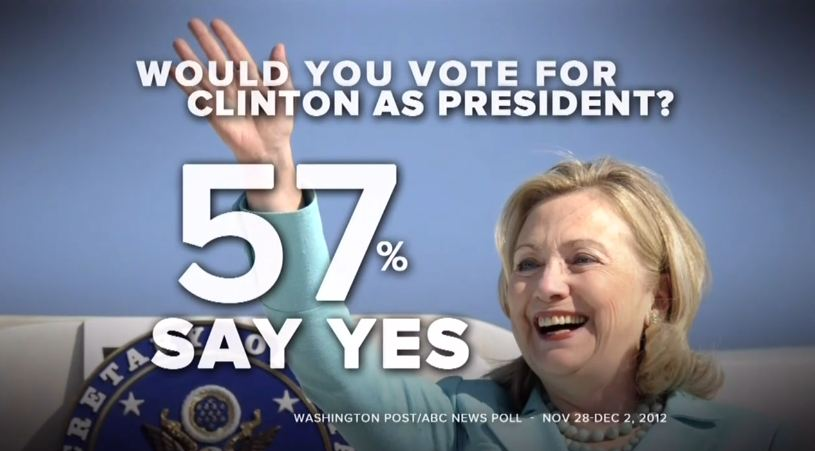
In the Fallacy in the Wild we looked at this print ad for Hillary Clinton:
Then we talked about this clip from The O’Reilly Factor :
Fake News
Here are the statements from this week’s Fake News game, which Mark hosted, and our guests Caplin and Massiah answered:
- (about Boris Johnson) I think he thinks I’m doing a great job. I am doing a great job, that I can tell you — just in case you haven’t noticed. But Boris Johnson, I think would be a great Prime Minister.
- (about Theresa May) They asked me why we held hands. What can I say? I’m a gentleman. She appreciated that. We got on great. An incredible woman — beautiful woman inside and out I have great respect for her, and all women.
- (about Putin) If I had a relationship with Putin — I don’t know him, I’ve met him twice, maybe three times, two-and-a-half times.
Click below for the answer
Spoiler
Statement 2 is Fake News. Caplan and Massiah chose number 2Our guests got it right this week, so Mark somehow still lost, and remains on 0%
Singing is not a logical fallacy
Mark interviewed Caplin and Massiah about their new anti-Trump song called “All You”. Here’s the official video:
The stories we really didn’t have time to talk about (and in a fun twist, every single one of these stories happened on Tuesday August 21st):
- Michael Cohen pled guilty to eight counts, including tax and bank fraud, and campaign finance violations, “in coordination with and at the direction of a candidate for federal office… for the principal purpose of influencing the election”. Gee, I wonder which candidate he could be talking about.
- Having told Chuck Todd last week that “Truth isn’t truth”, Rudy Giuliani turned his gaslight up to 11, telling Reuters “There is no allegation of any wrongdoing against the President in the government’s charges against Mr. Cohen.” also saying “I think the president is absolutely in the clear. The Cohen thing is over.” He was later heard to say “Adam Sandler is the best actor of all time and Big Macs are health food”
- Within minutes of the Cohen plea, Trump’s former campaign manager Paul Manafort was found guilty of eight counts of tax and bank fraud. Which is not completely shocking, since part of his defence was – and this is an actual quote – “Nobody intending to violate the law would leave the evidence around for his accountant to find it.” I think that’s called the ‘Basic Instinct defence’.
- Although Cohen’s plea deal didn’t include cooperating with prosecutors, his lawyer, Lanny Davis, said “Mr. Cohen has knowledge on certain subjects that should be of interest to the special counsel and is more than happy to tell the special counsel all that he knows.” that’s some kinda non-cooperation!
- According to the UN’s nuclear watchdog, there is no indication that North Korea has halted or dismantled any nuclear activities since Kim Jong Un met with Trump and specifically didn’t agree to do that. I’m shocked that this didn’t go how Trump planned. Shocked.
- A Trump advisor has been linked to white supremacist Peter Brimelow. No, not the speechwriter who was fired earlier this month for his links to the noted racist – this time we’re talking about Larry Kudlow, who invited Brimelow to his birthday party. Apparently he didn’t want to, but his Mum made him invite everyone in his class so that nobody felt left out.
- One of Trump’s earliest supporters in Congress has been indicted on federal charges. No, not Chris Collins, who was charged with insider trading earlier this month – this time we’re talking about California Congressman Duncan Hunter, who, along with his wife Margaret, stands accused of using a quarter of a million dollars of campaign funds for personal expenses. Hunter must have been taking lessons from Ben Carson, because in an interview with Fox News on Thursday, Hunter blamed the whole thing on his wife.
- A new rule from the EPA called The Affordable Clean Energy Rule could cause up to 1400 premature deaths per year due to relaxed emission standards. That’s according to the EPA’s own impact analysis. The rule replaces stricter Obama era guidelines which the EPA says would have prevented up to 3600 annual premature deaths. So the government knows their policies will kill you, but they’re fine with that. Because fuck you, that’s why.
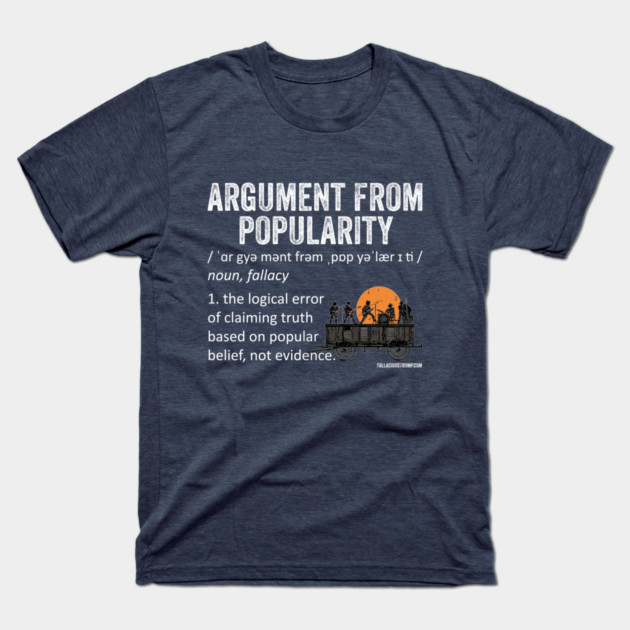
If you wanted to buy a T-shirt featuring this fallacy, you could click here. No pressure
And if you have some money left over after that, Jim’s book, 2000 Mules and One Big Lie: A Stubborn Conspiracy Theory is available now.
That’s almost all for this week, but here’s our AI-aided transcript, which is quite accurate, but not totally:
Argument from Popularity – FT#7 Transcript
Read the full transcript
00:23 Jim: Hello and welcome to Fallacious Trump, the podcast where we use the insane ramblings of an unindicted co-conspirator to explain logical fallacies. I'm your host, Jim.
00:31 Mark: And I'm your other host, Mark. A logical fallacy is an error in reasoning that results in bad or invalid arguments. And the logical fallacy we're looking at this week is the argument from popularity, also known as argumentum ad populum, appeal to the masses, and the bandwagon fallacy.
00:48 Jim: So the argument from popularity basically says that if lots of people believe something, then it must be true. It's fairly easy to debunk because there are so many examples of things that lots of people believe that aren't true. One that gets trotted out all the time is that supposedly everyone used to believe that the earth was flat and it didn't make it any more true. Right, it's not a particularly good example because, as far as we know, there's no time, uh that in in history where a large number of people who knew what they were talking about believe the earth was flat. People have known the earth for a very long time and in fact, done experiments to show what the circumference is and things like that, even back to kind of greek times. So that's a bad example. But yeah, yeah, and this is ironically a very, very popular fallacy – um, it is, it's very common, um, people. It is because it kind of feels intuitive. It kind of feels like with the, for example, who wants to be a millionaire. If you, if you ask the audience what they think is the answer to the question, you expect that the wisdom of crowds might hold and lots of people all together will probably get the right answer. So it feels like there's some sense to it, but, um, it's not reliable. You can't assume that just because lots of people think something it's true. So yeah to to check out a Trump example for the argument: from popularity we actually turn to um a very unusual ally for pathological fallacies, which is Bill O 'Reilly.
02:21 Clip: Trump talking about voter fraud
— Is there any validity to the criticism of you that you say things you can't back up factually? And as the president, if you say, for example, that there are three million illegal aliens who voted and then you don't have the data to back it up, some people are going to say that's irresponsible for a president to say that. Is there any validity? Many people have come out and said, I'm right. You know, I know, but you've got to have data to back that up. Let me just tell you. So you think you're going to be proven correct in that statement?
— Well, I think I already have. A lot of people have come out and said that I am correct.
— Yeah, but the data has to show that 3 million illegals voted.
— Forget that. Forget all of that. I love that.
02:59 Mark: When he says, just forget that. Forget that. Forget all of that.
03:02 Jim: When Bill O'Reilly is questioning your logic, you really, it's time to take a long, hard look at yourself. This is the man who claimed that because we can't, we, there's no way we can possibly understand the tides. God must must exist.
03:20 [Unclear]: That's anyway right,
03:22 Mark: just because we can't understand it. Okay, yeah, God bless him. He consistently persisted with: well, hang on a minute, and you've got to have the data to back that up.
03:31 Jim: Yeah, so even Bill understands that you have to have data to back up a claim. Name like that, Trump, is saying that. In fact, when, when he says, do you think you'll be shown to be correct? He, Trump, says he's already been shown to be correct because a lot of people have said he's right.
03:46 [Unclear]: Yeah, so that right,
03:47 Jim: that is not proof. Um, no, all that is is that there are other people who agree with him. It it probably isn't even true that a lot of people have said he's right, but even if it it was, it's just lots of people's opinion instead of one person's opinion, and that doesn't make it more likely to be true. And with something like this, there is a an objective truth. There is something that you can check. You can do actual research and find out the number, and the people who who've done the research and looked into it have said: there's no evidence of three million illegal voters.
04:23 Mark: But this is the kind of stuff where you need somebody to go and look at it rather than just say those numbers.
04:28 Jim: But the key to Trump's argument there is not that they've looked into it or that they're going to look into it. Even just that lots of people have said it's true. Therefore, he's been proven right when he said it.
04:41 Mark: Yeah, and it would be less objectionable, less Fallacious, even if the – well, it would still be – would it still be a fallacy even if the people that he says, well, many people, have said that I'm right. And then he goes on to say: and those many people are the people who investigate electoral fraud, they are electoral fraud investigators. Many electoral fraud investigators have told me that I'm right. Would that add any more validity?
05:09 Jim: Yeah, that would absolutely add more validity, because, um, it's. Then you're basing the truth claim of the argument not necessarily on the quantity of them, but on their expertise, and if they have relevant expertise, then it is reasonable to to listen to what they have to say. And in that case, if there are multiple people in a field who all do the same kind of work, the fact that there are many of them who believe the same thing is further evidence that that thing is probably true. It's not necessarily true, um, but um, like with the global warming debate. For example, 97 of climate scientists believe that global warming is happening and it's human made. Um, and that is good evidence that it's happening, yeah, and it's, yeah, anthropogenic. It's evidence because these people are people who do, who, for their job, are looking into this, are researching it, and they're basing their claim that it's true not just on the fact fact that they're a climate scientist, but on the work they're doing, on the research that they're looking at and the data they're processing every day. So the fact that, having done that work, they have come to this conclusion, doesn't mean you should just trust them blindly. But the fact that there's a scientific consensus on that and on other things, on you know when, like evolution, for example, or other things, where scientists all working in a field, who are experts with various levels of of specific research in that area, are coming to the same conclusion, independently, usually, of each other, that's good evidence that that is probably close to true. Or on you know, our best guess for now of how things actually work. It can also, uh, work the other way. You can claim that if lots of people don't believe in something, it must be false.
07:05 Mark: Ah right, yes, yes, yes.
07:07 Jim: So there's. We've got another example from Trump using that way around of doing it. This is at a town Hall meeting in Rochester, New Hampshire, where he was asked about climate change and about whether he believed in it and what he was going to do about it. Basically. And this is what he said.
07:24 Clip: Trump taking a straw poll on global warming
— Who believes in global warming? Raise your hand. Wow. Not much, huh? Do you have your hand up? Little? No? No. Now, nobody, one person. Well, sir, that that's well. It's a very interesting you believe, right, you believe?
07:41 Jim: We'll get in a moment to how he actually did that. But his argument was because none of the people in this room, full of Trump supporters, believe in global warming. It's not true, so we don't need to do anything about it. He didn't state that he didn't. To be fair to him, he didn't say there's there's nothing to be done because it's clearly not real. But that seems to be the implication of why he would ask the room whether, whether people actually believe in it. Obviously, the person who asked the question, yeah, yeah. The one interesting thing about it is the camera in this clip is quite tight on Trump. There's about 15 or 20 people behind him. Two of them have their hands up. Yeah, and this town Hall?
08:19 Mark: Yeah, probably they don't. He's probably a couple of thousand people in there.
08:23 Jim: I don't believe the only two people with their hands up were behind him on camera. And so when he's kind of going, nobody, really nobody. I just he's ignoring all the hands that are up. Frankly, one of one of the guys behind him is quite enthusiastically going me, I do, I do,
08:40 Mark: yeah, yeah, yeah, and somebody's interrupting him in front of him saying: yeah, but sir, no,
08:47 Jim: that was the person who asked the original question.
08:48 Mark: Yeah, oh, okay, ah, yeah, so they. There is the implication that they don't feel he answered the question. I don't think that would be fair to assume. Yeah, he's kind of not answered it. He's put it out. He's done what he did in the other interview. He's put the answer out to the people instead of saying: okay, here's my answer, based on the consideration of the evidence that's been put in front of me by 97 % of all climate change specialists. And you know I'm not persuaded by it, and this is the reason why he doesn't actually do any of that. He just says: anybody here believe in it. He almost implies that their opinion is of more uh, it's based in more knowledge, it's based from more real life experience and therefore, uh, should be listened to. And that's the message he's taking to capital hill. He's saying: you know,
09:50 Jim: know, you need to listen to the people. He dismisses the science, which is very well established
09:54 [Unclear]: at this point,
09:55 Jim: um, just by saying: well, you know, these people right in front of me don't believe in it.
09:59 [Unclear]: So yeah, yeah and
10:02 Mark: and and thereby distracting their attention from the fact that he's doing it because there are lots of vested interests who want to continue to mine coal and burn stuff and and not pay carbon taxes or look into renewable energies and all those kind of things which are perhaps more traditionally a Democrat kind of
10:30 Jim: position to hold. Yeah, I think that's right.
10:35 Mark: So, you know, it would lose him votes if he did that, if he said, yeah, yeah, we need to.
10:40 Jim: Well, it would lose him support from some of his corporate donors. I think, yeah, yeah, thanks. So the last example that I want to talk about from Trump is a tweet from 2014, which is my favorite um of his arguments from popularity, in which he said: many people have said: I'm the world's greatest writer of 140 character sentences, sentences, I. I personally don't believe that many people have said that. No, no, but even if they had it, it certainly wouldn't make it true I, I think, no, no, it's probable that there are people who can write better sentences that donald Trump. Oh, yes, regardless of the character count,
11:31 Mark: exactly, but it's very interesting that, oh, I mean, does he, does he believe that? I don't?
11:39 Jim: I, I'd like to think so, but I think I expect he was joking. Um, it's possible. I mean, you know, I couldn't, I wouldn't put it past him that he believes it, but it it sounds a bit like a joke.
11:51 Mark: Well, it just occurs to me that he surrounds himself with, yes, men and women who are not going going to disagree with him for fear of losing their job and for fear of losing their, therefore their position of power. And you know, they work in the warehouse. Why wouldn't you want to keep your job.
12:11 Jim: You can totally imagine him calling his people into his office and saying: what do you think? Do you think I'm the greatest writer of 140 character sentences in the world? And them going, yes,
12:22 [Unclear]: who doesn't think I'm?
12:24 Mark: Who doesn't think I'm the greatest? Yeah, and everyone's looking around and nobody's raised their hand and they kind of go, right, yeah, well, that reminds you of that. Many people think so. Did he ever? Yeah, did he ever? Was it a press conference or something? He invited the press in to what was a cabinet meeting to all intents and purposes and everyone spent the first 10 minutes and heaping enormous praise on how marvelous it was.
12:51 Jim: It was, yeah, people. They just kind of went around the table with people going, uh, mr president, I'm I'm so proud to be here with you and I'm so grateful to you for giving me this opportunity. Oh God, it was just blessed, it was amazing.
13:05 Mark: I'm blessed to be part of this and you think, wow, that yeah. So if there's a room full of those kind of people – yeah, of course I mean those, and there were many of them in the room. It was quite north korea. Many is many. That's exactly what I was thinking. Yes, if that was was dubbed into korean, you wouldn't, you wouldn't, you'd be surprised? Yeah, and. But you know how many is many? That's the other question, you know, is it, is it more than a few or or less than?
13:34 Jim: Well, I said it and melania said it, so that's many.
13:38 Mark: It must, yeah, that's many, and she said it many times. And
13:48 [Sting: Mark's British Politics Corner] And now is the time, I think, for Mark's British Politics Corner.
13:52 Mark: So, uh, I've got some examples that Kind of maybe stretching that the ad populum fallacy, but I would maintain they're coming from a position whereby, not dissimilar to Trump, the various British politicians attribute a position to the people in order to pursue their own ends, in order to justify things that they're saying. So the first example I'd like to play is this. So it's an interview with Michael Gove, who was the then Justice Secretary when he was interviewed in 2016, and he's being interviewed on Sky News. He's being interviewed by Faisal Islam.
14:46 Clip: Michael Gove and Faisal Islam
— The leaders of the US, India, China, Australia, every single one of our allies, the Bank of England, the IFS, the IMF, the CBI, five former native secretary generals, the chief exec of the NHS and most of the leaders of the trade unions in Britain all say that you, Boris and Nigel, are wrong. Why should the public trust you over them?
— I'm not asking the public to trust me. I'm asking the public to trust themselves.
15:10 Mark: So what's interesting about this one is so Faisal is listing off all the people who are. So he says that Boris Nigel and you, Michael Gove. So Boris is Boris Johnson, who we've met before. Nigel is Nigel Farage, who we've talked about before. He was the leader of the UK Independence Party, whose entire raison d'etre was to get out of Europe and become independent of Europe.
15:37 Jim: Which made it very amusing in the uh yeah elections after brexit was announced, where the Uk Independence Party lost all their seats because they had no purpose anymore at all.
15:46 Mark: There's no purpose anymore, yeah. So the Tory – just Tories – just scooped them up and and adopted all their policies. So what is interesting I've just realized in listening to it again, is that what feisal is doing is using the argument uh for uh to popularity. Because, yeah, he is,
16:04 Jim: he's definitely there's. There's an element of that in it. I think if he was, if he had an opportunity to explain why those people should be trusted, because some of them are specifically uh experts. Because there's the like um heads of banks, for example, which who you might know perhaps more than the average person about what the implications of brexit might be, and so if they're saying that Boris and Nigel and michael gover wrong, you maybe should listen more to what they would have to say than the head of the nhs, which I don't know why that would be relevant. But, yeah, I think you're right. He is. He's listing a large number of people and hoping, I think, that the, the large number that he's listed, gives weight to the argument and saying that look. So yeah, I think you're wrong. You must be wrong,
16:56 Mark: yeah, but I don't think it's, it's just the, the number, because I think that, as I'll go on to argue, is that it's not just the the weight of the number, but it's the kind of people. So it's a bit like the our thought that if, um, you know several, uh, electoral fraud investigators, or many, to use use Trump's word, electoral fraud investigators – had told him that he was right, then that would increase the weight of the argument. So what Faisal Islam is doing is saying: there are all these people who have some knowledge in the impact that leaving the EU would have on businesses, on workers' rights, possibly on the National Health Service – who knows? So what he's doing is not just saying there are lots of people. He's saying there are lots of the right people, lots of people who know about this stuff that are saying that your position is wrong, um. What Michael Gove goes on to say is that because Faisal says so, why should they trust you? And he said: well, I'm not asking. He neatly sidesteps and what he does is literally, literally, call in the populace. He says I don't. I'm not asking them to trust me, I'm asking the people to trust themselves. So I would say that he is literally appealing to the masses. He is using an argumentum ad populum by saying to the people: you need to listen to yourselves and not me.
18:43 Jim: I, as we've discussed off the air, I'm not completely convinced. This is an argument, um, from popularity, because he is not saying: um, don't trust me, trust the other 52 percent of the population that that agree with me. Um, and there's a lot of people okay in saying you know, you should trust yourself. Each individual person is is basically he's saying: um, you know, use your instinct, really, rather than yeah, um, believe the. The large number of people, frankly, because the – a large number of people who were, who were making statements at that time in public, were against brexit, all of the, all of the? Um heads of industry and and celebrities, even, for the most part, who were coming out and saying anything, that it did seem like the tide was against them, didn't it? So it's difficult at this stage for gov to be saying, um, go with the what most people think, because it seemed like most people didn't think Brexit was a good idea.
19:45 Mark: Yeah, OK. Well, let's play the second clip.
19:49 Clip: Michael Gove and Faisal Islam
— The people who are arguing that we should get out are concerned to ensure that the working people of this country at last get a fair deal. I think the people in this country have had enough of experts with organisations from acronyms saying… The people of this country have had enough of experts? ..from organisations with acronyms saying that they know what is best and getting it consistently wrong. The people of this country have had enough of experts? These people are the same ones who've got consistently wrong.
— This is proper Trump politics, isn't it?
— No, it's actually a faith in the…
20:17 Mark: It's Osbridge Trump. So this is the famous speech which kind of came back to bite him when he said: I think the people have had enough of experts. So see, I would argue that this is an argumentum ad populum, because he is again invoking the people. Paul, instead of saying I have had enough of experts, he's saying I think the people have had enough of experts. So he's putting the populace, the population of the UK, between him and his opinion in order to give weight to his position for his own ends and to hide the fact that he's got his own personal agenda, which is to leave the EU, where it was actually to become the next prime minister, but, uh, which he failed to do as well. Um, so I would say that this is a similar thing to what Trump has done. When he asks for the audience to raise their hands, um, he's kind of saying, he's scooping up their um responses and saying: yeah, you see, we need to listen to you. Don't listen to me. I'm just a politician. What do I know? Um, I am one of you. I am a member of the people, and people are, and those in charge of, uh, these opinions about why we shouldn't leave the Eu are not listening to you, the people. So I am representing your voice. I'm saying: I think the people have had enough of experts, so I think he is literally using the populace to bring weight to his argument.
22:09 Jim: I think you're right. I think this is a. This is much closer, if anything possibly is an argument from popularity, because I think what he's saying, in a way, is: um, the people generally have had enough of experts. And he's kind of what he's he's not saying is: don't you agree? Haven't you two had enough of x? Because all of the other people think that it's. They've listened enough to this kind of stupid politician phrase of from organizations with acronyms like that is some kind of cohesive group. Um, yeah, yeah, yeah, we've heard enough from the cbi and the nhs, don't you agree? Basically, he's kind of trying to trying to push people to go the same way as the rest of the people. So, yeah, yeah.
22:56 Mark: And instead of reaching for the evidence, he's just saying: well, I think just people are fed up with the experts, yeah, and. And he doesn't say I'm fed up with the experts, because that would reveal that he doesn't have the evidence and so he's doing a. What is incredulous
23:14 Jim: when he says that? Because it is a fundamentally, fundamentally stupid thing to say what gov is basically saying is: oh, we've heard enough from people who know what they're talking about,
23:24 Mark: yes, yes, because isn't that the definition of an expert, that we don't want to listen to someone who knows what they're talking about, who've looked into really good at what they do.
23:35 Jim: What we want is just to go with people's gut feeling about whether we want brown people in our country. That's what it's really all about.
23:44 Mark: I mean, it's a very skillful thing that he's done, which is to spot the populist moment and turn the the conversation and twist the rhetoric to his own ends.
23:55 Jim: I'm not sure he convinced anyone, though, with his argument it was. It was quick thinking, but oh no, everyone.
24:03 [Unclear]: It's like: what are you talking about?
24:04 Jim: That's stupid, yeah, yeah,
24:07 Mark: well, yeah, well, you say that. Well, let's play the, the third clip. So this is about I. I think he's invoking the populace again to justify some numbers that he hasn't got.
24:20 Clip: Michael Gove and Faisal Islam
— I'm pointing out that the majority of people in this country are suffering as a result of a membership of the European Union. Their wages are lower.
— The majority of people?
— Their wages are lower. Access to public services is restricted.
— What's your factual basis for that claim that 33 million people are suffering from EU membership? You complain about the other side's figures. What's your factual basis to say the majority of people in this country are suffering from EU membership.
— Well, I know myself from my own background.
24:49 Mark: So there we go. So actually I think I was wrong in saying that he convinced anybody, because I think Faisal is doing the convincing, because he's doing exactly what Trump was asked to do, which is come up with the factual stuff. So he comes up with this broad generalisation which is, I think, the majority of the people in this country. You know, the majority of people are with me – um, and I stand for the majority of people.
25:16 Jim: And that's actually where it gets quite dangerous, because you were asking earlier on how many is many? When you just use a weasel word, like many, it's easy to say that because, yeah, because you can say: you know, even in a country of 300 million people, you can say: well, you know, a thousand people think the same way as I do. That's many people, that's a lot of people. Um, yeah, if you say the, the majority, that's putting a number on it. That is saying more than half, 51 percent of the people in this country, or at least that number, think this. And then you need to pick it up. At that point someone can say, like Faisal says here: 33 million people. What's your evidence for that?
25:54 Mark: And what actually happens is that later on in the interview – and – and we couldn't bear to play the whole thing because it's just awful, but it is online, go look, go look up that tired of experts. Just type that into youtube and it will come up. He does go on to switch the the conversation with the interviewer and says: you see, you're on the side of the elitists and I'm on the side of the people, and that gets a round of applause. And so he is. Throughout this thing, he's appealing to the people.
26:28 [Sting: Fallacy in the Wild (Born to Be Wild – Steppenwolf)]
26:47 Jim: There you go, I'm enjoying these things. They're good.
26:50 Mark: Yeah, Steppenwolf there, from the Easy Rider soundtrack. So, yeah, uh,
26:58 Jim: in the Fallacy in the Wild, we like to talk about the fallacy of the week from a, uh, non -political perspective. Usually, um, and actually there's a little bit of politics mixed in with this, but it's, it's uh, older stuff and pop culture related as well. So, um, the first thing is actually a, a print ad, uh, for hillary clinton as president when she was running against obama in 2012, and, and it's very simple, all is is a picture of hillary and, uh, the line says: would you vote for, for clinton as president? 57 say yes. So the whole point of that ad is to say: look how many people would vote for clinton. You might as well vote for a two, because, yeah, they must be. You know, there's so many people – 57 – more than half of people – would say yes, they would vote for her. So, yeah, they, they can't all be wrong. Basically, is the implication there? This is a really common uh fallacy that's used in advertising and this is basically just an advert. Although it's a political advert, that's what it is. It's saying: look, how many people do do this. It is just like um mcdonald's saying how many billions of burgers they've sold. They're not just boasting for the sake of it, they're saying: all these people like mcdonald's, therefore you'll probably like mcdonald's, so you should probably come in and have a burger.
28:22 Mark: Yeah, I'm sure there must have been adverts in the 50s that say: you know, a million marlboro light smokers can't be wrong. There was a specific one for camel which was really,
28:34 Jim: which was about doctors. This camel was the most smoked brand among doctors.
28:39 [Unclear]: Um, wow, and so yeah,
28:42 Jim: that was basically what they were saying – like nine out of ten to smoke camel.
28:46 [Unclear]: So, um, that's bizarre,
28:49 Jim: yeah, but yeah, that's how.
28:50 [Unclear]: Yeah, yeah, um, wow,
28:52 Mark: oh, that's that. It reminds me that I saw a billboard uh poster on on the London Underground this week for Dan Brown's new book. And it's set, so it's just come out, and it says global number one bestseller.
29:13 Jim: Yeah, every book that has bestseller on it is, and the whole the kind of charts of the bestsellers in the USA Today and the New York Times and the Times in London, and they are. They're. They are showing you what books are popular at the moment, because popular things probably are good. That's the thinking behind.
29:33 [Unclear]: Yeah, yeah, yeah, because yeah,
29:35 Mark: yeah, well, isn't that why people try, you know, kill, to try and get their book on oprah's reading list?
29:40 Jim: Yeah, and it's. And it's also why things like netflix and amazon prime video, um, you can filter the what you're looking for when you're browsing through things by um, you know the year it came, came out and stuff like that – but mostly by popularity, by um, by which videos are trending, which films, people, lots of people at the moment, because if lots of people are watching it, maybe it's good. Yeah, so this is really really common. And, um, I mean, there's another example: a maybelline print advert, um, which has a big headline saying america's favorite mascara. No wonder one is sold every 1, .7 seconds.
30:18 [Unclear]: Well, yeah, again, they're not just
30:21 Jim: boasting, they're suggesting that. Yeah, because they sell so many, it's the favorite one, it's the best choice for you favorite one, you'll probably yeah.
30:29 Mark: So the argumentum ad populum is how we've got to things trending on twitter.
30:36 [Unclear]: Absolutely, yeah, and and these,
30:39 Jim: the idea that those things are the most important things. Yes, yes, that's the. The implication is: yeah, so if you say that, that you know this, yeah, this um person's joke trended, so it's the funniest joke at the moment on twitter. There May be much funnier jokes that just haven't been noticed by people. Um, and, yeah, yeah. So that's where it becomes a fallacy is when you're making a claim, or, in some cases, if you're – if we want to be less cautious about it – if you're implying a claim, like the maybelline thing, um, yeah, yeah, if you're, if you're making a truth claim based on on the number of people who, who believe something, or have have said that they enjoy something, or just in terms of, like you say, with bestsellers, you know the number of people who bought a thing, suggesting that that implies quality. And since this is episode 007, um, yes, we have to say that if the uh argument from popularity was true, then, uh, it would be true that thunderball is a better bond film than goldfinger, which is clearly nonsense, because, because thunderball made more money – uh, even right, when you factor in inflation – than goldfinger, um, but, but obviously it's a significantly inferior film.
32:00 Mark: Oh, yeah, quite, you know, by all objective measures, absolutely it's a. There's really no one who could
32:07 Jim: possibly argue with that. So no, yeah, no, everyone knows it.
32:12 Mark: yeah, quite, yeah, quite so uh.
32:16 Jim: Another example that is now we're kind of getting it away from advertising a little bit – is, uh, our new friend Bill o'reilly. Yay, so uh, let's play a clip where um Bill is talking. Actually he's on his show, the o'reilly factor on Fox. He is playing a, a clip of Rachel Maddow who is on MSNBC, and she's talking about Fox in the clip. So it's a little bit kind of inception-y.
32:45 Clip: The O'Reilly Factor
— This is what Fox News does. This is how they are different from other news organizations. Just like the fake acorn controversy, Fox News knows that it has a role in this dance. That's not new. That's not actually even interesting about this scandal. Fox does Which is
— kick your network's butt every
— single night, madam.
33:05 Jim: Bill O'Reilly there saying that what Fox does is kick MSNBC's butt every single night in the ratings. So he's suggesting that you shouldn't listen to Rachel Maddow. She's talking nonsense because we have more viewers than them. That's what he's saying. Now, as we know, Bill understands the argument from popularity. He realizes that it's a fallacy. But he's still.
33:31 Mark: He's still doing this quite effectively – challenged the president of the? U? .s on that very subject.
33:35 Jim: Um, and, as Rachel Maddow pointed out after this happened, um, there are, there are lots of programs that that do better than msnbc. There are lots of programs that do better than Fox. Yeah, um, but right, that doesn't mean they are more accurate or better or inherently higher quality, necessarily. It just means that more people watch them, didn't she say that one One of them was Spongebob. So Spongebob kicks Bill O'Reilly's butt, yeah.
34:04 Mark: Every night. On the ratings.
34:07 Jim: So you should be careful how you use that. Now, at this point in the show, we would normally have fake news, but we've changed the schedule a little bit this week. In a slight change, we have a section which, this week at least, we are calling Singing is Not a Logical Fallacy.
34:29 Mark: Because we're very pleased to be able to bring you an interview we did with the music duo, Kaplan and Messiah. That's Paul caplin and Zetia Messiah. They're long established musicians. Paul was in the band hazy fantasia in the 80s and Zetia had a number one dance hit in the us, and together they have a new song out called all you, which is about Trump. And, like us, they're British and are profoundly concerned and affected by the way the global political temperature has been changing since Trump, and we took the opportunity to talk to them about that and how it is being in the arts in the the world today.
35:01 Jim: Oh, and Mark also got them to play fake news so that he could be a host and possibly not lose.
35:19 [Unclear]: My name is Zetia.
35:20 Mark: And my name is Paul. Welcome to Fallacious Trump. And we're very happy to be here. Thank you. We're very happy to have real artists on the show. I guess we are kind of doing similar things to draw attention to the inflated orange man baby. And we do it through analysing the logical failings in his arguments, statements, pronouncements, endless tweets, And I would maintain that you've done it through your song. So what motivated you to write a protest song?
35:48 Paul: Songwriting is a funny thing. It's not a very conscious process. It's a kind of instinctive process. And you just wait for something to come to mind or to come out that seems to be interesting or seems to have some power to it. And you don't really get to pick that much what you write about. You write about what jumps to the front of your mind. Most of the songs that I've written in the last few years since Zisha and I have been together. We've been married for the last two and a half years. and most of the songs that I've written during that time have been about love because that's mostly what I've been feeling. Quite right too, I'm glad
36:16 Mark: to hear that.
36:17 Paul: But just towards the end of last year I was feeling disgusted and revolted by what was going on in the States, not just Donald J. Trump but also the way the Republican Party was behaving en masse in a very, very self-serving, selfish, short-sighted way. And that song just popped out really, it just sprung to mind and wrote itself. Itself.
36:36 Mark: There's always been a history in art to react to major political events: the futurists of the first world war, giacometti and the holocaust, and even more recently, the red wedge and rock against racism,
36:51 Paul: yeah, and the whole punk movement, I suppose in the 70s – yeah, same category with
36:56 Mark: your position in the music world. Do you think you're seeing a change reflecting the times that we're in?
37:01 Paul: I'm not seeing much of a one, actually, and I wish there was more. I. If you think back to the early 1970s, there were a lot of protest songs. In fact, it was a major musical genre of its own. That was what pop music was in those days and what a big part of it was. It certainly isn't what it is now. There are protest songs being written, but most of them are not in the pop mainstream at all. Most pop music is highly commercial. It's mostly about sex, and which is fine. Yeah, nothing wrong being commercial or writing about sex, but it's a shame that commentary on what's going on uh, doesn't seem to figure at all at the moment.
37:32 Mark: Yeah, I recently saw the skids and uh, yeah, and billy bragg, and both of them said that they, they were writing songs then because they performed. You know a lot of their back catalogue. Yep, they were writing songs then, hoping to bring about change. Yes, and they were still angry that the change hadn't happened. And they're still having to write, write songs now about the same issues. So do you think that it's possible to bring down the government one song at a time?
38:02 Paul: I don't think a song has ever brought down a government, but I do think that songs and music in general, like all the arts, have a surprisingly large role to play in influencing public discourse. Where would communism be without the red flag? You know, with the people. People need songs to sing. No one song has ever changed the world, but a lot of songs can change the way people think.
38:26 Mark: And the media and the message is very powerful, and governments know that.
38:30 Paul: And the first thing that virtually every dictator does on coming to power is start banning songs and movies and books. And they don't do it because they've got nothing better to do. They do it because they know how influential they can be. And the whole fake news thing that's going on at the moment and the big protests recently by the news media in the States led by the Gosselin Globe kind of highlights that. People who think that way, let's say liberals, are alarmed that Trump is acting exactly like a dictator in demonising the press.
38:59 [Clip: All You – Caplin and Massiah]
39:09 Mark: in the song is the Ross Hall bit. So that whole… That's how shallow I am. That's my favourite bit too. Not at all. Especially with the, with the and the voodoo character. Yeah, in the background, at one point Paul is smashing tvs with a sledgehammer. Did you do so because they're symbols of power?
39:27 Zetia: Um, the rassle bit. I don't know if you know that, but that's a bajan sort of swear word, if you like, like saying arsehole in a sense. But it's just because it's bajan and we wanted to emphasize the rassle because we were like really angry. So that was our part to say: you know, this is how we feel. But the smashing of the tv came because we wanted to emphasize how angry we both were, exasperated.
39:50 Paul: Yeah, just just just tired of. Tired of Trump continuing to be the most talked about man in the world. He doesn't deserve it. But then we make a video of it.
39:58 [Clip: All You – Caplin and Massiah]
40:10 Mark: glorification of money is often the content of rap songs. Yes, do you think this song, then, is a product of that kind of?
40:18 Paul: The other way around, I think. I think a lot of, a lot of gangster rap was about money and how nice it was to have money and how you could spend it all on hoes, you know, and, and, and, and. Yeah, but that's kind of in the past now a bit. There isn't much gangster rap being made nowadays, and most of the rap that is being made is pretty sort of emotional and sensitive. If you listen to drake, you know it sounds like he's gonna burst into tears at any minute. He's mostly talking about his more delicate feelings, um, yeah, so, so what? We were writing a song that really doesn't have much in common lyrically with most of what's in the charts, but we decided to arrange and record it in a pop style, so it's in that idiom.
40:53 [Clip: All You – Caplin and Massiah]
41:08 Mark: basically a tv star and he loves it. He's after ratings. There was a time when there would be TV stars and then there would be politicians and politics is. You know, it was always described as showbiz for ugly people, and now we've got the crossover.
41:24 Paul: Totally. Yeah, well, he's the world's greatest reality TV star, isn't he? And although he's clearly a bit dim in many ways and doesn't speak English very well and doesn't know anything much about history or geography or politics or most of what goes on in the world, he does have clearly a genius for demagoguery and and manipulating social media. He's terribly good at it.
41:44 Mark: Do you think that you two, being in the media and being media savvy, that you're in the right milieu to get to him, more than anything else?
41:55 Paul: Certainly. We intend single-handedly to depose him, and we expect his resignation at any moment. I don't know why it's taken so long. I know. But it's only been a matter of days now.
42:05 [Clip: All You – Caplin and Massiah]
42:15 Mark: Forgive me for saying so, Paul, but you lived through eras. You're old enough, you're as old as me. You lived through these eras. Was it ever thus?
42:25 Paul: I think it's wrong to characterise the world As being dominated by right -wing opinion. I think the thing that's scary and alarming About the way certainly the Western world is at the moment Is this huge schism, the fact that it's split as never before in my recollection, between what the Americans would call liberals and conservatives, who not only hate each other but really, really don't understand each other. They observe the same world, and they come to completely different conclusions about it. Yeah, and then they don't discuss it. Well, because of the echo chamber. They just shout at each other. Yeah, because the internet has enabled each one only to hear reinforcing opinions. Instead of reading the Washington Post and the BBC News, I should read Breitbart and watch Fox, because then I get a more balanced view. I haven't managed to bring myself to do it yet, but you know, we all live inside our little echo chambers, don't we, and listen to the opinions we like to hear.
43:15 Mark: Are you just Singing into the same echo chamber?
43:18 Paul: Well, we're not, because there have been an awful lot of plays of the video on YouTube and an awful lot of huge response on Facebook and maybe 60 or 70 percent of it is strongly supportive and 30 or 40 percent of it is venomous and filled with hate.
43:35 Mark: And and I guess what you can take heart from is that you know it's getting, it's going across the divide because you know you're you're not just getting um people saying, yeah, it's lovely, um, you're getting people, they're going. You know we hate it. As an artist, you're transcending those two silos.
43:53 Paul: A good thing about music and and music video is you do get to cross that divide because there aren't sort of liberal musical radio stations and conservative radio stations. You know that so far music is at right angles to all of that, so you do get to talk to everyone.
44:09 [Unclear]: John Wayne
44:14 Mark: is big leg is similarly a protest song. Oh, let's eat.
44:18 Paul: Your answer: yes, it was. It was a protest about American imperialism and in fact it wasn't until all you was out there and people were listening to it that it dawned on me that all these years later I'm still complaining about the same thing. I really haven't thought about it till then. Although if you listen to the lyrics, John Wayne is a big legging, it isn't really about movie stars. It's not really about John Wayne. It's an allegory and John Wayne represents a particular American point of view.
44:45 Mark: Which we're reaping the rewards of. The whirlwind, yeah. The whirlwind, yeah.
44:51 Paul: Yeah, unfortunately we are. Because there's a large number of people, particularly in America there's probably 100 million people – whose standard of living has been declining now for 15 or 20 years steadily and who feel ignored and unheard, and the Democrats have tended to just try to pacify them and hope they would shut up. Despite ostensibly being their Party, they haven't really done anything for them, and Trump sees that opportunity as people are all over the world.
45:15 Mark: So I think it's amazing and wonderful that you managed to distill those thoughts into this really fantastic song.
45:21 Paul: Well, it's a kind of you too. I'm happy you think we have. Let's hope other people do too. So
45:32 [Sting: Fake News] we're going to play fake news, folks. I love the game. It's a great game. I understand the game as well as anybody. As well as anybody.
45:39 Mark: Yes, it's time for fake news, the game where normally Jim reads out three Trump quotes, two of which are real and one he made up. And this week, our special guests, Paul and Zetia, have to figure out which one is fake news. This time, being the quiz master, at least I'll get a respite for my long losing streak. So, okay, you ready, you two? So these are all from Trump's press conference with Theresa May when he visited Britain. So quote number one is about Boris Johnson. I think he thinks I'm doing a great job. I am doing a great job. That I can tell you, just in case you haven't noticed. But Boris Johnson, I think, will be a great prime minister.
46:19 [Unclear]: I think it's true.
46:21 Mark: Quote number two. Don't be so hasty. Quote. Number two is about teresa. May they asked me why we hold hands. What can I say? I'm a gentleman. She appreciated that we got on great. An incredible woman, beautiful woman inside and out. I have great respect for her and all women. Okay, or is it? Or is it number three, which is about putin? If I had a relationship with putin, I don't know him. I met him twice, maybe three times, two and a half times, okay, so do you think it's one, two or three which is the one that Jim made up? I think you're fairly. You're fairly certain about number one, aren't you?
47:03 Zetia: I think it's the second one that he made up.
47:06 Paul: Okay, I agree with Zetia. Yeah, I think I've heard the first one, the third one. The third one's particularly funny because at different times over a period of 12 months, he has said: I know putin really well, he's my buddy, we've been on tv together, yeah, and he's also said: I've never met the man. I don't even know who he is, you know so. But yeah, I agree with ziti. I think number two. It would be great if he said that,
47:32 [Unclear]: but I don't think he did.
47:34 Mark: Okay, so you think number one is true? Then? Yes, we think it is okay. Well, let me just tell you that it is true. And here is: I
47:47 Clip: Trump, played during Fake News
— think he thinks I'm doing a great job. I am doing a great job, that I can tell you, just in case you haven't noticed. But Boris Johnson, I think, would be a great prime minister.
47:55 Mark: Nothing like diplomacy, is there? Nothing like that's nothing like diplomacy, yeah, yeah. So, and you think number three is true. Okay, are you sure? You don't want to phone a friend? Okay, number three is true.
48:12 Clip: Trump, played during Fake News
— If I had a relationship with Putin – I don't know him. I met him twice, maybe three times, two and a half times. How could you meet somebody two and a half times? You meet someone half the time.
48:23 Paul: Because the whole thing is imaginary anyway. I have met him pi times.
48:28 Mark: That's right, he's probably just averaging out. Having met him many times and not met him at all, he's just averaging out. So you are right. But he didn't say that about Theresa May.
48:41 Paul: Yeah, and that proves we really do understand him, so you should take the song seriously because we know what you're talking about.
48:47 Mark: But thank you very much indeed for your time and for your song. It's been a great pleasure. It's been a great pleasure. Thank you. It's been a delight talking to you.
48:55 Zetia: Thank you. You too.
49:03 Jim: So, Mark, strictly speaking, even though you were the host, you still managed to leave us fake news.
49:10 Mark: Yeah, I know, I know. But I did get a nice insight into what you do, Luke, because I adapted the one that you wrote about Theresa May and added a few more little Trumpisms. I think that's what lost it for you to Christ. I think, do you? Yeah, well, you see, ah, but I, yeah, see, I've done the, I've realised with that piece of practical research which actually brought gales of laughter, as you've heard – with that little bit of practice, I realised that if I, if there are – I think I've said this before – if there are more sentences or more little bits of sentences, the less likely it's to be really Trump. But then, of course, you always find an example where he does that. And I'm hoodwinked yet again. Well, I don't think I
50:03 Jim: can technically take that as a win. So it's not 7-0, but maybe it's 6-1-0.
50:11 Mark: Nil, okay, yeah, yeah. So, yeah, one for our guests. Should we have any other guests, we can see whether they win. Yeah, yeah, so that's yeah, yeah, okay. And finally, some things we really don't have time to talk about and, in a fun twist, every single one of these stories happened on Tuesday, august 21st.
50:33 Jim: Michael Cohen pled guilty to eight counts, including tax and bank fraud, and campaign finance violations, “in coordination with and at the direction of a candidate for federal office… for the principal purpose of influencing the election”. Gee, I wonder which candidate he could be talking about.
50:51 Mark: I've no idea. Having told Chuck Todd last week that “Truth isn’t truth”, Rudy Giuliani turned his gaslight up to 11, telling Reuters “There is no allegation of any wrongdoing against the President in the government’s charges against Mr. Cohen.” also saying “I think the president is absolutely in the clear. The Cohen thing is over.” He was later heard to say “Adam Sandler is the best actor of all time and Big Macs are health food”
51:20 Jim: Within minutes of the Cohen plea, Trump’s former campaign manager Paul Manafort was found guilty of eight counts of tax and bank fraud. Which is not completely shocking, since part of his defence was – and this is an actual quote – “Nobody intending to violate the law would leave the evidence around for his accountant to find it.” I think that’s called the ‘Basic Instinct defence’.
51:42 Mark: And Although Cohen’s plea deal didn’t include cooperating with prosecutors, his lawyer, Lanny Davis, said “Mr. Cohen has knowledge on certain subjects that should be of interest to the special counsel and is more than happy to tell the special counsel all that he knows.” that’s some kinda non-cooperation! kind of non -cooperation.
52:02 Jim: According to the UN’s nuclear watchdog, there is no indication that North Korea has halted or dismantled any nuclear activities since Kim Jong Un met with Trump and specifically didn’t agree to do that. I’m shocked that this didn’t go how Trump planned. Shocked.
52:18 Mark: Oh no, it's… A Trump advisor has been linked to white supremacist Peter Brimelow. No, not the speechwriter who was fired earlier this month for his links to the noted racist – this time we’re talking about Larry Kudlow, who invited Brimelow to his birthday party. Apparently he didn’t want to, but his Mum made him invite everyone in his class so that nobody felt left out.
52:40 Jim: One of Trump’s earliest supporters in Congress has been indicted on federal charges. No, not Chris Collins, who was charged with insider trading earlier this month – this time we’re talking about California Congressman Duncan Hunter, who, along with his wife Margaret, stands accused of using a quarter of a million dollars of campaign funds for personal expenses. Hunter must have been taking lessons from Ben Carson, because in an interview with Fox News on Thursday, Hunter blamed the whole thing on his wife.
53:05 [Unclear]: That's such a bad idea.
53:06 Jim: I mean, you're only going to be in jail for probably a few years, but you've got to. You've got to be married to that person, but oh, that's such a bad idea.
53:18 Mark: Yeah, I don't think she probably will continue to be married after that. Oh, my word, yep. A new rule from the EPA called The Affordable Clean Energy Rule could cause up to 1400 premature deaths per year due to relaxed emission standards. That’s according to the EPA’s own impact analysis. The rule replaces stricter Obama era guidelines which the EPA says would have prevented up to 3600 annual premature deaths. So the government knows their policies will kill you, but they’re fine with that. Because fuck you, that’s why.
53:55 Jim: So, before we wrap up tonight, I just want to say a couple of thank yous, because this has been quite a weird and successful week for our podcast, or a few weeks, because, as many of you new listeners know we got mentioned on scathing atheist. Uh, if you haven't ever scathing to the scathing atheist podcast, please do. It's amazing and I just want to say thank you to the puzzle in a thunderdome, guys on scathing atheist. They're great and really appreciate it. Thanks, guys. So thank you also to all of the new listeners that have come along. I hope you're enjoying the show. I hope you subscribe,
54:28 Mark: yeah, and giving us nice reviews. They have enjoyed it. Yeah, that's brilliant. Do some more. Thank you very much, yeah.
54:36 Jim: So that's all of the bad arguments and faulty reasoning. We have time for this episode. If you hear Trump say something stupid and wonder if it's a fallacy, email us on Fallacious Trump at gmail .com or find us on twitter at Fallacious Trump.
54:47 Mark: If you think we've used a fallacy ourselves, let us know. And if you've had a good time, please give us a review on itunes, stitcher or wherever you get your podcasts. And this show is based on jim's book of the same name. It's available as a tree friendly download from amazon. Superbly written: snort your coffee, be through your nose. Funny and immensely derogatory towards el trompo blimpo, whilst being rigorously logical. It's the book equivalent of spock with clown shoes.
55:14 Jim: You can support the show on our Patreon page at Patreon .com. Slash f Trump, just like our very first patron, cal alera. Yay, welcome aboard, cal, welcome uh. Thank you so much for your support. You know, Mark, we might, in the course of this show, have up to three patrons maybe, but you never forget your first one. If you'd like to join cal, head over to Patreon .com. Slash f Trump and you too can get a shout out on the show as well as early access to extended episodes, exclusive bonus content and other cool stuff.
55:45 Mark: All music is by the outbursts and captain the Messiah and we use with permission. You can see and hear captain the Messiah at www. .captainmessiah .com and on youtube, Facebook, twitter, etc. Etc. So until next time, I'm Fallacious Trump. We'll leave the last word to the dollar.
56:02 [Outro] That's right, go home to mommy. Bye. You
56:22 [Clip: All You – Caplin and Massiah]
56:43 [Clip: All You – Caplin and Massiah]
57:43 [Clip: All You – Caplin and Massiah]
58:30 [Clip: All You – Caplin and Massiah]