The case files
Episodes
Looking for a particular fallacy? Try the Fallacy A–Z.
-

Argumentum Ad Nauseam FT#15
The Ad Nauseam logical fallacy refers to a situation where someone asserts a claim repeatedly, often even after the claim has been debunked, in the hope…
-

Hasty Generalization FT#14
The fallacy of Hasty Generalization is committed when an assumption is made based on too little information. It may, for example, be that a small sample…
-

Post Hoc Ergo Propter Hoc FT#13
Latin for ‘after this, therefore because of this’, this fallacy is committed when people confuse correlation for causation and assume that because one event followed another,…
-

Tu Quoque FT#12
Tu Quoque is another Latin one – it literally means “You too.” It’s a particular type of Red Herring fallacy where the speaker avoids responding to…
-
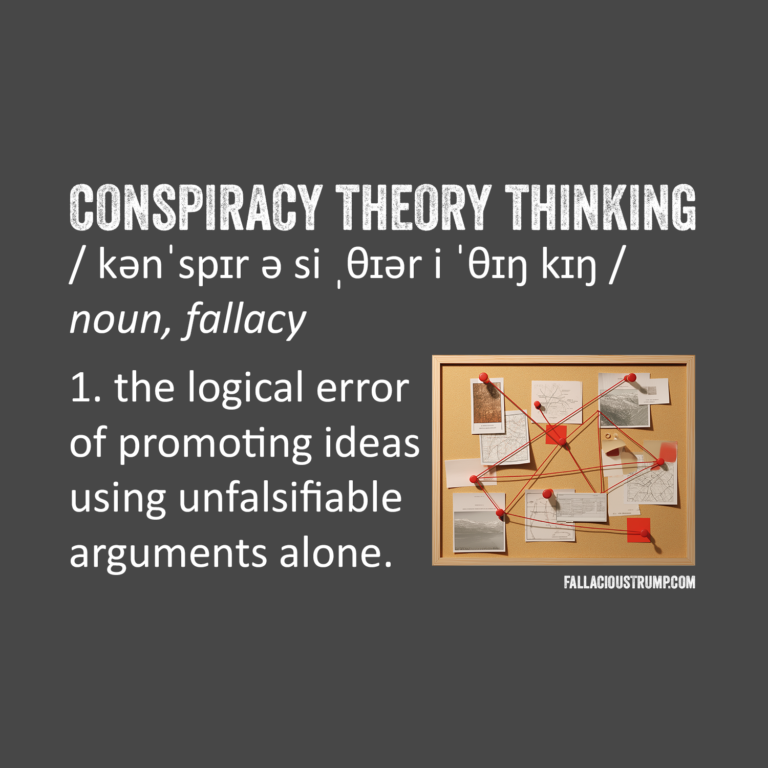
Conspiracy Theory FT#11
Conspiracy theorists often create unfalsifiable arguments, using a combination of goalpost moving, arguments from ignorance and circular logic.
-

Slippery Slope FT#10
The Slippery Slope fallacy is committed when a person assumes if one bad thing happens, then more, and often worse, bad things will inevitably follow. It…
-

Galileo Fallacy FT#9
When someone claims that the fact that everyone called them crazy means they must be right, because ‘they called Galileo crazy’ (or some other person who…
-

Moving the Goalposts FT#8
Moving the Goalposts is such a common tactic that I’m sure everyone has come across it at some point.
-

Argument from Popularity FT#7
Trump likes to talk about ‘many people’ doing, thinking or saying something, to give the impression that whatever they are doing, thinking or saying is correct.…
-

Inconsistent Comparison FT#6
When supporting your claims by comparing two things, it’s important to be consistent in terms of what you’re actually comparing. By doing so you can ensure…
-

Non Sequitur FT#5
Non Sequitur is Latin for ‘does not follow’. Colloquially, non-sequitur tends to be used to mean a sentence which has no relation to the previous one,…
-

False Dilemma FT#4
The False Dilemma fallacy is depressingly common, and quite easy to spot. It occurs when someone suggests or implies there are only two possible choices or…