Show Notes
The Anecdotal Fallacy is committed when someone allows an anecdote to lend far more weight to an argument than it warrants.
Trump
We started out by talking about this clip of Trump claiming an employee of his had a child who was made autistic by a vaccine:
Then we talked about this clip of Trump claiming a friend of his was made better by hydroxychloroquine:
Mark’s British Politics Corner
Mark is back! He talked about these clips of the Irish and Thai leaders explaining why they paused vaccinations after anecdotal evidence of problems with the AstraZeneca vaccine:
Then he covered this clip of Michael Gove using an anecdote in place of evidence for people being harmed by the EU:
Fallacy in the Wild (Sting: Heard it Through the Grapevine – Marvin Gaye)
We talked about this clip from Mad Men:
We followed that up with this clip from Enemies of Reason:
Jim’s Skeptics in the Pub Talk
At 7pm GMT on Thursday March 25th, Jim is giving a talk to Skeptics in the Pub Online about film censorship in the UK. You can watch at http://twitch.tv/sitp
Competition!
If you’d like to win some Fallacious Trump Merch and a t-shirt, go to the competition page and do exactly what it says there!
Fake News
Here are the statements from this week’s Fake News game:
- It’s sort of like when you go in for an operation, if a person is healthy. Healthy. We were healthy — we had the greatest economy in the world, we went in for an operation. We closed our country down. We closed it down, we saved possibly two million, two and a half million lives. Now it could have been a million lives, I don’t think anything less than that.
- It’s like a hurricane and we were worried. We didn’t know is this going to be a hurricane or a major, major recession? A major recession that’s not artificially caused because we artificially — this was artificially closed. We just said “Boom. Closed.” And everything just stopped and also you know what else stopped — big numbers on death by doing it.
- It’s kind of like with a great fighter, really one of the greats. We had a really bad situation that was not even our fault. China should have stopped it, and they could have done, but they didn’t. We did everything right — even my enemies said I did the right thing by closing, but afterwards. Only afterwards. A lot of people didn’t want me to do it.
Click below for the answer
Spoiler
Statement 3 is Fake News. Mark chose number 3Mark got it right this week, and is currently on 46%
Voter suppression is still not a logical fallacy
We covered some of the GOP’s latest efforts to make voting harder.
The stories we really didn’t have time to talk about
- When Biden didn’t manage to get a $15 minimum wage included in the stimulus bill, a surprisingly large number of people decided that meant he was just like Trump. Presumably because they are idiots. Here’s just one example of how they’re different. Remember back in 2017 when Bill O’Reilly told Trump that Putin is a killer, and Trump immediately threw America under the bus, saying “What, do you think our country’s so innocent?” Well, last week George Stephanopoulos asked Biden if Putin was a killer, and Joe said “Mmhhmm, I do.” Vlad the killer isn’t quite used to US Presidents who have the balls to criticise him, so bizarrely, he challenged Biden to a live debate. Biden’s a bit busy Presidenting right now, but also, that’s not a fucking thing that happens. Politicians debate their political opponents when they’re trying to get elected, not just randos with hurt feelings. Needless to say, Charlie Kirk, Madison Cawthorn and basically all of Fox News are openly rooting for Russia in the non-debate against the US.
- Long regarded as the grandfather of creepy artificially-coloured tallow-derived horror; The House of Wax has nothing on Ripley’s Believe or Not Louis Tussaud’s Odditorium in San Antonio Texas. The likeness of dripping grease collection Donald Trump has had to be removed for repair. In a rather leading question (we’re all thinking it!) spokeswoman Suzanne Smagala-Potts was asked if the damage to the Trump figure occurred because of repeated punches to the face, she said, “Have some people done that? Yes. But it’s also been damaged accidentally, as well.” Usually wax museum’s likenesses are laughably inaccurate in their depictions of famous faces, so its either testament to their “talented team of artists” that Trump’s face was punchably recognisable or it simply needed a couple of good haymakers to have it resemble the collapsed honeycomb of his visage more closely. Suzanne assures us “the company has no political bias and allows visitors to pose with figures however they want”. Great I’m heading to San Antonio with a baseball bat!
- Wisconsin Republican traitor Ron Johnson, sorry, Senator traitor Ron Johnson, told a conservative radio show that he ‘never felt threatened’ during the armed insurrection on the Capitol, but that he would have been more concerned if the mob were Black Lives Matter protesters. Keen to prove he’s not just being unbelievably racist, Johnson gave us some cold, hard facts: “Out of 7,750 protests last summer associated with BLM and Antifa, 570 turned into violent riots that killed 25 people” and later, he even cited a source – a study by the Armed Conflict Location & Event Data Project. Unfortunately for Ron, a spokesman for that organization then pointed out that that wasn’t what their data said. The number of BLM related protests was correct, but the 570 that turned violent was the total number from all protests, which includes thousands of non BLM based protests including right wing and anti-lockdown protests. And the 25 people killed by BLM protests? Well that number includes the people Kyle Rittenhouse shot, at least three BLM protesters who were hit by cars that counter-protesters, sorry, racists, drove into crowds, and numerous other examples that have in fact been attributed by authorities to far right extremists.
- In what promises to be another to add to Jim and my list of Trump adjacent films to *cough cough* “review”. “Actress” Louise Linton, wife of Steve Mnuchin, makes her directorial debut with the release of ‘Me You Madness,’ that she also stars in. Financed by “friends and family members,” it probably won’t be mistaken for a Scorsese film. – Is this an astute observation by social media gadfly Perez Hilton? you may ask – nope this from the twitter feed of Ron Filipkowski – Whose profile states with joyous glee – Attorney, Marine, Triathlete, Historian. Former Federal Prosecutor & Repub; now Defense Attorney & Democrat. Political comedy, commentary, theatre and horror. Welcome Ron what a pleasure it is to have you back from the dark side… now then (rubs hand with glee) how do we get to see that movie…
- Last week, the House passed a resolution to award Congressional Gold Medals to the Capitol Police and other law enforcement officers who protected Members of Congress during an armed insurrection. You’d think that would be pretty uncontroversial, but that’s because you forgot about America’s dumbest politician, Louie Gohmert. Yes, that guy who claimed there are no rules about making so much noise you can’t hear a witness testifying to Congress. Anyway, Gohmert and eleven equally repulsive colleagues from the party of law and order and blue lives matter circulated an alternative resolution which carefully avoided any mention of the attack on the Capitol, presumably to avoid accidentally insulting any of Gohmert’s supporters. The initial bill, which included the phrase “a mob of insurrectionists”, passed 413-12.
- Just when you thought it was safe to go back onto Twitter – Trump invents spam faxes – he sent out a missive on headed paper ostensibly from the 45th President of course no mention of the 46th laying claim to the COVID Vaccine and its rollout – “I hope everyone remembers when they’re getting the COVID-19 (often referred to as the China Virus) Vaccine, that if I wasn’t President, you wouldn’t be getting that beautiful ‘shot’ for 5 years, at best, and probably wouldn’t be getting it at all,” it reads. It concludes with a repeat of the words, “I hope everyone remembers!” A classic Trump statement: the wounded narcissism, the unnecessary but very pronounced bigotry, the random capitalizations, the random quotation marks, the ridiculous boasts that he then increases to make himself feel better, the pointless repetition. How Twitter has changed – no longer the falling at the feet of Trump’s thunderous and ranty rallying cries, people are comparing him to the shuffling tramp on the street corner with a tin cup begging for alms for an old (fake) soldier, pointing out that tho on headed paper it fits in a tweet! And of course like postal voting the people he’s asking to remember it was him are the people who aren’t going to get it cos he convinced them not to! You can take Trump out of Twitter but you can’t take the fucking idiot out of Trump!
- Timothy Hale-Cusinelli, an army reservist charged with taking part in the Capitol riot, has been called a Nazi sympathiser by coworkers. I mean, it’s not hugely surprising, but come on, it’s not like he had a Hitler mustache and regularly talked about killing Jews… Holy fuck, the guy had a Hitler mustache and regularly talked about killing Jews! One colleague at the Navy base where he was employed as a security contractor said he told him “he would kill all the Jews and eat them for breakfast, lunch, and dinner, and he wouldn’t need to season them because the salt from their tears would make it flavorful enough” and others recall him making derogatory remarks about women, black people and other minorities. His lawyer, who is really earning his money here, wrote in a filing that there was no evidence his client belongs to any white supremacist organizations. Well maybe he’s not a joiner! I don’t think that should be the only criteria we need to worry about!
- In re-engaging with British Politics on returning to Fallacious Trump I am of course simply struck by how perverse it all still is, the leader of the opposition Keir Starmer in spite of the record number of deaths, the record number of corrupt backhanders dealt to to friends of the government and then hidden for years, and the interference by the Scottish Tories in the potential overthrowing of Nicola Sturgeon as head of the SNP in an attempt to ward of a Scottish referendum and secession from the United Kingdom, an increase in the nuclear arsenal so we can kill everyone several more times over and no pay increase for the health sector so we can continue to kill them several times over, despite all of this Keir Starmer has slipped below Boris in the polls as most popular leader and best person to be prime minister. Of course Starmer isn’t taking this lying down nope he’s doing the rounds and blaming Corbyn, rather than holding up his hand and leaving the field for missing so many open goals, goals so open for a while there the other team wasn’t even on the field. Blow the whistle ref it’s game over!
If you wanted to buy a T-shirt featuring this fallacy, you could click here. No pressure
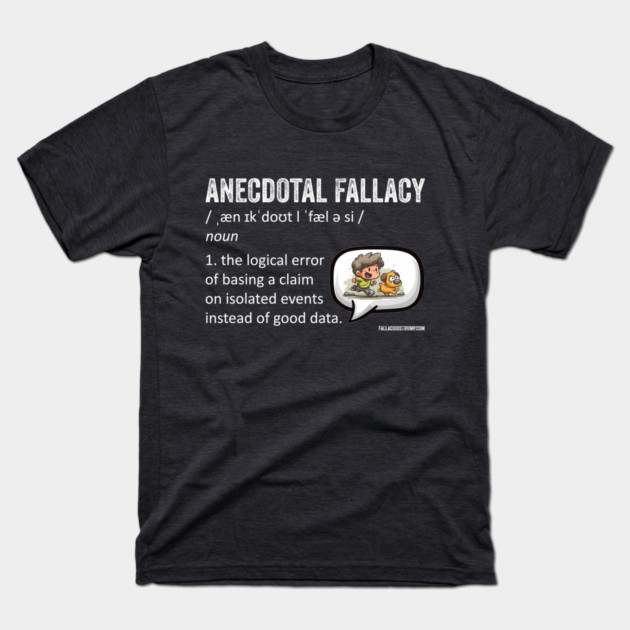
And if you have some money left over after that, Jim’s book, 2000 Mules and One Big Lie: A Stubborn Conspiracy Theory is available now.
That’s almost all for this week, but here’s our AI-aided transcript, which is quite accurate, but not totally:
Anecdotal Fallacy – FT#71 Transcript
Read the full transcript
00:23 Jim: Hello and welcome to Fallacious Trump, the podcast where we use the insane ramblings of RGB number FFA500 to explain logical fallacies. I'm your host, Jim.
00:34 Mark: And I'm your other host, Mark. A logical fallacy is an error in reasoning that results in bad or invalid arguments. And the logical fallacy we're looking at this week is the anecdotal fallacy, also known as the Volvo fallacy. I say we because yes, we're both here. I'm back and raring to go.
00:51 [Unclear]: Yay.
00:52 Jim: And I think I speak for everyone when I say welcome back. It has not been the same without, without you.
00:57 Mark: I think that's an anecdote right there.
01:00 Jim: Oh, it's, I've had to do so much more work, it's. I think you'll agree that I now get several months off and that's fine.
01:10 Mark: We'll do it around the other way. Yeah, no, that's fine. Yeah, and thanks to everybody that stood in. Yeah, absolutely, and and had some to some extent have to kind of read nonsensical things in the same way that I do. Yeah, yeah, that was good, we had a good bunch of people, and thanks again everyone for making it what it is
01:33 Jim: and and your secret mission is over, saved the world, got the girl, and yeah, oh yeah,
01:38 Mark: and the and I will return. Yeah, and then we'll return in comes up at the end: yeah, all of that, yeah, yeah, excellent.
01:47 Jim: So the anecdotal fallacy is when people use anecdotes to back up their, their arguments. Now, there's nothing inherently wrong with using anecdotes. In fact, it's incredibly useful to explain stuff to people, and I mean, we know as filmmakers that there's really nothing better than a story to about a specific person to get a point across, rather than data or, you know, graphs and stuff like that. It just doesn't have the same emotional impact.
02:16 Mark: Yeah, exactly, it kind of focuses the story around in a kind of human way, yeah, doesn't it so if you're putting a a large story across it and get a single person to represent that large story and the large number of people that it affects, then it's much. You can connect with it much more readily.
02:32 Jim: But it becomes a fallacy when you use anecdotes to lend much more weight than they warrant to an argument, or or actually kind of often use them in the face of data which contradicts them. So our, Our first example comes from Trump, back in the second Republican presidential candidate debate. And he was talking about vaccines.
02:56 Clip: Trump claiming a vaccine made an employee's child autistic
— But you take this little beautiful baby and you pump. I mean, it looks just like it's meant for a horse, not for a child. And we've had so many instances, people that work for me. Just the other day, two years old, two and a half years old, a child, a beautiful child, went to have the vaccine and came back. And a week later got a tremendous fever, got very, very sick. Now is autistic.
03:19 Jim: So even if we assume that's true, right, yeah, um, and that's very sad, if it is true, yeah, that's one case, yeah, which flies in the face of all of the data on vaccines causing autism, or rather not causing autism. Yeah, as it turns out obviously being Trump. Probably isn't true, yeah, or at least if it is true, who he is? Kind of Angela Lansbury in Cabot Cove. Levels of near people who get autism from vaccines. Because he also told a similar story about six months before, which also apparently happened recently to him. And a different story a couple of years before that.
04:04 Mark: And that's that. It's made for a horse thing turns up a lot, doesn't it? That kind of, he said that.
04:11 Jim: Well, that's because he's never been close to a baby who's being vaccinated. He's obviously not taken any of his kids. He thinks that because they give them lots of vaccinations, it must be a massive needle.
04:22 Mark: Yeah, and it inflates the kid. There's a sense that, as he's telling that story, that the kid gets pumped up somehow and then grows up to become a large orange blimp. Yeah, maybe that's, yeah, Trump Sr. all that time did that to him.
04:41 Jim: But yeah, even if it was true, that's one person's story. The problem with anecdotes, and this is why they're not useful, is we don't know all of the details. We don't know if, again, imagining that story was true. We don't know what that child was like beforehand. We don't know what other things might have been factors in that. That we, we don't have that kid's medical history or any of the the other information. We would need to say that that is evidence that that child got autism because of a vaccine. We have, at best, a post hoc, ergo propter hoc – thing where one thing happened and then another thing happened.
05:21 Mark: And is it the thing that happens with the anecdotal fallacy that it gets. They get cited in the face of a lot, lot of evidence. So that's where the Volvo fallacy comes from, is, you know, you look up on the website, you decide to buy a Volvo, they've got the highest safety rating, um, and then you, you tell somebody that you're going to buy a Volvo and they say: oh no, well, my, you know the, the um, the oxygen sensor light kept coming on and you had to change the master cylinder and that was really expensive. So, in the face of all that evidence to the contrary, you get this latest bit of anecdotal stuff from somebody that you know.
06:07 Jim: And that the reason that we use stories to get points across is because humans have evolved basically to pass on information through stories. And the whole thing about social proof is that you believe what people tell you, to some extent at least, about their own experiences with something. And if you know that person, you're more likely to value that person's opinion or experience. Experience and yeah, you might then choose to go against the evidence of something like with the volvos, that the actual kind of crash tests that have been done that show them to be particularly safe, and someone says, oh well, I knew someone who was in a crash and it was very bad and they were hurt. Um, I mean, I've got a, an anecdote about volvos. I Volvo was my first car and when I was driving a Volvo there was a, a story in our local paper of a Volvo that had been in a crash with a bus and and there was a picture and the bus had gone into a ditch and was like crashed and the Volvo barely had a scratch on it.
07:11 [Unclear]: Yeah, well, yeah, Volvo came out the best.
07:15 Mark: Yes, the 16 people died all in the bus.
07:18 Jim: Yeah, so, and you know, I don't know any of the other details of that story that might not be be representative of of what happened,
07:27 Mark: but you know, it's kind of stuck in my head and I guess it's because the that uh anecdotal thing, the hook for, uh, you like in trump's case telling that story, he knows that it's got the right, it's got the elements that you need in order to hook people in. Um, so it's got a baby. It's got, um, you know, something being done to it. It's got some the awful outcome and therefore you ought not to do that to your babies. Yeah, you're immediately engaged with the the story. You're open and accessible to what that means and how that will make you feel in the face of cold, hard facts. So, and the same with you know, if you own a Volvo, then it means all you're thinking about volvos and somebody says, oh well, here's the story about out volvos. Yeah, you remember it, or it it you you're kind of your.
08:25 Jim: It has more of an impact on you. Yeah, yeah, and it can be used as well. I mean that's being kind of in a negative sense of the vaccines, but it can be used in a positive way as well, in order to kind of argue in favor of something. And this is Trump from uh more recently talking about hydroxychloroquine.
08:41 Clip: Trump on hydroxychloroquine
— Over the last seven days, my administration has deployed roughly 28 million doses of hydroxychloroquine from our national stockpile. We have uh millions of doses that we bought and many people are using it all over the country, and just recently, uh, a friend of mine told me he got better because of the use of that that drug. So who knows?
09:03 Jim: Trump doesn't have any friends, so we know immediately: that's a lie, exactly,
09:07 Mark: and it's kind of it reminded me of john cleese's. He turned me into a new – yeah, you're clearly not a newt now. Yeah, yes, so he got, yeah, and, and that's the speech. He's reading the speech and he just goes off piste. Yeah, and you know the the man in the other room is just going: oh God, no, please, yeah, yeah.
09:35 Jim: And the hydroxychloroquine thing was was built almost missed entirely from anecdotes, and when they actually did data collection on it, when they did randomized control trials, when they did even cohort trials of looking at what people were given and what their outcomes were, again and again it came out that it really didn't have a positive impact and in some cases, had a negative impact. And that's what you need to pay attention to, because there's a reason we do randomized control trials and double blind trials and things where where people aren't basing it on isolated cases, where you don't have all the information. And the more people who just say, well, yeah, it worked for someone I know, that doesn't help.
10:17 [Sting: Mark's British Politics Corner] And now is the time, I think, for Mark's British Politics Corner.
10:22 Mark: Well carrying on in that vein of the dangers inherent in the anecdotal fallacy around vaccines. Recently the European governments, many European governments, halted the rollout of the AstraZeneca vaccine in the face of anecdotal evidence, despite them saying that there was no causal connection. So here's a clip of the Irish Prime Minister and the Dean of the Faculty of Medicine in Thailand talking about why they stopped the rollout of the vaccines.
10:55 Clip: The Thai and Irish leaders on pausing vaccinations
— Thailand's Prime Minister and members of the cabinet were supposed to receive the AstraZeneca vaccine on Friday, but instead health officials announced a delay to the vaccine rollout after a number of reports of blood clotting in Europe.
— There was one patient in Denmark who died and there were other patients who had blood clots. Denmark's government announced the suspension because they were not sure. This is not to say it's related to the vaccine, but when such cases occur for safety, we have to postpone the administration of the injections to allow further investigation getting to take place.
— You guys made the decision over the weekend to pause on this AstraZeneca vaccine. Tell me why you made that decision.
— Well, essentially, our clinical advisers took this decision on foot of a notice from the Norwegian authorities in respect of a cluster of cases that occurred in Norway in terms of blood clotting. Now there is no causal effect established or anything like that yet, but as a precautionary move, in line with the precautionary principle and an abundance of caution or clinical advice, was to pause the program. So what's what they're both saying is,
12:02 Mark: and it's kind of it's, it's telling, I think in this, in the, the way that it's anecdotal is that one of them cites Denmark and the other one cites norway. And you think, well, where is it? And I couldn't track down what the, the, where the, the route was. But there was this kind of sudden wildfire, anecdotal um, oh yeah, no, it's, it's causing lots, it's causing blood clots and there's like one person and a few people and a cluster and then it. So it's all very vague, um, but it's reached as far as thailand. And the irish prime minister there, michael martin, taught, also taught – invokes the precautionary principle to, to kind of justify, And the precautionary principle states that a precaution should prevent potentially harmful actions being taken even before a causal link has been established by absolute, clear scientific evidence. And it comes from an EU proclamation in 1987 intended to prevent harmful substances being dumped into the sea, even if there was no scientific evidence providing a direct link to environmental damage. So it's a bit like well as we'll come on to in the example of the world. There's that kind of well. We'll just bung a whole bunch of horrible shit into the North Sea. There's no evidence that it will as yet, that it will cause environmental damage, but it's awful shit that we don't want on land and we're putting it in the sea. There's likely to, let's just assume there is going to be some damage, a bit precautious about it. Yeah, it's a bit like the kind of
13:39 Jim: climate change thing is, you know, yeah, it seems like it's bad already and it seems like it's probably getting worse and everyone's like, yeah, but you can't prove, it's definitely going to destroy the planet, so we probably shouldn't do anything about it at all.
13:51 Mark: Yeah, yeah, but you kind of think, oh, actually, yeah, we should, yeah, so that. So, um, natasha loder, who's the health Policy editor at the economist, kind of says: well, the calculation is different. During a pandemic, stopping vaccination is not a cost -free option. You know that when in dumping the stuff into the sea, if you didn't, if you stopped dumping stuff into the sea and waited for more evidence, there's no cost involved. French doctor estimated that vaccinating 100 000 people over 50 today rather than tomorrow will save 15 lives. So there is a cost involved with not vaccinating people. So So just hearing this anecdotal evidence – and the anecdotal evidence is kind of there's one or two . I think they were measured. They were so far across the EU and the UK, there have been 15 events of deep vein thrombosis. These are the blood clots they're talking about, and 22 events of pulmonary embolism, so blood clots in the lung. So that's 37 events. Events. Normally one in a thousand people will get a blood clot Event going on. So we therefore should have at least a hundred a week, because five million or so people have received the vaccine already, but there aren't. There's 37. So you would, under normal circumstances, would you not just go go, well, that's less than the background count. So let's not use that as evidence to stop the thing. We'll just continue to monitor it because, actually, covid is really bad for giving you blood clots, especially in the lungs. So you know it isn't a bad thing to take this vaccine. It doesn't increase the, the um, the chances certainly hasn't gone up to the background limit of the background number of one in a thousand. Covid is the thing that will give it to you. So take the vaccine because, like all vaccines – and this one's been tested and it continues to be tested – like all vaccines it will prevent you getting it.
16:05 Jim: Yeah, and unfortunately, in the kind of the, the attempt to be cautious, cautious, um, with the amount of vaccine, hesitancy and and misunderstanding and conspiracy theories and stuff there are about the vaccines anyway, stopping vaccinating it, having lots of news stories about it and all that kind of stuff – when actually there's there isn't really any evidence. Uh, when you look at it, that that is a problem causes much more of a problem.
16:31 Mark: It fuels the conspiracy fire. Yeah, it adds, it adds. I mean, as soon as I was reading this out to to the anti -vaxxer in my Life, um, they were saying, oh right, what, what? What evidence is that then? So I had to read out the numbers and say, well, it's against the background thing is less. There've been fewer cases than there are normally. Yeah, so anything appears to be helping, quite yeah. Yeah, you know, but anecdotally, you wouldn't want to say that, no, you would say, well, Well, let's test it. It appears on the face of it, you would think. So part of those. So the second part of that of the example one is this clip where, which is kind of the UK response in all of this furore. The UK is not halting the rollout of that. And this is what the reporting and the expert is saying about that.
17:27 Clip: The Thai and Irish leaders on pausing vaccinations (continued)
— There's no increased rate of blood clots following vaccination. Experts say the European reaction has been disproportionate.
— When we see these kinds of stories, we all, of course, start to worry, is this a real problem? And in my view, we don't have enough evidence at all to conclude that yet. And so I would just want to be very wary that we don't put people off from taking the vaccine when we know for sure that it will prevent severe Covid illness and death.
— These are new vaccines and medical staff are hyper-vigilant for anything unusual. There's nothing to suggest a causal link between clots and the vaccine. So there seems no reason to be worried about either vaccine being used in the UK rollout.
18:11 Mark: What I like is, yeah, this will prevent death. So, yeah, you know, let's just go for that. So that was Ian Douglas who kind of, pretty much saying there that the plural of anecdote is not evidence, just anecdotes.
18:26 Jim: And that is something that we've said before as well in related fantasies, I guess. But to be completely fair, the plural of anecdote is evidence or data. It's just not good data. That's the thing. And if you want good data, you have to have extremely well-controlled anecdotes with lots of surrounding information. With lots of context. Context. Yeah, yeah, but what you get when you add lots and lots of anecdotes together is very, very messy, not very useful data.
19:00 Mark: Yeah, well, there's that whole distinction in the research field of quantitative and qualitative research, and quantitative is the stuff where you try and control it, so it's mostly numbers and those kind of things, whereas qualitative is, well, how do you feel about that? You know that kind of stuff which, and you kind of, it's difficult to use that in a, uh, a controlled way. It's difficult to quantify people's qualitative responses. Yeah, because they're two different things.
19:32 Jim: They're both useful, but for different purposes.
19:34 Mark: Yeah, so that, and also, um, what's interesting in the reporter thomas moore just there was using what sound like Like anecdotal language, experts say the reaction has been disproportionate, which, in our knowledge of conspiracy theorists, they would just go: oh look, you see. Well, experts are saying that. They were according to scientists.
20:01 Jim: Well, it's our previous episode, Anonymous Authority.
20:06 Mark: Experts say. So it's that kind of thing. But you kind of go, well, yes. The reason they're saying that is because they are looking at the evidence and saying there is no causal connection that can be established from this evidence. So the only causal connection that can be established is by somebody just making stuff up or being overcautious. And what's interesting is that the UK's response is to trust the experts, which contrasts rather vividly with the second example which we've used before from 2016, when Michael Gove infamously said people have had enough of experts and cited his single own personal experience as sufficient anecdotal evidence to support his claim that the majority of the UK have had their lives made worse by the European Union.
20:56 Clip: Michael Gove using an anecdote about the EU
— What's your factual basis to say the majority of people in this country are suffering from EU membership?
— Well, I know myself from my own background. I know that the European Union depresses employment and destroys jobs. My father had a fishing business in Aberdeen destroyed by the European Union and the Common Fisheries Policy. The European Union has hollowed out communities across this country.
21:22 Mark: So yeah, a bit of a jump from. My father had a fishing job and he lost his job because of the agreement with the Europeans. So, therefore, the majority of people have been affected by that. And yet this is the same. Michael Gove is now saying: yeah, we must trust the experts and we will continue to put this vaccine out. And you kind of well, actually. So what we've learned is that, especially from this government, is that anecdotal evidence is only valid when it's politically expedient to make it so, and also that it must contain inherent Eu bashing in order for it to be proper evidence.
22:04 Jim: It's also always worth pointing out that michael gove's dad denies that the Eu had anything to do with why his fishing business went under.
22:11 Mark: Well, exactly, yeah, and you know he did. And and michael gove saying, yeah, it's, it's you know from my experience. He said what your experience as a um, you know, a member of the, the of westminster voted in and he went to oxford: no, it's not done you too bad, actually, if it's not, you know, you've spent most of your political Life under the Eu, as part of the Eu, and then you just it was expedient for you to say, oh, no, it's terrible. In 2016, when you saw your chance, there's
22:42 [Sting: Fallacy in the Wild (I Heard It Through the Grapevine – Marvin Gaye)]
23:36 Mark: marvin gaye there with his archetypal anecdotal song – heard it through the grapevine:
23:41 Jim: that's an ambitious uh key. Yeah, it was.
23:46 Mark: And one that no amount of auto tuning would fix – yeah, well, maybe it would in a more skilled auto tuning. And yeah, sounded perfect when I was singing along to him. I was absolutely, even when I stopped singing he continued, quite, you know. But uh, yeah, we can't ever, shan't ever, speak of this again.
24:10 Jim: So in the Fallacy in the Wild, we like to talk about the fallacy of the weekend from a non -political perspective, and our first example this week comes from the pilot episode of mad men, in which the guys from lucky strike come into the office to talk about their new advertising campaign.
24:26 Clip: Mad Men
— This morning I got a call from our competitors at brown and williamson and they're getting sued by the federal government because of the health claims they made.
— Yeah, we're aware of that, mr garner, but you have to realize that through manipulation of the mass media, the public is under the impression that your cigarettes are linked to certain fatal diseases. Manipulation of the media – hell,
— that's what I pay you for. Our product is fine. I smoke them myself. My granddad smoked them. He died at 95 years old. He's hit by a truck.
25:00 Jim: Brilliant, yeah, an absolutely classic, as an anecdotal fallacy is. Well, you know, I cigarettes must be fine, because I know someone who smoked them and didn't die from it.
25:12 Mark: Yeah, yeah, yeah, and you kind of call that one out at the moment. Yeah, it was a bit like david hockney. Um, he's kind of – I think later on in this scene they say: you know, so are you saying you're gonna die anyway, so you might as well smoke our cigarettes? And, um, david hockney has a sign up in his studio because he's notoriously smoked and he's like 80 something now and in his studio it does say: you're gonna die anyway, so smoke them if you got them. It's that that kind of yeah, there There is that kind of reversed thing. And you think, well, it would be interesting to see how many people smoked who didn't die versus how many people smoked who did die. And it's which reminds me of the other vaccine related antidote fallacy thing. I read this meme that was all the people that were on the pilot smallpox vaccines in 1798. They're all dead now makes you think:
26:15 Jim: yeah, yeah, yeah, so, um. So our second example in this section is from a series called enemies of reason, which was a documentary by richard dawkins, and in this one he is talking to professor chris french, who's a psychology professor at goldsmiths college and a kind of investigator into paranormal claims. In fact, we saw him do a brilliant talk a couple years ago about reincarnation and stuff. And here he's talking about dowsing. And he set up an experiment where he gets people to try and demonstrate their ability at dowsing.
26:57 Clip: Enemies of Reason
— What you'll typically find when you talk to dowsers is they'll give you lots and lots of anecdotal evidence, lots of stories about how they discovered a leak in their neighbor's pipes, and so on and so forth. But there are always other possible explanations there. What we're trying to to do: setup conditions which would rule out any of those other explanations. But then we get down to the very fundamental, basic issue: can the dowsers actually do what they think they can do?
27:19 Jim: Yes, spoiler, no, they can't.
27:21 Mark: Yeah, had someone particularly distraught at the fact that she couldn't do it? Yeah, but I I had. When, when you put this one up, I reached across on my shelves in my study. I've got got a certificate where I'm actually a certified dowser because I went to this place in cornwall. Um, I think maybe I'm a an honorary member of the guild of cornish druids as a result. And, um, they gave you a set of dowsing rods which was basically like an enormous wishbone, and you had to hold it in the most unnatural fashion and then walk under what looked like a prehistoric stone arch and if the thing moved at a certain time, they would go. Well, there you go, you you're so well what I've discovered? Water, what? And they could well. No, you've got in touch with the ley lines or whatever. And um, anything. Well, hang on a minute. This prehistoric um arch here that's made of, you know, massive blue stone or whatever it is. How did you get permission to build what's ostensibly a bungalow five feet from it. He said, oh no, the bungalow is here first. And you go: okay, so yeah, not so ancient. Well, it's a bit ancient, it's probably the 90s, but you know it's not so ancient.
28:38 Jim: So, yeah, yeah, yeah, so yeah, what chris french did here is he. He got a tent and set up um various kind of buckets, essentially with lids, uh, into which um of six he put water or someone, actually, because it was double blind. So one of his assistants, without, without, without him knowing which one it was in, put a bottle of water in one of them and bottles of sand in the others. So they all had plastic bottles in. The only difference was that only one had water in. And the dowsers were given, I think, two guesses on each turn to see which one had water in it. And at no point did anyone get better than chance.
29:21 Jim: And when he was, like, showing them and saying, you know, you haven't got it right this time. And, yeah, one woman was particularly going, well, I can't do this then. This is, I don't know what's going wrong. But then, like, 10 minutes later, she was saying, oh, yeah, well, I'm, you know, I'm usually much better than this. And this is just, you know, it's a bad day or this is not the way I usually do it. And why couldn't we just kind of have it set up with boards and a kind of floor over it so that I could walk above them, because that's what I normally do? And yeah, they're making up, they're doing special pleading, they're making up excuses for why it didn't work that time for them, when it normally works,
30:02 Mark: and then also heap, heaping in in the face of objective evidence, heaping in their anecdotes, saying, well, I have done this, I went to a person's house and I fixed the leak in their hose. Yeah, all that stuff. So they're kind of it's often used in In the face of overwhelming evidence to the contrary.
30:23 Jim: And these people, I think one of the reasons that he did this experiment with dowsers is compared to sometimes psychics or other charlatans. Dowsers very often seem to completely believe in their own abilities. There's very little benefit to them pretending. Pretending, yeah, whereas in some other areas that you know, some people might have reasons for pretending – but yeah, with dowsers it tends to be they. They honestly believe they can do it. They've got they, they have the anecdotes that have convinced them of the times that they have have, you know, done something and – and a lot of it is probably confirmation bias – where they've the times they didn't find something or they got it wrong. They just kind of ignore those ones. But but, it's sufficient, it's all the evidence they need to prove that they can do what they think they can do, uh, until you actually test it and then they can't do it. Yeah, so before we move on to uh fake news this week, uh, it's just time to to kind of tease the thing that's coming up this week, which is a talk I'm doing for skeptics in the pub online. Uh, on Thursday, 25th of march at At 7 p .m. GMT, I'll be talking to a bunch of sceptics about the British Board of Film Classification and film censorship in the UK. And I'll be answering questions. And then after the talks at Sceptics in the Pub there's always a kind of a Zoom virtual pub thing where I'll also be hanging around for a couple of hours answering any questions that people have and having a chat.
31:59 Mark: Fantastic. Fantastic. Will you be telling your anecdote about your personal involvement in pizza games?
32:05 Jim: I will. That will come up. Yeah, and I'll be talking about why Torquay Council banned Life of Brian until, I think, 2007. Why James Furman banned Teenage Mutant Ninja Turtles from throwing sausages around in the 90s. All kinds of fun stuff.
32:22 [Unclear]: Wow. That's on video, is it? It's a Zoom call? Yeah, it's actually on Twitch.
32:28 Jim: Yeah, so if you want to watch that, you can go to Twitch .tv. Slash S -I -T -P Skeptics in the Pub at 7pm GMT on 25th of March and watch it there.
32:37 Mark: And you'll actually get to see what Jim actually looks like in actual reality.
32:44 Jim: If you haven't seen our No More Jockeys games on YouTube.
32:48 Mark: Yeah, that kind of, you know, putting the name to the voice. Oh, my God, what do you look like?
32:54 Jim: It'll only be a disappointment. Enjoyment.
32:56 Mark: So, yeah, but maybe they could use that in the um in the designs for the competition we're about to talk about.
33:04 Jim: Yeah, so let's talk about that. Yeah, yes, we are having a competition with our friends at t public, yeah, who host our, our t -shirt store, our merch store, and basically it's to celebrate the return of Mark. Really is why we're doing competition very kind. And if you've ever had an idea for a t -shirt – yes, probably specifically one about critical thinking, logical fallacies, Trump or our show – then, uh, then now is your chance to make it into a t -shirt. And if you go to Fallacious Trump .com slash competition, you can see all of the details there. But ultimately it's just upload a design for a t -shirt to t public, uh, using the details that you find on that page, and if anyone wants to buy that t -shirt on that store, you'll get some money. And also, yeah, and not just while the competition is running, but forever. Basically, if you leave the design up there, you get money if people want to buy your t -shirt, and we'll hopefully get a bunch of designs uploaded and then we will have a voting period and people can vote for which one they like best and whoever wins will get a bunch of Fallacious Trump merch and a free t -shirt from our t -shirt store.
34:19 Mark: Yeah, I'm looking forward to seeing those, because you know we've come up with some good ones, some of which have sold, some of which, yeah, but the things that have occurred to us whilst the participating in the world of Trump, uh, and out of it, that we just kind of turn into a t -shirt and shove up there, and you must have had similar thoughts. So now's your, now's your chance to turn and into money and T -shirts and merch.
34:47 Jim: So you've got until the 17th of April to enter, and then we'll have a bit of voting and we'll announce the winner at the beginning of May. FallaciousTrump.com slash competition.
34:57 [Sting: Fake News] So we're going to play fake news, folks. I love the game. It's a great game. I understand the game as well as anybody. As well as anybody.
35:05 Jim: Yes, it's time for fake news. The game where I read out three Trump quotes, two of which are real and one I made up, and Mark has to figure out which one is fake news.
35:11 Mark: You see, anecdotally, from what people have told me, this thing's been completely rigged from the start. Because since I've not been playing, everybody's won.
35:22 Jim: Well, there have been a couple of people who have done better than you. That's true. But overall, I
35:32 [Unclear]: think you're still doing okay.
35:34 Jim: I was quite heartened. Marsh has done very poorly.
35:37 Mark: I know I was quite heartened to uh, to hear him going all out, all gung -ho, just like he did first time round, not learning a thing, yeah, yeah, and to be to be caught out by that. You see, you, sometimes you kind of you know, in the face of all overwhelming evidence, you still think anecdotally: I'm gonna win this time and you can't.
36:01 [Unclear]: Yeah, yeah, uh, well,
36:03 Jim: you're currently on 27 out of 60.
36:06 Mark: Oh, good, yeah, so blimey.
36:09 Jim: So, yeah, you're doing better than some people, worse than other people.
36:15 Mark: Um, that's very comforting, yeah, yeah, yeah, it's very philosophical.
36:21 Jim: Could be worse? You're officially not the worst person in the world at this game. So, yeah, brilliant, um, that's brilliant, yeah, uh. So the theme this week is: I went back to to an old speech that I've actually taken some examples from before, because it was right, fucking mad, and this was actually about: um, it was a press conference that Trump held about positive job numbers when everyone thought, during the pandemic, the job numbers were going to be really bad and they were only slightly bad, um, and, and he talked for an hour – almost none of it was about that, right and uh, but what he did do during this speech is is do several. It used several different analogies for, for coronavirus, um, and then immediately forget what he was talking about and move on to something else without really finishing the analogy. Oh, okay, so that's what these are about, right? So statement number one: it's sort of like when you go in for an operation, if a person is healthy – healthy, we were healthy, we had the greatest economy in the world – we went in for an operation. We closed our country down, we closed it down, we saved possibly two million, two and a half million lives. Now, it could have been a million lives. I don't think anything less than that,
37:40 Jim: Statement two: yeah, it's like a hurricane and we were worried. We didn't know: is this going to be a hurricane or a major, major recession? A major recession that's not artificially caused, because we artificially, this was artificially closed. We just said boom, closed and everything just stopped. And also, you know what else stopped? Big numbers on death by doing it. And statement number three: it's kind of like, okay, it's kind of like with a great fighter, really one of the greats. We had a really bad situation. That was not even our fault. China should have stopped it and they could have done, but they didn't. We did everything right. Even my enemies said I did the right thing by closing, but afterwards – only afterwards – a lot of people didn't want me to do it
38:29 Mark: Okay, well, I quite like the, the hurricane, what. It's great, but it's kind of no, no, forget that, forget that. It's like a hurricane, no, no, I forget it. It was like when you're fighting muhammad ali, right, it's like that, but then just doesn't finish the. So you're waiting to go. Okay, how is it like round up the analogy so that you're making a, you know, a deep and meaningful insight that I can hook on to. Okay, so I, I quite like the hurricane one. It sounds very much like him because he's got a major, it's a major recession. It's either a hurricane or a major recession, like people say that it's a hurricane or a cyclone. No, it's a hurricane or a major recession, major recession that's not artificially caused because we artificially – this was artificially closed. That sounds like he's had a thought that might lead somewhere. Okay, so I'm sort of quite like that one. When you're going for an operation person, healthy, we were healthy, close it down, see that, I don't think anything less than that is kind of a. It's a, a Trump, nonsensical thing. But then the third one, he's, he's managed to have a dig in there at china and at his enemies, okay. Having said that, so I think, great fighter hurricane operation, okay, all right, I think number three is the one that you made up,
40:11 Jim: okay, so, out of the other two, which are you more convinced?
40:15 Mark: I'm more convinced by the hurricane, okay.
40:18 Jim: So, number two: yeah,
40:21 Clip: Trump, played during Fake News
— is real, it's
— like a hurricane and we were worried. We didn't know is this gonna be a hurricane or a major, major recession, a major recession that's not artificially caused, because we artificially – this was artificially closed. We just said boom, closed, and everything just stopped. And also, you, You know what else stopped. Big numbers on death by doing it.
40:48 Mark: Big numbers on death. That's brilliant. Wait a minute. A major recession that's not artificially caused because we caused it artificially. It's basically what he's saying. Then he realized he's tied himself up in knots. It's a major that's not artificially. What? Oh, so it is a major recession, but not one that we caused. So it's the one that we cause is less of a recession, or is it a hurricane?
41:14 [Unclear]: Oh yeah, but either way,
41:18 Mark: big numbers on death, yeah, big numbers on death. That's a brilliant, that's a fantastic album title, isn't it? Big numbers on death? So, uh, okay, you also thought the number one.
41:31 Clip: Trump, played during Fake News
— I think It's real
41:33 Jim: and number one is real.
41:37 Clip: Trump, played during Fake News
— It's sort of like when you go in for an operation, if a person is healthy – healthy, we were healthy. We had the greatest economy in the world. We went in for an operation, we closed our country down, we closed it down, we saved possibly 2 million, 2.5 million lives. Now, it could have been a million lives. I don't think anything less than that.
42:00 Mark: So, where's the? Where's the analogy? It's like, okay, so, you're perfectly healthy, but you're going for an operation? Yeah, yeah, because, and therefore, that means well, no, he doesn't.
42:10 Jim: Yeah, about about six or seven minutes later. Right, he got to the point of this.
42:16 [Unclear]: Oh, okay, because this,
42:18 Jim: this was in june of 2020. So, yeah, so, still that at that point, I think there were 110 000 uh deaths. It's, it's up to 530 000 now in the? U .s? Um. But at that point, he was saying, you know, it's, it's basically over and, um, he was. He was saying that the reason that they'd done so well and and achieved so brilliantly was because they were so strong going into it. Right, that's the point is that the patient that needed the operation of closing down was was strong, was healthy and healthy when they needed the operation. Okay, um, yeah, that was the point of that one. The hurricane one: yeah, um, I don't get at all he does. He does go on to talk about how in texas and florida, where they just have hurricanes all the time, yeah, they have a hurricane and then, like, the next day, everyone's just mowing their lawn, right, but that that didn't at any point make any more sense than than that right,
43:23 Clip: Trump, played during Fake News
— yeah, yeah, that was the extent of a hurricane with a momentary knockback of the economy.
43:28 Mark: Yeah, I think he was basically a natural recession,
43:31 Jim: a horror, as a major recession would last a long time. A hurricane doesn't last very long.
43:35 [Unclear]: Uh, right, yeah, all right,
43:38 Jim: I think that was what he was going for, but it wasn't very clear,
43:40 Mark: giving him far more credit than you know. Yeah, I think we might be overreaching there.
43:48 [Unclear]: Yeah, yeah, but
43:50 Mark: yeah, but there. And the other thing is I don't get, is that we, we say possibly two million, two and a half million, so it could have been a million? Yeah, I don't think anything less than that, not, yeah, so at least we could have saved. We could have saved a million, but we've saved. What's he talking about?
44:09 Jim: Death that he's? He reckons that by closing the economy and the country down, they saved two and a half million lives, when, right When, the model that had the absolute biggest death toll, which I think was University, College, London model, said that if nobody in the world did anything at all – and literally people didn't even wash their hands or do anything – the US would lose 2, .2 million lives. Right, that would be like the absolute worst case scenario if you took no notice of it whatsoever and everyone pretended nothing was happening. Um, and he says that they saved two and a half million lives by by closing the borders to china in february. Right, yeah, yeah, so that means that you did. On your return, you got. Your first one is is right, right, which takes you to 28 out of 61, which is 40, almost 46 percent, good God. So so, uh, well, yeah, I mean above chance, oh, okay, because, because chance will be 33 percent. So, yeah, oh well, that's dang. Yeah, it's creeping, creeping up towards the 50 percent.
45:30 Mark: Yeah, anecdotally, I kind of think that's because I've got it sorted out now, but But no, in the face of overwhelming evidence, it's just luck.
45:42 [Unclear]: Yeah, data doesn't support. No, no.
45:45 Mark: I thought for a minute that I could begin to read your ones like a book, but no. But next time round, it won't be the same, I don't suppose.
45:57 [Unclear]: So
46:03 Jim: it's time for the part of the show that this week at least is called Voter Suppression is Still Not a Logical Fallacy. Because, uh, well, Biden won, and so the Republicans have realized that the only way they can ever have any chance of winning again is is to do even more voter Suppression than they were already trying to do.
46:21 [Unclear]: Yeah, yeah, so, as a result,
46:26 Jim: as of this is, as of february 19th, there were 253 bills introduced across the country that restrict voting access across 43 states. Um, wow, which is? Which is a fuck ton in in a month after biden's inauguration. Basically, yeah, um, in texas, more than two dozen bills have been, uh, or are under consideration at the moment have been introduced. Uh, basically, they do things like increasing Id requirement for um absentee voting, limiting early voting and just making it harder for people generally to vote. Yeah, um, and I mean, ultimately, it's because Trump convinced people, or convinced Republicans, that there was widespread voter fraud. Um, a quinnipiac poll in december said that 77 percent of Republicans believed that there had had been widespread voter fraud in the 2020 elections.
47:26 Mark: Well, is that not just their their go -to explanation for losing? Yeah, it's just kind of whether it's obviously voter fraud. So what they're, what that allows them to do, is to say, okay, so what we need to do is pass some laws to stop voter fraud, even though there wasn't any. Yeah so, and those laws are basically to turn the screws Screws down to prevent people who were not voting Republican to not be able to vote.
47:59 Jim: Yeah, I mean the thing is, in order to figure out what laws you would have to pass to reduce voter fraud, first of all you would need to figure out what voter fraud was happening. Surely that would be like, how much is there and how is it happening? And therefore we can then have laws which will stop it. But yeah, texas attorney general ken paxton's office spent 22 000 hours looking for voter fraud in texas, where there are 17 million registered voters. Right, they found 16 cases of false addresses on registration forms.
48:36 [Unclear]: That's it, wow, so,
48:38 Mark: literally one in a million,
48:40 [Unclear]: yeah, wow, and they,
48:43 Jim: and they really really looked.
48:45 Mark: Yeah, yeah, well, 22 000 hours, yeah, that's quite some time, isn't it? That's thousand days, what's that? Three years, it's. It's what are? 24 hours a day? It's about a thousand days.
48:59 Jim: I feel like this. There's a song from rent which would tell us this: yeah, but yeah, it's, it's ridiculous, they have they. They looked, they couldn't find any. So they decided to make laws that don't address voter fraud in any way. They just make it harder for people to vote, especially minorities and poor people, people basically, who are more likely to to vote Democrat, Democrat, yeah, um. In georgia, they have really taken this to a new kind of art form. Just this legislative year, there are nearly 80 voting related bills in the georgia legislature, including two huge omnibus bills, which which do things like: um, they reduce, uh, in -person early, early voting. They remove sundays from early voting, so they, they just allow early voting Monday to Friday and, like every other Saturday. Um, and there's a. There's a big uh thing, especially in southern states and in georgia, uh called souls to the polls, where churches, especially black churches, get like organize their people to go and vote early after after church service. So they're basically outlawing that. They limit absentee drop boxes to one per voting area or one per 100,000 voters. They severely reduce eligibility for absentee voting. They increase the ID requirements. They cut the time that you can request your absentee ballot from 180 days down to 78 days. So by more than half. Yeah, um, and – and I think this is just unbelievable – they, they, they have made it or they, they have passed a bill, um, through their house, which, which is now needs to go through their senate, which makes it illegal to give food or water to people waiting in line to vote.
50:59 Mark: Whoa, bloody hell.
51:02 Jim: Which, especially, again, in areas where they have less polling stations, less absentee ballot drop boxes and things like that. Yeah, people, people are standing, and people were standing in 2020 – are standing in line all day to vote. Yeah, and they're trying to stop that from happening. And they, because they know that the more people vote, the less likely they are to win – yeah,
51:28 Mark: which is just nonsense, isn't it? So, yeah, I mean the. The other side of the coin is: I, I wanted, Biden, you know, almost it – as the first thing, to just legislate on how voting works, so that it's universal. So, do away with the electoral college and just have, you know, one man, one vote, and just make it the same system across the entire us.
51:56 Jim: Well, I have some mediumly good news for you,
52:04 Jim: nobody's getting rid of the electoral college at the moment, right, but hr1, the for the people act, passed the house of representatives in dc at the beginning of this month. Aha, and it is a uh, a significant uh – restructuring of voting laws which they are. They're trying to make federal laws so that they supersede the state's ability to change things. Basically. Things it does, it expands voter access, voter registration, absentee voting and early voting across every state. It makes it harder to purge voters from the polls because they didn't vote in the previous election and things like that. It deals with campaign finance and gerrymandering. And and as a kind of bit of a dig, I think it also requires the president and the vice president to release uh 10 years worth of tax returns. Yeah, it has already gone through the house of representatives. It passed narrowly with a, with a kind of pretty much party line vote with the Democrats, so now it has to be uh looked at in the senate. That's where there might be a sticking point, right, because although the, the Democrats it's 50: 50 in senate, um, and the Democrats have kamala harris as the kind of tie -breaking vote. But uh, this is um vulnerable to the filibuster stopping it and and them needing a, um, a kind of two -thirds margin, I think, to um to decide to stop debating it and vote on it, right, basically, yeah, so while the filibuster still is in place, the the Republicans can. I think the filibuster rules are tricky to understand, but as far as I understand it, they can. They can kind of keep the debate going and stop them actually being able to vote on it and stop it from passing. Yeah, there's also a lot of talk about the either not necessarily abolishing the filibuster, because, um, unfortunately there's a couple of uh Democrat senators who are against abolishing it – um, but there is talk about making it harder to use. Essentially, right, it would mean that if you wanted to filibuster to to stop a vote, you would literally have to stand there and talk for the whole time and and like it would become more tricky to use and and potentially put people off doing it. Yeah, um, but yeah, I mean, ultimately, I think the Republicans in the senate are going to to fight as much as they can to stop this passing, because this will stop a lot of those – those state votes from, or state bills – from actually having any teeth and and causing problems for, yeah, moving forward.
54:55 Mark: So that's the because, that's the thing, isn't it? If, if that's the worry and that's why they're putting them in place, is because if the Democrats have got any sense, they will change the are also that you can't impose these restrictions and the Republicans are justifiably frightened that they will never get in again.
55:19 Jim: So we can hope at least that at some point, either the filibuster will be, uh, changed and that will ultimately let this go to a vote, uh, or some Some other thing will happen which will miraculously make this possible. But it's a great bill. I mean, and it's actually really – I mean, the way, for example, that they deal with gerrymandering is really carefully non-partisan. It's really trying to make sure that the people who are drawing the maps of districts for voting are completely independent. And there are rules in there. And it's like a 790-page bill, this thing. So it goes into detail. There's something like 30 pages just on how they would choose the panels of people who would do the drawing of the districts and the rules of how they can't have basically any political affiliation at all. Um, so there's, so that they're really trying to avoid any um impropriety or appearance of impropriety or anything that the that they could say. And yet, of course, still, the people on the right are saying: you know, hr1 is just a blatant power grab from Democrats.
56:43 Mark: Yeah, yeah, yeah, of course, yeah, well, that's, yeah, that's the thing, isn't it that the, the left wing, and the same occurs to me. Well, it feels like it's like this in the UK as well, that the left wing are very careful about the nuances in order to appear to be completely a partisan and to make the law be able to be adopted by both sides of the house, because it isn't, you know, it's clearly neutral. Neutral. They try to make it as clearly neutral as they possibly can, and that's true of the Democrats, it's true of the Labour party, and. But that doesn't, that doesn't bother, doesn't make any difference, doesn't make any difference to how it's viewed from the right. And when the right do it, they make it clearly advantageous to themselves whilst dressing it up as not being like that. And, of course, if you point it out, they will go. How dare you point that out? You're just being being partisan yourself. That's the kind of thing you would say on the left.
57:48 [Unclear]: And yeah, people who call us racists are the real racists. Yes, exactly, yeah, all
57:54 Mark: political lives matter. Yeah, there's, there's. That never ceases to appall me that the and in a way, that's why I wanted Biden to just kind of play as dirty as the Republicans, because who's gonna, he's gonna,
58:09 Jim: they're gonna say he's doing that anyway. Yeah, damned if you do,
58:12 Mark: damned if you don't. So you might as well just be as fucking awful as the Republicans are and ruthless, and you know focus and just say: we are just gonna do this, we're gonna stop you doing what you're clearly doing in texas and georgia – and we know you're doing it, and just you can fuck off the lot of you and we're gonna vote this through, yeah, you know, And they'll just go: whoa, what was that? But they don't. They're decent and humane and neutral about it. And they still get called left-wing communists destroying the world. And finally, some things we really don't have time to talk about.
59:02 Jim: When Biden didn’t manage to get a $15 minimum wage included in the stimulus bill, a surprisingly large number of people decided that meant he was just like Trump. Presumably because they are idiots. Here’s just one example of how they’re different. Remember back in 2017 when Bill O’Reilly told Trump that Putin is a killer, and Trump immediately threw America under the bus, saying “What, do you think our country’s so innocent?” Well, last week George Stephanopoulos asked Biden if Putin was a killer, and Joe said “Mmhhmm, I do.” Vlad the killer isn’t quite used to US Presidents who have the balls to criticise him, so bizarrely, he challenged Biden to a live debate. Biden’s a bit busy Presidenting right now, but also, that’s not a fucking thing that happens. Politicians debate their political opponents when they’re trying to get elected, not just randos with hurt feelings. Needless to say, Charlie Kirk, Madison Cawthorn and basically all of Fox News are openly rooting for Russia in the non-debate against the US.
1:00:00 Mark: Yeah, which makes them good old Americans. Yeah, very, very odd. Long regarded as the grandfather of creepy artificially-coloured tallow-derived horror; The House of Wax has nothing on Ripley’s Believe or Not Louis Tussaud’s Odditorium in San Antonio Texas. The likeness of dripping grease collection Donald Trump has had to be removed for repair. In a rather leading question (we’re all thinking it!) spokeswoman Suzanne Smagala-Potts was asked if the damage to the Trump figure occurred because of repeated punches to the face, she said, “Have some people done that? Yes. But it’s also been damaged accidentally, as well.” Usually wax museum’s likenesses are laughably inaccurate in their depictions of famous faces, so its either testament to their “talented team of artists” that Trump’s face was punchably recognisable or it simply needed a couple of good haymakers to have it resemble the collapsed honeycomb of his visage more closely. Suzanne assures us “the company has no political bias and allows visitors to pose with figures however they want”. Great I’m heading to San Antonio with a baseball bat!
1:01:18 Jim: Wisconsin Republican traitor Ron Johnson, sorry, Senator traitor Ron Johnson, told a conservative radio show that he ‘never felt threatened’ during the armed insurrection on the Capitol, but that he would have been more concerned if the mob were Black Lives Matter protesters. Keen to prove he’s not just being unbelievably racist, Johnson gave us some cold, hard facts: “Out of 7,750 protests last summer associated with BLM and Antifa, 570 turned into violent riots that killed 25 people” and later, he even cited a source – a study by the Armed Conflict Location & Event Data Project. Unfortunately for Ron, a spokesman for that organization then pointed out that that wasn’t what their data said. The number of BLM related protests was correct, but the 570 that turned violent was the total number from all protests, which includes thousands of non BLM based protests including right wing and anti-lockdown protests. And the 25 people killed by BLM protests? Well that number includes the people Kyle Rittenhouse shot, at least three BLM protesters who were hit by cars that counter-protesters, sorry, racists, drove into crowds, and numerous other examples that have in fact been attributed by authorities to far right extremists.
1:02:30 Mark: In what promises to be another to add to Jim and my list of Trump adjacent films to *cough cough* “review”. “Actress” Louise Linton, wife of Steve Mnuchin, makes her directorial debut with the release of ‘Me You Madness,’ that she also stars in. Financed by “friends and family members,” it probably won’t be mistaken for a Scorsese film. – Is this an astute observation by social media gadfly Perez Hilton? you may ask – nope this from the twitter feed of Ron Filipkowski – Whose profile states with joyous glee – Attorney, Marine, Triathlete, Historian. Former Federal Prosecutor & Repub; now Defense Attorney & Democrat. Political comedy, commentary, theatre and horror. Welcome Ron what a pleasure it is to have you back from the dark side… now then (rubs hand with glee) how do we get to see that movie… Did you see the clip that?
1:03:29 Jim: Oh my fucking God, it's amazing.
1:03:33 Mark: The one believe that when she's lifting weights and he's just put: it's not mel street.
1:03:40 [Unclear]: Oh christ, it's amazing, it is, but it's bo derrick all over.
1:03:47 Jim: I was expecting to see anthony quinn pop up at any moment,
1:03:52 Mark: Oh God, call me perverse, but I can't wait, it's definitely. I did go and see a film by one of my ex film students, I think, and, um, and it was, it was definitely financed by friends and family, and you kind of go there and you just it was great location, and I went to see it and And after they came running up and said: well, what do you think? And all I could think was, fantastic location. And that was it. Oh, my God. It's just those things where you just go, I've got to leave before they ask me anything else. How do I get out? Yeah, and it's going to be like that. The fact that it's her directorial debut. She wrote it.
1:04:41 Jim: She wrote, directed, and starred in it. It's fucking amazing.
1:04:45 Mark: It's like we've learned nothing. You know, it's that kind of it's we've know about madonna. Just don't don't do that, don't don't. It's your debut. You've written it, you're in it and you're directing it, and it's your debut. Yeah, you know anecdotally, and otherwise we know. No, that's going to stink. Not Scorsese.
1:05:16 Jim: Last week, the House passed a resolution to award Congressional Gold Medals to the Capitol Police and other law enforcement officers who protected Members of Congress during an armed insurrection. You’d think that would be pretty uncontroversial, but that’s because you forgot about America’s dumbest politician, Louie Gohmert. Yes, that guy who claimed there are no rules about making so much noise you can’t hear a witness testifying to Congress. Anyway, Gohmert and eleven equally repulsive colleagues from the party of law and order and blue lives matter circulated an alternative resolution which carefully avoided any mention of the attack on the Capitol, presumably to avoid accidentally insulting any of Gohmert’s supporters. The initial bill, which included the phrase “a mob of insurrectionists”, passed 413-12. 413 to 12.
1:05:58 Mark: Yeah, it gets to the 12-R, yes. Just when you thought it was safe to go back onto Twitter – Trump invents spam faxes – he sent out a missive on headed paper ostensibly from the 45th President of course no mention of the 46th laying claim to the COVID Vaccine and its rollout – “I hope everyone remembers when they’re getting the COVID-19 (often referred to as the China Virus) Vaccine, that if I wasn’t President, you wouldn’t be getting that beautiful ‘shot’ for 5 years, at best, and probably wouldn’t be getting it at all,” it reads. It concludes with a repeat of the words, “I hope everyone remembers!” A classic Trump statement: the wounded narcissism, the unnecessary but very pronounced bigotry, the random capitalizations, the random quotation marks, the ridiculous boasts that he then increases to make himself feel better, the pointless repetition. How Twitter has changed – no longer the falling at the feet of Trump’s thunderous and ranty rallying cries, people are comparing him to the shuffling tramp on the street corner with a tin cup begging for alms for an old (fake) soldier, pointing out that tho on headed paper it fits in a tweet! And of course like postal voting the people he’s asking to remember it was him are the people who aren’t going to get it cos he convinced them not to! You can take Trump out of Twitter but you can’t take the fucking idiot out of Trump! Trump.
1:07:26 Jim: Timothy Hale-Cusinelli, an army reservist charged with taking part in the Capitol riot, has been called a Nazi sympathiser by coworkers. I mean, it’s not hugely surprising, but come on, it’s not like he had a Hitler mustache and regularly talked about killing Jews… Holy fuck, the guy had a Hitler mustache and regularly talked about killing Jews! One colleague at the Navy base where he was employed as a security contractor said he told him “he would kill all the Jews and eat them for breakfast, lunch, and dinner, and he wouldn’t need to season them because the salt from their tears would make it flavorful enough” and others recall him making derogatory remarks about women, black people and other minorities. His lawyer, who is really earning his money here, wrote in a filing that there was no evidence his client belongs to any white supremacist organizations. Well maybe he’s not a joiner! I don’t think that should be the only criteria we need to worry about!
1:08:19 Mark: In re-engaging with British Politics on returning to Fallacious Trump I am of course simply struck by how perverse it all still is, the leader of the opposition Keir Starmer in spite of the record number of deaths, the record number of corrupt backhanders dealt to to friends of the government and then hidden for years, and the interference by the Scottish Tories in the potential overthrowing of Nicola Sturgeon as head of the SNP in an attempt to ward of a Scottish referendum and secession from the United Kingdom, an increase in the nuclear arsenal so we can kill everyone several more times over and no pay increase for the health sector so we can continue to kill them several times over, despite all of this Keir Starmer has slipped below Boris in the polls as most popular leader and best person to be prime minister. Of course Starmer isn’t taking this lying down nope he’s doing the rounds and blaming Corbyn, rather than holding up his hand and leaving the field for missing so many open goals, goals so open for a while there the other team wasn’t even on the field. Blow the whistle ref it’s game over!
1:09:34 Jim: So that's all the bad arguments and faulty reasoning we have time for this week. You'll find the show notes at fallacioustrump .com, and if you hear Trump say something stupid and want to ask if it's a fallacy, our contact details are on the contact page.
1:09:44 Mark: If you think we've used a fallacy ourselves, let us know. And if you've had a good time, please give us a review on Apple Podcasts, Stitcher or wherever you get your podcasts, and you can support the show at Patreon .com: slash ftrump, just like our Strawman -level patrons Kaz Toohey, Mark Reiche and Amber R. Buchanan. Thank you so much, everyone. We really appreciate your support.
1:10:04 Jim: You can connect with those awesome people as well as us and other listeners in the Facebook group at facebook.com slash groups slash fallacioustrump.
1:10:11 Mark: All music is by The Outbursts and was used with permission. So until next time, I'm Fallacious Trump. We'll leave the last word to the Donald.
1:10:20 [Outro] That's right. Go home to mommy. Bye. Bye.